Culture Ark · D-1707 · Holidays and traditions · Browse the gallery · The full 2,000-pick list
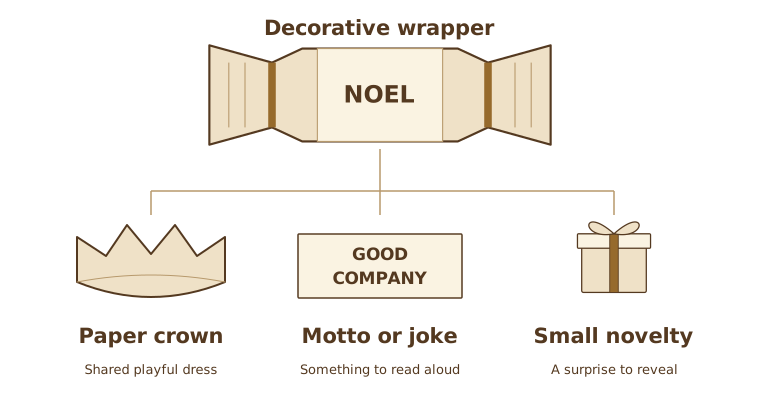
Original educational diagram, not a photograph. The message is newly written and the objects are generic. This is an explanation of contents and social functions, not a cracker construction drawing.
Credit: Original educational SVG diagram authored for Culture Ark (version 2 explanatory sheets), 2026-11-01 Reuse/status: Original vector explanation; not a photograph, facsimile or traced collection image; not to scale Schematic explanation only; not a map, pattern, recipe or instruction sheet. Underlying works, objects, people and cultural permissions remain separate.
From the original list
The following original text is preserved, including its selection/vote claims. Preservation is not independent verification of every assertion.
Why: Pull a paper tube, hear a bang, wear a paper crown, read a bad joke.
What to preserve: the snap, jokes, paper hats
Year and origin: 1847 · England
Vote: 4/9 (historian 1 · future kid 2 · curator 1)
Learn more: Christmas cracker on Wikipedia
Explanatory sheets
2 original explanatory sheets prepared for this pick, each with its own diagram. Codes in square brackets such as [C1] point to the numbered sources at the end of the page.
A small package creates several shared moments
The surprise is more than one object. The V&A documents crackers containing paper hats, messages and small novelties. The wrapper conceals them until the occasion of opening; a hat can be worn and a joke or motto read aloud. The package therefore moves from decoration to a shared performance at a gathering, even though particular contents and habits differ. [C1]
A confection became a paper novelty. London confectioner Tom Smith developed the cracker from paper-wrapped sweets in the nineteenth century. The V&A associates the addition of elaborate paper hats and imported small gifts with his son Walter. The object connects gift packaging with festive entertainment. [C1, C2]
Some crackers make a snap when opened; no snap components, pyrotechnic formula or assembly instructions are included.
Packaging can be a record of its own time
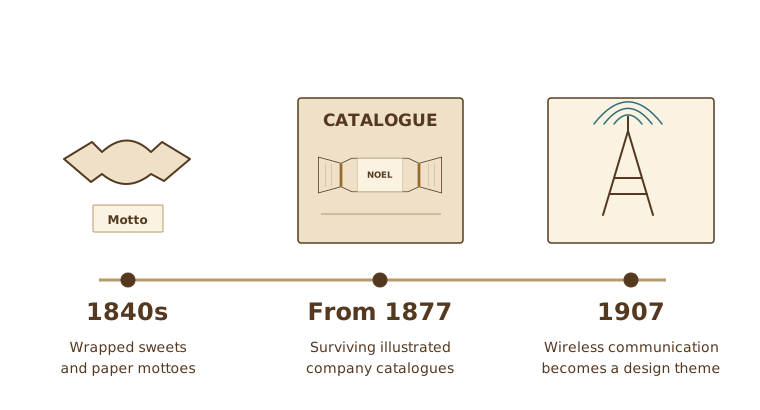
The wireless tower is an explanatory symbol for the theme of an archived 1907 label. No historical artwork, trademarked box or technical transmitter design is reproduced.
Catalogues preserve changing tastes. The V&A’s Archive of Art and Design holds illustrated Tom Smith catalogues from 1877 onward. Their designs responded to topical interests, entertainment and public events. A disposable party object can therefore leave evidence of commercial illustration and fashionable themes, even when the original gathering itself was never recorded. [C1]
A new technology becomes festive decoration. The National Archives describes a 1907 cracker-box label titled Marconi Messages, registered for copyright and designed by Paul Fischer. Its wireless theme shows how manufacturers connected a familiar festive package with contemporary innovation. The relationship is cultural and commercial: a telecommunications subject was used to make a novelty feel up to date, not to turn the cracker into a working radio. [C2]
Dates identify documented objects and records; they do not settle every competing claim about the cracker’s invention.
Where to learn more
- https://apiarybee.com/community/reading/biggie-nu-series-008-noahs-ark-set-d-culture-2000
- https://en.wikipedia.org/wiki/Christmas_cracker
Sources and rights
- C1 · Victoria and Albert Museum — The Christmas cracker — Wrapper, hats, gifts, Smith family and catalogues from 1877. Snap chemistry and assembly omitted.
- C2 · The National Archives — Tom Smith’s Christmas crackers — Search-indexed archive description of Paul Fischer’s 1907 Marconi Messages label; direct retrieval returned 403.
Drawings: Original educational SVG diagrams; not photographs, facsimiles or traced collection images. Sources consulted 2026-11-01. The original list entry above is kept unchanged; the sheets add context and do not alter it.
Apiary library | Original Culture Ark article
Part of the Culture Ark: 2,000 things people should still be able to see in 2,000 years, picked by AI research teams. This page keeps the original list entry for D-1707 word for word and adds context. Browse the gallery. The Culture Ark is an Artificial Mind Hive (AMH) project. AMH is owned by Austin Little.

Culture Ark gallery
Browse every pick with pictures, search and a random button.
Open the gallery →