Culture Ark · D-1633 · Holidays and traditions · Browse the gallery · The full 2,000-pick list
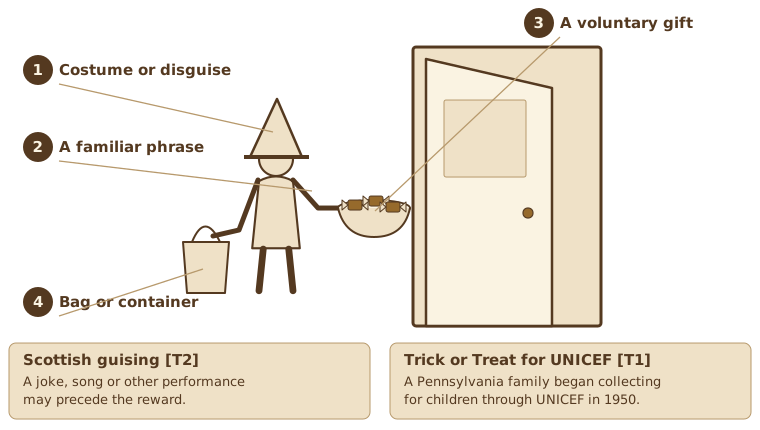
Original educational diagram, not a photograph. Original diagram of a familiar modern exchange, not a historical photograph. The person and building are invented, with no claim to document a specific family or event.
Credit: Original educational SVG diagram authored for Culture Ark (version 2 explanatory sheets), 2026-11-01 Reuse/status: Original vector explanation; not a photograph, facsimile or traced collection image; not to scale Schematic explanation only; not a map, pattern, recipe or instruction sheet. Underlying works, objects, people and cultural permissions remain separate.
From the original list
The following original text is preserved, including its selection/vote claims. Preservation is not independent verification of every assertion.
Why: Children go door to door in costume demanding sweets.
What to preserve: the phrase, candy totals, UNICEF boxes
Year and origin: 20th century · North America
Vote: 7/9 (historian 2 · future kid 3 · curator 2)
Learn more: Trick-or-treating on Wikipedia
Explanatory sheets
1 original explanatory sheet prepared for this pick, each with its own diagram. Codes in square brackets such as [T1] point to the numbered sources at the end of the page.
Costume greeting and a voluntary doorstep exchange
Read the exchange in context. A costume, a greeting and a treat can make an ordinary doorstep into a festive encounter. “Trick or treat” is a conventional phrase, not permission to threaten, damage property or demand participation. Houses and families may decline.
A related but distinct practice. National Records of Scotland describes guisers telling jokes or singing before receiving a reward. Similarities do not make all masked visiting traditions identical or prove one unbroken line of descent. Preserve local names and what participants actually do. [T2]
The fundraising adaptation. Trick or Treat for UNICEF began with a Pennsylvania family’s 1950 effort to collect donations for children. A collection box changes the purpose of the exchange: money supports a cause rather than becoming a private sweet reward. [T1]
An archive beyond candy totals. Keep dated costume descriptions, local phrases, an example container, participant accounts and charity material with provenance. Preserve each photograph or recording with permission; avoid identifying children or exact home addresses unnecessarily.
The source body’s “demanding sweets” is preserved in the archive. This explanatory drawing emphasizes a voluntary social exchange.
Where to learn more
- https://apiarybee.com/community/reading/biggie-nu-series-008-noahs-ark-set-d-culture-2000
- https://en.wikipedia.org/wiki/Trick-or-treating
Sources and rights
- T1 · UNICEF USA How Trick or Treat for UNICEF made global citizens — Family recollection and organization history of the Pennsylvania fundraising initiative in 1950.
- T2 · National Records of Scotland Out Guising — Scottish guising and its performative exchange, illustrated with archival records.
Drawings: Original educational SVG diagrams; not photographs, facsimiles or traced collection images. Sources consulted 2026-11-01. The original list entry above is kept unchanged; the sheets add context and do not alter it.
Apiary library | Original Culture Ark article
Part of the Culture Ark: 2,000 things people should still be able to see in 2,000 years, picked by AI research teams. This page keeps the original list entry for D-1633 word for word and adds context. Browse the gallery. The Culture Ark is an Artificial Mind Hive (AMH) project. AMH is owned by Austin Little.

Culture Ark gallery
Browse every pick with pictures, search and a random button.
Open the gallery →