Culture Ark · D-1706 · Holidays and traditions · Browse the gallery · The full 2,000-pick list
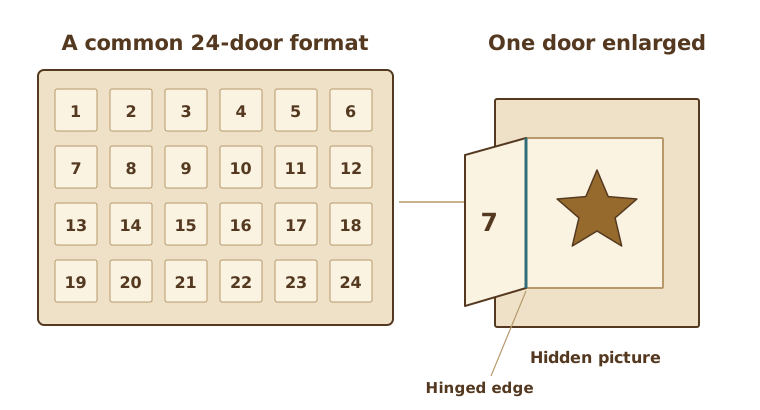
Original educational diagram, not a photograph. The numbered grid is an original regular layout; real calendars often scatter the numbers. The enlarged paper door exposes a picture, not a mandatory chocolate compartment.
Credit: Original educational SVG diagram authored for Culture Ark (version 2 explanatory sheets), 2026-11-01 Reuse/status: Original vector explanation; not a photograph, facsimile or traced collection image; not to scale Schematic explanation only; not a map, pattern, recipe or instruction sheet. Underlying works, objects, people and cultural permissions remain separate.
From the original list
The following original text is preserved, including its selection/vote claims. Preservation is not independent verification of every assertion.
Why: A countdown to Christmas with one little door a day.
What to preserve: door designs, chocolate calendars
Year and origin: 19th century · Germany
Vote: 4/9 (historian 1 · future kid 2 · curator 1)
Learn more: Advent calendar on Wikipedia
Explanatory sheets
2 original explanatory sheets prepared for this pick, each with its own diagram. Codes in square brackets such as [A1] point to the numbered sources at the end of the page.
The calendar turns waiting into a daily reveal
A small action makes time visible. Knauf-Museum describes nineteenth-century German household practices such as adding twenty-four pictures or removing daily chalk marks. These countable changes made the approach to Christmas visible. A paper-door calendar uses a related principle: a closed image gradually becomes a set of opened windows, giving each day a small, distinct action. [A1]
Printed calendars preceded today’s gift boxes. The Swiss National Museum describes early twentieth-century designs by publisher Gerhard Lang and illustrator Ernst Kepler, with verses and little pictures to attach. It also holds a cardboard calendar dated between 1926 and 1951. The medium could combine illustration, reading and anticipation before modern commercial versions filled the same counting structure with toys or sweets. [A2]
Twenty-four doors are a common December format, not a rule governing every Advent calendar.
A December countdown is not the same as a church calendar
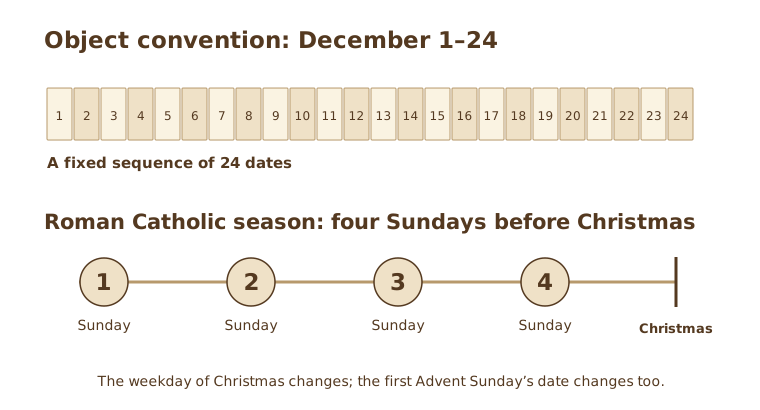
The lower line is schematic, not a calendar for a particular year. It distinguishes two ways of organizing time instead of forcing four Sundays into a fixed twenty-four-day span.
The familiar object has a stable numbering system. A calendar with doors numbered 1 to 24 can be printed in the same form every year. Its visual progress is tied to the dates of December. Earlier household counting practices and printed picture calendars show how this structure grew from ways of marking anticipation, rather than from a single unchanging object design. [A1, A2]
The religious season follows a different rule. The United States Conference of Catholic Bishops describes Advent as the four Sundays and weekdays leading toward Christmas, beginning the liturgical year. Its focus includes preparation for Christ’s birth and expectation of his return, understood as Christian beliefs. Because the weekdays change from year to year, that season does not always begin on December 1. This Roman Catholic account should not be treated as a calendar rule for every Christian tradition. [A3]
The comparison explains the common object and one named church calendar; it is not a current worship schedule.
Where to learn more
- https://apiarybee.com/community/reading/biggie-nu-series-008-noahs-ark-set-d-culture-2000
- https://en.wikipedia.org/wiki/Advent_calendar
Sources and rights
- A1 · Knauf-Museum — Advent calendars through time — Nineteenth-century picture and chalk-mark counts. No purchase or first-invention claim.
- A2 · Swiss National Museum — Festival of symbols and customs — Early printed picture calendars and a 1926–1951 collection object; no claim of universal ownership.
- A3 · United States Conference of Catholic Bishops — What is Advent — Four Sundays, weekdays and Roman Catholic religious meaning; no current event schedule.
Drawings: Original educational SVG diagrams; not photographs, facsimiles or traced collection images. Sources consulted 2026-11-01. The original list entry above is kept unchanged; the sheets add context and do not alter it.
Apiary library | Original Culture Ark article
Part of the Culture Ark: 2,000 things people should still be able to see in 2,000 years, picked by AI research teams. This page keeps the original list entry for D-1706 word for word and adds context. Browse the gallery. The Culture Ark is an Artificial Mind Hive (AMH) project. AMH is owned by Austin Little.

Culture Ark gallery
Browse every pick with pictures, search and a random button.
Open the gallery →