What Set D is
The first three Noah's Ark inventories asked a practical question: if a society had to rebuild, what knowledge would it need to carry? Set A and Set B listed 4,000 proposed knowledge packages, covering water, food, shelter, tools, medicine, governance and teaching. Set C added 2,000 more for the trades and institutions that sat between those categories: animal care, timber, mining, radio repair, ledgers and deeds.
Set D asks a different question. Suppose the water is clean and the lights are back on. What would people miss? Which songs, games, jokes, dishes, festivals, buildings and inventions would they want back, not because these things keep anyone alive, but because they make up what a shared human life feels like?
This is a list of 2,000 answers. It is not a list of the greatest works of art or the most important events in history. It is a sample of culture in the broad sense: Gangnam Style next to Beethoven's Ninth, Tetris next to the Royal Game of Ur, the knock-knock joke next to Egyptian hieroglyphs, instant noodles next to the spice trade. Every entry explains why it was chosen, what exactly should be kept, where and when it comes from, and how three AI judges voted on it.
One thing matters more than any other, so it comes first. Nothing here has been acquired. These are proposed entries for a cultural ark, not a collection anyone holds. Every song, film, image, building plan and recipe belongs to whoever owns it now, and a list like this gives no one a right to copy or distribute any of it.
How the experiment worked
Five collecting teams
The work was split into ten categories, two per team:
- Team 1: music; film and TV
- Team 2: games; food
- Team 3: internet culture; language and humor
- Team 4: inventions; design
- Team 5: holidays and traditions; science, landmarks and events
Each team was an AI agent, and every team wrote up its candidates in the same fixed shape: a title, a one-line reason (Why), a short note on what exactly should be kept (What to preserve), a year and place of origin, and the title of an English Wikipedia article that a reader can use to learn more.
The teams' files held 3,235 rows in total. Several teams gathered more than they needed and cut back. Team 1, for example, proposed 424 music candidates and 569 film and TV candidates before trimming each list to 300. The teams also checked every Wikipedia title, following redirects and dropping duplicates. Team 3 found that its "Douyin" and "TikTok" entries pointed to the same article and kept only one. After merging and cleanup, 2,814 candidates went to the judges. Category sizes ranged from 244 (internet culture) to 300 (music, and film and TV).
A three-judge panel
Each candidate was scored by three AI judges. Each judge was given a different lens, so that no single idea of "important" would decide the result:
- The historian was asked to weigh importance and influence: what explains how people lived, worked and thought.
- The future kid was asked to judge as a curious, fun-loving kid in the year 4026: what is delightful, funny, playable, catchy or surprising.
- The curator was asked to keep the collection balanced across regions, eras and kinds of culture, with everyday life counting as much as headlines.
Each judge gave every one of the 2,814 candidates a score from 0 (lowest) to 3 (highest).
The tally rules
The rules were fixed before counting:
- Total score. Add the three judges' scores, for a total from 0 to 9.
- Top 2,000. Rank every candidate by total and take the top 2,000.
- First tie-break: breadth of support. When totals are equal, a candidate that more judges rated 2 or higher goes first. A 2/1/0 beats a 1/1/1, because at least one judge really wanted it.
- Second tie-break: category balance. If a group of tied candidates still crosses the 2,000 line, places go one at a time to the category that has so far had the smallest share of its candidates selected. Within a category, the candidate that was proposed earlier goes first.
Here is how the totals came out:
| Total score | Candidates | Selected |
|---|---|---|
| 9/9 | 93 | 93 |
| 8/9 | 114 | 114 |
| 7/9 | 185 | 185 |
| 6/9 | 393 | 393 |
| 5/9 | 446 | 446 |
| 4/9 | 476 | 476 |
| 3/9 | 664 | 293 |
| 2/9 | 254 | 0 |
| 1/9 | 111 | 0 |
| 0/9 | 78 | 0 |
Every candidate that scored 4 or more made the cut: 1,707 of them. That left 293 places for the 664 candidates on 3 points. Those with a 2 from at least one judge went first. The remaining 631 all had the same lukewarm score, 1 from each judge, and the category-balance rule chose 260 of them.
That second tie-break mattered. Holidays and traditions, and food, scored lowest on average, so they fell behind in their share of places. As a result, all 61 holidays scored 1/1/1 went in, and 69 of the 70 food items with that score. None of the 65 games or 50 science, landmarks and events candidates scored 1/1/1 were needed, because those categories had already filled most of their places with higher scores.
How Set D differs from Sets A to C
Sets A, B and C are about capability: how to purify water, set a bone, keep goats, read a deed. They are edited lists in which each category gets exactly 100 packages, and each package lists prerequisites, safety notes and rights conditions.
Set D is about culture, and it was built differently in three ways.
- It was voted on, not edited. No person placed each entry by hand. The list is whatever the collecting teams proposed and the three judges scored highest under the rules above.
- Categories are not equal. They range from 174 to 213 entries, because category balance only came into play at the cut line.
- The entries are shorter. A pop song does not have prerequisites the way a kiln does. Each entry gives a reason, the specific things worth keeping (a recording, a dance, a recipe, a rulebook), a date and place, the vote, and a Wikipedia link.
What the vote produced
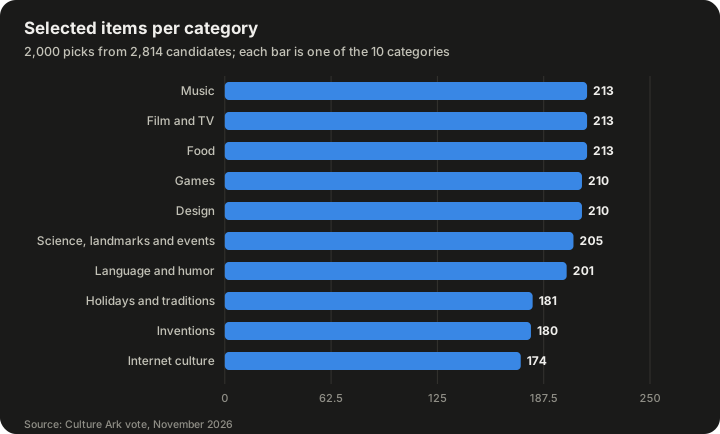
| Category | Candidates | Selected | Share selected |
|---|---|---|---|
| Music | 300 | 213 | 71.0% |
| Film and TV | 300 | 213 | 71.0% |
| Food | 299 | 213 | 71.2% |
| Games | 296 | 210 | 70.9% |
| Design | 295 | 210 | 71.2% |
| Science, landmarks and events | 273 | 205 | 75.1% |
| Language and humor | 282 | 201 | 71.3% |
| Holidays and traditions | 272 | 181 | 66.5% |
| Inventions | 253 | 180 | 71.1% |
| Internet culture | 244 | 174 | 71.3% |
| All | 2,814 | 2,000 | 71.1% |
Music, film and TV, and food each got 213 places, the most of any category. Internet culture got the fewest, 174, but it also started with the fewest candidates. Science, landmarks and events had the highest selection rate (75.1%), because its candidates had the highest average total of any category (5.00 out of 9). Holidays and traditions had the lowest rate (66.5%) and the lowest average (3.42).
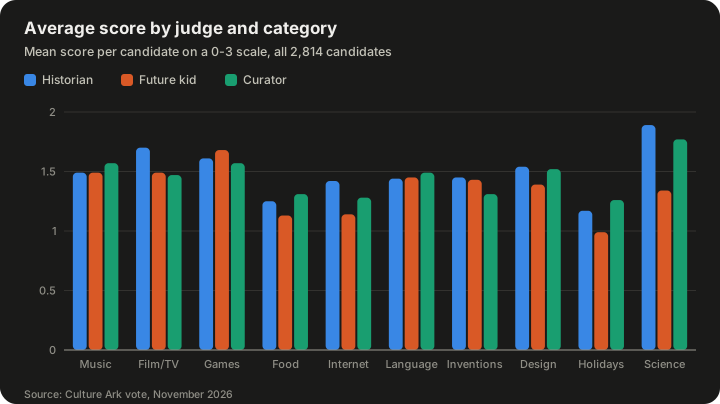
| Category | Historian | Future kid | Curator |
|---|---|---|---|
| Music | 1.49 | 1.49 | 1.57 |
| Film and TV | 1.70 | 1.49 | 1.47 |
| Games | 1.61 | 1.68 | 1.57 |
| Food | 1.25 | 1.13 | 1.31 |
| Internet culture | 1.42 | 1.14 | 1.28 |
| Language and humor | 1.44 | 1.45 | 1.49 |
| Inventions | 1.45 | 1.43 | 1.31 |
| Design | 1.54 | 1.39 | 1.52 |
| Holidays and traditions | 1.17 | 0.99 | 1.26 |
| Science, landmarks and events | 1.89 | 1.34 | 1.77 |
| All candidates | 1.50 | 1.36 | 1.46 |
The three lenses produced three different patterns. The historian was most generous with science, landmarks and events (1.89 on average) and with film and TV (1.70). The future kid was the toughest judge overall: 372 zeros, compared with 222 from the historian and 163 from the curator. But the future kid's highest average was for games (1.68), above what either other judge gave games, and its lowest was for holidays (0.99). The curator's scores sat closest to the middle.
The historian and the curator agreed most:
| Judge pair | Same score | Within one point | Correlation (Pearson r) |
|---|---|---|---|
| Historian and curator | 77.19% | 99.64% | 0.80 |
| Future kid and curator | 51.49% | 97.26% | 0.55 |
| Historian and future kid | 45.91% | 93.6% | 0.46 |
The three judges gave exactly the same score to 1,109 candidates (39.41%). 93 candidates got a perfect 9, and 78 got 0 from everyone. Only 4 candidates split the panel completely, with one judge giving 0 and another giving 3.
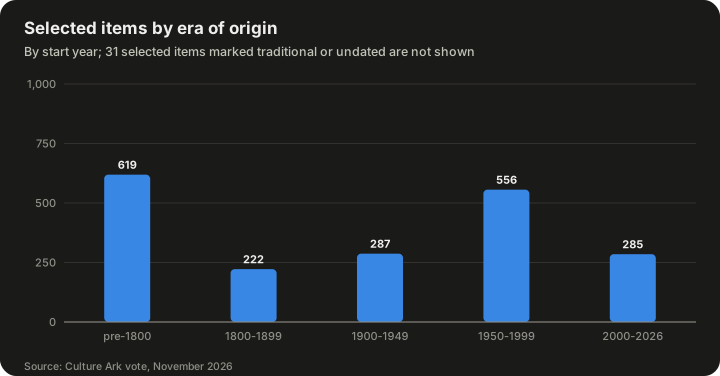
| Era (by start year) | Candidates | Selected | Share selected |
|---|---|---|---|
| pre-1800 | 804 | 619 | 77.0% |
| 1800-1899 | 300 | 222 | 74.0% |
| 1900-1949 | 400 | 287 | 71.8% |
| 1950-1999 | 786 | 556 | 70.7% |
| 2000-2026 | 469 | 285 | 60.8% |
| Traditional / undated | 55 | 31 | 56.4% |
The ark is old and recent at once. The largest group, 619 entries, began before 1800: board games, scripts, monuments, staple foods and festivals with centuries of history. The second largest, 556, is the second half of the twentieth century, the era of television, pop music, video games and the early internet. Recent culture made the cut less often. 60.8% of candidates from 2000 onward were selected, against 77.0% of those from before 1800. The era is based on each entry's start year, so a festival first recorded in the 1600s counts as pre-1800 even though it is still held today.
Standout picks and close calls
Unanimous favorites. 93 candidates got 3 from every judge. They include Thriller, Beethoven's Symphony No. 9, Happy Birthday to You, the haka, jazz and hip hop; A Trip to the Moon, Spirited Away, Sesame Street and Mr. Bean; Go, Mancala, the Royal Game of Ur, Tetris, Minecraft and rock paper scissors; chocolate, sushi and instant noodles; emoji and Wikipedia; the knock-knock joke and Philogelos, the oldest surviving joke book; the wheel and the bicycle; Lascaux, the Great Wave off Kanagawa and the long-term warning messages designed for nuclear waste sites; Diwali, the Day of the Dead and Chinese New Year; and the Moon landing, the Voyager Golden Record, Ötzi, the dodo and the number zero.
The historian's picks. These are candidates the historian rated 3 while the future kid gave 1 or less. The Salt March (D-0726, vote 3/1/1) and La Dolce Vita (D-0368, 3/1/1) made the cut mostly on the historian's support. So, with more help from the curator, did the Zapruder film (3/1/2), Shoah (3/1/2), the Phoenician alphabet (3/1/2), M-Pesa (3/1/2) and the Great Firewall (3/1/2).
The future kid's picks. This judge gave a 3 to a list of delights the others rated 1: PPAP, What Does the Fox Say?, the kazoo, Pingu, Katamari Damacy, Untitled Goose Game, bog snorkelling, chessboxing, Pop Rocks, cotton candy, the deep-fried Mars bar, the cardboard box, the snow globe, the Super Soaker, the pogo stick, Krzywy Domek (Poland's "crooked house") and Pi Day (each 1/3/1). Two entries got in mostly on the future kid's vote, despite a 0 from the historian: the giant inflatable Rubber Duck sculpture (D-1573, 0/3/1) and Korea's Boryeong Mud Festival (D-1713, 0/3/1).
The curator's picks. The curator was the only judge to rate The Shawshank Redemption (1/1/3) a must-keep, and the only one to rate Pokémon above zero (0/0/3). Pokémon got in with a total of 3, the lowest score that made the cut, because one judge rated it 2 or higher. The curator also joined the historian in giving 3 to Watson and Crick's 1953 paper on the structure of DNA, while the future kid gave it 0 (3/0/3).
Close calls that missed. 371 candidates finished on 3 points without a 2 from any judge and did not get in. Most of them lost on the category-balance rule rather than on merit. They include Bad Bunny, Billie Jean, Vaporwave, Naruto, Vine, Cards Against Humanity, Genshin Impact, Hurling, Palio di Siena, Newgrounds, Spanglish, Flyting, the Amazon Kindle, neon lighting, Hopper's Nighthawks, the Normandy landings, the Kepler space telescope and Mars Pathfinder. Three candidates came closer than their totals suggest: the 1998 Euro-dance song Blue, Cup Noodles and the revolving door each got a 2 from the future kid and 0 from the other two judges. Some well-known names got 0 from all three, including Heartbreak Hotel, Ring of Fire and The Ren & Stimpy Show.
Honest limits
- The judges are AI. The scores come from language models applying a lens, not from historians, children or museum curators. They are consistent and they can be checked, but they reflect what those models learned, including their blind spots. Two of the three lenses also turned out to be fairly similar: the historian and the curator gave the same score 77.19% of the time.
- English Wikipedia sets the boundary. Every candidate needed an English Wikipedia article. That favors things already written about in English, and it under-counts oral traditions, regional cuisines, local festivals and culture from places with less English-language coverage. The teams tried to spread across countries, but the source shapes what can be proposed in the first place.
- The collecting teams shaped the field. A judge can only score what a team proposed. Gaps in Set D are, first of all, gaps in the candidate lists.
- It is not a popularity poll. No audience voted, and nothing was weighted by streams, sales or page views. Some very famous things missed the cut, and some small and odd things got in because one judge argued hard for them.
- The cut line is coarse. Totals run from 0 to 9, so hundreds of candidates share each score. Below a score of 4, the tie-break rules, not the judges, decided who got in. Within a category, the earlier-proposed candidate won.
- Dates are approximate. Years like "ancient," "medieval" or "16th century" were assigned to an era by their earliest plausible start. 31 selected entries are marked traditional and have no date.
- Rights stay with their owners. Songs, films, games, characters, logos, artworks and recipes remain the property of their creators, estates, companies and communities. Where a tradition belongs to a living community, as with the haka, that community decides how it is shared. These are proposed entries; nothing has been acquired, licensed or copied.
How to read an entry
Entries are grouped by category. Within each category they are sorted by total vote, highest first. Identifiers run from D-0001 to D-2000 in that order. They mark a position in this list, not a rank across the whole set. In each entry, Why gives the collecting team's reason, What to preserve names the specific things worth keeping, and Vote shows the total followed by each judge's score. The Learn more link goes to the English Wikipedia article the team checked.
Category navigation
- [Music](#music) — 213 entries
- [Film and TV](#film-and-tv) — 213 entries
- [Games](#games) — 210 entries
- [Food](#food) — 213 entries
- [Internet culture](#internet-culture) — 174 entries
- [Language and humor](#language-and-humor) — 201 entries
- [Inventions](#inventions) — 180 entries
- [Design](#design) — 210 entries
- [Holidays and traditions](#holidays-and-traditions) — 181 entries
- [Science landmarks and events](#science-landmarks-and-events) — 205 entries
Music
D-0001 — Gangnam Style
Why: The first YouTube video to pass one billion views, a K-pop satire of Seoul wealth that the whole planet danced to.
What to preserve: The music video, the horse-riding dance steps, view-count history, global parodies
Year and origin: 2012 · South Korea
Vote: 9/9 (historian 3 · future kid 3 · curator 3)
Learn more: Gangnam Style on Wikipedia
D-0002 — Thriller
Why: Its 14-minute zombie music video turned the music video into an art form.
What to preserve: The John Landis music video, the zombie dance, red jacket costume
Year and origin: 1983 · United States
Vote: 9/9 (historian 3 · future kid 3 · curator 3)
Learn more: Thriller (song) on Wikipedia
D-0003 — Symphony No. 9
Why: A deaf composer's symphony whose choral "Ode to Joy" became the anthem of European unity.
What to preserve: The full score, a landmark recording, the Ode to Joy text
Year and origin: 1824 · Germany (Austria premiere)
Vote: 9/9 (historian 3 · future kid 3 · curator 3)
Learn more: Symphony No. 9 (Beethoven) on Wikipedia
D-0004 — Happy Birthday to You
Why: The most-sung song in English, performed at nearly every birthday on Earth.
What to preserve: The melody, lyrics in many languages, the copyright lawsuit story
Year and origin: 1893 · United States
Vote: 9/9 (historian 3 · future kid 3 · curator 3)
Learn more: Happy Birthday to You on Wikipedia
D-0005 — Karaoke
Why: A Japanese invention that lets ordinary people sing like stars, now in every bar and phone.
What to preserve: An early karaoke machine, the Daisuke Inoue story, karaoke box culture
Year and origin: 1971 · Japan
Vote: 9/9 (historian 3 · future kid 3 · curator 3)
Learn more: Karaoke on Wikipedia
D-0006 — Haka
Why: A Maori posture dance, now famous before every All Blacks rugby match.
What to preserve: Ka Mate text, rugby performances, ceremonial uses
Year and origin: Ancient · New Zealand
Vote: 9/9 (historian 3 · future kid 3 · curator 3)
Learn more: Haka on Wikipedia
D-0007 — Rio Carnival
Why: The world's biggest carnival, with samba schools parading in feathered costumes.
What to preserve: Sambadrome parade footage, costumes, samba school songs
Year and origin: 1723 · Brazil
Vote: 9/9 (historian 3 · future kid 3 · curator 3)
Learn more: Rio Carnival on Wikipedia
D-0008 — Eurovision Song Contest
Why: The world's largest music competition, gloriously camp and political.
What to preserve: Winning songs, scoring system, archive footage
Year and origin: 1956 · Europe
Vote: 9/9 (historian 3 · future kid 3 · curator 3)
Learn more: Eurovision Song Contest on Wikipedia
D-0009 — Jazz
Why: America's great art form of improvisation.
What to preserve: Recordings, history of styles
Year and origin: 1910s · United States (New Orleans)
Vote: 9/9 (historian 3 · future kid 3 · curator 3)
Learn more: Jazz on Wikipedia
D-0010 — Rock and roll
Why: The rebellious music that created the teenager.
What to preserve: Key recordings, history
Year and origin: 1950s · United States
Vote: 9/9 (historian 3 · future kid 3 · curator 3)
Learn more: Rock and roll on Wikipedia
D-0011 — The Beatles
Why: The most influential band in history.
What to preserve: Albums, films, Beatlemania
Year and origin: 1960 · United Kingdom
Vote: 9/9 (historian 3 · future kid 3 · curator 3)
Learn more: The Beatles on Wikipedia
D-0012 — Hip hop music
Why: Born at a Bronx block party, it became the world's dominant music.
What to preserve: Origin story, DJ Kool Herc, key recordings
Year and origin: 1973 · United States (New York)
Vote: 9/9 (historian 3 · future kid 3 · curator 3)
Learn more: Hip-hop on Wikipedia
D-0013 — Bohemian Rhapsody
Why: A six-minute rock opera that broke every rule of the pop single and still topped charts.
What to preserve: The studio recording, the 1975 promo video, Wayne's World headbang scene
Year and origin: 1975 · United Kingdom
Vote: 8/9 (historian 2 · future kid 3 · curator 3)
Learn more: Bohemian Rhapsody on Wikipedia
D-0014 — Umm Kulthum
Why: The "Star of the East" whose hour-long songs could empty the streets of Cairo.
What to preserve: Concert recordings, Enta Omri, funeral footage
Year and origin: 1920s · Egypt
Vote: 8/9 (historian 3 · future kid 2 · curator 3)
Learn more: Umm Kulthum on Wikipedia
D-0015 — Gamelan
Why: Shimmering bronze orchestras of Java and Bali that influenced Debussy.
What to preserve: A gamelan set, recordings, tuning systems
Year and origin: Ancient · Indonesia
Vote: 8/9 (historian 3 · future kid 2 · curator 3)
Learn more: Gamelan on Wikipedia
D-0016 — K-pop
Why: Idol-driven pop with precise group choreography that went global.
What to preserve: Representative videos, training system, fan culture
Year and origin: 1990s · South Korea
Vote: 8/9 (historian 3 · future kid 2 · curator 3)
Learn more: K-pop on Wikipedia
D-0017 — Peking opera
Why: Painted faces, acrobatics and falsetto singing form China's national opera.
What to preserve: Performance film, costumes, face-painting codes
Year and origin: 18th century · China
Vote: 8/9 (historian 3 · future kid 2 · curator 3)
Learn more: Peking opera on Wikipedia
D-0018 — Tango
Why: A passionate couples' dance born in Buenos Aires and Montevideo port slums.
What to preserve: Dance footage, bandoneon music, milonga culture
Year and origin: 1880s · Argentina/Uruguay
Vote: 8/9 (historian 3 · future kid 2 · curator 3)
Learn more: Tango on Wikipedia
D-0019 — Reggae
Why: Jamaica's offbeat music of resistance, love and Rastafari.
What to preserve: Classic recordings, sound system culture
Year and origin: 1960s · Jamaica
Vote: 8/9 (historian 3 · future kid 2 · curator 3)
Learn more: Reggae on Wikipedia
D-0020 — Flamenco
Why: Andalusian song, guitar and stamping dance born of Romani culture.
What to preserve: Performances, guitar techniques, dance
Year and origin: 18th century · Spain
Vote: 8/9 (historian 3 · future kid 2 · curator 3)
Learn more: Flamenco on Wikipedia
D-0021 — Wolfgang Amadeus Mozart
Why: The child prodigy who became the symbol of musical genius.
What to preserve: Complete works list, letters, portraits
Year and origin: 1760s · Austria
Vote: 8/9 (historian 3 · future kid 2 · curator 3)
Learn more: Wolfgang Amadeus Mozart on Wikipedia
D-0022 — Johann Sebastian Bach
Why: The composer whose counterpoint is the foundation of Western music.
What to preserve: Complete works catalogue (BWV), manuscripts
Year and origin: 1700s · Germany
Vote: 8/9 (historian 3 · future kid 2 · curator 3)
Learn more: Johann Sebastian Bach on Wikipedia
D-0023 — Hurrian songs
Why: The oldest substantially surviving notated music in the world, on clay tablets.
What to preserve: The tablets, reconstructions of Hymn no. 6
Year and origin: c. 1400 BC · Syria (Ugarit)
Vote: 8/9 (historian 3 · future kid 2 · curator 3)
Learn more: Hurrian songs on Wikipedia
D-0024 — Griot
Why: Hereditary singer-historians who memorize the genealogy of peoples.
What to preserve: Oral epics (Sundiata), recordings
Year and origin: 13th century · West Africa
Vote: 8/9 (historian 3 · future kid 2 · curator 3)
Learn more: Griot on Wikipedia
D-0025 — Blues
Why: The music of African American hardship that is the root of rock and roll.
What to preserve: Robert Johnson recordings, 12-bar form
Year and origin: 1860s · United States
Vote: 8/9 (historian 3 · future kid 2 · curator 3)
Learn more: Blues on Wikipedia
D-0026 — Michael Jackson
Why: The King of Pop and the most famous entertainer of his age.
What to preserve: Thriller, moonwalk, performances
Year and origin: 1960s · United States
Vote: 8/9 (historian 3 · future kid 2 · curator 3)
Learn more: Michael Jackson on Wikipedia
D-0027 — Piano
Why: The universal instrument of homes and concert halls.
What to preserve: An instrument, Cristofori design
Year and origin: c. 1700 · Italy
Vote: 8/9 (historian 3 · future kid 2 · curator 3)
Learn more: Piano on Wikipedia
D-0028 — Macarena
Why: A simple Spanish line-dance song that became a worldwide party ritual in the 1990s.
What to preserve: The Bayside Boys remix, the arm-move choreography, chart history
Year and origin: 1993 · Spain
Vote: 7/9 (historian 2 · future kid 3 · curator 2)
Learn more: Macarena on Wikipedia
D-0029 — Twinkle, Twinkle, Little Star
Why: A lullaby on a French melody that taught generations of children to wonder at the night sky.
What to preserve: The poem, the melody (Ah vous dirai-je, maman), Mozart's variations
Year and origin: 1806 · England
Vote: 7/9 (historian 2 · future kid 3 · curator 2)
Learn more: Twinkle, Twinkle, Little Star on Wikipedia
D-0030 — Baby Shark
Why: A children's earworm that became the most-viewed video in YouTube history.
What to preserve: The Pinkfong video, hand motions, billion-view milestones
Year and origin: 2016 · South Korea
Vote: 7/9 (historian 2 · future kid 3 · curator 2)
Learn more: Baby Shark on Wikipedia
D-0031 — Rickrolling
Why: The bait-and-switch prank that shows how early internet humor worked.
What to preserve: Famous Rickrolls, the 2008 Macy's parade cameo, link-prank culture
Year and origin: 2007 · United States (internet)
Vote: 7/9 (historian 2 · future kid 3 · curator 2)
Learn more: Rickrolling on Wikipedia
D-0032 — Moonwalk
Why: The backward-gliding step Michael Jackson made famous on live TV.
What to preserve: The Motown 25 performance, a how-to breakdown, earlier backslide history
Year and origin: 1983 · United States
Vote: 7/9 (historian 2 · future kid 3 · curator 2)
Learn more: Moonwalk (dance) on Wikipedia
D-0033 — Y.M.C.A.
Why: Disco song whose arm-spelled letters are performed by stadiums and wedding crowds.
What to preserve: The Village People video, the Y-M-C-A arm moves
Year and origin: 1978 · United States
Vote: 7/9 (historian 2 · future kid 3 · curator 2)
Learn more: Y.M.C.A. (song) on Wikipedia
D-0034 — Hatsune Miku
Why: A singing synthesizer software with an anime avatar who performs live concerts as a hologram.
What to preserve: The voice library, popular songs, hologram concerts
Year and origin: 2007 · Japan
Vote: 7/9 (historian 2 · future kid 3 · curator 2)
Learn more: Hatsune Miku on Wikipedia
D-0035 — Tuvan throat singing
Why: Singers who produce two or more notes at once, imitating wind and rivers.
What to preserve: Recordings, techniques (khoomei, sygyt, kargyraa)
Year and origin: Ancient · Russia (Tuva)
Vote: 7/9 (historian 2 · future kid 3 · curator 2)
Learn more: Tuvan throat singing on Wikipedia
D-0036 — Didgeridoo
Why: An Aboriginal wind instrument made from termite-hollowed eucalyptus, played with circular breathing.
What to preserve: An instrument, a traditional performance recording
Year and origin: Ancient · Australia
Vote: 7/9 (historian 2 · future kid 3 · curator 2)
Learn more: Didgeridoo on Wikipedia
D-0037 — Mariachi
Why: Strolling Mexican bands with violins, trumpets and sombreros.
What to preserve: Performances, costumes, UNESCO listing
Year and origin: 18th century · Mexico
Vote: 7/9 (historian 2 · future kid 2 · curator 3)
Learn more: Mariachi on Wikipedia
D-0038 — Divje Babe flute
Why: A Neanderthal-era cave bear bone with holes, possibly the oldest musical instrument.
What to preserve: The artifact, the debate over its origin
Year and origin: c. 50,000 BC · Slovenia
Vote: 7/9 (historian 3 · future kid 2 · curator 2)
Learn more: Divje Babe flute on Wikipedia
D-0039 — Elvis Presley
Why: The King of Rock and Roll whose hips scandalized television.
What to preserve: Recordings, Ed Sullivan appearances, Graceland
Year and origin: 1950s · United States
Vote: 7/9 (historian 3 · future kid 2 · curator 2)
Learn more: Elvis Presley on Wikipedia
D-0040 — Breakdancing
Why: Spinning street dance of hip-hop, now an Olympic sport.
What to preserve: Footage, moves, the 2024 Olympics
Year and origin: 1970s · United States
Vote: 7/9 (historian 2 · future kid 3 · curator 2)
Learn more: Breakdancing on Wikipedia
D-0041 — All I Want for Christmas Is You
Why: The Christmas song that returns to the charts every December.
What to preserve: Recording, annual chart history
Year and origin: 1994 · United States
Vote: 7/9 (historian 2 · future kid 3 · curator 2)
Learn more: All I Want for Christmas Is You on Wikipedia
D-0042 — Jingle Bells
Why: Probably the best-known Christmas song, first song played in space.
What to preserve: Lyrics, Gemini 6 harmonica story
Year and origin: 1857 · United States
Vote: 7/9 (historian 2 · future kid 3 · curator 2)
Learn more: Jingle Bells on Wikipedia
D-0043 — Nyan Cat
Why: A pixel cat with a Pop-Tart body flying on a rainbow, set to a looping Japanese tune.
What to preserve: Animation, song loop
Year and origin: 2011 · United States (internet)
Vote: 7/9 (historian 2 · future kid 3 · curator 2)
Learn more: Nyan Cat on Wikipedia
D-0044 — Phonograph
Why: Edison's machine that first recorded and played back sound.
What to preserve: A device, the "Mary Had a Little Lamb" story
Year and origin: 1877 · United States
Vote: 7/9 (historian 3 · future kid 2 · curator 2)
Learn more: Phonograph on Wikipedia
D-0045 — Walkman
Why: Sony's portable tape player that made music private and mobile.
What to preserve: A device, cassette
Year and origin: 1979 · Japan
Vote: 7/9 (historian 2 · future kid 2 · curator 3)
Learn more: Walkman on Wikipedia
D-0046 — Kabuki
Why: Stylized Japanese dance-drama with dramatic makeup.
What to preserve: Performance film, makeup, costumes
Year and origin: 1603 · Japan
Vote: 7/9 (historian 2 · future kid 2 · curator 3)
Learn more: Kabuki on Wikipedia
D-0047 — Ballet
Why: Theatrical dance on pointe, a discipline of grace and strength.
What to preserve: Positions, pointe shoes, performances
Year and origin: 15th century · Italy/France
Vote: 7/9 (historian 3 · future kid 2 · curator 2)
Learn more: Ballet on Wikipedia
D-0048 — Nokia tune
Why: The most-heard ringtone in history, from a 19th-century guitar waltz.
What to preserve: Ringtone, Gran Vals origin
Year and origin: 1994 · Finland
Vote: 7/9 (historian 2 · future kid 3 · curator 2)
Learn more: Nokia tune on Wikipedia
D-0049 — Yodeling
Why: Alpine singing with rapid jumps between chest and head voice.
What to preserve: Recordings, technique
Year and origin: Ancient · Switzerland/Austria
Vote: 7/9 (historian 2 · future kid 3 · curator 2)
Learn more: Yodeling on Wikipedia
D-0050 — Dancing plague of 1518
Why: Hundreds of people danced uncontrollably for weeks, a mystery of mass behavior.
What to preserve: Historical records
Year and origin: 1518 · Strasbourg (Holy Roman Empire)
Vote: 7/9 (historian 2 · future kid 3 · curator 2)
Learn more: Dancing plague of 1518 on Wikipedia
D-0051 — Old MacDonald Had a Farm
Why: Children's song teaching animal sounds.
What to preserve: Lyrics, variants
Year and origin: 1917 · United States
Vote: 7/9 (historian 2 · future kid 3 · curator 2)
Learn more: Old MacDonald Had a Farm on Wikipedia
D-0052 — 4′33″
Why: John Cage's piece of silence, asking what music is.
What to preserve: Score, performance
Year and origin: 1952 · United States
Vote: 7/9 (historian 2 · future kid 3 · curator 2)
Learn more: 4′33″ on Wikipedia
D-0053 — Coffin Dance
Why: Ghanaian pallbearers dancing with a coffin, a pandemic-era meme.
What to preserve: Footage, Astronomia track
Year and origin: 2017 · Ghana
Vote: 7/9 (historian 2 · future kid 3 · curator 2)
Learn more: Dancing Pallbearers on Wikipedia
D-0054 — We Shall Overcome
Why: The anthem of the civil rights movement.
What to preserve: Lyrics, march footage
Year and origin: 1940s · United States
Vote: 7/9 (historian 3 · future kid 1 · curator 3)
Learn more: We Shall Overcome on Wikipedia
D-0055 — Imagine
Why: A gentle piano hymn to a world without borders, sung at vigils and Olympics ever since.
What to preserve: The recording, lyrics, the white-room film, uses at memorials
Year and origin: 1971 · United Kingdom
Vote: 6/9 (historian 2 · future kid 2 · curator 2)
Learn more: Imagine (song) on Wikipedia
D-0056 — The Four Seasons
Why: Baroque violin concertos that paint spring birds and winter ice, still the most played classical music.
What to preserve: The score, the accompanying sonnets, a period-instrument recording
Year and origin: 1725 · Italy
Vote: 6/9 (historian 2 · future kid 2 · curator 2)
Learn more: The Four Seasons (Vivaldi) on Wikipedia
D-0057 — Für Elise
Why: Probably the first piece millions of piano students ever learned, and a ringtone and ice-cream-truck tune.
What to preserve: The sheet music, a beginner's recording, its role in piano lessons
Year and origin: 1810 · Germany
Vote: 6/9 (historian 2 · future kid 2 · curator 2)
Learn more: Für Elise on Wikipedia
D-0058 — Afrobeat
Why: Fela Kuti's fusion of highlife, jazz and funk, built for long dances and political protest.
What to preserve: Signature recordings, horn and percussion arrangements
Year and origin: 1960s · Nigeria
Vote: 6/9 (historian 2 · future kid 2 · curator 2)
Learn more: Afrobeat on Wikipedia
D-0059 — Sitar
Why: The buzzing long-necked lute that brought Indian classical music to the Beatles.
What to preserve: An instrument, a Ravi Shankar recording, playing technique
Year and origin: 16th century · India
Vote: 6/9 (historian 2 · future kid 2 · curator 2)
Learn more: Sitar on Wikipedia
D-0060 — Bhangra
Why: Punjabi harvest dance music remixed by British-Asian youth into club music.
What to preserve: The dhol beat, dance moves, UK bhangra recordings
Year and origin: 1980s · Punjab (India/Pakistan) and UK
Vote: 6/9 (historian 2 · future kid 2 · curator 2)
Learn more: Bhangra (music) on Wikipedia
D-0061 — BTS
Why: The boy band that made K-pop a global force and addressed the UN.
What to preserve: Music videos, UN speech, ARMY fandom history
Year and origin: 2013 · South Korea
Vote: 6/9 (historian 2 · future kid 2 · curator 2)
Learn more: BTS on Wikipedia
D-0062 — Taiko
Why: Thunderous Japanese drumming, both ritual and athletic performance.
What to preserve: Drums, ensemble performance film
Year and origin: Ancient · Japan
Vote: 6/9 (historian 2 · future kid 2 · curator 2)
Learn more: Taiko on Wikipedia
D-0063 — Hula
Why: Hawaii's storytelling dance with chant and hip movement.
What to preserve: Hula kahiko and auana performances, chants
Year and origin: Ancient · United States (Hawaii)
Vote: 6/9 (historian 2 · future kid 2 · curator 2)
Learn more: Hula on Wikipedia
D-0064 — Over the Rainbow
Why: A song of hope from The Wizard of Oz, later reborn on a ukulele by Israel Kamakawiwoole.
What to preserve: Judy Garland's film scene, the IZ ukulele medley
Year and origin: 1939 · United States
Vote: 6/9 (historian 2 · future kid 2 · curator 2)
Learn more: Over the Rainbow on Wikipedia
D-0065 — Samba
Why: Afro-Brazilian rhythm and dance, the heartbeat of Rio's Carnival.
What to preserve: Samba school recordings, dance footage
Year and origin: 1910s · Brazil
Vote: 6/9 (historian 2 · future kid 2 · curator 2)
Learn more: Samba on Wikipedia
D-0066 — Capoeira
Why: A martial art disguised as dance, created by enslaved Africans in Brazil.
What to preserve: The roda, berimbau music, movements
Year and origin: 16th century · Brazil
Vote: 6/9 (historian 2 · future kid 2 · curator 2)
Learn more: Capoeira on Wikipedia
D-0067 — Bob Marley
Why: The face of reggae and a global symbol of freedom.
What to preserve: Albums, One Love Peace Concert footage
Year and origin: 1960s · Jamaica
Vote: 6/9 (historian 2 · future kid 2 · curator 2)
Learn more: Bob Marley on Wikipedia
D-0068 — Steelpan
Why: An instrument made from oil drums, the only acoustic instrument invented in the 20th century.
What to preserve: An instrument, steel band recordings
Year and origin: 1930s · Trinidad and Tobago
Vote: 6/9 (historian 2 · future kid 2 · curator 2)
Learn more: Steelpan on Wikipedia
D-0069 — Waltz
Why: The spinning couples' dance that scandalized and then ruled ballrooms.
What to preserve: Dance steps, Strauss waltzes
Year and origin: 18th century · Austria/Germany
Vote: 6/9 (historian 2 · future kid 2 · curator 2)
Learn more: Waltz on Wikipedia
D-0070 — The Blue Danube
Why: The most famous waltz, played every New Year in Vienna and floating through space in 2001.
What to preserve: Score, Vienna New Year's Concert performance
Year and origin: 1866 · Austria
Vote: 6/9 (historian 2 · future kid 2 · curator 2)
Learn more: The Blue Danube on Wikipedia
D-0071 — Swan Lake
Why: The most famous ballet, with dancers as swans.
What to preserve: Score, choreography, Dance of the Little Swans
Year and origin: 1877 · Russia
Vote: 6/9 (historian 2 · future kid 2 · curator 2)
Learn more: Swan Lake on Wikipedia
D-0072 — The Nutcracker
Why: Tchaikovsky's Christmas ballet performed every December worldwide.
What to preserve: Score, choreography, Sugar Plum Fairy
Year and origin: 1892 · Russia
Vote: 6/9 (historian 2 · future kid 2 · curator 2)
Learn more: The Nutcracker on Wikipedia
D-0073 — Bagpipes
Why: A droning instrument found from Scotland to India.
What to preserve: An instrument, pipe band recordings
Year and origin: Ancient · Scotland (and Eurasia)
Vote: 6/9 (historian 2 · future kid 2 · curator 2)
Learn more: Bagpipes on Wikipedia
D-0074 — Auld Lang Syne
Why: The song the English-speaking world sings at midnight on New Year's.
What to preserve: Robert Burns text, melody, New Year tradition
Year and origin: 1788 · Scotland
Vote: 6/9 (historian 2 · future kid 2 · curator 2)
Learn more: Auld Lang Syne on Wikipedia
D-0075 — ABBA
Why: Swedish pop quartet whose songs became a musical and a hologram show.
What to preserve: Albums, Mamma Mia!, ABBA Voyage
Year and origin: 1972 · Sweden
Vote: 6/9 (historian 2 · future kid 2 · curator 2)
Learn more: ABBA on Wikipedia
D-0076 — Sufi whirling
Why: The spinning meditation of the Mevlevi dervishes.
What to preserve: Sema ceremony footage, Rumi's poetry
Year and origin: 13th century · Turkey
Vote: 6/9 (historian 2 · future kid 2 · curator 2)
Learn more: Sufi whirling on Wikipedia
D-0077 — Talking drum
Why: An hourglass drum that mimics tonal speech to send messages.
What to preserve: An instrument, recordings
Year and origin: Ancient · West Africa
Vote: 6/9 (historian 2 · future kid 2 · curator 2)
Learn more: Talking drum on Wikipedia
D-0078 — Louis Armstrong
Why: The trumpeter and singer who defined jazz.
What to preserve: Hot Five recordings, What a Wonderful World
Year and origin: 1920s · United States
Vote: 6/9 (historian 2 · future kid 2 · curator 2)
Learn more: Louis Armstrong on Wikipedia
D-0079 — What a Wonderful World
Why: Louis Armstrong's gentle song of gratitude for ordinary life.
What to preserve: Recording, lyrics
Year and origin: 1967 · United States
Vote: 6/9 (historian 2 · future kid 2 · curator 2)
Learn more: What a Wonderful World on Wikipedia
D-0080 — Woodstock
Why: A muddy music festival that became the symbol of the 1960s counterculture.
What to preserve: Film, Hendrix's Star-Spangled Banner
Year and origin: 1969 · United States
Vote: 6/9 (historian 2 · future kid 2 · curator 2)
Learn more: Woodstock on Wikipedia
D-0081 — Disco
Why: Glittering dance music of the 1970s nightclub.
What to preserve: Studio 54, key recordings
Year and origin: 1970s · United States
Vote: 6/9 (historian 2 · future kid 2 · curator 2)
Learn more: Disco on Wikipedia
D-0082 — Heavy metal music
Why: Loud, distorted music with a worldwide devoted fanbase.
What to preserve: Black Sabbath, Iron Maiden recordings
Year and origin: 1960s · United Kingdom
Vote: 6/9 (historian 2 · future kid 2 · curator 2)
Learn more: Heavy metal music on Wikipedia
D-0083 — Taylor Swift
Why: The most commercially dominant musician of the 2020s.
What to preserve: Albums, re-recordings, fan culture
Year and origin: 2006 · United States
Vote: 6/9 (historian 2 · future kid 2 · curator 2)
Learn more: Taylor Swift on Wikipedia
D-0084 — Country music
Why: American music of rural life, heartbreak and trucks.
What to preserve: Key recordings, Grand Ole Opry
Year and origin: 1920s · United States
Vote: 6/9 (historian 2 · future kid 2 · curator 2)
Learn more: Country music on Wikipedia
D-0085 — Compact disc
Why: The digital disc that replaced vinyl.
What to preserve: A CD, specs
Year and origin: 1982 · Japan/Netherlands
Vote: 6/9 (historian 2 · future kid 2 · curator 2)
Learn more: Compact disc on Wikipedia
D-0086 — iPod
Why: "1,000 songs in your pocket."
What to preserve: A device, click wheel, ads
Year and origin: 2001 · United States
Vote: 6/9 (historian 2 · future kid 2 · curator 2)
Learn more: IPod on Wikipedia
D-0087 — Auto-Tune
Why: Pitch-correction software that became a vocal style.
What to preserve: Software, example tracks
Year and origin: 1997 · United States
Vote: 6/9 (historian 2 · future kid 2 · curator 2)
Learn more: AutoTune on Wikipedia
D-0088 — Violin
Why: The four-string instrument central to orchestras and folk music worldwide.
What to preserve: An instrument, playing technique
Year and origin: 16th century · Italy
Vote: 6/9 (historian 2 · future kid 2 · curator 2)
Learn more: Violin on Wikipedia
D-0089 — Powwow
Why: Gatherings of Indigenous North Americans with drumming and dancing.
What to preserve: Grand entry, dance styles
Year and origin: 19th century · North America
Vote: 6/9 (historian 2 · future kid 2 · curator 2)
Learn more: Powwow on Wikipedia
D-0090 — Hava Nagila
Why: A Hebrew folk song sung at Jewish weddings and bar mitzvahs.
What to preserve: Lyrics, hora dance
Year and origin: 1918 · Jerusalem
Vote: 6/9 (historian 2 · future kid 2 · curator 2)
Learn more: Hava Nagila on Wikipedia
D-0091 — Frère Jacques
Why: A nursery round sung in dozens of languages.
What to preserve: Lyrics, round singing
Year and origin: 18th century · France
Vote: 6/9 (historian 2 · future kid 2 · curator 2)
Learn more: Frère Jacques on Wikipedia
D-0092 — Gregorian chant
Why: Plainsong of medieval monks, the root of Western music notation.
What to preserve: Manuscripts, neumes, monastic recordings
Year and origin: 9th century · Western Europe
Vote: 6/9 (historian 3 · future kid 1 · curator 2)
Learn more: Gregorian chant on Wikipedia
D-0093 — Vuvuzela
Why: The droning plastic horn of the 2010 World Cup.
What to preserve: An instrument, World Cup audio
Year and origin: 2000s · South Africa
Vote: 6/9 (historian 1 · future kid 3 · curator 2)
Learn more: Vuvuzela on Wikipedia
D-0094 — Air Guitar World Championships
Why: An annual contest for people playing invisible guitars.
What to preserve: Contest footage, rules
Year and origin: 1996 · Finland
Vote: 6/9 (historian 1 · future kid 3 · curator 2)
Learn more: Air Guitar World Championships on Wikipedia
D-0095 — Theremin
Why: An instrument played without touching it.
What to preserve: An instrument, sci-fi soundtracks
Year and origin: 1920 · Soviet Union
Vote: 6/9 (historian 1 · future kid 3 · curator 2)
Learn more: Theremin on Wikipedia
D-0096 — Despacito
Why: A Spanish-language reggaeton song that became the most-watched YouTube video of its era.
What to preserve: The music video, remix with Justin Bieber, streaming records
Year and origin: 2017 · Puerto Rico
Vote: 5/9 (historian 1 · future kid 2 · curator 2)
Learn more: Despacito on Wikipedia
D-0097 — Hey Jude
Why: The Beatles' seven-minute singalong whose "na na na" coda invited the whole world to join in.
What to preserve: The recording, the David Frost TV performance, singalong coda
Year and origin: 1968 · United Kingdom
Vote: 5/9 (historian 1 · future kid 2 · curator 2)
Learn more: Hey Jude on Wikipedia
D-0098 — Chicken Dance
Why: A goofy wing-flapping tune played at weddings and Oktoberfests worldwide.
What to preserve: The melody, the beak-and-wing moves, record-crowd dance
Year and origin: 1950s · Switzerland
Vote: 5/9 (historian 1 · future kid 2 · curator 2)
Learn more: Chicken Dance on Wikipedia
D-0099 — Jerusalema
Why: A gospel-house song whose dance challenge united people during the COVID-19 pandemic.
What to preserve: The music video, the Jerusalema dance challenge videos
Year and origin: 2019 · South Africa
Vote: 5/9 (historian 1 · future kid 2 · curator 2)
Learn more: Jerusalema on Wikipedia
D-0100 — Fairuz
Why: The voice heard in Arab homes every morning for seven decades.
What to preserve: Signature songs, Rahbani brothers collaborations
Year and origin: 1950s · Lebanon
Vote: 5/9 (historian 2 · future kid 1 · curator 2)
Learn more: Fairuz on Wikipedia
D-0101 — Oud
Why: The pear-shaped lute that is the ancestor of the European lute and guitar.
What to preserve: Instrument specimens, playing technique, maqam music
Year and origin: Ancient · Middle East
Vote: 5/9 (historian 2 · future kid 1 · curator 2)
Learn more: Oud on Wikipedia
D-0102 — Raga
Why: The melodic framework of Indian classical music, tied to times of day and moods.
What to preserve: Explanations of ragas, representative performances
Year and origin: Ancient · India
Vote: 5/9 (historian 2 · future kid 1 · curator 2)
Learn more: Raga on Wikipedia
D-0103 — Qawwali
Why: Sufi devotional singing that can bring listeners to ecstasy.
What to preserve: Performance recordings, poetry, shrine culture
Year and origin: 13th century · South Asia
Vote: 5/9 (historian 2 · future kid 1 · curator 2)
Learn more: Qawwali on Wikipedia
D-0104 — Nusrat Fateh Ali Khan
Why: The Shahenshah-e-Qawwali whose voice carried Sufi music to global stages.
What to preserve: Concert recordings, film collaborations
Year and origin: 1970s · Pakistan
Vote: 5/9 (historian 2 · future kid 1 · curator 2)
Learn more: Nusrat Fateh Ali Khan on Wikipedia
D-0105 — Guqin
Why: A seven-string zither played by Confucius, whose music was sent into space on the Voyager record.
What to preserve: An instrument, notation, "Flowing Water" recording
Year and origin: Ancient · China
Vote: 5/9 (historian 2 · future kid 1 · curator 2)
Learn more: Guqin on Wikipedia
D-0106 — Teresa Teng
Why: A singer so loved that mainland Chinese said "by day Deng Xiaoping rules, by night Teresa Teng".
What to preserve: Recordings, her cross-strait influence
Year and origin: 1970s · Taiwan
Vote: 5/9 (historian 2 · future kid 1 · curator 2)
Learn more: Teresa Teng on Wikipedia
D-0107 — Bossa nova
Why: Cool, whispered Brazilian jazz-samba that conquered the world.
What to preserve: Joao Gilberto recordings, guitar rhythm
Year and origin: 1950s · Brazil
Vote: 5/9 (historian 2 · future kid 1 · curator 2)
Learn more: Bossa nova on Wikipedia
D-0108 — Reggaeton
Why: Dembow-driven Latin music that dominated world charts in the 21st century.
What to preserve: Representative songs, the dembow beat
Year and origin: 1990s · Puerto Rico/Panama
Vote: 5/9 (historian 2 · future kid 1 · curator 2)
Learn more: Reggaeton on Wikipedia
D-0109 — Cumbia
Why: Colombian coastal folk rhythm that spread across all of Latin America.
What to preserve: Recordings, dance, regional variants
Year and origin: 17th century · Colombia
Vote: 5/9 (historian 2 · future kid 1 · curator 2)
Learn more: Cumbia on Wikipedia
D-0110 — Fado
Why: Lisbon's mournful song of saudade (longing).
What to preserve: Amalia Rodrigues recordings
Year and origin: 1820s · Portugal
Vote: 5/9 (historian 2 · future kid 1 · curator 2)
Learn more: Fado on Wikipedia
D-0111 — The Magic Flute
Why: Mozart's fairy-tale opera with the Queen of the Night's dazzling aria.
What to preserve: Libretto, score, Queen of the Night aria
Year and origin: 1791 · Austria
Vote: 5/9 (historian 1 · future kid 2 · curator 2)
Learn more: The Magic Flute on Wikipedia
D-0112 — Carmen
Why: An opera whose Habanera and Toreador Song everybody knows.
What to preserve: Score, libretto, Habanera
Year and origin: 1875 · France
Vote: 5/9 (historian 2 · future kid 1 · curator 2)
Learn more: Carmen on Wikipedia
D-0113 — Seikilos epitaph
Why: The oldest complete musical composition, carved on a tombstone: "while you live, shine".
What to preserve: The inscription, transcription, a performance
Year and origin: 1st century AD · Ancient Greece (Anatolia)
Vote: 5/9 (historian 2 · future kid 1 · curator 2)
Learn more: Seikilos epitaph on Wikipedia
D-0114 — Lyres of Ur
Why: Bull-headed lyres from royal tombs, among the oldest stringed instruments.
What to preserve: The lyres, reconstructions
Year and origin: c. 2500 BC · Iraq (Sumer)
Vote: 5/9 (historian 2 · future kid 1 · curator 2)
Learn more: Lyres of Ur on Wikipedia
D-0115 — Kraftwerk
Why: Robotic Germans who invented electronic pop.
What to preserve: Autobahn, The Man-Machine, live robot shows
Year and origin: 1970 · West Germany
Vote: 5/9 (historian 2 · future kid 1 · curator 2)
Learn more: Kraftwerk on Wikipedia
D-0116 — Techno
Why: Machine-made dance music from Detroit that became Berlin's religion.
What to preserve: Belleville Three recordings, Berlin clubs
Year and origin: 1980s · United States (Detroit)
Vote: 5/9 (historian 2 · future kid 1 · curator 2)
Learn more: Techno on Wikipedia
D-0117 — House music
Why: Four-on-the-floor dance music from Chicago's gay Black clubs.
What to preserve: Frankie Knuckles recordings, The Warehouse
Year and origin: 1980s · United States (Chicago)
Vote: 5/9 (historian 2 · future kid 1 · curator 2)
Learn more: House music on Wikipedia
D-0118 — La Vie en rose
Why: Edith Piaf's signature song of romantic Paris.
What to preserve: Piaf recording, lyrics
Year and origin: 1947 · France
Vote: 5/9 (historian 2 · future kid 1 · curator 2)
Learn more: La Vie en rose on Wikipedia
D-0119 — La Marseillaise
Why: A revolutionary marching song turned national anthem.
What to preserve: Lyrics, score, Casablanca scene
Year and origin: 1792 · France
Vote: 5/9 (historian 2 · future kid 1 · curator 2)
Learn more: La Marseillaise on Wikipedia
D-0120 — Bella ciao
Why: An Italian partisan song that became a global protest anthem (and Money Heist hit).
What to preserve: Lyrics, partisan history, protest uses
Year and origin: 1940s · Italy
Vote: 5/9 (historian 2 · future kid 1 · curator 2)
Learn more: Bella ciao on Wikipedia
D-0121 — Belly dance
Why: Raqs sharqi, an expressive dance of the hips with deep Middle Eastern roots.
What to preserve: Performance film, costumes
Year and origin: Ancient · Egypt/Middle East
Vote: 5/9 (historian 2 · future kid 1 · curator 2)
Learn more: Belly dance on Wikipedia
D-0122 — The Lion Sleeps Tonight
Why: Solomon Linda's "Mbube" became a global hit, and a story of stolen royalties.
What to preserve: Mbube original, The Tokens version, Lion King use
Year and origin: 1939 · South Africa
Vote: 5/9 (historian 1 · future kid 2 · curator 2)
Learn more: The Lion Sleeps Tonight on Wikipedia
D-0123 — Nkosi Sikelel' iAfrika
Why: A Xhosa hymn that became the anthem of African liberation.
What to preserve: Lyrics, history, anthem versions
Year and origin: 1897 · South Africa
Vote: 5/9 (historian 2 · future kid 1 · curator 2)
Learn more: Nkosi Sikelel' iAfrika on Wikipedia
D-0124 — Congolese rumba
Why: Guitar-driven dance music of Kinshasa and Brazzaville, on UNESCO's heritage list.
What to preserve: Franco and OK Jazz recordings
Year and origin: 1940s · Democratic Republic of the Congo
Vote: 5/9 (historian 2 · future kid 1 · curator 2)
Learn more: Congolese rumba on Wikipedia
D-0125 — Kora
Why: A 21-string harp-lute played by griots.
What to preserve: An instrument, Toumani Diabate recordings
Year and origin: 13th century · West Africa
Vote: 5/9 (historian 2 · future kid 1 · curator 2)
Learn more: Kora (instrument) on Wikipedia
D-0126 — Djembe
Why: A goblet drum from the Mali Empire, now played in drum circles everywhere.
What to preserve: An instrument, rhythms
Year and origin: 12th century · West Africa
Vote: 5/9 (historian 2 · future kid 1 · curator 2)
Learn more: Djembe on Wikipedia
D-0127 — Fela Kuti
Why: Afrobeat's creator, a musician who challenged dictatorship.
What to preserve: Albums, Kalakuta Republic history
Year and origin: 1960s · Nigeria
Vote: 5/9 (historian 2 · future kid 1 · curator 2)
Learn more: Fela Kuti on Wikipedia
D-0128 — Madonna
Why: The Queen of Pop, master of reinvention.
What to preserve: Videos, tours
Year and origin: 1980s · United States
Vote: 5/9 (historian 2 · future kid 1 · curator 2)
Learn more: Madonna on Wikipedia
D-0129 — We Are the World
Why: A charity single where stars sang together to fight famine.
What to preserve: Recording, video
Year and origin: 1985 · United States
Vote: 5/9 (historian 2 · future kid 1 · curator 2)
Learn more: We Are the World on Wikipedia
D-0130 — Live Aid
Why: A global concert for famine relief watched by 1.9 billion people.
What to preserve: Broadcast footage, Queen's set
Year and origin: 1985 · United Kingdom/United States
Vote: 5/9 (historian 2 · future kid 1 · curator 2)
Learn more: Live Aid on Wikipedia
D-0131 — Silent Night
Why: A Christmas carol sung in no-man's land in the 1914 Christmas truce.
What to preserve: Lyrics, Christmas truce story
Year and origin: 1818 · Austria
Vote: 5/9 (historian 2 · future kid 1 · curator 2)
Learn more: Silent Night on Wikipedia
D-0132 — Punk rock
Why: Three-chord rebellion and do-it-yourself culture.
What to preserve: Ramones, Sex Pistols recordings
Year and origin: 1970s · United States/United Kingdom
Vote: 5/9 (historian 2 · future kid 1 · curator 2)
Learn more: Punk rock on Wikipedia
D-0133 — Beyoncé
Why: A singer, dancer and visual-album pioneer.
What to preserve: Albums, Lemonade, Coachella performance
Year and origin: 1990s · United States
Vote: 5/9 (historian 2 · future kid 1 · curator 2)
Learn more: Beyoncé on Wikipedia
D-0134 — Amazing Grace
Why: A hymn by a former slave-ship captain, one of the most sung songs ever.
What to preserve: Lyrics, John Newton story
Year and origin: 1779 · England
Vote: 5/9 (historian 2 · future kid 1 · curator 2)
Learn more: Amazing Grace on Wikipedia
D-0135 — Strange Fruit
Why: Billie Holiday's haunting protest against lynching.
What to preserve: Recording
Year and origin: 1939 · United States
Vote: 5/9 (historian 2 · future kid 1 · curator 2)
Learn more: Strange Fruit on Wikipedia
D-0136 — The Internationale
Why: The anthem of the socialist movement, sung at Tiananmen in 1989.
What to preserve: Lyrics, translations
Year and origin: 1871 · France
Vote: 5/9 (historian 2 · future kid 1 · curator 2)
Learn more: The Internationale on Wikipedia
D-0137 — MTV
Why: The channel that made music visual.
What to preserve: Launch broadcast, VJs
Year and origin: 1981 · United States
Vote: 5/9 (historian 2 · future kid 1 · curator 2)
Learn more: MTV on Wikipedia
D-0138 — Fender Stratocaster
Why: The most copied guitar shape in the world.
What to preserve: An instrument
Year and origin: 1954 · United States
Vote: 5/9 (historian 2 · future kid 1 · curator 2)
Learn more: Fender Stratocaster on Wikipedia
D-0139 — West Side Story
Why: Romeo and Juliet with New York street gangs and dance.
What to preserve: Score, choreography
Year and origin: 1957 · United States
Vote: 5/9 (historian 2 · future kid 1 · curator 2)
Learn more: West Side Story on Wikipedia
D-0140 — Bharatanatyam
Why: Classical Indian temple dance of expressive hands and eyes.
What to preserve: Mudras, performance film
Year and origin: Ancient · India
Vote: 5/9 (historian 2 · future kid 1 · curator 2)
Learn more: Bharatanatyam on Wikipedia
D-0141 — Seven Nation Army
Why: A riff that became the world's football chant.
What to preserve: Recording, stadium chant
Year and origin: 2003 · United States
Vote: 5/9 (historian 1 · future kid 2 · curator 2)
Learn more: Seven Nation Army on Wikipedia
D-0142 — Lofi Girl
Why: A YouTube livestream of a studying anime girl with endless lo-fi beats.
What to preserve: The stream, animation
Year and origin: 2017 · France
Vote: 5/9 (historian 1 · future kid 2 · curator 2)
Learn more: Lofi Girl on Wikipedia
D-0143 — Arirang
Why: A folk song that is the unofficial anthem of both Koreas.
What to preserve: Lyrics, variants
Year and origin: Ancient · Korea
Vote: 5/9 (historian 2 · future kid 1 · curator 2)
Learn more: Arirang on Wikipedia
D-0144 — Carnatic music
Why: South India's classical music.
What to preserve: Recordings, compositions
Year and origin: Ancient · India
Vote: 5/9 (historian 2 · future kid 1 · curator 2)
Learn more: Carnatic music on Wikipedia
D-0145 — Persian traditional music
Why: The classical radif music of Iran.
What to preserve: Recordings, instruments
Year and origin: Ancient · Iran
Vote: 5/9 (historian 2 · future kid 1 · curator 2)
Learn more: Persian traditional music on Wikipedia
D-0146 — Kōhaku Uta Gassen
Why: Japan's New Year's Eve music show, a national tradition.
What to preserve: Broadcasts
Year and origin: 1951 · Japan
Vote: 5/9 (historian 2 · future kid 1 · curator 2)
Learn more: Kōhaku Uta Gassen on Wikipedia
D-0147 — PPAP
Why: A 45-second absurdist song that the whole world copied.
What to preserve: The video, the dance, its record-breaking chart entry
Year and origin: 2016 · Japan
Vote: 5/9 (historian 1 · future kid 3 · curator 1)
Learn more: PPAP (Pen-Pineapple-Apple-Pen) on Wikipedia
D-0148 — Korobeiniki
Why: A Russian folk song the world knows as the Tetris theme.
What to preserve: Poem, folk melody, Game Boy Tetris version
Year and origin: 1861 · Russia
Vote: 5/9 (historian 1 · future kid 3 · curator 1)
Learn more: Korobeiniki on Wikipedia
D-0149 — Kazoo
Why: A humming toy instrument anyone can play.
What to preserve: An instrument
Year and origin: 19th century · United States
Vote: 5/9 (historian 1 · future kid 3 · curator 1)
Learn more: Kazoo on Wikipedia
D-0150 — What Does the Fox Say?
Why: A Norwegian comedy song asking about fox noises.
What to preserve: Video, Ylvis
Year and origin: 2013 · Norway
Vote: 5/9 (historian 1 · future kid 3 · curator 1)
Learn more: The Fox (What Does the Fox Say?) on Wikipedia
D-0151 — Ievan Polkka
Why: A Finnish folk polka reborn as an internet meme with a spinning leek and a singing robot.
What to preserve: The Loituma a cappella recording, the Leekspin animation, Hatsune Miku cover
Year and origin: 1930s · Finland
Vote: 4/9 (historian 1 · future kid 2 · curator 1)
Learn more: Ievan polkka on Wikipedia
D-0152 — Never Gonna Give You Up
Why: A sunny 1980s pop hit that became the internet's favorite prank.
What to preserve: The music video, the dance, the history of Rickrolling
Year and origin: 1987 · United Kingdom
Vote: 4/9 (historian 1 · future kid 2 · curator 1)
Learn more: Never Gonna Give You Up on Wikipedia
D-0153 — Harlem Shake
Why: A 30-second dance meme where one person dances alone, then a cut reveals chaos.
What to preserve: Representative videos, the Baauer track, the meme format
Year and origin: 2013 · United States (internet)
Vote: 4/9 (historian 1 · future kid 1 · curator 2)
Learn more: Harlem Shake (meme) on Wikipedia
D-0154 — Floss
Why: A swinging-arms dance spread by kids and video games across playgrounds worldwide.
What to preserve: The Backpack Kid SNL clip, step instructions, Fortnite emote
Year and origin: 2016 · United States
Vote: 4/9 (historian 1 · future kid 2 · curator 1)
Learn more: Floss (dance) on Wikipedia
D-0155 — Hokey cokey
Why: A wartime party dance where everyone puts their left leg in and shakes it all about.
What to preserve: Lyrics, circle-dance instructions, the Hokey Pokey variant
Year and origin: 1942 · United Kingdom
Vote: 4/9 (historian 1 · future kid 2 · curator 1)
Learn more: Hokey Cokey on Wikipedia
D-0156 — Cha-Cha Slide
Why: A dance song that literally tells you what moves to do, a fixture of every party.
What to preserve: The recording, the called-out step sequence
Year and origin: 2000 · United States
Vote: 4/9 (historian 1 · future kid 2 · curator 1)
Learn more: Cha Cha Slide on Wikipedia
D-0157 — Numa Numa
Why: A teenager lip-syncing in his chair became one of the first viral videos.
What to preserve: The original webcam video, its spread and imitators
Year and origin: 2004 · United States (internet)
Vote: 4/9 (historian 1 · future kid 2 · curator 1)
Learn more: Numa Numa on Wikipedia
D-0158 — Highlife
Why: Ghana's guitar-and-horn dance music, soundtrack of West African independence.
What to preserve: Classic recordings (E. T. Mensah), dance-band history
Year and origin: 1920s · Ghana
Vote: 4/9 (historian 1 · future kid 1 · curator 2)
Learn more: Highlife on Wikipedia
D-0159 — Amapiano
Why: Log-drum-driven township house music that took over dance floors in the 2020s.
What to preserve: Representative tracks, the log drum sound, dance styles
Year and origin: 2010s · South Africa
Vote: 4/9 (historian 1 · future kid 1 · curator 2)
Learn more: Amapiano on Wikipedia
D-0160 — Jai Ho
Why: A Slumdog Millionaire song that won an Oscar and became a global victory chant.
What to preserve: The song, the train-station dance finale
Year and origin: 2008 · India
Vote: 4/9 (historian 1 · future kid 2 · curator 1)
Learn more: Jai Ho (song) on Wikipedia
D-0161 — Kecak
Why: A Balinese chant-dance performed by a circle of men chanting "cak".
What to preserve: Performance film, the chant patterns, Ramayana storyline
Year and origin: 1930s · Indonesia (Bali)
Vote: 4/9 (historian 1 · future kid 2 · curator 1)
Learn more: Kecak on Wikipedia
D-0162 — Ukulele
Why: A tiny four-string instrument from Portuguese immigrants that became Hawaii's sound.
What to preserve: An instrument, playing basics
Year and origin: 1880s · United States (Hawaii)
Vote: 4/9 (historian 1 · future kid 2 · curator 1)
Learn more: Ukulele on Wikipedia
D-0163 — La Cucaracha
Why: A silly folk song about a cockroach, tied to the Mexican Revolution.
What to preserve: Lyrics, variants, car-horn tune
Year and origin: 1910s · Spain/Mexico
Vote: 4/9 (historian 1 · future kid 2 · curator 1)
Learn more: La Cucaracha on Wikipedia
D-0164 — Polka
Why: A bouncy couples' dance that swept 19th-century Europe and immigrant America.
What to preserve: Dance steps, recordings
Year and origin: 1830s · Czech Republic (Bohemia)
Vote: 4/9 (historian 1 · future kid 1 · curator 2)
Learn more: Polka on Wikipedia
D-0165 — Messiah
Why: An oratorio whose Hallelujah chorus makes audiences stand up.
What to preserve: Score, Hallelujah chorus recording, standing tradition
Year and origin: 1741 · Great Britain
Vote: 4/9 (historian 2 · future kid 1 · curator 1)
Learn more: Messiah (Handel) on Wikipedia
D-0166 — Riverdance
Why: A Eurovision interval act that turned Irish step dancing into a global show.
What to preserve: The 1994 performance, the show
Year and origin: 1994 · Ireland
Vote: 4/9 (historian 1 · future kid 2 · curator 1)
Learn more: Riverdance on Wikipedia
D-0167 — Daft Punk
Why: Helmeted French robots who made electronic dance music mainstream.
What to preserve: Albums, helmets, Alive 2007 pyramid
Year and origin: 1993 · France
Vote: 4/9 (historian 1 · future kid 2 · curator 1)
Learn more: Daft Punk on Wikipedia
D-0168 — Dabke
Why: A stamping line dance performed at Arab weddings.
What to preserve: Dance footage, music
Year and origin: Ancient · Levant
Vote: 4/9 (historian 1 · future kid 1 · curator 2)
Learn more: Dabke on Wikipedia
D-0169 — Mbira
Why: A thumb piano used to contact ancestors in Shona ceremonies.
What to preserve: An instrument, recordings
Year and origin: Ancient · Zimbabwe
Vote: 4/9 (historian 1 · future kid 1 · curator 2)
Learn more: Mbira on Wikipedia
D-0170 — Charleston
Why: The flapper dance of the Roaring Twenties.
What to preserve: Dance footage, the song
Year and origin: 1920s · United States
Vote: 4/9 (historian 1 · future kid 1 · curator 2)
Learn more: Charleston (dance) on Wikipedia
D-0171 — Swing music
Why: Big-band jazz that made the whole world dance.
What to preserve: Benny Goodman, Count Basie recordings
Year and origin: 1930s · United States
Vote: 4/9 (historian 2 · future kid 1 · curator 1)
Learn more: Swing music on Wikipedia
D-0172 — Stayin' Alive
Why: Bee Gees falsetto, a disco strut and the rhythm used for CPR training.
What to preserve: Recording, Saturday Night Fever, CPR tempo
Year and origin: 1977 · United States
Vote: 4/9 (historian 1 · future kid 2 · curator 1)
Learn more: Stayin' Alive on Wikipedia
D-0173 — Eduard Khil
Why: A Soviet singer whose wordless song became the "Trololo" meme.
What to preserve: The 1976 performance, meme history
Year and origin: 1960s · Soviet Union
Vote: 4/9 (historian 1 · future kid 2 · curator 1)
Learn more: Eduard Khil on Wikipedia
D-0174 — Crazy Frog
Why: An animated frog ringtone that outsold Coldplay.
What to preserve: Ringtone, Axel F video
Year and origin: 2005 · Sweden
Vote: 4/9 (historian 1 · future kid 2 · curator 1)
Learn more: Crazy Frog on Wikipedia
D-0175 — Mannequin Challenge
Why: People freezing in place while a camera moves through.
What to preserve: Videos, Black Beatles song
Year and origin: 2016 · United States
Vote: 4/9 (historian 1 · future kid 2 · curator 1)
Learn more: Mannequin Challenge on Wikipedia
D-0176 — The Star-Spangled Banner
Why: A national anthem born from a battle, sung before every American sporting event.
What to preserve: Lyrics, Whitney Houston and Hendrix versions
Year and origin: 1814 · United States
Vote: 4/9 (historian 2 · future kid 1 · curator 1)
Learn more: The Star-Spangled Banner on Wikipedia
D-0177 — Moog synthesizer
Why: The synthesizer that brought electronic sound into pop.
What to preserve: An instrument, Switched-On Bach
Year and origin: 1964 · United States
Vote: 4/9 (historian 2 · future kid 1 · curator 1)
Learn more: Moog synthesizer on Wikipedia
D-0178 — Stradivarius
Why: Violins by Antonio Stradivari, priceless and still played.
What to preserve: Instruments, research
Year and origin: 17th century · Italy
Vote: 4/9 (historian 1 · future kid 1 · curator 2)
Learn more: Stradivarius on Wikipedia
D-0179 — Sweet Caroline
Why: The "bah bah bah" singalong at baseball and football games.
What to preserve: Recording, Fenway Park tradition
Year and origin: 1969 · United States
Vote: 4/9 (historian 1 · future kid 2 · curator 1)
Learn more: Sweet Caroline on Wikipedia
D-0180 — Tunak Tunak Tun
Why: Daler Mehndi dancing in multiple copies of himself became a global meme.
What to preserve: Video, the dance
Year and origin: 1998 · India
Vote: 4/9 (historian 1 · future kid 2 · curator 1)
Learn more: Tunak Tunak Tun on Wikipedia
D-0181 — Naatu Naatu
Why: A rural dance from RRR that won an Oscar.
What to preserve: Film sequence, dance steps
Year and origin: 2022 · India
Vote: 4/9 (historian 1 · future kid 2 · curator 1)
Learn more: Naatu Naatu on Wikipedia
D-0182 — Klezmer
Why: Joyous Jewish music of weddings, with clarinets and fiddles.
What to preserve: Recordings
Year and origin: Medieval · Eastern Europe
Vote: 4/9 (historian 2 · future kid 1 · curator 1)
Learn more: Klezmer on Wikipedia
D-0183 — Alphorn
Why: A very long wooden horn played by Alpine herders.
What to preserve: An instrument
Year and origin: Medieval · Switzerland
Vote: 4/9 (historian 1 · future kid 2 · curator 1)
Learn more: Alphorn on Wikipedia
D-0184 — Danse Macabre
Why: Medieval images of skeletons leading people of all ranks in a dance of death.
What to preserve: Paintings, Saint-Saens' music
Year and origin: 15th century · Europe
Vote: 4/9 (historian 2 · future kid 1 · curator 1)
Learn more: Danse Macabre on Wikipedia
D-0185 — Chopsticks
Why: A two-finger piano waltz everyone can play.
What to preserve: Sheet music, Big piano scene
Year and origin: 1877 · United Kingdom
Vote: 4/9 (historian 1 · future kid 2 · curator 1)
Learn more: Chopsticks (waltz) on Wikipedia
D-0186 — Tinikling
Why: A dance hopping between clapping bamboo poles.
What to preserve: Dance footage
Year and origin: Ancient · Philippines
Vote: 4/9 (historian 1 · future kid 2 · curator 1)
Learn more: Tinikling on Wikipedia
D-0187 — Ride of the Valkyries
Why: Wagner's charging music, a helicopter attack in Apocalypse Now.
What to preserve: Score, film use
Year and origin: 1870 · Germany
Vote: 4/9 (historian 1 · future kid 2 · curator 1)
Learn more: Ride of the Valkyries on Wikipedia
D-0188 — O Fortuna
Why: A thunderous medieval poem set to music that every movie trailer uses.
What to preserve: Carmina Burana score, recording
Year and origin: 1937 · Germany
Vote: 4/9 (historian 1 · future kid 2 · curator 1)
Learn more: O Fortuna on Wikipedia
D-0189 — Wellerman
Why: A whaling ballad that started a TikTok sea shanty craze.
What to preserve: Lyrics, Nathan Evans duets
Year and origin: 19th century · New Zealand
Vote: 4/9 (historian 1 · future kid 2 · curator 1)
Learn more: Wellerman on Wikipedia
D-0190 — Dancing baby
Why: A 3D baby dancing, one of the first viral videos.
What to preserve: Animation
Year and origin: 1996 · United States
Vote: 4/9 (historian 1 · future kid 2 · curator 1)
Learn more: Dancing baby on Wikipedia
D-0191 — Epic Sax Guy
Why: A Moldovan saxophonist's pelvic-thrusting Eurovision solo became an endless meme.
What to preserve: The Eurovision clip, meme loops
Year and origin: 2010 · Moldova
Vote: 3/9 (historian 0 · future kid 2 · curator 1)
Learn more: Sergey Stepanov (musician) on Wikipedia
D-0192 — Swing Low, Sweet Chariot
Why: An African American spiritual, now an English rugby anthem.
What to preserve: Fisk Jubilee Singers recording
Year and origin: 1870s · United States
Vote: 3/9 (historian 2 · future kid 0 · curator 1)
Learn more: Swing Low, Sweet Chariot on Wikipedia
D-0193 — Twist
Why: The first worldwide dance craze of the rock era, danced apart rather than in couples.
What to preserve: Footage of the dance, the Chubby Checker TV performance
Year and origin: 1960 · United States
Vote: 3/9 (historian 1 · future kid 1 · curator 1)
Learn more: Twist (dance) on Wikipedia
D-0194 — Single Ladies
Why: Beyonce's black-and-white music video spawned countless dance covers.
What to preserve: The music video, the hand-flip choreography
Year and origin: 2008 · United States
Vote: 3/9 (historian 1 · future kid 1 · curator 1)
Learn more: Single Ladies (Put a Ring on It) on Wikipedia
D-0195 — Lambada
Why: A sultry summer hit that spread a Brazilian couples' dance across the globe.
What to preserve: The Kaoma video, the dance, its Bolivian song origins
Year and origin: 1989 · France/Brazil
Vote: 3/9 (historian 1 · future kid 1 · curator 1)
Learn more: Lambada (song) on Wikipedia
D-0196 — Dragostea Din Tei
Why: A Moldovan pop song that gave the internet the "Numa Numa" moment.
What to preserve: The O-Zone video, chart history, the Numa Numa connection
Year and origin: 2003 · Moldova
Vote: 3/9 (historian 1 · future kid 1 · curator 1)
Learn more: Dragostea din tei on Wikipedia
D-0197 — Pata Pata
Why: Miriam Makeba's joyful dance song carried South African music to the world during apartheid.
What to preserve: The recording, the dance, Makeba's story in exile
Year and origin: 1967 · South Africa
Vote: 3/9 (historian 1 · future kid 1 · curator 1)
Learn more: Pata Pata on Wikipedia
D-0198 — Soul Makossa
Why: A Cameroonian saxophone groove sampled by Michael Jackson and Rihanna.
What to preserve: The recording, the "mama-say mama-sa" chant, sampling history
Year and origin: 1972 · Cameroon
Vote: 3/9 (historian 1 · future kid 1 · curator 1)
Learn more: Soul Makossa on Wikipedia
D-0199 — Calm Down
Why: An Afrobeats love song that became one of the biggest global hits from Africa.
What to preserve: The song, the Selena Gomez remix, chart history
Year and origin: 2022 · Nigeria
Vote: 3/9 (historian 1 · future kid 1 · curator 1)
Learn more: Calm Down (Rema song) on Wikipedia
D-0200 — Tinariwen
Why: Tuareg rebels with electric guitars who created desert blues.
What to preserve: Albums, the desert blues sound, their exile story
Year and origin: 1979 · Mali
Vote: 3/9 (historian 1 · future kid 1 · curator 1)
Learn more: Tinariwen on Wikipedia
D-0201 — Ravi Shankar
Why: The sitar master who taught the West to listen to Indian classical music.
What to preserve: Monterey Pop and Concert for Bangladesh recordings
Year and origin: 1940s · India
Vote: 3/9 (historian 1 · future kid 1 · curator 1)
Learn more: Ravi Shankar on Wikipedia
D-0202 — Chaiyya Chaiyya
Why: An iconic Bollywood song danced on the roof of a moving train.
What to preserve: The film sequence, the song, its global covers
Year and origin: 1998 · India
Vote: 3/9 (historian 1 · future kid 1 · curator 1)
Learn more: Chaiyya Chaiyya on Wikipedia
D-0203 — Why This Kolaveri Di
Why: A Tamil-English nonsense song that became India's first major viral music hit.
What to preserve: The studio video, the "Tanglish" lyrics, response covers
Year and origin: 2011 · India
Vote: 3/9 (historian 1 · future kid 1 · curator 1)
Learn more: Why This Kolaveri Di on Wikipedia
D-0204 — Dangdut
Why: Indonesia's hugely popular pop, mixing Malay, Indian and Arabic sounds.
What to preserve: Rhoma Irama recordings, dance styles
Year and origin: 1970s · Indonesia
Vote: 3/9 (historian 1 · future kid 1 · curator 1)
Learn more: Dangdut on Wikipedia
D-0205 — Blackpink
Why: The girl group that became the most-subscribed music act on YouTube.
What to preserve: Music videos, Coachella performance
Year and origin: 2016 · South Korea
Vote: 3/9 (historian 1 · future kid 1 · curator 1)
Learn more: Blackpink on Wikipedia
D-0206 — Sukiyaki
Why: The only Japanese-language song ever to top the US Billboard charts.
What to preserve: Kyu Sakamoto's recording, its real title, chart history
Year and origin: 1961 · Japan
Vote: 3/9 (historian 1 · future kid 1 · curator 1)
Learn more: Sukiyaki (song) on Wikipedia
D-0207 — City pop
Why: Glossy Japanese urban pop that found a second life on YouTube decades later.
What to preserve: Representative albums, cover art, YouTube revival
Year and origin: 1970s · Japan
Vote: 3/9 (historian 1 · future kid 1 · curator 1)
Learn more: City pop on Wikipedia
D-0208 — Waltzing Matilda
Why: Australia's unofficial anthem about a swagman and a stolen sheep.
What to preserve: Lyrics, recordings, Banjo Paterson's story
Year and origin: 1895 · Australia
Vote: 3/9 (historian 1 · future kid 1 · curator 1)
Learn more: Waltzing Matilda on Wikipedia
D-0209 — The Girl from Ipanema
Why: One of the most recorded songs in history, the sound of the bossa nova craze.
What to preserve: The Getz/Gilberto recording, lyrics
Year and origin: 1962 · Brazil
Vote: 3/9 (historian 1 · future kid 1 · curator 1)
Learn more: The Girl from Ipanema on Wikipedia
D-0210 — Guantanamera
Why: A Cuban song with verses by Jose Marti, a worldwide folk standard.
What to preserve: Recordings, lyrics
Year and origin: 1929 · Cuba
Vote: 3/9 (historian 1 · future kid 1 · curator 1)
Learn more: Guantanamera on Wikipedia
D-0211 — Buena Vista Social Club
Why: An album that revived forgotten Cuban musicians and became a global phenomenon.
What to preserve: The album, the Wim Wenders film
Year and origin: 1997 · Cuba
Vote: 3/9 (historian 1 · future kid 1 · curator 1)
Learn more: Buena Vista Social Club (album) on Wikipedia
D-0212 — Mambo No. 5
Why: A mambo by Perez Prado, revived in 1999 with a list of girls' names.
What to preserve: Perez Prado original, Lou Bega version
Year and origin: 1949 · Cuba/Mexico
Vote: 3/9 (historian 1 · future kid 1 · curator 1)
Learn more: Mambo No. 5 on Wikipedia
D-0213 — Cielito Lindo
Why: "Ay ay ay ay, canta y no llores": a Mexican song sung at every celebration.
What to preserve: Lyrics, recordings
Year and origin: 1882 · Mexico
Vote: 3/9 (historian 1 · future kid 1 · curator 1)
Learn more: Cielito Lindo on Wikipedia
Film and TV
D-0214 — A Trip to the Moon
Why: Georges Melies' fantasy with the rocket in the Moon's eye.
What to preserve: The hand-colored print
Year and origin: 1902 · France
Vote: 9/9 (historian 3 · future kid 3 · curator 3)
Learn more: A Trip to the Moon on Wikipedia
D-0215 — Charlie Chaplin
Why: The Tramp made the whole world laugh without words.
What to preserve: The Tramp costume, key films
Year and origin: 1914 · United Kingdom/United States
Vote: 9/9 (historian 3 · future kid 3 · curator 3)
Learn more: Charlie Chaplin on Wikipedia
D-0216 — Mickey Mouse
Why: The most recognized cartoon character.
What to preserve: Design history, films
Year and origin: 1928 · United States
Vote: 9/9 (historian 3 · future kid 3 · curator 3)
Learn more: Mickey Mouse on Wikipedia
D-0217 — The Wizard of Oz
Why: A girl in ruby slippers follows a yellow brick road.
What to preserve: The film, ruby slippers
Year and origin: 1939 · United States
Vote: 9/9 (historian 3 · future kid 3 · curator 3)
Learn more: The Wizard of Oz on Wikipedia
D-0218 — Godzilla
Why: A radioactive monster born of Hiroshima's trauma.
What to preserve: The film, suit, roar
Year and origin: 1954 · Japan
Vote: 9/9 (historian 3 · future kid 3 · curator 3)
Learn more: Godzilla (1954 film) on Wikipedia
D-0219 — Star Wars
Why: A space fairy tale that became a global mythology.
What to preserve: The film, lightsaber, opening crawl
Year and origin: 1977 · United States
Vote: 9/9 (historian 3 · future kid 3 · curator 3)
Learn more: Star Wars (film) on Wikipedia
D-0220 — Spirited Away
Why: A girl working in a spirit bathhouse, Japan's highest-grossing film for 19 years.
What to preserve: The film
Year and origin: 2001 · Japan
Vote: 9/9 (historian 3 · future kid 3 · curator 3)
Learn more: Spirited Away on Wikipedia
D-0221 — Mr. Bean
Why: A nearly silent man-child understood in every country.
What to preserve: Episodes, Mini, teddy
Year and origin: 1990 · United Kingdom
Vote: 9/9 (historian 3 · future kid 3 · curator 3)
Learn more: Mr. Bean on Wikipedia
D-0222 — Bollywood
Why: India's Hindi film industry of song and dance.
What to preserve: Films, song sequences
Year and origin: 1930s · India
Vote: 9/9 (historian 3 · future kid 3 · curator 3)
Learn more: Hindi cinema on Wikipedia
D-0223 — YouTube
Why: The video site where anyone can broadcast.
What to preserve: Platform history
Year and origin: 2005 · United States
Vote: 9/9 (historian 3 · future kid 3 · curator 3)
Learn more: YouTube on Wikipedia
D-0224 — Sesame Street
Why: Children's TV with Muppets in a city street.
What to preserve: Episodes, characters
Year and origin: 1969 · United States
Vote: 9/9 (historian 3 · future kid 3 · curator 3)
Learn more: Sesame Street on Wikipedia
D-0225 — The Simpsons
Why: The longest-running American animated series.
What to preserve: Episodes, couch gag
Year and origin: 1989 · United States
Vote: 9/9 (historian 3 · future kid 3 · curator 3)
Learn more: The Simpsons on Wikipedia
D-0226 — Tom and Jerry
Why: A cat and mouse chase forever, understood in every language.
What to preserve: Cartoons
Year and origin: 1940 · United States
Vote: 9/9 (historian 3 · future kid 3 · curator 3)
Learn more: Tom and Jerry on Wikipedia
D-0227 — SpongeBob SquarePants
Why: A sponge living in a pineapple under the sea.
What to preserve: Episodes, memes
Year and origin: 1999 · United States
Vote: 9/9 (historian 3 · future kid 3 · curator 3)
Learn more: SpongeBob SquarePants on Wikipedia
D-0228 — Anime
Why: Japanese animation, now a global culture.
What to preserve: Examples
Year and origin: 1917 · Japan
Vote: 9/9 (historian 3 · future kid 3 · curator 3)
Learn more: Anime on Wikipedia
D-0229 — Toy Story
Why: The first fully computer-animated feature film.
What to preserve: The film, Woody and Buzz
Year and origin: 1995 · United States
Vote: 8/9 (historian 3 · future kid 3 · curator 2)
Learn more: Toy Story on Wikipedia
D-0230 — Bruce Lee
Why: The martial artist who made kung fu global.
What to preserve: Films, Jeet Kune Do
Year and origin: 1970s · Hong Kong/United States
Vote: 8/9 (historian 3 · future kid 2 · curator 3)
Learn more: Bruce Lee on Wikipedia
D-0231 — Nollywood
Why: Nigeria's video film industry, one of the largest on Earth.
What to preserve: Films, production methods
Year and origin: 1990s · Nigeria
Vote: 8/9 (historian 3 · future kid 2 · curator 3)
Learn more: Nollywood on Wikipedia
D-0232 — Hollywood
Why: Hollywood, the film capital that exported American dreams.
What to preserve: Studios, history
Year and origin: 1910s · United States
Vote: 8/9 (historian 3 · future kid 2 · curator 3)
Learn more: Cinema of the United States on Wikipedia
D-0233 — TikTok
Why: Short video app that reshaped music and culture.
What to preserve: App, trends
Year and origin: 2016 · China
Vote: 8/9 (historian 3 · future kid 2 · curator 3)
Learn more: TikTok on Wikipedia
D-0234 — Television
Why: The box in the living room that united nations in watching.
What to preserve: Sets, history
Year and origin: 1920s · Worldwide
Vote: 8/9 (historian 3 · future kid 2 · curator 3)
Learn more: Television on Wikipedia
D-0235 — Telenovela
Why: Latin American serial drama with a defined ending.
What to preserve: Format
Year and origin: 1950s · Latin America
Vote: 8/9 (historian 3 · future kid 2 · curator 3)
Learn more: Telenovela on Wikipedia
D-0236 — Doraemon
Why: A robot cat from the future with a magic pocket.
What to preserve: Manga, anime
Year and origin: 1969 · Japan
Vote: 8/9 (historian 3 · future kid 3 · curator 2)
Learn more: Doraemon on Wikipedia
D-0237 — Disneyland
Why: A theme park built from cartoons.
What to preserve: Park, castle
Year and origin: 1955 · United States
Vote: 8/9 (historian 3 · future kid 3 · curator 2)
Learn more: Disneyland on Wikipedia
D-0238 — Shadow play
Why: Puppets casting shadows on a screen were humanity's first moving pictures.
What to preserve: Puppets, screen, performance film
Year and origin: Ancient · China/India/Southeast Asia
Vote: 7/9 (historian 3 · future kid 2 · curator 2)
Learn more: Shadow play on Wikipedia
D-0239 — James Bond
Why: The longest-running film spy, "shaken, not stirred."
What to preserve: Films, gadgets, gun-barrel sequence
Year and origin: 1953 · United Kingdom
Vote: 7/9 (historian 3 · future kid 2 · curator 2)
Learn more: James Bond on Wikipedia
D-0240 — 2001: A Space Odyssey
Why: A monolith, a murderous computer and humanity's evolution.
What to preserve: The film, HAL 9000
Year and origin: 1968 · United States/United Kingdom
Vote: 7/9 (historian 3 · future kid 2 · curator 2)
Learn more: 2001: A Space Odyssey on Wikipedia
D-0241 — E.T. the Extra-Terrestrial
Why: A boy and an alien flying past the Moon on a bicycle.
What to preserve: The film, bicycle scene
Year and origin: 1982 · United States
Vote: 7/9 (historian 2 · future kid 3 · curator 2)
Learn more: E.T. the Extra-Terrestrial on Wikipedia
D-0242 — Back to the Future
Why: A teenager time-travels in a DeLorean.
What to preserve: The film, DeLorean
Year and origin: 1985 · United States
Vote: 7/9 (historian 2 · future kid 3 · curator 2)
Learn more: Back to the Future on Wikipedia
D-0243 — My Neighbor Totoro
Why: A giant forest spirit waiting for the bus in the rain.
What to preserve: The film, Catbus
Year and origin: 1988 · Japan
Vote: 7/9 (historian 2 · future kid 3 · curator 2)
Learn more: My Neighbor Totoro on Wikipedia
D-0244 — Jurassic Park
Why: Dinosaurs brought to life by computers.
What to preserve: The film, T. rex, water glass ripple
Year and origin: 1993 · United States
Vote: 7/9 (historian 2 · future kid 3 · curator 2)
Learn more: Jurassic Park on Wikipedia
D-0245 — The Lion King
Why: An animated lion prince and "Circle of Life."
What to preserve: The film, songs
Year and origin: 1994 · United States
Vote: 7/9 (historian 2 · future kid 3 · curator 2)
Learn more: The Lion King on Wikipedia
D-0246 — Titanic
Why: "I'm the king of the world!" on the bow of the doomed ship.
What to preserve: The film
Year and origin: 1997 · United States
Vote: 7/9 (historian 3 · future kid 2 · curator 2)
Learn more: Titanic (1997 film) on Wikipedia
D-0247 — Shrek
Why: A grumpy ogre who parodied fairy tales.
What to preserve: The film
Year and origin: 2001 · United States
Vote: 7/9 (historian 2 · future kid 3 · curator 2)
Learn more: Shrek on Wikipedia
D-0248 — Frozen
Why: "Let It Go."
What to preserve: The film, song
Year and origin: 2013 · United States
Vote: 7/9 (historian 2 · future kid 3 · curator 2)
Learn more: Frozen (2013 film) on Wikipedia
D-0249 — Monty Python and the Holy Grail
Why: Coconut-clopping knights and the Black Knight.
What to preserve: The film, coconuts
Year and origin: 1975 · United Kingdom
Vote: 7/9 (historian 2 · future kid 3 · curator 2)
Learn more: Monty Python and the Holy Grail on Wikipedia
D-0250 — Jackie Chan
Why: Comedy kung fu with dangerous stunts.
What to preserve: Films, stunts
Year and origin: 1970s · Hong Kong
Vote: 7/9 (historian 2 · future kid 3 · curator 2)
Learn more: Jackie Chan on Wikipedia
D-0251 — Charlie Bit My Finger
Why: A baby bites his brother: one of YouTube's first megahits.
What to preserve: The video
Year and origin: 2007 · United Kingdom
Vote: 7/9 (historian 2 · future kid 3 · curator 2)
Learn more: Charlie Bit My Finger on Wikipedia
D-0252 — Star Trek: The Original Series
Why: "To boldly go where no man has gone before."
What to preserve: Episodes, Vulcan salute
Year and origin: 1966 · United States
Vote: 7/9 (historian 3 · future kid 2 · curator 2)
Learn more: Star Trek: The Original Series on Wikipedia
D-0253 — The Muppet Show
Why: Kermit and friends' backstage variety show.
What to preserve: Episodes
Year and origin: 1976 · United Kingdom/United States
Vote: 7/9 (historian 2 · future kid 3 · curator 2)
Learn more: The Muppet Show on Wikipedia
D-0254 — Friends
Why: Six friends in a New York coffee shop.
What to preserve: Episodes, "The Rachel" haircut
Year and origin: 1994 · United States
Vote: 7/9 (historian 3 · future kid 2 · curator 2)
Learn more: Friends on Wikipedia
D-0255 — Takeshi's Castle
Why: Contestants falling into mud and water.
What to preserve: Episodes
Year and origin: 1986 · Japan
Vote: 7/9 (historian 2 · future kid 3 · curator 2)
Learn more: Takeshi's Castle on Wikipedia
D-0256 — Looney Tunes
Why: Warner Bros. cartoons with "That's all folks!"
What to preserve: Cartoons
Year and origin: 1930 · United States
Vote: 7/9 (historian 2 · future kid 3 · curator 2)
Learn more: Looney Tunes on Wikipedia
D-0257 — Studio Ghibli
Why: Japan's beloved animation studio.
What to preserve: Films
Year and origin: 1985 · Japan
Vote: 7/9 (historian 3 · future kid 2 · curator 2)
Learn more: Studio Ghibli on Wikipedia
D-0258 — Skibidi Toilet
Why: Singing heads in toilets, Gen Alpha's meme.
What to preserve: Episodes
Year and origin: 2023 · Georgia
Vote: 7/9 (historian 2 · future kid 3 · curator 2)
Learn more: Skibidi Toilet on Wikipedia
D-0259 — Marilyn Monroe
Why: Hollywood's icon of glamour.
What to preserve: Films, white dress
Year and origin: 1950s · United States
Vote: 7/9 (historian 3 · future kid 2 · curator 2)
Learn more: Marilyn Monroe on Wikipedia
D-0260 — Who Killed Captain Alex?
Why: A $200 action film from Wakaliwood.
What to preserve: The film
Year and origin: 2010 · Uganda
Vote: 7/9 (historian 2 · future kid 3 · curator 2)
Learn more: Who Killed Captain Alex? on Wikipedia
D-0261 — Patterson–Gimlin film
Why: Supposed Bigfoot footage.
What to preserve: The film
Year and origin: 1967 · United States
Vote: 7/9 (historian 2 · future kid 3 · curator 2)
Learn more: Patterson–Gimlin film on Wikipedia
D-0262 — Cosplay
Why: Dressing as fictional characters.
What to preserve: Costumes, conventions
Year and origin: 1984 · Japan
Vote: 7/9 (historian 2 · future kid 3 · curator 2)
Learn more: Cosplay on Wikipedia
D-0263 — CCTV New Year's Gala
Why: The most-watched TV program in the world every Chinese New Year.
What to preserve: Broadcasts
Year and origin: 1983 · China
Vote: 7/9 (historian 3 · future kid 1 · curator 3)
Learn more: CMG Spring Festival Gala on Wikipedia
D-0264 — Pokémon
Why: Ash and Pikachu, "Gotta catch 'em all."
What to preserve: Episodes
Year and origin: 1997 · Japan
Vote: 7/9 (historian 3 · future kid 3 · curator 1)
Learn more: Pokémon (TV series) on Wikipedia
D-0265 — Wayang
Why: Javanese shadow puppet theatre performing epics through the night.
What to preserve: Wayang kulit puppets, gamelan, performance footage
Year and origin: 10th century · Indonesia
Vote: 6/9 (historian 2 · future kid 2 · curator 2)
Learn more: Wayang on Wikipedia
D-0266 — Punch and Judy
Why: A slapstick seaside puppet show with a violent, squeaky-voiced hero.
What to preserve: Puppets, swazzle, scripts
Year and origin: 1662 · England
Vote: 6/9 (historian 2 · future kid 2 · curator 2)
Learn more: Punch and Judy on Wikipedia
D-0267 — Magic lantern
Why: The image projector that led to cinema.
What to preserve: A lantern, slides
Year and origin: 1659 · Netherlands
Vote: 6/9 (historian 2 · future kid 2 · curator 2)
Learn more: Magic lantern on Wikipedia
D-0268 — Roundhay Garden Scene
Why: The oldest surviving motion picture, two seconds long.
What to preserve: The film
Year and origin: 1888 · United Kingdom
Vote: 6/9 (historian 2 · future kid 2 · curator 2)
Learn more: Roundhay Garden Scene on Wikipedia
D-0269 — Laurel and Hardy
Why: The thin and fat comedy duo.
What to preserve: Films, piano-moving scene
Year and origin: 1927 · United States
Vote: 6/9 (historian 2 · future kid 2 · curator 2)
Learn more: Laurel and Hardy on Wikipedia
D-0270 — Metropolis
Why: A science fiction epic of class war and a robot woman.
What to preserve: The restored film, robot design
Year and origin: 1927 · Germany
Vote: 6/9 (historian 2 · future kid 2 · curator 2)
Learn more: Metropolis (1927 film) on Wikipedia
D-0271 — King Kong
Why: A giant ape atop the Empire State Building.
What to preserve: The film, stop-motion
Year and origin: 1933 · United States
Vote: 6/9 (historian 2 · future kid 2 · curator 2)
Learn more: King Kong (1933 film) on Wikipedia
D-0272 — Snow White and the Seven Dwarfs
Why: The first cel-animated feature film.
What to preserve: The film
Year and origin: 1937 · United States
Vote: 6/9 (historian 2 · future kid 2 · curator 2)
Learn more: Snow White and the Seven Dwarfs (film) on Wikipedia
D-0273 — Seven Samurai
Why: The template for every team-up action film.
What to preserve: The film
Year and origin: 1954 · Japan
Vote: 6/9 (historian 2 · future kid 2 · curator 2)
Learn more: Seven Samurai on Wikipedia
D-0274 — The Sound of Music
Why: Julie Andrews singing on an Alpine hilltop.
What to preserve: The film, songs
Year and origin: 1965 · United States
Vote: 6/9 (historian 2 · future kid 2 · curator 2)
Learn more: The Sound of Music (film) on Wikipedia
D-0275 — Jaws
Why: A shark and a two-note score invented the summer blockbuster.
What to preserve: The film, score
Year and origin: 1975 · United States
Vote: 6/9 (historian 2 · future kid 2 · curator 2)
Learn more: Jaws (film) on Wikipedia
D-0276 — The Matrix
Why: Bullet time and the red pill.
What to preserve: The film, bullet time
Year and origin: 1999 · United States
Vote: 6/9 (historian 2 · future kid 2 · curator 2)
Learn more: The Matrix on Wikipedia
D-0277 — Coco
Why: A boy visits the Land of the Dead on the Day of the Dead.
What to preserve: The film
Year and origin: 2017 · United States/Mexico
Vote: 6/9 (historian 2 · future kid 2 · curator 2)
Learn more: Coco (2017 film) on Wikipedia
D-0278 — Black Panther
Why: An Afrofuturist superhero kingdom.
What to preserve: The film, "Wakanda Forever" salute
Year and origin: 2018 · United States
Vote: 6/9 (historian 2 · future kid 2 · curator 2)
Learn more: Black Panther (film) on Wikipedia
D-0279 — KPop Demon Hunters
Why: A K-pop girl group fights demons in Netflix's most-watched film.
What to preserve: The film, Golden song
Year and origin: 2025 · United States/South Korea
Vote: 6/9 (historian 2 · future kid 2 · curator 2)
Learn more: KPop Demon Hunters on Wikipedia
D-0280 — Drive-in theater
Why: Watching movies from your car.
What to preserve: A drive-in, speakers
Year and origin: 1933 · United States
Vote: 6/9 (historian 2 · future kid 2 · curator 2)
Learn more: Drive-in theater on Wikipedia
D-0281 — VHS
Why: The videotape that brought movies into homes.
What to preserve: Tapes, VCR
Year and origin: 1976 · Japan
Vote: 6/9 (historian 2 · future kid 2 · curator 2)
Learn more: VHS on Wikipedia
D-0282 — Blockbuster
Why: The video rental store chain, with "be kind, rewind."
What to preserve: Store, membership card, last store in Oregon
Year and origin: 1985 · United States
Vote: 6/9 (historian 2 · future kid 2 · curator 2)
Learn more: Blockbuster (retailer) on Wikipedia
D-0283 — Me at the zoo
Why: The first YouTube video, 18 seconds at the elephants.
What to preserve: The video
Year and origin: 2005 · United States
Vote: 6/9 (historian 2 · future kid 2 · curator 2)
Learn more: Me at the zoo on Wikipedia
D-0284 — Mukbang
Why: Livestreams of people eating huge meals.
What to preserve: Videos
Year and origin: 2008 · South Korea
Vote: 6/9 (historian 2 · future kid 2 · curator 2)
Learn more: Mukbang on Wikipedia
D-0285 — El Chavo del Ocho
Why: A poor boy in a barrel, beloved across Latin America.
What to preserve: Episodes, characters
Year and origin: 1973 · Mexico
Vote: 6/9 (historian 2 · future kid 2 · curator 2)
Learn more: El Chavo del Ocho on Wikipedia
D-0286 — Doctor Who
Why: A time traveler in a police box.
What to preserve: Episodes, TARDIS, theme
Year and origin: 1963 · United Kingdom
Vote: 6/9 (historian 2 · future kid 2 · curator 2)
Learn more: Doctor Who on Wikipedia
D-0287 — Monty Python's Flying Circus
Why: Absurdist sketch comedy: Dead Parrot, Ministry of Silly Walks.
What to preserve: Episodes, sketches
Year and origin: 1969 · United Kingdom
Vote: 6/9 (historian 2 · future kid 2 · curator 2)
Learn more: Monty Python's Flying Circus on Wikipedia
D-0288 — Peppa Pig
Why: A pig family jumping in muddy puddles.
What to preserve: Episodes
Year and origin: 2004 · United Kingdom
Vote: 6/9 (historian 2 · future kid 2 · curator 2)
Learn more: Peppa Pig on Wikipedia
D-0289 — Squid Game
Why: Deadly children's games, Netflix's biggest show.
What to preserve: Episodes, tracksuits
Year and origin: 2021 · South Korea
Vote: 6/9 (historian 2 · future kid 2 · curator 2)
Learn more: Squid Game on Wikipedia
D-0290 — El Santo
Why: A masked wrestler who starred in monster films.
What to preserve: Films, mask
Year and origin: 1950s · Mexico
Vote: 6/9 (historian 2 · future kid 2 · curator 2)
Learn more: El Santo on Wikipedia
D-0291 — Mole
Why: A little Czech mole, Krtek.
What to preserve: Cartoons
Year and origin: 1957 · Czechoslovakia
Vote: 6/9 (historian 2 · future kid 2 · curator 2)
Learn more: The Little Mole on Wikipedia
D-0292 — The Smurfs
Why: Little blue creatures in mushroom houses.
What to preserve: Comics, cartoons
Year and origin: 1958 · Belgium
Vote: 6/9 (historian 2 · future kid 2 · curator 2)
Learn more: The Smurfs on Wikipedia
D-0293 — The Adventures of Tintin
Why: A boy reporter and his dog Snowy.
What to preserve: Comics, animation
Year and origin: 1929 · Belgium
Vote: 6/9 (historian 2 · future kid 2 · curator 2)
Learn more: The Adventures of Tintin on Wikipedia
D-0294 — Asterix
Why: Gauls resisting Rome with a magic potion.
What to preserve: Comics, films
Year and origin: 1959 · France
Vote: 6/9 (historian 2 · future kid 2 · curator 2)
Learn more: Asterix on Wikipedia
D-0295 — Moomins
Why: Hippo-like trolls in Moominvalley.
What to preserve: Books, animation
Year and origin: 1945 · Finland
Vote: 6/9 (historian 2 · future kid 2 · curator 2)
Learn more: Moomins on Wikipedia
D-0296 — Dragon Ball
Why: Goku's quest for the Dragon Balls and Kamehameha.
What to preserve: Manga, anime
Year and origin: 1984 · Japan
Vote: 6/9 (historian 2 · future kid 2 · curator 2)
Learn more: Dragon Ball on Wikipedia
D-0297 — The Flintstones
Why: A Stone Age family sitcom.
What to preserve: Episodes, "Yabba dabba doo"
Year and origin: 1960 · United States
Vote: 6/9 (historian 2 · future kid 2 · curator 2)
Learn more: The Flintstones on Wikipedia
D-0298 — The Room
Why: A film so bad it became a cult hit.
What to preserve: The film, spoons
Year and origin: 2003 · United States
Vote: 6/9 (historian 2 · future kid 2 · curator 2)
Learn more: The Room on Wikipedia
D-0299 — The Rocky Horror Picture Show
Why: A cult musical with audience participation.
What to preserve: The film, Time Warp
Year and origin: 1975 · United Kingdom/United States
Vote: 6/9 (historian 2 · future kid 2 · curator 2)
Learn more: The Rocky Horror Picture Show on Wikipedia
D-0300 — Dünyayı Kurtaran Adam
Why: "Turkish Star Wars," with stolen footage.
What to preserve: The film
Year and origin: 1982 · Turkey
Vote: 6/9 (historian 2 · future kid 2 · curator 2)
Learn more: Dünyayı Kurtaran Adam on Wikipedia
D-0301 — Rajinikanth
Why: Tamil superstar with gravity-defying style.
What to preserve: Films
Year and origin: 1970s · India
Vote: 6/9 (historian 2 · future kid 2 · curator 2)
Learn more: Rajinikanth on Wikipedia
D-0302 — Hachikō Monogatari
Why: The loyal dog waiting at Shibuya station.
What to preserve: The film
Year and origin: 1987 · Japan
Vote: 6/9 (historian 2 · future kid 2 · curator 2)
Learn more: Hachikō Monogatari on Wikipedia
D-0303 — Cosmos: A Personal Voyage
Why: Carl Sagan's "pale blue dot" and cosmic perspective.
What to preserve: Episodes
Year and origin: 1980 · United States
Vote: 6/9 (historian 2 · future kid 2 · curator 2)
Learn more: Cosmos: A Personal Voyage on Wikipedia
D-0304 — Spaghetti Western
Why: Italian-made westerns.
What to preserve: Examples
Year and origin: 1960s · Italy
Vote: 6/9 (historian 2 · future kid 2 · curator 2)
Learn more: Spaghetti Western on Wikipedia
D-0305 — Mighty Morphin Power Rangers
Why: "It's morphin' time!"
What to preserve: Episodes
Year and origin: 1993 · United States/Japan
Vote: 6/9 (historian 2 · future kid 2 · curator 2)
Learn more: Mighty Morphin Power Rangers on Wikipedia
D-0306 — Dinner for One
Why: A British sketch watched by Germans every New Year's Eve.
What to preserve: The sketch, "same procedure as every year"
Year and origin: 1963 · West Germany
Vote: 6/9 (historian 2 · future kid 2 · curator 2)
Learn more: Dinner for One on Wikipedia
D-0307 — Pippi Longstocking
Why: The strongest girl in the world.
What to preserve: Episodes
Year and origin: 1969 · Sweden
Vote: 6/9 (historian 2 · future kid 2 · curator 2)
Learn more: Pippi Longstocking (1969 TV series) on Wikipedia
D-0308 — Slow television
Why: Live broadcasts of train journeys, knitting and fireplaces for hours.
What to preserve: Broadcasts
Year and origin: 2009 · Norway
Vote: 6/9 (historian 2 · future kid 2 · curator 2)
Learn more: Slow television on Wikipedia
D-0309 — America's Funniest Home Videos
Why: Home video blooper show.
What to preserve: Episodes
Year and origin: 1989 · United States
Vote: 6/9 (historian 2 · future kid 2 · curator 2)
Learn more: America's Funniest Home Videos on Wikipedia
D-0310 — Workers Leaving the Lumière Factory
Why: One of the first films shown to a paying audience.
What to preserve: The film
Year and origin: 1895 · France
Vote: 6/9 (historian 3 · future kid 1 · curator 2)
Learn more: Workers Leaving the Lumière Factory on Wikipedia
D-0311 — Home Alone
Why: A boy defending his house from burglars with traps.
What to preserve: The film, traps, scream
Year and origin: 1990 · United States
Vote: 6/9 (historian 2 · future kid 3 · curator 1)
Learn more: Home Alone on Wikipedia
D-0312 — Wallace and Gromit
Why: A cheese-loving inventor and his silent dog.
What to preserve: Films
Year and origin: 1989 · United Kingdom
Vote: 6/9 (historian 2 · future kid 3 · curator 1)
Learn more: Wallace & Gromit on Wikipedia
D-0313 — Dumb Ways to Die
Why: A train-safety ad with cute characters dying.
What to preserve: The video, song
Year and origin: 2012 · Australia
Vote: 6/9 (historian 1 · future kid 3 · curator 2)
Learn more: Dumb Ways to Die on Wikipedia
D-0314 — Coronation of Elizabeth II
Why: One of the first great live TV events.
What to preserve: Broadcast
Year and origin: 1953 · United Kingdom
Vote: 6/9 (historian 3 · future kid 1 · curator 2)
Learn more: Coronation of Elizabeth II on Wikipedia
D-0315 — Shoah
Why: A nine-hour Holocaust documentary of testimony.
What to preserve: The film
Year and origin: 1985 · France
Vote: 6/9 (historian 3 · future kid 1 · curator 2)
Learn more: Shoah (film) on Wikipedia
D-0316 — Zapruder film
Why: Home movie of the Kennedy assassination.
What to preserve: The film
Year and origin: 1963 · United States
Vote: 6/9 (historian 3 · future kid 1 · curator 2)
Learn more: Zapruder film on Wikipedia
D-0317 — Steamboat Willie
Why: Mickey Mouse whistling at the wheel, the dawn of synchronized cartoons.
What to preserve: The film
Year and origin: 1928 · United States
Vote: 5/9 (historian 2 · future kid 2 · curator 1)
Learn more: Steamboat Willie on Wikipedia
D-0318 — Citizen Kane
Why: Often called the greatest film ever made: "Rosebud."
What to preserve: The film
Year and origin: 1941 · United States
Vote: 5/9 (historian 2 · future kid 1 · curator 2)
Learn more: Citizen Kane on Wikipedia
D-0319 — Casablanca
Why: A wartime romance full of famous lines.
What to preserve: The film
Year and origin: 1942 · United States
Vote: 5/9 (historian 2 · future kid 1 · curator 2)
Learn more: Casablanca (film) on Wikipedia
D-0320 — Rashomon
Why: Four contradicting accounts of one crime gave a name to unreliable truth.
What to preserve: The film
Year and origin: 1950 · Japan
Vote: 5/9 (historian 2 · future kid 1 · curator 2)
Learn more: Rashomon on Wikipedia
D-0321 — Pather Panchali
Why: Satyajit Ray's poetic film of village childhood in Bengal.
What to preserve: The film
Year and origin: 1955 · India
Vote: 5/9 (historian 2 · future kid 1 · curator 2)
Learn more: Pather Panchali on Wikipedia
D-0322 — Psycho
Why: The shower scene changed horror forever.
What to preserve: The film, shower scene, score
Year and origin: 1960 · United States
Vote: 5/9 (historian 2 · future kid 1 · curator 2)
Learn more: Psycho (1960 film) on Wikipedia
D-0323 — The Godfather
Why: "An offer he can't refuse": the gangster film as family epic.
What to preserve: The film
Year and origin: 1972 · United States
Vote: 5/9 (historian 2 · future kid 1 · curator 2)
Learn more: The Godfather on Wikipedia
D-0324 — Schindler's List
Why: A Holocaust film that made millions confront history.
What to preserve: The film, girl in the red coat
Year and origin: 1993 · United States
Vote: 5/9 (historian 2 · future kid 1 · curator 2)
Learn more: Schindler's List on Wikipedia
D-0325 — Dilwale Dulhania Le Jayenge
Why: A Bollywood romance that ran in a Mumbai cinema for over 25 years.
What to preserve: The film, train scene
Year and origin: 1995 · India
Vote: 5/9 (historian 2 · future kid 1 · curator 2)
Learn more: Dilwale Dulhania Le Jayenge on Wikipedia
D-0326 — Spider-Man: Into the Spider-Verse
Why: A comic-book animation style that changed animated film.
What to preserve: The film
Year and origin: 2018 · United States
Vote: 5/9 (historian 1 · future kid 2 · curator 2)
Learn more: Spider-Man: Into the Spider-Verse on Wikipedia
D-0327 — Everything Everywhere All at Once
Why: A laundromat owner in the multiverse.
What to preserve: The film, hot-dog fingers
Year and origin: 2022 · United States
Vote: 5/9 (historian 2 · future kid 2 · curator 1)
Learn more: Everything Everywhere All at Once on Wikipedia
D-0328 — Barbenheimer
Why: Fans double-billed a pink comedy and an atomic bomb drama.
What to preserve: Memes, box office
Year and origin: 2023 · United States (internet)
Vote: 5/9 (historian 1 · future kid 2 · curator 2)
Learn more: Barbenheimer on Wikipedia
D-0329 — Ne Zha 2
Why: The highest-grossing animated film in history.
What to preserve: The film
Year and origin: 2025 · China
Vote: 5/9 (historian 2 · future kid 1 · curator 2)
Learn more: Ne Zha 2 on Wikipedia
D-0330 — Academy Awards
Why: The Oscars, cinema's biggest night.
What to preserve: Statuette, ceremony
Year and origin: 1929 · United States
Vote: 5/9 (historian 2 · future kid 1 · curator 2)
Learn more: Academy Awards on Wikipedia
D-0331 — Netflix
Why: Mail DVDs turned streaming giant.
What to preserve: Interface, history
Year and origin: 1997 · United States
Vote: 5/9 (historian 2 · future kid 1 · curator 2)
Learn more: Netflix on Wikipedia
D-0332 — Soap opera
Why: Endless serialized family drama.
What to preserve: Format
Year and origin: 1930s · United States
Vote: 5/9 (historian 2 · future kid 1 · curator 2)
Learn more: Soap opera on Wikipedia
D-0333 — Teletubbies
Why: Colorful creatures with TVs in their bellies.
What to preserve: Episodes, characters
Year and origin: 1997 · United Kingdom
Vote: 5/9 (historian 1 · future kid 2 · curator 2)
Learn more: Teletubbies on Wikipedia
D-0334 — Bluey
Why: A Blue Heeler puppy family, beloved by parents and kids.
What to preserve: Episodes
Year and origin: 2018 · Australia
Vote: 5/9 (historian 1 · future kid 2 · curator 2)
Learn more: Bluey (TV series) on Wikipedia
D-0335 — I Love Lucy
Why: Lucille Ball and the chocolate conveyor belt.
What to preserve: Episodes
Year and origin: 1951 · United States
Vote: 5/9 (historian 2 · future kid 1 · curator 2)
Learn more: I Love Lucy on Wikipedia
D-0336 — Big Brother
Why: Strangers in a house under surveillance.
What to preserve: Format
Year and origin: 1999 · Netherlands
Vote: 5/9 (historian 2 · future kid 1 · curator 2)
Learn more: Big Brother (franchise) on Wikipedia
D-0337 — Keeping Up with the Kardashians
Why: Reality TV and famous for being famous.
What to preserve: Episodes
Year and origin: 2007 · United States
Vote: 5/9 (historian 2 · future kid 1 · curator 2)
Learn more: Keeping Up with the Kardashians on Wikipedia
D-0338 — Ramayan
Why: A TV epic that emptied India's streets every Sunday.
What to preserve: Episodes
Year and origin: 1987 · India
Vote: 5/9 (historian 2 · future kid 1 · curator 2)
Learn more: Ramayan (1987 TV series) on Wikipedia
D-0339 — Cantinflas
Why: The Mexican comic whose nonsense speech became a verb.
What to preserve: Films
Year and origin: 1930s · Mexico
Vote: 5/9 (historian 2 · future kid 1 · curator 2)
Learn more: Cantinflas on Wikipedia
D-0340 — Popeye
Why: A sailor who eats spinach for strength.
What to preserve: Cartoons
Year and origin: 1929 · United States
Vote: 5/9 (historian 2 · future kid 2 · curator 1)
Learn more: Popeye on Wikipedia
D-0341 — Bugs Bunny
Why: "What's up, Doc?"
What to preserve: Cartoons
Year and origin: 1940 · United States
Vote: 5/9 (historian 2 · future kid 2 · curator 1)
Learn more: Bugs Bunny on Wikipedia
D-0342 — Fantasia
Why: Classical music animated, Mickey as the Sorcerer's Apprentice.
What to preserve: The film
Year and origin: 1940 · United States
Vote: 5/9 (historian 2 · future kid 2 · curator 1)
Learn more: Fantasia (1940 film) on Wikipedia
D-0343 — Nu, pogodi!
Why: A Soviet wolf chasing a hare.
What to preserve: Episodes
Year and origin: 1969 · Soviet Union
Vote: 5/9 (historian 2 · future kid 2 · curator 1)
Learn more: Well, Just You Wait! on Wikipedia
D-0344 — Cheburashka
Why: A big-eared creature of unknown species.
What to preserve: Character, films
Year and origin: 1966 · Soviet Union
Vote: 5/9 (historian 2 · future kid 2 · curator 1)
Learn more: Cheburashka on Wikipedia
D-0345 — Masha and the Bear
Why: A mischievous girl and a patient bear.
What to preserve: Episodes
Year and origin: 2009 · Russia
Vote: 5/9 (historian 1 · future kid 2 · curator 2)
Learn more: Masha and the Bear on Wikipedia
D-0346 — Sailor Moon
Why: Magical girls who fight evil.
What to preserve: Episodes
Year and origin: 1991 · Japan
Vote: 5/9 (historian 2 · future kid 2 · curator 1)
Learn more: Sailor Moon on Wikipedia
D-0347 — How the Grinch Stole Christmas!
Why: A grumpy creature learns the meaning of Christmas.
What to preserve: The special
Year and origin: 1966 · United States
Vote: 5/9 (historian 2 · future kid 2 · curator 1)
Learn more: How the Grinch Stole Christmas! (TV special) on Wikipedia
D-0348 — Stop motion
Why: Moving objects frame by frame.
What to preserve: Technique
Year and origin: 1890s · Worldwide
Vote: 5/9 (historian 1 · future kid 2 · curator 2)
Learn more: Stop motion on Wikipedia
D-0349 — Chroma key
Why: Green screen effects.
What to preserve: Technique
Year and origin: 1930s · Worldwide
Vote: 5/9 (historian 2 · future kid 1 · curator 2)
Learn more: Chroma key on Wikipedia
D-0350 — Superman
Why: "You'll believe a man can fly."
What to preserve: The film
Year and origin: 1978 · United States
Vote: 5/9 (historian 2 · future kid 2 · curator 1)
Learn more: Superman (1978 film) on Wikipedia
D-0351 — Soul Train
Why: A dance show of Black American culture with the Soul Train line.
What to preserve: Episodes
Year and origin: 1971 · United States
Vote: 5/9 (historian 2 · future kid 1 · curator 2)
Learn more: Soul Train on Wikipedia
D-0352 — The Tonight Show Starring Johnny Carson
Why: America's late-night ritual.
What to preserve: Episodes
Year and origin: 1962 · United States
Vote: 5/9 (historian 2 · future kid 1 · curator 2)
Learn more: The Tonight Show Starring Johnny Carson on Wikipedia
D-0353 — Groundhog Day
Why: Reliving the same day.
What to preserve: The film
Year and origin: 1993 · United States
Vote: 5/9 (historian 2 · future kid 2 · curator 1)
Learn more: Groundhog Day (film) on Wikipedia
D-0354 — Dr. Strangelove
Why: A nuclear apocalypse satire.
What to preserve: The film
Year and origin: 1964 · United Kingdom/United States
Vote: 5/9 (historian 2 · future kid 1 · curator 2)
Learn more: Dr. Strangelove on Wikipedia
D-0355 — Planet Earth
Why: Wildlife filmed in HD.
What to preserve: Episodes
Year and origin: 2006 · United Kingdom
Vote: 5/9 (historian 2 · future kid 2 · curator 1)
Learn more: Planet Earth (2006 TV series) on Wikipedia
D-0356 — Triumph of the Will
Why: Nazi propaganda film, a warning about cinema's power.
What to preserve: The film, propaganda history
Year and origin: 1935 · Germany
Vote: 5/9 (historian 2 · future kid 1 · curator 2)
Learn more: Triumph of the Will on Wikipedia
D-0357 — Newsreel
Why: News shown in cinemas before films.
What to preserve: Examples
Year and origin: 1910s · Worldwide
Vote: 5/9 (historian 2 · future kid 1 · curator 2)
Learn more: Newsreel on Wikipedia
D-0358 — Silent film
Why: Films without synchronized sound.
What to preserve: Examples
Year and origin: 1890s · Worldwide
Vote: 5/9 (historian 2 · future kid 1 · curator 2)
Learn more: Silent film on Wikipedia
D-0359 — Wuxia
Why: Martial heroes in Chinese fiction and film.
What to preserve: Examples
Year and origin: Ancient · China
Vote: 5/9 (historian 2 · future kid 1 · curator 2)
Learn more: Wuxia on Wikipedia
D-0360 — Sound film
Why: The arrival of talkies.
What to preserve: History
Year and origin: 1920s · Worldwide
Vote: 5/9 (historian 2 · future kid 1 · curator 2)
Learn more: Sound film on Wikipedia
D-0361 — Ultraman
Why: A giant hero fighting kaiju.
What to preserve: Episodes
Year and origin: 1966 · Japan
Vote: 5/9 (historian 2 · future kid 2 · curator 1)
Learn more: Ultraman on Wikipedia
D-0362 — Sandmännchen
Why: The Sandman bedtime cartoon.
What to preserve: Episodes
Year and origin: 1959 · East Germany
Vote: 5/9 (historian 2 · future kid 1 · curator 2)
Learn more: Sandmännchen on Wikipedia
D-0363 — The Irony of Fate
Why: A New Year's Eve comedy watched every year in Russia.
What to preserve: The film
Year and origin: 1975 · Soviet Union
Vote: 5/9 (historian 2 · future kid 1 · curator 2)
Learn more: The Irony of Fate on Wikipedia
D-0364 — Star Wars Kid
Why: An early viral video of a teen with a golf-ball retriever.
What to preserve: The video, cyberbullying lesson
Year and origin: 2003 · Canada
Vote: 5/9 (historian 2 · future kid 2 · curator 1)
Learn more: Star Wars Kid on Wikipedia
D-0365 — Double Rainbow
Why: "What does it mean?"
What to preserve: The video
Year and origin: 2010 · United States
Vote: 5/9 (historian 1 · future kid 2 · curator 2)
Learn more: Double Rainbow (viral video) on Wikipedia
D-0366 — Downfall
Why: A film whose bunker scene became endless subtitled parodies.
What to preserve: The film, parodies
Year and origin: 2004 · Germany
Vote: 5/9 (historian 2 · future kid 1 · curator 2)
Learn more: Downfall (2004 film) on Wikipedia
D-0367 — Despicable Me
Why: The Minions are born.
What to preserve: The film
Year and origin: 2010 · United States
Vote: 5/9 (historian 2 · future kid 2 · curator 1)
Learn more: Despicable Me on Wikipedia
D-0368 — La Dolce Vita
Why: Anita Ekberg in the Trevi Fountain; it gave us the word "paparazzi."
What to preserve: The film, fountain scene
Year and origin: 1960 · Italy
Vote: 5/9 (historian 3 · future kid 1 · curator 1)
Learn more: La Dolce Vita on Wikipedia
D-0369 — The Shawshank Redemption
Why: A film about hope in prison that slowly became beloved.
What to preserve: The film
Year and origin: 1994 · United States
Vote: 5/9 (historian 1 · future kid 1 · curator 3)
Learn more: The Shawshank Redemption on Wikipedia
D-0370 — Pingu
Why: A clay penguin speaking gibberish.
What to preserve: Episodes, "Noot noot"
Year and origin: 1990 · Switzerland
Vote: 5/9 (historian 1 · future kid 3 · curator 1)
Learn more: Pingu on Wikipedia
D-0371 — Karagöz and Hacivat
Why: Ottoman shadow-puppet comedy duo who mocked everyone.
What to preserve: Puppets, scripts
Year and origin: 16th century · Turkey (Ottoman Empire)
Vote: 4/9 (historian 2 · future kid 1 · curator 1)
Learn more: Karagöz and Hacivat on Wikipedia
D-0372 — Fantasmagorie
Why: The first fully animated film.
What to preserve: The film
Year and origin: 1908 · France
Vote: 4/9 (historian 1 · future kid 2 · curator 1)
Learn more: Fantasmagorie (film) on Wikipedia
D-0373 — The Birth of a Nation
Why: A technically groundbreaking but racist film that revived the Ku Klux Klan, a warning.
What to preserve: The film, protest history
Year and origin: 1915 · United States
Vote: 4/9 (historian 2 · future kid 1 · curator 1)
Learn more: The Birth of a Nation on Wikipedia
D-0374 — Battleship Potemkin
Why: The Odessa Steps sequence taught the world film editing.
What to preserve: The film, Odessa Steps
Year and origin: 1925 · Soviet Union
Vote: 4/9 (historian 2 · future kid 1 · curator 1)
Learn more: Battleship Potemkin on Wikipedia
D-0375 — Bicycle Thieves
Why: Italian neorealism: a poor father searching for his stolen bicycle.
What to preserve: The film
Year and origin: 1948 · Italy
Vote: 4/9 (historian 2 · future kid 1 · curator 1)
Learn more: Bicycle Thieves on Wikipedia
D-0376 — Mother India
Why: A landmark of Indian cinema about a peasant mother's sacrifice.
What to preserve: The film
Year and origin: 1957 · India
Vote: 4/9 (historian 2 · future kid 1 · curator 1)
Learn more: Mother India on Wikipedia
D-0377 — The Seventh Seal
Why: A knight plays chess with Death.
What to preserve: The film, chess scene
Year and origin: 1957 · Sweden
Vote: 4/9 (historian 2 · future kid 1 · curator 1)
Learn more: The Seventh Seal on Wikipedia
D-0378 — Mary Poppins
Why: A magical nanny, chimney sweeps and "Supercalifragilisticexpialidocious."
What to preserve: The film, songs
Year and origin: 1964 · United States
Vote: 4/9 (historian 1 · future kid 2 · curator 1)
Learn more: Mary Poppins (film) on Wikipedia
D-0379 — Night of the Living Dead
Why: The film that created the modern zombie.
What to preserve: The film
Year and origin: 1968 · United States
Vote: 4/9 (historian 2 · future kid 1 · curator 1)
Learn more: Night of the Living Dead on Wikipedia
D-0380 — The Battle of Algiers
Why: A documentary-style film of the Algerian independence war.
What to preserve: The film
Year and origin: 1966 · Algeria/Italy
Vote: 4/9 (historian 2 · future kid 1 · curator 1)
Learn more: The Battle of Algiers on Wikipedia
D-0381 — Blade Runner
Why: A rain-soaked future city that defined cyberpunk.
What to preserve: The film, "tears in rain"
Year and origin: 1982 · United States
Vote: 4/9 (historian 2 · future kid 1 · curator 1)
Learn more: Blade Runner on Wikipedia
D-0382 — Akira
Why: A cyberpunk anime that brought Japanese animation to the West.
What to preserve: The film, the bike slide
Year and origin: 1988 · Japan
Vote: 4/9 (historian 2 · future kid 1 · curator 1)
Learn more: Akira (1988 film) on Wikipedia
D-0383 — Up
Why: A house lifted by balloons and a wordless marriage montage.
What to preserve: The film, "Married Life" montage
Year and origin: 2009 · United States
Vote: 4/9 (historian 1 · future kid 2 · curator 1)
Learn more: Up (2009 film) on Wikipedia
D-0384 — Inside Out
Why: Emotions as characters inside a girl's head.
What to preserve: The film
Year and origin: 2015 · United States
Vote: 4/9 (historian 1 · future kid 2 · curator 1)
Learn more: Inside Out on Wikipedia
D-0385 — RRR
Why: An over-the-top Telugu action epic of friendship.
What to preserve: The film, Naatu Naatu
Year and origin: 2022 · India
Vote: 4/9 (historian 2 · future kid 1 · curator 1)
Learn more: RRR on Wikipedia
D-0386 — Kung Fu Hustle
Why: A cartoonish kung fu comedy.
What to preserve: The film
Year and origin: 2004 · Hong Kong/China
Vote: 4/9 (historian 1 · future kid 2 · curator 1)
Learn more: Kung Fu Hustle on Wikipedia
D-0387 — The Gods Must Be Crazy
Why: A Coke bottle falls from the sky into the Kalahari.
What to preserve: The film
Year and origin: 1980 · South Africa
Vote: 4/9 (historian 1 · future kid 2 · curator 1)
Learn more: The Gods Must Be Crazy on Wikipedia
D-0388 — Binge-watching
Why: Watching many episodes in a row.
What to preserve: Phenomenon
Year and origin: 2010s · Worldwide
Vote: 4/9 (historian 2 · future kid 1 · curator 1)
Learn more: Binge-watching on Wikipedia
D-0389 — Test card
Why: Test patterns shown when TV was off air.
What to preserve: Test Card F
Year and origin: 1930s · Worldwide
Vote: 4/9 (historian 1 · future kid 1 · curator 2)
Learn more: Test card on Wikipedia
D-0390 — Yo soy Betty, la fea
Why: The most successful telenovela ever, remade worldwide as Ugly Betty.
What to preserve: Episodes
Year and origin: 1999 · Colombia
Vote: 4/9 (historian 2 · future kid 1 · curator 1)
Learn more: Yo soy Betty, la fea on Wikipedia
D-0391 — The Crocodile Hunter
Why: Steve Irwin's "Crikey!" wildlife show.
What to preserve: Episodes
Year and origin: 1996 · Australia
Vote: 4/9 (historian 1 · future kid 2 · curator 1)
Learn more: The Crocodile Hunter on Wikipedia
D-0392 — The Twilight Zone
Why: Eerie moral sci-fi tales.
What to preserve: Episodes
Year and origin: 1959 · United States
Vote: 4/9 (historian 2 · future kid 1 · curator 1)
Learn more: The Twilight Zone on Wikipedia
D-0393 — Roots
Why: A miniseries about slavery that America watched together.
What to preserve: Episodes
Year and origin: 1977 · United States
Vote: 4/9 (historian 2 · future kid 1 · curator 1)
Learn more: Roots (1977 miniseries) on Wikipedia
D-0394 — Jeopardy!
Why: Answers given in the form of questions.
What to preserve: Episodes, music
Year and origin: 1964 · United States
Vote: 4/9 (historian 2 · future kid 1 · curator 1)
Learn more: Jeopardy! on Wikipedia
D-0395 — American Idol
Why: A TV contest that made pop stars.
What to preserve: Episodes
Year and origin: 2002 · United States
Vote: 4/9 (historian 2 · future kid 1 · curator 1)
Learn more: American Idol on Wikipedia
D-0396 — Breaking Bad
Why: A chemistry teacher becomes a drug lord.
What to preserve: Episodes
Year and origin: 2008 · United States
Vote: 4/9 (historian 2 · future kid 1 · curator 1)
Learn more: Breaking Bad on Wikipedia
D-0397 — Korean wave
Why: Hallyu: the global rise of Korean pop culture.
What to preserve: Dramas, K-pop
Year and origin: 1990s · South Korea
Vote: 4/9 (historian 2 · future kid 1 · curator 1)
Learn more: Korean Wave on Wikipedia
D-0398 — Journey to the West
Why: The Monkey King on TV, repeated thousands of times.
What to preserve: Episodes
Year and origin: 1986 · China
Vote: 4/9 (historian 1 · future kid 2 · curator 1)
Learn more: Journey to the West (1986 TV series) on Wikipedia
D-0399 — Wile E. Coyote and the Road Runner
Why: A coyote's endless failed traps from ACME.
What to preserve: Cartoons
Year and origin: 1949 · United States
Vote: 4/9 (historian 1 · future kid 2 · curator 1)
Learn more: Wile E. Coyote and the Road Runner on Wikipedia
D-0400 — Astro Boy
Why: A robot boy, the start of anime.
What to preserve: Manga, series
Year and origin: 1952 · Japan
Vote: 4/9 (historian 2 · future kid 1 · curator 1)
Learn more: Astro Boy on Wikipedia
D-0401 — Pikachu
Why: An electric mouse, the face of Pokémon.
What to preserve: Character
Year and origin: 1996 · Japan
Vote: 4/9 (historian 1 · future kid 2 · curator 1)
Learn more: Pikachu on Wikipedia
D-0402 — Anpanman
Why: A superhero with a bread head who feeds the hungry.
What to preserve: Episodes
Year and origin: 1973 · Japan
Vote: 4/9 (historian 1 · future kid 2 · curator 1)
Learn more: Anpanman on Wikipedia
D-0403 — Persepolis
Why: An Iranian girl's coming of age during the revolution.
What to preserve: The film
Year and origin: 2007 · France/Iran
Vote: 4/9 (historian 2 · future kid 1 · curator 1)
Learn more: Persepolis (film) on Wikipedia
D-0404 — Futurama
Why: A delivery boy frozen until the year 3000.
What to preserve: Episodes
Year and origin: 1999 · United States
Vote: 4/9 (historian 1 · future kid 2 · curator 1)
Learn more: Futurama on Wikipedia
D-0405 — Adventure Time
Why: A boy and his magical dog in a post-apocalyptic land.
What to preserve: Episodes
Year and origin: 2010 · United States
Vote: 4/9 (historian 1 · future kid 2 · curator 1)
Learn more: Adventure Time on Wikipedia
D-0406 — Ray Harryhausen
Why: Stop-motion master of mythical monsters.
What to preserve: Films, skeleton fight
Year and origin: 1950s · United States
Vote: 4/9 (historian 2 · future kid 1 · curator 1)
Learn more: Ray Harryhausen on Wikipedia
D-0407 — Raja Harishchandra
Why: India's first full-length feature film.
What to preserve: The film
Year and origin: 1913 · India
Vote: 4/9 (historian 2 · future kid 1 · curator 1)
Learn more: Raja Harishchandra on Wikipedia
D-0408 — Iranian New Wave
Why: Poetic realist Iranian cinema.
What to preserve: Films
Year and origin: 1960s · Iran
Vote: 4/9 (historian 2 · future kid 1 · curator 1)
Learn more: Iranian New Wave on Wikipedia
D-0409 — Living in Bondage
Why: The film that started Nollywood.
What to preserve: The film
Year and origin: 1992 · Nigeria
Vote: 4/9 (historian 2 · future kid 1 · curator 1)
Learn more: Living in Bondage on Wikipedia
D-0410 — Ousmane Sembène
Why: "The father of African cinema."
What to preserve: Films
Year and origin: 1960s · Senegal
Vote: 4/9 (historian 2 · future kid 1 · curator 1)
Learn more: Ousmane Sembène on Wikipedia
D-0411 — Mad Max
Why: A cop in a post-apocalyptic Australia.
What to preserve: The film
Year and origin: 1979 · Australia
Vote: 4/9 (historian 2 · future kid 1 · curator 1)
Learn more: Mad Max (film) on Wikipedia
D-0412 — The Log Driver's Waltz
Why: A Canadian animated song about log drivers.
What to preserve: The film
Year and origin: 1979 · Canada
Vote: 4/9 (historian 1 · future kid 2 · curator 1)
Learn more: The Log Driver's Waltz on Wikipedia
D-0413 — Encanto
Why: A magical Colombian family, "We Don't Talk About Bruno."
What to preserve: The film
Year and origin: 2021 · United States/Colombia
Vote: 4/9 (historian 1 · future kid 2 · curator 1)
Learn more: Encanto on Wikipedia
D-0414 — 1984
Why: Apple's Super Bowl ad launching the Macintosh.
What to preserve: The ad
Year and origin: 1984 · United States
Vote: 4/9 (historian 2 · future kid 1 · curator 1)
Learn more: 1984 (advertisement) on Wikipedia
D-0415 — Whassup?
Why: A Budweiser ad where friends shout "Whassup!"
What to preserve: The ad
Year and origin: 1999 · United States
Vote: 4/9 (historian 1 · future kid 2 · curator 1)
Learn more: Whassup? on Wikipedia
D-0416 — Nanook of the North
Why: An early documentary of Inuit life.
What to preserve: The film
Year and origin: 1922 · United States/Canada
Vote: 4/9 (historian 2 · future kid 1 · curator 1)
Learn more: Nanook of the North on Wikipedia
D-0417 — Lightsaber
Why: The glowing sword of Star Wars.
What to preserve: Prop, sound
Year and origin: 1977 · United States
Vote: 4/9 (historian 1 · future kid 2 · curator 1)
Learn more: Lightsaber on Wikipedia
D-0418 — Fort Boyard
Why: Challenges in a sea fort.
What to preserve: Episodes
Year and origin: 1990 · France
Vote: 4/9 (historian 1 · future kid 2 · curator 1)
Learn more: Fort Boyard (game show) on Wikipedia
D-0419 — Pixar
Why: The studio that invented CGI features.
What to preserve: Films
Year and origin: 1986 · United States
Vote: 4/9 (historian 2 · future kid 1 · curator 1)
Learn more: Pixar on Wikipedia
D-0420 — Cannes Film Festival
Why: The world's most prestigious film festival.
What to preserve: Palme d'Or, red carpet
Year and origin: 1946 · France
Vote: 3/9 (historian 2 · future kid 0 · curator 1)
Learn more: Cannes Film Festival on Wikipedia
D-0421 — Oshin
Why: A drama of a poor girl's hard life, a hit in dozens of countries.
What to preserve: Episodes
Year and origin: 1983 · Japan
Vote: 3/9 (historian 2 · future kid 0 · curator 1)
Learn more: Oshin on Wikipedia
D-0422 — South Park
Why: Foul-mouthed paper-cutout kids satirizing everything.
What to preserve: Episodes
Year and origin: 1997 · United States
Vote: 3/9 (historian 2 · future kid 1 · curator 0)
Learn more: South Park on Wikipedia
D-0423 — The Adventures of Prince Achmed
Why: The oldest surviving animated feature, made of paper silhouettes.
What to preserve: The film
Year and origin: 1926 · Germany
Vote: 3/9 (historian 1 · future kid 1 · curator 1)
Learn more: The Adventures of Prince Achmed on Wikipedia
D-0424 — Bambi
Why: Bambi's mother's death taught millions about loss.
What to preserve: The film
Year and origin: 1942 · United States
Vote: 3/9 (historian 1 · future kid 1 · curator 1)
Learn more: Bambi on Wikipedia
D-0425 — Rocky
Why: An underdog boxer running up the Philadelphia museum steps.
What to preserve: The film, steps scene, theme
Year and origin: 1976 · United States
Vote: 3/9 (historian 1 · future kid 1 · curator 1)
Learn more: Rocky on Wikipedia
D-0426 — Top Gun
Why: Fighter jets, aviators and volleyball.
What to preserve: The film
Year and origin: 1986 · United States
Vote: 3/9 (historian 1 · future kid 1 · curator 1)
Learn more: Top Gun on Wikipedia
Games
D-0427 — Royal Game of Ur
Why: A 4,500-year-old race game whose rules were recovered from a cuneiform tablet.
What to preserve: The Ur boards, the Finkel rule reconstruction, the tablet
Year and origin: c. 2600 BC · Mesopotamia (Sumer)
Vote: 9/9 (historian 3 · future kid 3 · curator 3)
Learn more: Royal Game of Ur on Wikipedia
D-0428 — Go
Why: A game of simple rules and near-infinite depth, played for over two millennia.
What to preserve: Rules, a board and stones, famous historic games, ranking system
Year and origin: c. 4th century BC · China
Vote: 9/9 (historian 3 · future kid 3 · curator 3)
Learn more: Go (game) on Wikipedia
D-0429 — Chess
Why: The world's most studied game and a lasting symbol of strategic thought.
What to preserve: Rules, a set, notation, famous games, opening theory
Year and origin: c. 15th century (modern rules) · India / Persia / Europe
Vote: 9/9 (historian 3 · future kid 3 · curator 3)
Learn more: Chess on Wikipedia
D-0430 — Mancala
Why: A family of sowing games played with seeds and pits across Africa and Asia.
What to preserve: Boards, regional rule variants, carved and dug examples
Year and origin: c. 7th century · Africa
Vote: 9/9 (historian 3 · future kid 3 · curator 3)
Learn more: Mancala on Wikipedia
D-0431 — Mahjong
Why: A tile game of skill and chance that is a social ritual across East Asia.
What to preserve: A full tile set, regional rules, scoring tables
Year and origin: c. 1850s · China
Vote: 9/9 (historian 3 · future kid 3 · curator 3)
Learn more: Mahjong on Wikipedia
D-0432 — Playing card
Why: The 52-card deck is a near-universal tool for thousands of games.
What to preserve: Historic decks, French suits, regional suit systems
Year and origin: 9th century · China (Tang dynasty)
Vote: 9/9 (historian 3 · future kid 3 · curator 3)
Learn more: Playing card on Wikipedia
D-0433 — Monopoly
Why: The property-trading game that became a worldwide symbol of capitalism.
What to preserve: Board, money, pieces, Landlord's Game origins, regional editions
Year and origin: 1935 · United States
Vote: 9/9 (historian 3 · future kid 3 · curator 3)
Learn more: Monopoly (game) on Wikipedia
D-0434 — Dungeons & Dragons
Why: The game that invented tabletop role-playing and shared storytelling.
What to preserve: Rulebooks, dice, character sheets, the 1980s moral panic
Year and origin: 1974 · United States
Vote: 9/9 (historian 3 · future kid 3 · curator 3)
Learn more: Dungeons & Dragons on Wikipedia
D-0435 — Rubik's Cube
Why: The best-selling puzzle ever, with 43 quintillion states.
What to preserve: A cube, solving methods, speedcubing records
Year and origin: 1974 · Hungary
Vote: 9/9 (historian 3 · future kid 3 · curator 3)
Learn more: Rubik's Cube on Wikipedia
D-0436 — Rock paper scissors
Why: A hand game used everywhere to settle disputes fairly.
What to preserve: Gestures, regional names, tournament strategy
Year and origin: c. 17th century · China / Japan
Vote: 9/9 (historian 3 · future kid 3 · curator 3)
Learn more: Rock paper scissors on Wikipedia
D-0437 — Hide-and-seek
Why: Perhaps the most universal children's game.
What to preserve: Rules, regional names, counting rhymes
Year and origin: ancient · Worldwide
Vote: 9/9 (historian 3 · future kid 3 · curator 3)
Learn more: Hide-and-seek on Wikipedia
D-0438 — Lego
Why: Interlocking bricks that built a universal creative language.
What to preserve: Brick patent, sets, minifigures
Year and origin: 1958 · Denmark
Vote: 9/9 (historian 3 · future kid 3 · curator 3)
Learn more: Lego on Wikipedia
D-0439 — Teddy bear
Why: Named after Theodore Roosevelt, a comfort object worldwide.
What to preserve: Steiff bears, the Roosevelt cartoon
Year and origin: 1902 · United States / Germany
Vote: 9/9 (historian 3 · future kid 3 · curator 3)
Learn more: Teddy bear on Wikipedia
D-0440 — Pac-Man
Why: A hungry yellow circle became a pop icon.
What to preserve: Cabinet, ghost behavior, maze
Year and origin: 1980 · Japan
Vote: 9/9 (historian 3 · future kid 3 · curator 3)
Learn more: Pac-Man on Wikipedia
D-0441 — Tetris
Why: Falling blocks that became the most-ported game ever.
What to preserve: Game, music, Game Boy version, classic tournament
Year and origin: 1985 · Soviet Union
Vote: 9/9 (historian 3 · future kid 3 · curator 3)
Learn more: Tetris on Wikipedia
D-0442 — Super Mario Bros.
Why: The platformer that defined video games for a generation.
What to preserve: Game, World 1-1 design, theme music
Year and origin: 1985 · Japan
Vote: 9/9 (historian 3 · future kid 3 · curator 3)
Learn more: Super Mario Bros. on Wikipedia
D-0443 — Minecraft
Why: A block world where players build anything; the best-selling game ever.
What to preserve: Game, famous builds, Education Edition
Year and origin: 2011 · Sweden
Vote: 9/9 (historian 3 · future kid 3 · curator 3)
Learn more: Minecraft on Wikipedia
D-0444 — Olympic Games
Why: The modern world's biggest sporting gathering.
What to preserve: Events, records, ceremonies
Year and origin: 1896 · Greece
Vote: 9/9 (historian 3 · future kid 3 · curator 3)
Learn more: Olympic Games on Wikipedia
D-0445 — Association football
Why: The world's most popular sport.
What to preserve: Laws of the Game, FIFA records
Year and origin: 1863 · England
Vote: 9/9 (historian 3 · future kid 3 · curator 3)
Learn more: Association football on Wikipedia
D-0446 — FIFA World Cup
Why: The most watched sporting event on Earth.
What to preserve: Trophy, finals, records
Year and origin: 1930 · Uruguay
Vote: 9/9 (historian 3 · future kid 3 · curator 3)
Learn more: FIFA World Cup on Wikipedia
D-0447 — Sumo
Why: Wrestling wrapped in Shinto ritual.
What to preserve: Ranks, rituals
Year and origin: ancient · Japan
Vote: 9/9 (historian 3 · future kid 3 · curator 3)
Learn more: Sumo on Wikipedia
D-0448 — Senet
Why: One of the oldest known board games, buried with pharaohs as a passage to the afterlife.
What to preserve: Board and pieces, reconstructed rules, tomb paintings of players
Year and origin: c. 3100 BC · Ancient Egypt
Vote: 8/9 (historian 3 · future kid 2 · curator 3)
Learn more: Senet on Wikipedia
D-0449 — Snakes and ladders
Why: A moral lesson about virtue and vice turned into a children's race game.
What to preserve: Original Gyan chaupar boards, modern boards, rules
Year and origin: ancient · India
Vote: 8/9 (historian 3 · future kid 3 · curator 2)
Learn more: Snakes and ladders on Wikipedia
D-0450 — Crossword
Why: The word puzzle first published by Arthur Wynne that became a daily habit.
What to preserve: Wynne's first puzzle, NYT crosswords, construction rules
Year and origin: 1913 · United States
Vote: 8/9 (historian 3 · future kid 2 · curator 3)
Learn more: Crossword on Wikipedia
D-0451 — Kite
Why: Flown for war, science and celebration.
What to preserve: Kites, kite festivals, Franklin's experiment
Year and origin: c. 5th century BC · China
Vote: 8/9 (historian 3 · future kid 2 · curator 3)
Learn more: Kite on Wikipedia
D-0452 — Origami
Why: Folding a single sheet into a crane or a spacecraft solar array.
What to preserve: Fold diagrams, the paper crane, math of folding
Year and origin: Edo period · Japan
Vote: 8/9 (historian 3 · future kid 3 · curator 2)
Learn more: Origami on Wikipedia
D-0453 — Barbie
Why: A doll that mirrored and argued with ideals of womanhood for decades.
What to preserve: Dolls through the decades, the 2023 film
Year and origin: 1959 · United States
Vote: 8/9 (historian 3 · future kid 2 · curator 3)
Learn more: Barbie on Wikipedia
D-0454 — AlphaGo versus Lee Sedol
Why: An AI beat a top Go professional with "move 37".
What to preserve: Games, move 37, documentary
Year and origin: 2016 · South Korea
Vote: 8/9 (historian 3 · future kid 2 · curator 3)
Learn more: AlphaGo versus Lee Sedol on Wikipedia
D-0455 — Ancient Olympic Games
Why: Games held at Olympia for over a thousand years.
What to preserve: Events, Olympia site, truce
Year and origin: 776 BC · Ancient Greece
Vote: 8/9 (historian 3 · future kid 2 · curator 3)
Learn more: Ancient Olympic Games on Wikipedia
D-0456 — Christmas truce
Why: Enemy soldiers played football in no man's land.
What to preserve: Letters, accounts
Year and origin: 1914 · Belgium / France (Western Front)
Vote: 8/9 (historian 3 · future kid 2 · curator 3)
Learn more: Christmas truce on Wikipedia
D-0457 — Cricket
Why: A game of long afternoons played by billions.
What to preserve: Laws, scorecards, records
Year and origin: 16th century · England
Vote: 8/9 (historian 3 · future kid 2 · curator 3)
Learn more: Cricket on Wikipedia
D-0458 — Mesoamerican ballgame
Why: A rubber-ball game with ritual and sometimes deadly stakes.
What to preserve: Courts, rubber balls, carvings
Year and origin: c. 1650 BC · Mesoamerica
Vote: 8/9 (historian 3 · future kid 2 · curator 3)
Learn more: Mesoamerican ballgame on Wikipedia
D-0459 — Gladiator
Why: Combat spectacle in the arena.
What to preserve: Types, arenas
Year and origin: ancient · Ancient Rome
Vote: 8/9 (historian 3 · future kid 2 · curator 3)
Learn more: Gladiator on Wikipedia
D-0460 — Poker
Why: A game of bluffing that reads people as much as cards.
What to preserve: Hand rankings, variants, World Series of Poker history
Year and origin: early 19th century · United States
Vote: 7/9 (historian 3 · future kid 2 · curator 2)
Learn more: Poker on Wikipedia
D-0461 — Uno
Why: A simple color-matching card game played in nearly every home.
What to preserve: A deck, rules, house-rule debates
Year and origin: 1971 · United States
Vote: 7/9 (historian 2 · future kid 3 · curator 2)
Learn more: Uno (card game) on Wikipedia
D-0462 — Tic-tac-toe
Why: The first strategy game many children learn, and a solved game.
What to preserve: Rules, the solved game tree, early computer versions
Year and origin: ancient · Worldwide
Vote: 7/9 (historian 2 · future kid 3 · curator 2)
Learn more: Tic-tac-toe on Wikipedia
D-0463 — Twister
Why: A game that uses players' bodies as pieces, once called "sex in a box".
What to preserve: Mat, spinner, the Johnny Carson broadcast
Year and origin: 1966 · United States
Vote: 7/9 (historian 2 · future kid 3 · curator 2)
Learn more: Twister (game) on Wikipedia
D-0464 — Jenga
Why: A stacked-block tower of tension that everyone can play.
What to preserve: Blocks, rules, tallest-tower records
Year and origin: 1983 · United Kingdom
Vote: 7/9 (historian 2 · future kid 3 · curator 2)
Learn more: Jenga on Wikipedia
D-0465 — Where's Wally?
Why: Picture books where finding a striped man is the game.
What to preserve: Illustrations, Wally's outfit
Year and origin: 1987 · United Kingdom
Vote: 7/9 (historian 2 · future kid 3 · curator 2)
Learn more: Where's Wally? on Wikipedia
D-0466 — Yo-yo
Why: A string toy that became a craze again and again.
What to preserve: Yo-yos, trick names, 1920s Philippine revival
Year and origin: c. 500 BC · Ancient Greece
Vote: 7/9 (historian 2 · future kid 3 · curator 2)
Learn more: Yo-yo on Wikipedia
D-0467 — Slinky
Why: A spring that walks down stairs.
What to preserve: A Slinky, the jingle, physics demonstrations
Year and origin: 1945 · United States
Vote: 7/9 (historian 2 · future kid 3 · curator 2)
Learn more: Slinky on Wikipedia
D-0468 — Matryoshka doll
Why: Nesting dolls, symbol of Russian folk art.
What to preserve: A set, painting styles
Year and origin: 1890 · Russia
Vote: 7/9 (historian 2 · future kid 3 · curator 2)
Learn more: Matryoshka doll on Wikipedia
D-0469 — Tamagotchi
Why: A virtual pet that needed constant care.
What to preserve: Device, the craze, school bans
Year and origin: 1996 · Japan
Vote: 7/9 (historian 2 · future kid 3 · curator 2)
Learn more: Tamagotchi on Wikipedia
D-0470 — Pet Rock
Why: A rock in a box that sold over a million.
What to preserve: Box, care manual
Year and origin: 1975 · United States
Vote: 7/9 (historian 2 · future kid 3 · curator 2)
Learn more: Pet Rock on Wikipedia
D-0471 — Rubber duck
Why: A bath toy turned pop icon.
What to preserve: Ducks, giant floating art duck
Year and origin: late 19th century · United States
Vote: 7/9 (historian 2 · future kid 3 · curator 2)
Learn more: Rubber duck on Wikipedia
D-0472 — Whoopee cushion
Why: The classic practical joke.
What to preserve: A cushion
Year and origin: 1930 · Canada
Vote: 7/9 (historian 2 · future kid 3 · curator 2)
Learn more: Whoopee cushion on Wikipedia
D-0473 — Roller coaster
Why: A ride that sells safe terror.
What to preserve: Coney Island Switchback Railway, record coasters
Year and origin: 1884 · United States
Vote: 7/9 (historian 2 · future kid 3 · curator 2)
Learn more: Roller coaster on Wikipedia
D-0474 — Pong
Why: The table-tennis game that launched the video game industry.
What to preserve: Cabinet, code
Year and origin: 1972 · United States
Vote: 7/9 (historian 2 · future kid 3 · curator 2)
Learn more: Pong on Wikipedia
D-0475 — Deep Blue versus Garry Kasparov
Why: A machine beat the world chess champion.
What to preserve: Games, match records
Year and origin: 1997 · United States
Vote: 7/9 (historian 3 · future kid 2 · curator 2)
Learn more: Deep Blue versus Garry Kasparov on Wikipedia
D-0476 — Basketball
Why: Invented with peach baskets, now global.
What to preserve: Naismith's 13 rules, NBA
Year and origin: 1891 · United States
Vote: 7/9 (historian 2 · future kid 2 · curator 3)
Learn more: Basketball on Wikipedia
D-0477 — Lucha libre
Why: Masked wrestling, theatrical and acrobatic.
What to preserve: Masks, luchadores
Year and origin: 1933 · Mexico
Vote: 7/9 (historian 2 · future kid 3 · curator 2)
Learn more: Lucha libre on Wikipedia
D-0478 — Skateboarding
Why: Sidewalk surfing became an Olympic sport.
What to preserve: Boards, tricks
Year and origin: 1950s · United States
Vote: 7/9 (historian 2 · future kid 3 · curator 2)
Learn more: Skateboarding on Wikipedia
D-0479 — Wife-carrying
Why: Racing while carrying your spouse.
What to preserve: Rules, prizes
Year and origin: 1992 · Finland
Vote: 7/9 (historian 2 · future kid 3 · curator 2)
Learn more: Wife-carrying on Wikipedia
D-0480 — Cooper's Hill Cheese-Rolling and Wake
Why: Chasing a wheel of cheese down a steep hill.
What to preserve: Footage
Year and origin: 19th century · England
Vote: 7/9 (historian 2 · future kid 3 · curator 2)
Learn more: Cooper's Hill Cheese-Rolling and Wake on Wikipedia
D-0481 — Ludo
Why: A simplified Pachisi that became a family staple across the Commonwealth.
What to preserve: Board, dice, rules, regional variants
Year and origin: 1896 · England
Vote: 6/9 (historian 2 · future kid 2 · curator 2)
Learn more: Ludo on Wikipedia
D-0482 — Backgammon
Why: A race game whose dice-and-checkers ancestors go back 5,000 years.
What to preserve: Rules, a board, the doubling cube, historic ancestors
Year and origin: c. 17th century (modern rules) · Persia / Middle East
Vote: 6/9 (historian 2 · future kid 2 · curator 2)
Learn more: Backgammon on Wikipedia
D-0483 — Dominoes
Why: Simple tiles that spawned dozens of games and the domino-toppling art form.
What to preserve: A set, game rules, domino-toppling records
Year and origin: c. 12th century · China
Vote: 6/9 (historian 2 · future kid 2 · curator 2)
Learn more: Dominoes on Wikipedia
D-0484 — Microsoft Solitaire
Why: The bundled game that taught millions to use a mouse.
What to preserve: The program, card-back art, the bouncing-card win animation
Year and origin: 1990 · United States
Vote: 6/9 (historian 2 · future kid 2 · curator 2)
Learn more: Microsoft Solitaire on Wikipedia
D-0485 — Draughts
Why: Checkers, played on a chessboard by millions worldwide.
What to preserve: Rules, international and English variants, Chinook solving it in 2007
Year and origin: c. 12th century · Europe
Vote: 6/9 (historian 2 · future kid 2 · curator 2)
Learn more: Checkers on Wikipedia
D-0486 — Carrom
Why: A finger-flick tabletop game played on rooftops and in clubs.
What to preserve: Board, strikers, coins, rules
Year and origin: traditional · South Asia
Vote: 6/9 (historian 2 · future kid 2 · curator 2)
Learn more: Carrom on Wikipedia
D-0487 — Ouija
Why: A parlor game that became a cultural icon of the supernatural.
What to preserve: The board, planchette, patents, horror film use
Year and origin: 1890 · United States
Vote: 6/9 (historian 2 · future kid 2 · curator 2)
Learn more: Ouija on Wikipedia
D-0488 — Scrabble
Why: The crossword board game that made word lists a sport.
What to preserve: Board, tile distribution, official word lists, top scores
Year and origin: 1948 · United States
Vote: 6/9 (historian 2 · future kid 2 · curator 2)
Learn more: Scrabble on Wikipedia
D-0489 — Cluedo
Why: A murder-mystery game of deduction in a country house.
What to preserve: Board, characters, weapons, rules
Year and origin: 1949 · United Kingdom
Vote: 6/9 (historian 2 · future kid 2 · curator 2)
Learn more: Cluedo on Wikipedia
D-0490 — Catan
Why: The trading game that launched the modern board game boom.
What to preserve: Board tiles, resource cards, rules
Year and origin: 1995 · Germany
Vote: 6/9 (historian 2 · future kid 2 · curator 2)
Learn more: Catan on Wikipedia
D-0491 — Magic: The Gathering
Why: The first trading card game, with a vast collector economy.
What to preserve: Cards (Black Lotus), rules, art
Year and origin: 1993 · United States
Vote: 6/9 (historian 2 · future kid 2 · curator 2)
Learn more: Magic: The Gathering on Wikipedia
D-0492 — Sudoku
Why: A number-placement puzzle that became a global craze in 2005.
What to preserve: Rules, example grids, Nikoli's role
Year and origin: 1979 · United States / Japan
Vote: 6/9 (historian 2 · future kid 2 · curator 2)
Learn more: Sudoku on Wikipedia
D-0493 — Jigsaw puzzle
Why: Cut-up pictures, first made as geography lessons.
What to preserve: Spilsbury's map puzzles, modern puzzles, the competitive scene
Year and origin: 1760s · England
Vote: 6/9 (historian 2 · future kid 2 · curator 2)
Learn more: Jigsaw puzzle on Wikipedia
D-0494 — Tangram
Why: Seven shapes that form thousands of silhouettes.
What to preserve: A set, classic figures
Year and origin: c. 1800 · China
Vote: 6/9 (historian 2 · future kid 2 · curator 2)
Learn more: Tangram on Wikipedia
D-0495 — Wordle
Why: A daily five-letter word game whose shared colored squares took over social media.
What to preserve: Rules, word list, emoji grid sharing
Year and origin: 2021 · United States
Vote: 6/9 (historian 2 · future kid 2 · curator 2)
Learn more: Wordle on Wikipedia
D-0496 — Maze
Why: A puzzle of paths from Cretan myth to hedge gardens.
What to preserve: Hampton Court maze, labyrinth designs
Year and origin: ancient · Worldwide
Vote: 6/9 (historian 2 · future kid 2 · curator 2)
Learn more: Maze on Wikipedia
D-0497 — Hopscotch
Why: A chalk-drawn hopping game found on pavements everywhere.
What to preserve: Court diagrams, regional variants
Year and origin: ancient · Worldwide
Vote: 6/9 (historian 2 · future kid 2 · curator 2)
Learn more: Hopscotch on Wikipedia
D-0498 — Skipping rope
Why: Jump-rope rhymes carry children's oral culture.
What to preserve: Rhymes, Double Dutch technique
Year and origin: ancient · Worldwide
Vote: 6/9 (historian 2 · future kid 2 · curator 2)
Learn more: Skipping rope on Wikipedia
D-0499 — Cat's cradle
Why: String figures made across many cultures.
What to preserve: String-figure sequences, Inuit and Pacific figures
Year and origin: ancient · Worldwide
Vote: 6/9 (historian 2 · future kid 2 · curator 2)
Learn more: Cat's cradle on Wikipedia
D-0500 — Marble
Why: Small glass balls used for games for thousands of years.
What to preserve: Marbles, game rules, glass-making
Year and origin: ancient · Worldwide
Vote: 6/9 (historian 2 · future kid 2 · curator 2)
Learn more: Marble (toy) on Wikipedia
D-0501 — Spinning top
Why: Spinning tops are among the oldest toys found by archaeologists.
What to preserve: Tops from many cultures, Beyblade descendants
Year and origin: ancient · Worldwide
Vote: 6/9 (historian 2 · future kid 2 · curator 2)
Learn more: Spinning top on Wikipedia
D-0502 — Hula hoop
Why: A plastic hoop that sold 25 million in months.
What to preserve: Hoops, the 1958 craze
Year and origin: 1958 · United States
Vote: 6/9 (historian 2 · future kid 2 · curator 2)
Learn more: Hula hoop on Wikipedia
D-0503 — Frisbee
Why: A flying disc that began as pie tins.
What to preserve: Discs, Ultimate and disc golf
Year and origin: 1957 · United States
Vote: 6/9 (historian 2 · future kid 2 · curator 2)
Learn more: Frisbee on Wikipedia
D-0504 — Play-Doh
Why: Modeling clay that began as wallpaper cleaner.
What to preserve: Dough, the scent, Fun Factory
Year and origin: 1956 · United States
Vote: 6/9 (historian 2 · future kid 2 · curator 2)
Learn more: Play-Doh on Wikipedia
D-0505 — Fidget spinner
Why: A spinning toy that was the craze of 2017.
What to preserve: Spinner, the fad
Year and origin: 2017 · United States
Vote: 6/9 (historian 2 · future kid 2 · curator 2)
Learn more: Fidget spinner on Wikipedia
D-0506 — Ferris wheel
Why: The giant wheel built for the Chicago World's Fair.
What to preserve: The 1893 wheel, the London Eye
Year and origin: 1893 · United States
Vote: 6/9 (historian 2 · future kid 2 · curator 2)
Learn more: Ferris wheel on Wikipedia
D-0507 — Arcade video game
Why: Coin-operated games that built a youth culture.
What to preserve: Cabinets, arcades
Year and origin: 1971 · United States
Vote: 6/9 (historian 2 · future kid 2 · curator 2)
Learn more: Arcade video game on Wikipedia
D-0508 — Space Invaders
Why: An arcade hit so popular it was blamed for a coin shortage.
What to preserve: Cabinet, sprites, sound
Year and origin: 1978 · Japan
Vote: 6/9 (historian 2 · future kid 2 · curator 2)
Learn more: Space Invaders on Wikipedia
D-0509 — Nintendo Entertainment System
Why: The console that revived home gaming after 1983.
What to preserve: Console, controller
Year and origin: 1983 · Japan
Vote: 6/9 (historian 2 · future kid 2 · curator 2)
Learn more: Nintendo Entertainment System on Wikipedia
D-0510 — Game Boy
Why: A handheld that made games portable.
What to preserve: Device, Tetris bundle
Year and origin: 1989 · Japan
Vote: 6/9 (historian 2 · future kid 2 · curator 2)
Learn more: Game Boy on Wikipedia
D-0511 — Doom
Why: The first-person shooter that spawned modding.
What to preserve: Game, WAD files, ports to everything
Year and origin: 1993 · United States
Vote: 6/9 (historian 2 · future kid 2 · curator 2)
Learn more: Doom (1993 video game) on Wikipedia
D-0512 — PlayStation
Why: Sony's console that brought 3D gaming to adults.
What to preserve: Console
Year and origin: 1994 · Japan
Vote: 6/9 (historian 2 · future kid 2 · curator 2)
Learn more: PlayStation (console) on Wikipedia
D-0513 — The Sims
Why: A virtual dollhouse life simulator.
What to preserve: Game, Simlish
Year and origin: 2000 · United States
Vote: 6/9 (historian 2 · future kid 2 · curator 2)
Learn more: The Sims (video game) on Wikipedia
D-0514 — Wii Sports
Why: Motion controls got grandparents gaming.
What to preserve: Game, Wii Remote
Year and origin: 2006 · Japan
Vote: 6/9 (historian 2 · future kid 2 · curator 2)
Learn more: Wii Sports on Wikipedia
D-0515 — Roblox
Why: A platform where kids make games for kids.
What to preserve: Platform
Year and origin: 2006 · United States
Vote: 6/9 (historian 2 · future kid 2 · curator 2)
Learn more: Roblox on Wikipedia
D-0516 — Angry Birds
Why: The slingshot game that defined smartphone gaming.
What to preserve: Game
Year and origin: 2009 · Finland
Vote: 6/9 (historian 2 · future kid 2 · curator 2)
Learn more: Angry Birds (video game) on Wikipedia
D-0517 — Pokémon Go
Why: Augmented reality that sent millions outdoors.
What to preserve: Game, summer 2016 crowds
Year and origin: 2016 · United States
Vote: 6/9 (historian 2 · future kid 2 · curator 2)
Learn more: Pokémon Go on Wikipedia
D-0518 — Fortnite
Why: A battle royale that became a social space and concert venue.
What to preserve: Game, dances, concerts
Year and origin: 2017 · United States
Vote: 6/9 (historian 2 · future kid 2 · curator 2)
Learn more: Fortnite on Wikipedia
D-0519 — Among Us
Why: A pandemic-era game of finding the impostor.
What to preserve: Game, "sus" meme
Year and origin: 2018 · United States
Vote: 6/9 (historian 2 · future kid 2 · curator 2)
Learn more: Among Us on Wikipedia
D-0520 — Animal Crossing: New Horizons
Why: A cozy island life that comforted lockdown.
What to preserve: Game
Year and origin: 2020 · Japan
Vote: 6/9 (historian 2 · future kid 2 · curator 2)
Learn more: Animal Crossing: New Horizons on Wikipedia
D-0521 — Ping-pong diplomacy
Why: Table tennis opened US-China relations.
What to preserve: Visit records, photos
Year and origin: 1971 · China / United States
Vote: 6/9 (historian 2 · future kid 2 · curator 2)
Learn more: Ping-pong diplomacy on Wikipedia
D-0522 — Paralympic Games
Why: Elite sport for athletes with disabilities.
What to preserve: History, Stoke Mandeville roots
Year and origin: 1960 · Italy
Vote: 6/9 (historian 2 · future kid 2 · curator 2)
Learn more: Paralympic Games on Wikipedia
D-0523 — Baseball
Why: America's pastime, a game of numbers.
What to preserve: Rules, statistics, Negro leagues
Year and origin: 1840s · United States
Vote: 6/9 (historian 2 · future kid 2 · curator 2)
Learn more: Baseball on Wikipedia
D-0524 — Super Bowl
Why: A championship game that is a national holiday.
What to preserve: Games, halftime shows, ads
Year and origin: 1967 · United States
Vote: 6/9 (historian 2 · future kid 2 · curator 2)
Learn more: Super Bowl on Wikipedia
D-0525 — Jousting
Why: Knights charging with lances.
What to preserve: Rules, armor
Year and origin: medieval · Europe
Vote: 6/9 (historian 2 · future kid 2 · curator 2)
Learn more: Jousting on Wikipedia
D-0526 — Karate
Why: Empty-hand fighting from the Ryukyu Kingdom.
What to preserve: Kata, belts
Year and origin: early 20th century · Okinawa (Japan)
Vote: 6/9 (historian 2 · future kid 2 · curator 2)
Learn more: Karate on Wikipedia
D-0527 — Chinese martial arts
Why: Kung fu styles from Shaolin to wushu.
What to preserve: Styles, forms
Year and origin: ancient · China
Vote: 6/9 (historian 2 · future kid 2 · curator 2)
Learn more: Chinese martial arts on Wikipedia
D-0528 — Kabaddi
Why: A tag-wrestling sport played holding one breath.
What to preserve: Rules, Pro Kabaddi
Year and origin: ancient · India
Vote: 6/9 (historian 2 · future kid 2 · curator 2)
Learn more: Kabaddi on Wikipedia
D-0529 — Formula One
Why: The pinnacle of motor racing technology.
What to preserve: Cars, circuits
Year and origin: 1950 · United Kingdom / Europe
Vote: 6/9 (historian 2 · future kid 2 · curator 2)
Learn more: Formula One on Wikipedia
D-0530 — Marathon
Why: A 26-mile race based on an ancient legend.
What to preserve: Distance, records
Year and origin: 1896 · Greece
Vote: 6/9 (historian 2 · future kid 2 · curator 2)
Learn more: Marathon on Wikipedia
D-0531 — Surfing
Why: Riding waves, an ancient Hawaiian art.
What to preserve: Boards, Duke Kahanamoku
Year and origin: ancient · Polynesia (Hawaii)
Vote: 6/9 (historian 2 · future kid 2 · curator 2)
Learn more: Surfing on Wikipedia
D-0532 — Tug of war
Why: A rope and two teams.
What to preserve: Rules
Year and origin: ancient · Worldwide
Vote: 6/9 (historian 2 · future kid 2 · curator 2)
Learn more: Tug of war on Wikipedia
D-0533 — Dragon boat
Why: Paddling races honoring a poet.
What to preserve: Boats, festival
Year and origin: ancient · China
Vote: 6/9 (historian 2 · future kid 2 · curator 2)
Learn more: Dragon boat on Wikipedia
D-0534 — Nathan's Hot Dog Eating Contest
Why: An eating contest held every Fourth of July.
What to preserve: Records
Year and origin: 1972 · United States
Vote: 6/9 (historian 2 · future kid 2 · curator 2)
Learn more: Nathan's Hot Dog Eating Contest on Wikipedia
D-0535 — Land diving
Why: Jumping from towers with vines tied to the ankles.
What to preserve: Ritual
Year and origin: ancient · Vanuatu
Vote: 6/9 (historian 2 · future kid 2 · curator 2)
Learn more: Land diving on Wikipedia
D-0536 — Jamaica national bobsleigh team
Why: A tropical bobsleigh team that inspired a film.
What to preserve: Their run, Cool Runnings
Year and origin: 1988 · Jamaica
Vote: 6/9 (historian 1 · future kid 3 · curator 2)
Learn more: Jamaica national bobsleigh team on Wikipedia
D-0537 — Extreme ironing
Why: Ironing clothes in extreme places.
What to preserve: Photos
Year and origin: 1997 · United Kingdom
Vote: 6/9 (historian 1 · future kid 3 · curator 2)
Learn more: Extreme ironing on Wikipedia
D-0538 — Xiangqi
Why: Chinese chess, with its river and palace, played in parks across Asia.
What to preserve: Rules, board, pieces, street-play photographs
Year and origin: c. 8th century · China
Vote: 5/9 (historian 2 · future kid 1 · curator 2)
Learn more: Xiangqi on Wikipedia
D-0539 — Tarot
Why: Cards made for a game, later famous for fortune-telling.
What to preserve: Visconti-Sforza deck, Rider-Waite deck, tarocchi rules
Year and origin: 15th century · Italy
Vote: 5/9 (historian 2 · future kid 1 · curator 2)
Learn more: Tarot on Wikipedia
D-0540 — Hnefatafl
Why: The Viking board game of a king escaping from attackers.
What to preserve: Reconstructed rules, archaeological boards and pieces
Year and origin: c. 400 AD · Scandinavia
Vote: 5/9 (historian 2 · future kid 2 · curator 1)
Learn more: Tafl games on Wikipedia
D-0541 — Dreidel
Why: A spinning top played at Hanukkah with Hebrew letters.
What to preserve: A dreidel, letters and rules, Hanukkah context
Year and origin: medieval · Jewish diaspora (Europe)
Vote: 5/9 (historian 2 · future kid 2 · curator 1)
Learn more: Dreidel on Wikipedia
D-0542 — Escape room
Why: Physical puzzle rooms that teams solve against the clock.
What to preserve: Puzzle designs, the Takao Kato origin
Year and origin: 2007 · Japan
Vote: 5/9 (historian 1 · future kid 2 · curator 2)
Learn more: Escape room on Wikipedia
D-0543 — Knucklebones
Why: Jacks, played with animal bones since antiquity.
What to preserve: Bones and metal jacks, rules, Greek artworks
Year and origin: ancient Greece · Mediterranean
Vote: 5/9 (historian 2 · future kid 1 · curator 2)
Learn more: Knucklebones on Wikipedia
D-0544 — Hot Wheels
Why: Die-cast cars and orange tracks.
What to preserve: Cars, tracks, Redlines
Year and origin: 1968 · United States
Vote: 5/9 (historian 1 · future kid 2 · curator 2)
Learn more: Hot Wheels on Wikipedia
D-0545 — Beanie Babies
Why: Bean bag animals that became a speculative bubble.
What to preserve: Toys, tag collecting, price crash
Year and origin: 1993 · United States
Vote: 5/9 (historian 2 · future kid 2 · curator 1)
Learn more: Beanie Babies on Wikipedia
D-0546 — Pinball
Why: Flippers and lights, banned in New York until 1976.
What to preserve: Machines, the ban
Year and origin: 1930s · United States
Vote: 5/9 (historian 1 · future kid 2 · curator 2)
Learn more: Pinball on Wikipedia
D-0547 — SimCity
Why: A city simulator without a way to win.
What to preserve: Game
Year and origin: 1989 · United States
Vote: 5/9 (historian 2 · future kid 2 · curator 1)
Learn more: SimCity (1989 video game) on Wikipedia
D-0548 — Minesweeper
Why: The bundled puzzle on every office computer.
What to preserve: Game
Year and origin: 1989 · United States
Vote: 5/9 (historian 1 · future kid 2 · curator 2)
Learn more: Minesweeper (video game) on Wikipedia
D-0549 — Street Fighter II
Why: The fighting game that packed arcades.
What to preserve: Game, characters, combos
Year and origin: 1991 · Japan
Vote: 5/9 (historian 2 · future kid 2 · curator 1)
Learn more: Street Fighter II on Wikipedia
D-0550 — World of Warcraft
Why: The massively multiplayer world with millions of players.
What to preserve: Game, Corrupted Blood incident
Year and origin: 2004 · United States
Vote: 5/9 (historian 2 · future kid 1 · curator 2)
Learn more: World of Warcraft on Wikipedia
D-0551 — Candy Crush Saga
Why: The match-three game played on billions of commutes.
What to preserve: Game
Year and origin: 2012 · United Kingdom
Vote: 5/9 (historian 2 · future kid 1 · curator 2)
Learn more: Candy Crush Saga on Wikipedia
D-0552 — 1936 Summer Olympics
Why: Jesse Owens' four golds in Nazi Berlin.
What to preserve: Footage, Owens' races
Year and origin: 1936 · Germany
Vote: 5/9 (historian 2 · future kid 1 · curator 2)
Learn more: 1936 Summer Olympics on Wikipedia
D-0553 — 1968 Olympics Black Power salute
Why: A raised-fist protest on the podium.
What to preserve: The photo, aftermath
Year and origin: 1968 · Mexico
Vote: 5/9 (historian 2 · future kid 1 · curator 2)
Learn more: 1968 Olympics Black Power salute on Wikipedia
D-0554 — Argentina v England (1986 FIFA World Cup)
Why: Maradona's "Hand of God" and "Goal of the Century" in one match.
What to preserve: Both goals, context
Year and origin: 1986 · Mexico
Vote: 5/9 (historian 2 · future kid 1 · curator 2)
Learn more: Argentina v England (1986 FIFA World Cup) on Wikipedia
D-0555 — American football
Why: A game of plays, pads and Sundays.
What to preserve: Rules
Year and origin: 1869 · United States
Vote: 5/9 (historian 2 · future kid 1 · curator 2)
Learn more: American football on Wikipedia
D-0556 — Rugby union
Why: A muddy contact sport with strict honor codes.
What to preserve: Laws, World Cup
Year and origin: 1871 · England
Vote: 5/9 (historian 2 · future kid 1 · curator 2)
Learn more: Rugby union on Wikipedia
D-0557 — Ice hockey
Why: A fast game born on frozen ponds.
What to preserve: Rules, Stanley Cup
Year and origin: 1875 · Canada
Vote: 5/9 (historian 2 · future kid 1 · curator 2)
Learn more: Ice hockey on Wikipedia
D-0558 — Tennis
Why: A racket sport of polite rivalry and big titles.
What to preserve: Rules
Year and origin: 1870s · England
Vote: 5/9 (historian 2 · future kid 1 · curator 2)
Learn more: Tennis on Wikipedia
D-0559 — Table tennis
Why: A parlor game that became an Olympic sport.
What to preserve: Rules
Year and origin: 1880s · England
Vote: 5/9 (historian 2 · future kid 1 · curator 2)
Learn more: Table tennis on Wikipedia
D-0560 — Golf
Why: Hitting a ball into a hole in as few strokes as possible.
What to preserve: Rules, St Andrews
Year and origin: 15th century · Scotland
Vote: 5/9 (historian 2 · future kid 1 · curator 2)
Learn more: Golf on Wikipedia
D-0561 — Boxing
Why: Fistfighting turned into a ring sport.
What to preserve: Rules, famous bouts
Year and origin: ancient · Worldwide
Vote: 5/9 (historian 2 · future kid 1 · curator 2)
Learn more: Boxing on Wikipedia
D-0562 — Chariot racing
Why: The mass spectator sport of the ancient world.
What to preserve: Circus Maximus, teams
Year and origin: ancient · Ancient Rome / Greece
Vote: 5/9 (historian 2 · future kid 1 · curator 2)
Learn more: Chariot racing on Wikipedia
D-0563 — Tai chi
Why: A slow martial art practiced in parks at dawn.
What to preserve: Forms
Year and origin: 17th century · China
Vote: 5/9 (historian 2 · future kid 1 · curator 2)
Learn more: Tai chi on Wikipedia
D-0564 — Oil wrestling
Why: Wrestlers coated in olive oil at Kırkpınar.
What to preserve: Kırkpınar festival
Year and origin: 14th century · Turkey
Vote: 5/9 (historian 1 · future kid 2 · curator 2)
Learn more: Oil wrestling on Wikipedia
D-0565 — Naadam
Why: The festival of wrestling, horse racing and archery.
What to preserve: Events
Year and origin: ancient · Mongolia
Vote: 5/9 (historian 2 · future kid 1 · curator 2)
Learn more: Naadam on Wikipedia
D-0566 — Sepak takraw
Why: Volleyball played with feet and a rattan ball.
What to preserve: Rules, ball
Year and origin: 15th century · Southeast Asia
Vote: 5/9 (historian 1 · future kid 2 · curator 2)
Learn more: Sepak takraw on Wikipedia
D-0567 — Cuju
Why: An ancient Chinese football, recognized by FIFA.
What to preserve: Rules, depictions
Year and origin: c. 3rd century BC · China
Vote: 5/9 (historian 2 · future kid 1 · curator 2)
Learn more: Cuju on Wikipedia
D-0568 — Buzkashi
Why: Horseback teams fight over a goat carcass.
What to preserve: Rules
Year and origin: traditional · Central Asia (Afghanistan)
Vote: 5/9 (historian 2 · future kid 1 · curator 2)
Learn more: Buzkashi on Wikipedia
D-0569 — Rodeo
Why: Ranch skills turned competitive spectacle.
What to preserve: Events
Year and origin: 19th century · Mexico / United States
Vote: 5/9 (historian 2 · future kid 1 · curator 2)
Learn more: Rodeo on Wikipedia
D-0570 — Bullfighting
Why: A ritual of man and bull, now deeply contested.
What to preserve: History, the ban debate
Year and origin: 18th century (modern form) · Spain
Vote: 5/9 (historian 2 · future kid 1 · curator 2)
Learn more: Bullfighting on Wikipedia
D-0571 — Running of the bulls
Why: Running ahead of bulls in the San Fermín festival.
What to preserve: Route, footage
Year and origin: medieval · Spain (Pamplona)
Vote: 5/9 (historian 2 · future kid 1 · curator 2)
Learn more: Running of the bulls on Wikipedia
D-0572 — Falconry
Why: Hunting with birds of prey, a living heritage.
What to preserve: Techniques
Year and origin: ancient · Central Asia / Middle East
Vote: 5/9 (historian 2 · future kid 1 · curator 2)
Learn more: Falconry on Wikipedia
D-0573 — Tour de France
Why: A three-week cycling race around France.
What to preserve: Stages, yellow jersey
Year and origin: 1903 · France
Vote: 5/9 (historian 2 · future kid 1 · curator 2)
Learn more: Tour de France on Wikipedia
D-0574 — Skiing
Why: From winter travel to Alpine sport.
What to preserve: Rock art, history
Year and origin: ancient · Scandinavia
Vote: 5/9 (historian 2 · future kid 1 · curator 2)
Learn more: Skiing on Wikipedia
D-0575 — Ten-pin bowling
Why: Knocking down pins in neon alleys.
What to preserve: Rules
Year and origin: 19th century · United States
Vote: 5/9 (historian 1 · future kid 2 · curator 2)
Learn more: Tenpin bowling on Wikipedia
D-0576 — Etch A Sketch
Why: A drawing toy turned with two knobs.
What to preserve: The toy, famous artworks made on it
Year and origin: 1960 · France
Vote: 5/9 (historian 1 · future kid 3 · curator 1)
Learn more: Etch A Sketch on Wikipedia
D-0577 — Magic 8 Ball
Why: A fortune-telling toy with 20 answers.
What to preserve: The ball, the answer list
Year and origin: 1950 · United States
Vote: 5/9 (historian 1 · future kid 3 · curator 1)
Learn more: Magic 8 Ball on Wikipedia
D-0578 — Katamari Damacy
Why: Roll up everything in the world into a ball.
What to preserve: Game, soundtrack
Year and origin: 2004 · Japan
Vote: 5/9 (historian 1 · future kid 3 · curator 1)
Learn more: Katamari Damacy on Wikipedia
D-0579 — Untitled Goose Game
Why: Play as a mischievous goose.
What to preserve: Game
Year and origin: 2019 · Australia
Vote: 5/9 (historian 1 · future kid 3 · curator 1)
Learn more: Untitled Goose Game on Wikipedia
D-0580 — Harlem Globetrotters
Why: Basketball as comedy and showmanship.
What to preserve: Routines, "Sweet Georgia Brown"
Year and origin: 1926 · United States
Vote: 5/9 (historian 1 · future kid 3 · curator 1)
Learn more: Harlem Globetrotters on Wikipedia
D-0581 — Chessboxing
Why: Alternating rounds of chess and boxing.
What to preserve: Rules
Year and origin: 2003 · Netherlands
Vote: 5/9 (historian 1 · future kid 3 · curator 1)
Learn more: Chess boxing on Wikipedia
D-0582 — Bog snorkelling
Why: Swimming through a peat bog.
What to preserve: Rules
Year and origin: 1976 · Wales
Vote: 5/9 (historian 1 · future kid 3 · curator 1)
Learn more: Bog snorkelling on Wikipedia
D-0583 — Chaturanga
Why: The ancestor of chess, shogi and xiangqi, modeled on an ancient Indian army.
What to preserve: Reconstructed rules, piece types, links to its descendants
Year and origin: c. 6th century · India
Vote: 4/9 (historian 2 · future kid 1 · curator 1)
Learn more: Chaturanga on Wikipedia
D-0584 — Shogi
Why: Japanese chess where captured pieces return to play on your side.
What to preserve: Rules, board and pentagonal pieces, professional game records
Year and origin: c. 16th century · Japan
Vote: 4/9 (historian 2 · future kid 1 · curator 1)
Learn more: Shogi on Wikipedia
D-0585 — Pachisi
Why: The royal cross-and-circle game Mughal emperors played on life-size courtyards.
What to preserve: Rules, cloth boards, cowrie shells, the Fatehpur Sikri court
Year and origin: c. 16th century · India
Vote: 4/9 (historian 2 · future kid 1 · curator 1)
Learn more: Pachisi on Wikipedia
D-0586 — Patolli
Why: An Aztec gambling board game played with beans as dice.
What to preserve: Codex illustrations, reconstructed rules
Year and origin: pre-Columbian · Mesoamerica (Aztec)
Vote: 4/9 (historian 1 · future kid 1 · curator 2)
Learn more: Patolli on Wikipedia
D-0587 — Reversi
Why: A game of flipping discs, sold since 1971 as Othello.
What to preserve: Rules, board, Othello world championships
Year and origin: 1883 · England
Vote: 4/9 (historian 1 · future kid 2 · curator 1)
Learn more: Reversi on Wikipedia
D-0588 — Chinese checkers
Why: A star-shaped game that is neither Chinese nor checkers.
What to preserve: Board, marbles, rules, the naming story
Year and origin: 1892 · Germany
Vote: 4/9 (historian 1 · future kid 2 · curator 1)
Learn more: Chinese checkers on Wikipedia
D-0589 — The Landlord's Game
Why: Lizzie Magie's board game warning against land monopolists, Monopoly's ancestor.
What to preserve: Original patent, board, two rule sets
Year and origin: 1904 · United States
Vote: 4/9 (historian 2 · future kid 1 · curator 1)
Learn more: The Landlord's Game on Wikipedia
D-0590 — Risk
Why: A game of world conquest played on a map of continents.
What to preserve: Board, rules, dice-combat odds
Year and origin: 1957 · France
Vote: 4/9 (historian 2 · future kid 1 · curator 1)
Learn more: Risk (game) on Wikipedia
D-0591 — Pictionary
Why: Drawing guessing game, a party staple.
What to preserve: Rules, cards, timer
Year and origin: 1985 · United States
Vote: 4/9 (historian 1 · future kid 2 · curator 1)
Learn more: Pictionary on Wikipedia
D-0592 — Battleship
Why: A grid-guessing naval game first played on paper.
What to preserve: Pencil-paper grid, plastic set, rules
Year and origin: 1967 (board version) · United States
Vote: 4/9 (historian 1 · future kid 2 · curator 1)
Learn more: Battleship (game) on Wikipedia
D-0593 — Connect Four
Why: Drop-in four-in-a-row, solved by computers in 1988.
What to preserve: Grid, discs, proof of first-player win
Year and origin: 1974 · United States
Vote: 4/9 (historian 1 · future kid 2 · curator 1)
Learn more: Connect Four on Wikipedia
D-0594 — Kriegsspiel
Why: The war game used to train Prussian officers, ancestor of modern wargames.
What to preserve: Rules, maps, the von Reisswitz set
Year and origin: 1812 · Prussia (Germany)
Vote: 4/9 (historian 2 · future kid 1 · curator 1)
Learn more: Kriegsspiel on Wikipedia
D-0595 — Pokémon Trading Card Game
Why: Cards that made a generation trade on schoolyards.
What to preserve: First-edition cards, rules, Charizard prices
Year and origin: 1996 · Japan
Vote: 4/9 (historian 1 · future kid 2 · curator 1)
Learn more: Pokémon Trading Card Game on Wikipedia
D-0596 — Hungry Hungry Hippos
Why: A loud, chaotic marble-gobbling game for kids.
What to preserve: Board, hippos, marbles
Year and origin: 1978 · United States
Vote: 4/9 (historian 1 · future kid 2 · curator 1)
Learn more: Hungry Hungry Hippos on Wikipedia
D-0597 — Tower of Hanoi
Why: A puzzle of moving discs that teaches recursion.
What to preserve: Puzzle, the Brahma legend, the algorithm
Year and origin: 1883 · France
Vote: 4/9 (historian 1 · future kid 2 · curator 1)
Learn more: Tower of Hanoi on Wikipedia
D-0598 — Magic square
Why: Grids where every row adds up the same, the Lo Shu legend.
What to preserve: Lo Shu square, Dürer's square
Year and origin: ancient · China
Vote: 4/9 (historian 2 · future kid 1 · curator 1)
Learn more: Magic square on Wikipedia
D-0599 — Seven Bridges of Königsberg
Why: A walking puzzle whose solution by Euler founded graph theory.
What to preserve: The map, Euler's proof
Year and origin: 1736 · Prussia (Germany)
Vote: 4/9 (historian 2 · future kid 1 · curator 1)
Learn more: Seven Bridges of Königsberg on Wikipedia
D-0600 — Monty Hall problem
Why: A game-show probability puzzle that fooled mathematicians.
What to preserve: The problem, the 1990 Parade column controversy, simulations
Year and origin: 1975 · United States
Vote: 4/9 (historian 1 · future kid 2 · curator 1)
Learn more: Monty Hall problem on Wikipedia
D-0601 — Mad Libs
Why: Fill-in-the-blank silliness that teaches parts of speech.
What to preserve: Example books, format
Year and origin: 1958 · United States
Vote: 4/9 (historian 1 · future kid 2 · curator 1)
Learn more: Mad Libs on Wikipedia
D-0602 — Kendama
Why: A cup-and-ball skill toy turned into an extreme sport.
What to preserve: A kendama, trick lists
Year and origin: 1919 (modern form) · Japan
Vote: 4/9 (historian 1 · future kid 2 · curator 1)
Learn more: Kendama on Wikipedia
D-0603 — Silly Putty
Why: A failed rubber substitute became a bouncing, stretching toy.
What to preserve: The egg, chemistry
Year and origin: 1949 · United States
Vote: 4/9 (historian 1 · future kid 2 · curator 1)
Learn more: Silly Putty on Wikipedia
D-0604 — Transformers
Why: Robots in disguise, a toy line turned film franchise.
What to preserve: Toys, cartoon, conversion mechanics
Year and origin: 1984 · United States / Japan
Vote: 4/9 (historian 1 · future kid 2 · curator 1)
Learn more: Transformers on Wikipedia
D-0605 — Mr. Potato Head
Why: The first toy advertised on television.
What to preserve: Pieces, ad
Year and origin: 1952 · United States
Vote: 4/9 (historian 1 · future kid 2 · curator 1)
Learn more: Mr. Potato Head on Wikipedia
D-0606 — Speak & Spell
Why: An early talking electronic toy with speech synthesis.
What to preserve: Device, voice chip
Year and origin: 1978 · United States
Vote: 4/9 (historian 1 · future kid 2 · curator 1)
Learn more: Speak & Spell (toy) on Wikipedia
D-0607 — Spirograph
Why: Gears that draw mathematical curves.
What to preserve: Set, sample drawings
Year and origin: 1965 · United Kingdom
Vote: 4/9 (historian 1 · future kid 2 · curator 1)
Learn more: Spirograph on Wikipedia
D-0608 — Furby
Why: A talking furry robot pet.
What to preserve: Toy, Furbish language
Year and origin: 1998 · United States
Vote: 4/9 (historian 1 · future kid 2 · curator 1)
Learn more: Furby on Wikipedia
D-0609 — Sea-Monkeys
Why: Brine shrimp sold as instant pets.
What to preserve: Packets, comic-book ads
Year and origin: 1957 · United States
Vote: 4/9 (historian 1 · future kid 2 · curator 1)
Learn more: Sea-Monkeys on Wikipedia
D-0610 — Slime
Why: Green goo that became a do-it-yourself craze.
What to preserve: Slime, recipes
Year and origin: 1976 · United States
Vote: 4/9 (historian 1 · future kid 2 · curator 1)
Learn more: Slime (toy) on Wikipedia
D-0611 — Gashapon
Why: Capsule-toy vending machines.
What to preserve: Machines, capsules
Year and origin: 1965 · Japan
Vote: 4/9 (historian 1 · future kid 2 · curator 1)
Learn more: Gashapon on Wikipedia
D-0612 — Slot machine
Why: The one-armed bandit.
What to preserve: The Liberty Bell machine
Year and origin: 1890s · United States
Vote: 4/9 (historian 2 · future kid 1 · curator 1)
Learn more: Slot machine on Wikipedia
D-0613 — Tennis for Two
Why: One of the first video games, on an oscilloscope.
What to preserve: The setup, recreation
Year and origin: 1958 · United States
Vote: 4/9 (historian 1 · future kid 2 · curator 1)
Learn more: Tennis for Two on Wikipedia
D-0614 — Donkey Kong
Why: Introduced Mario and Shigeru Miyamoto.
What to preserve: Cabinet, high-score rivalry
Year and origin: 1981 · Japan
Vote: 4/9 (historian 1 · future kid 2 · curator 1)
Learn more: Donkey Kong (1981 video game) on Wikipedia
D-0615 — The Legend of Zelda
Why: An open adventure game with a battery save.
What to preserve: Game, map
Year and origin: 1986 · Japan
Vote: 4/9 (historian 1 · future kid 2 · curator 1)
Learn more: The Legend of Zelda (video game) on Wikipedia
D-0616 — Civilization
Why: Build an empire from the stone age to space.
What to preserve: Game, "one more turn"
Year and origin: 1991 · United States
Vote: 4/9 (historian 2 · future kid 1 · curator 1)
Learn more: Civilization (video game) on Wikipedia
D-0617 — Super Mario 64
Why: The template for 3D games.
What to preserve: Game
Year and origin: 1996 · Japan
Vote: 4/9 (historian 1 · future kid 2 · curator 1)
Learn more: Super Mario 64 on Wikipedia
D-0618 — Dance Dance Revolution
Why: A dance game for arcades and fitness.
What to preserve: Game, pads
Year and origin: 1998 · Japan
Vote: 4/9 (historian 1 · future kid 2 · curator 1)
Learn more: Dance Dance Revolution on Wikipedia
D-0619 — StarCraft
Why: A strategy game that became a national sport in South Korea.
What to preserve: Game, Korean esports broadcasts
Year and origin: 1998 · United States
Vote: 4/9 (historian 2 · future kid 1 · curator 1)
Learn more: StarCraft (video game) on Wikipedia
D-0620 — Guitar Hero
Why: Plastic guitars made everyone a rock star.
What to preserve: Game, controller
Year and origin: 2005 · United States
Vote: 4/9 (historian 1 · future kid 2 · curator 1)
Learn more: Guitar Hero on Wikipedia
D-0621 — League of Legends
Why: The most-played competitive game of its era.
What to preserve: Game, world championship
Year and origin: 2009 · United States
Vote: 4/9 (historian 2 · future kid 1 · curator 1)
Learn more: League of Legends on Wikipedia
D-0622 — Flappy Bird
Why: A frustrating tiny game pulled by its maker at its peak.
What to preserve: Game
Year and origin: 2013 · Vietnam
Vote: 4/9 (historian 1 · future kid 2 · curator 1)
Learn more: Flappy Bird on Wikipedia
D-0623 — GeoGuessr
Why: Guess where you are on Earth from street imagery.
What to preserve: Game
Year and origin: 2013 · Sweden
Vote: 4/9 (historian 1 · future kid 2 · curator 1)
Learn more: GeoGuessr on Wikipedia
D-0624 — Honor of Kings
Why: The mobile game played by over 100 million daily.
What to preserve: Game
Year and origin: 2015 · China
Vote: 4/9 (historian 2 · future kid 1 · curator 1)
Learn more: Honor of Kings on Wikipedia
D-0625 — Esports
Why: Competitive video gaming became a spectator sport.
What to preserve: Tournaments, viewership history
Year and origin: 1972 · United States
Vote: 4/9 (historian 2 · future kid 1 · curator 1)
Learn more: Esports on Wikipedia
D-0626 — World Chess Championship 1972
Why: Fischer vs Spassky, chess as Cold War drama.
What to preserve: Games, coverage
Year and origin: 1972 · Iceland
Vote: 4/9 (historian 2 · future kid 1 · curator 1)
Learn more: World Chess Championship 1972 on Wikipedia
D-0627 — Four-minute mile
Why: Roger Bannister broke a "barrier" of human limits.
What to preserve: Race footage, splits
Year and origin: 1954 · United Kingdom
Vote: 4/9 (historian 2 · future kid 1 · curator 1)
Learn more: Four-minute mile on Wikipedia
D-0628 — Badminton
Why: A shuttlecock sport huge across Asia.
What to preserve: Rules
Year and origin: 1873 · England / India
Vote: 4/9 (historian 1 · future kid 1 · curator 2)
Learn more: Badminton on Wikipedia
D-0629 — Calcio Fiorentino
Why: Historic football that looks like a brawl.
What to preserve: Rules, costumes
Year and origin: 16th century · Italy
Vote: 4/9 (historian 1 · future kid 2 · curator 1)
Learn more: Calcio storico fiorentino on Wikipedia
D-0630 — Curling
Why: Sliding stones and frantic sweeping.
What to preserve: Rules, stones
Year and origin: 16th century · Scotland
Vote: 4/9 (historian 1 · future kid 2 · curator 1)
Learn more: Curling on Wikipedia
D-0631 — Parkour
Why: Moving through cities as an obstacle course.
What to preserve: Movements
Year and origin: 1990s · France
Vote: 4/9 (historian 1 · future kid 2 · curator 1)
Learn more: Parkour on Wikipedia
D-0632 — Underwater hockey
Why: Hockey on the bottom of a pool.
What to preserve: Rules
Year and origin: 1954 · United Kingdom
Vote: 4/9 (historian 1 · future kid 2 · curator 1)
Learn more: Underwater hockey on Wikipedia
D-0633 — Quadball
Why: A sport adapted from Harry Potter's Quidditch.
What to preserve: Rules
Year and origin: 2005 · United States
Vote: 4/9 (historian 1 · future kid 2 · curator 1)
Learn more: Quadball on Wikipedia
D-0634 — Bungee jumping
Why: A leap from a bridge on an elastic cord.
What to preserve: First jumps
Year and origin: 1979 · United Kingdom
Vote: 4/9 (historian 1 · future kid 2 · curator 1)
Learn more: Bungee jumping on Wikipedia
D-0635 — Pokémon
Why: The highest-grossing media franchise, born from a game about collecting creatures.
What to preserve: Games, cards, creature designs
Year and origin: 1996 · Japan
Vote: 3/9 (historian 0 · future kid 0 · curator 3)
Learn more: Pokémon on Wikipedia
D-0636 — Second Life
Why: A virtual world with its own economy.
What to preserve: Platform
Year and origin: 2003 · United States
Vote: 3/9 (historian 2 · future kid 1 · curator 0)
Learn more: Second Life on Wikipedia
Food
D-0637 — Chocolate
Why: From sacred Mayan drink to candy bar.
What to preserve: Cacao, Mayan cups, bars
Year and origin: c. 1900 BC · Mesoamerica
Vote: 9/9 (historian 3 · future kid 3 · curator 3)
Learn more: Chocolate on Wikipedia
D-0638 — Coca-Cola
Why: The world's most recognized brand.
What to preserve: Bottle, recipe secrecy, ads
Year and origin: 1886 · United States
Vote: 9/9 (historian 3 · future kid 3 · curator 3)
Learn more: Coca-Cola on Wikipedia
D-0639 — Pizza
Why: Flatbread with toppings that conquered the world.
What to preserve: Neapolitan method, regional styles
Year and origin: 18th century · Italy (Naples)
Vote: 9/9 (historian 3 · future kid 3 · curator 3)
Learn more: Pizza on Wikipedia
D-0640 — Hamburger
Why: The sandwich that globalized fast food.
What to preserve: Recipe, chains
Year and origin: late 19th century · United States
Vote: 9/9 (historian 3 · future kid 3 · curator 3)
Learn more: Hamburger on Wikipedia
D-0641 — Sushi
Why: Rice and fish raised to an art.
What to preserve: Nigiri method, fermentation origins
Year and origin: Edo period · Japan
Vote: 9/9 (historian 3 · future kid 3 · curator 3)
Learn more: Sushi on Wikipedia
D-0642 — Instant noodles
Why: Momofuku Ando's invention feeds billions.
What to preserve: Chicken Ramen
Year and origin: 1958 · Japan
Vote: 9/9 (historian 3 · future kid 3 · curator 3)
Learn more: Instant noodles on Wikipedia
D-0643 — Bread
Why: The staple that fed civilizations and gave us "breaking bread".
What to preserve: Baking methods, regional breads, the Shubayqa flatbread find
Year and origin: c. 12,000 BC · Middle East (Natufian, Jordan)
Vote: 8/9 (historian 3 · future kid 2 · curator 3)
Learn more: Bread on Wikipedia
D-0644 — Rice
Why: The grain that feeds half the world.
What to preserve: Varieties, paddy farming
Year and origin: c. 7000 BC · China
Vote: 8/9 (historian 3 · future kid 2 · curator 3)
Learn more: Rice on Wikipedia
D-0645 — Coffee
Why: The drink that fueled coffeehouses and offices worldwide.
What to preserve: Brewing methods, beans, history
Year and origin: 15th century · Ethiopia / Yemen
Vote: 8/9 (historian 3 · future kid 2 · curator 3)
Learn more: Coffee on Wikipedia
D-0646 — Tea
Why: The world's most consumed drink after water.
What to preserve: Varieties, ceremonies
Year and origin: c. 2nd century BC · China
Vote: 8/9 (historian 3 · future kid 2 · curator 3)
Learn more: Tea on Wikipedia
D-0647 — Curry
Why: A family of spiced dishes.
What to preserve: Spices, history
Year and origin: ancient · India
Vote: 8/9 (historian 3 · future kid 2 · curator 3)
Learn more: Curry on Wikipedia
D-0648 — McDonald's
Why: The world's largest burger chain.
What to preserve: Golden Arches, menu
Year and origin: 1940 · United States
Vote: 8/9 (historian 3 · future kid 2 · curator 3)
Learn more: McDonald's on Wikipedia
D-0649 — Columbian exchange
Why: The swap of crops that remade the world's diet.
What to preserve: Crops, maps
Year and origin: 1492 · Americas / Afro-Eurasia
Vote: 8/9 (historian 3 · future kid 2 · curator 3)
Learn more: Columbian exchange on Wikipedia
D-0650 — Potato
Why: An Andean tuber that changed world population.
What to preserve: Varieties, Andean chuño
Year and origin: c. 8000 BC · Peru (Andes)
Vote: 7/9 (historian 3 · future kid 2 · curator 2)
Learn more: Potato on Wikipedia
D-0651 — French fries
Why: Fried potato strips eaten everywhere.
What to preserve: Recipe
Year and origin: late 18th century · Belgium / France
Vote: 7/9 (historian 2 · future kid 3 · curator 2)
Learn more: French fries on Wikipedia
D-0652 — Fortune cookie
Why: A cookie with a prophecy inside.
What to preserve: Recipe, fortunes
Year and origin: early 1900s · United States
Vote: 7/9 (historian 2 · future kid 3 · curator 2)
Learn more: Fortune cookie on Wikipedia
D-0653 — Kimchi
Why: Fermented vegetables at every Korean meal.
What to preserve: Kimjang, recipes
Year and origin: ancient · Korea
Vote: 7/9 (historian 2 · future kid 2 · curator 3)
Learn more: Kimchi on Wikipedia
D-0654 — La Tomatina
Why: A tomato-throwing festival.
What to preserve: Footage
Year and origin: 1945 · Spain
Vote: 7/9 (historian 2 · future kid 3 · curator 2)
Learn more: La Tomatina on Wikipedia
D-0655 — Popcorn
Why: Popping corn for millennia.
What to preserve: Popcorn
Year and origin: c. 4700 BC · Peru / Americas
Vote: 7/9 (historian 2 · future kid 3 · curator 2)
Learn more: Popcorn on Wikipedia
D-0656 — Ice cream
Why: Frozen sweet cream.
What to preserve: Recipes
Year and origin: ancient · Worldwide
Vote: 7/9 (historian 2 · future kid 3 · curator 2)
Learn more: Ice cream on Wikipedia
D-0657 — Space food
Why: Food for astronauts.
What to preserve: Tubes, freeze-dried
Year and origin: 1961 · United States / Soviet Union
Vote: 7/9 (historian 2 · future kid 3 · curator 2)
Learn more: Space food on Wikipedia
D-0658 — Svalbard Global Seed Vault
Why: A vault saving the world's seeds.
What to preserve: Vault, seeds
Year and origin: 2008 · Norway
Vote: 7/9 (historian 3 · future kid 2 · curator 2)
Learn more: Svalbard Global Seed Vault on Wikipedia
D-0659 — Boston Tea Party
Why: Tea dumped in protest.
What to preserve: Accounts
Year and origin: 1773 · United States
Vote: 7/9 (historian 2 · future kid 2 · curator 3)
Learn more: Boston Tea Party on Wikipedia
D-0660 — Birthday cake
Why: Candles on a cake for birthdays.
What to preserve: Tradition
Year and origin: 18th century · Germany
Vote: 7/9 (historian 2 · future kid 3 · curator 2)
Learn more: Birthday cake on Wikipedia
D-0661 — Beer
Why: One of humanity's oldest prepared drinks, once paid as wages.
What to preserve: Brewing process, Sumerian Hymn to Ninkasi, styles
Year and origin: c. 3500 BC · Mesopotamia
Vote: 7/9 (historian 3 · future kid 1 · curator 3)
Learn more: Beer on Wikipedia
D-0662 — Wine
Why: A drink woven into religion, trade and celebration.
What to preserve: Qvevri method, grape varieties, vintages
Year and origin: c. 6000 BC · Georgia (Caucasus)
Vote: 7/9 (historian 3 · future kid 1 · curator 3)
Learn more: Wine on Wikipedia
D-0663 — Maize
Why: A grass turned into the world's top crop by Mesoamerican farmers.
What to preserve: Teosinte origin, varieties
Year and origin: c. 7000 BC · Mexico
Vote: 7/9 (historian 3 · future kid 1 · curator 3)
Learn more: Maize on Wikipedia
D-0664 — Spice trade
Why: Spices drove empires and exploration.
What to preserve: Routes
Year and origin: ancient · Asia / Middle East / Europe
Vote: 7/9 (historian 3 · future kid 1 · curator 3)
Learn more: Spice trade on Wikipedia
D-0665 — Japanese tea ceremony
Why: A ritual of preparing tea as art and philosophy.
What to preserve: Procedures, utensils, Sen no Rikyū
Year and origin: 16th century · Japan
Vote: 6/9 (historian 2 · future kid 2 · curator 2)
Learn more: Japanese tea ceremony on Wikipedia
D-0666 — Oktoberfest
Why: The world's largest beer festival.
What to preserve: Tents, steins
Year and origin: 1810 · Germany
Vote: 6/9 (historian 2 · future kid 2 · curator 2)
Learn more: Oktoberfest on Wikipedia
D-0667 — Spaghetti
Why: Long pasta twirled on forks.
What to preserve: Recipe
Year and origin: 12th century · Italy
Vote: 6/9 (historian 2 · future kid 2 · curator 2)
Learn more: Spaghetti on Wikipedia
D-0668 — Hot dog
Why: Sausage in a bun at every ballpark.
What to preserve: Recipe
Year and origin: 19th century · United States / Germany
Vote: 6/9 (historian 2 · future kid 2 · curator 2)
Learn more: Hot dog on Wikipedia
D-0669 — Fish and chips
Why: The working-class meal of Britain.
What to preserve: Recipe, newspaper wrap
Year and origin: 1860s · England
Vote: 6/9 (historian 2 · future kid 2 · curator 2)
Learn more: Fish and chips on Wikipedia
D-0670 — Sandwich
Why: Named after the Earl of Sandwich.
What to preserve: Variations
Year and origin: 1762 · England
Vote: 6/9 (historian 2 · future kid 2 · curator 2)
Learn more: Sandwich on Wikipedia
D-0671 — Ramen
Why: Noodle soup that became a world obsession.
What to preserve: Styles
Year and origin: 1910 · Japan
Vote: 6/9 (historian 2 · future kid 2 · curator 2)
Learn more: Ramen on Wikipedia
D-0672 — Bento
Why: A boxed meal arranged as art.
What to preserve: Boxes, kyaraben
Year and origin: 12th century · Japan
Vote: 6/9 (historian 2 · future kid 2 · curator 2)
Learn more: Bento on Wikipedia
D-0673 — Jiaozi
Why: Dumplings for Lunar New Year.
What to preserve: Recipe
Year and origin: Han dynasty · China
Vote: 6/9 (historian 2 · future kid 2 · curator 2)
Learn more: Jiaozi on Wikipedia
D-0674 — Mooncake
Why: Pastries for the Mid-Autumn Festival.
What to preserve: Recipes, molds
Year and origin: ancient · China
Vote: 6/9 (historian 2 · future kid 2 · curator 2)
Learn more: Mooncake on Wikipedia
D-0675 — Langar
Why: Free kitchens feeding anyone.
What to preserve: Golden Temple kitchen
Year and origin: 16th century · India (Punjab)
Vote: 6/9 (historian 2 · future kid 2 · curator 2)
Learn more: Langar (Sikhism) on Wikipedia
D-0676 — Jollof rice
Why: A rice dish at the center of a friendly regional rivalry.
What to preserve: Recipes, Jollof wars
Year and origin: traditional · West Africa (Senegal)
Vote: 6/9 (historian 2 · future kid 2 · curator 2)
Learn more: Jollof rice on Wikipedia
D-0677 — Croissant
Why: A Viennese pastry perfected in Paris.
What to preserve: Recipe
Year and origin: 1839 · Austria / France
Vote: 6/9 (historian 2 · future kid 2 · curator 2)
Learn more: Croissant on Wikipedia
D-0678 — Surströmming
Why: Fermented herring, famous for its smell.
What to preserve: Process
Year and origin: 16th century · Sweden
Vote: 6/9 (historian 2 · future kid 2 · curator 2)
Learn more: Surströmming on Wikipedia
D-0679 — Taco
Why: Tortilla folded around anything.
What to preserve: Recipe, styles
Year and origin: 18th century · Mexico
Vote: 6/9 (historian 2 · future kid 2 · curator 2)
Learn more: Taco on Wikipedia
D-0680 — Hawaiian pizza
Why: Pineapple pizza that sparks arguments.
What to preserve: Recipe
Year and origin: 1962 · Canada
Vote: 6/9 (historian 2 · future kid 2 · curator 2)
Learn more: Hawaiian pizza on Wikipedia
D-0681 — Spam
Why: Canned meat that fed armies and Pacific islands.
What to preserve: Can
Year and origin: 1937 · United States
Vote: 6/9 (historian 2 · future kid 2 · curator 2)
Learn more: Spam (food) on Wikipedia
D-0682 — TV dinner
Why: A frozen meal on a tray.
What to preserve: Tray
Year and origin: 1953 · United States
Vote: 6/9 (historian 2 · future kid 2 · curator 2)
Learn more: Frozen meal on Wikipedia
D-0683 — Sliced bread
Why: The best thing since...
What to preserve: Machine
Year and origin: 1928 · United States
Vote: 6/9 (historian 2 · future kid 2 · curator 2)
Learn more: Sliced bread on Wikipedia
D-0684 — Ketchup
Why: A sauce from fish brine to tomato.
What to preserve: Recipe
Year and origin: 1812 · Southeast Asia / United States
Vote: 6/9 (historian 2 · future kid 2 · curator 2)
Learn more: Ketchup on Wikipedia
D-0685 — Cavendish banana
Why: A banana grown as a single clone.
What to preserve: Plants, Panama disease
Year and origin: 1830s · United Kingdom (from Southeast Asia)
Vote: 6/9 (historian 2 · future kid 2 · curator 2)
Learn more: Cavendish banana on Wikipedia
D-0686 — Bubble tea
Why: Tea with chewy tapioca pearls, a global craze.
What to preserve: Recipe, pearls
Year and origin: 1980s · Taiwan
Vote: 6/9 (historian 1 · future kid 3 · curator 2)
Learn more: Bubble tea on Wikipedia
D-0687 — Olive oil
Why: The liquid gold of Mediterranean life.
What to preserve: Pressing
Year and origin: c. 4000 BC · Mediterranean
Vote: 6/9 (historian 3 · future kid 1 · curator 2)
Learn more: Olive oil on Wikipedia
D-0688 — Chewing gum
Why: Chicle and resins chewed for millennia.
What to preserve: Gum
Year and origin: ancient · Worldwide
Vote: 6/9 (historian 1 · future kid 3 · curator 2)
Learn more: Chewing gum on Wikipedia
D-0689 — Kinder Surprise
Why: A chocolate egg with a toy.
What to preserve: Eggs
Year and origin: 1974 · Italy
Vote: 6/9 (historian 1 · future kid 3 · curator 2)
Learn more: Kinder Surprise on Wikipedia
D-0690 — Canning
Why: Preserving food that changed armies and kitchens.
What to preserve: Process
Year and origin: 1810 · France
Vote: 6/9 (historian 3 · future kid 1 · curator 2)
Learn more: Canning on Wikipedia
D-0691 — Pasteurization
Why: Heating to kill germs saved millions.
What to preserve: Process
Year and origin: 1864 · France
Vote: 6/9 (historian 3 · future kid 1 · curator 2)
Learn more: Pasteurization on Wikipedia
D-0692 — Great Famine (Ireland)
Why: A potato blight famine that reshaped a nation.
What to preserve: Accounts, memorials
Year and origin: 1845 · Ireland
Vote: 6/9 (historian 3 · future kid 1 · curator 2)
Learn more: Great Famine (Ireland) on Wikipedia
D-0693 — Green Revolution
Why: New crops that fed billions.
What to preserve: Wheat varieties
Year and origin: 1960s · Mexico / India
Vote: 6/9 (historian 3 · future kid 1 · curator 2)
Learn more: Green Revolution on Wikipedia
D-0694 — Sake
Why: Rice wine central to Japanese ritual.
What to preserve: Brewing with koji, grades
Year and origin: Nara period · Japan
Vote: 5/9 (historian 2 · future kid 1 · curator 2)
Learn more: Sake on Wikipedia
D-0695 — Starbucks
Why: A café chain that globalized coffee orders.
What to preserve: Logo, menu
Year and origin: 1971 · United States
Vote: 5/9 (historian 2 · future kid 1 · curator 2)
Learn more: Starbucks on Wikipedia
D-0696 — Soy sauce
Why: A fermented seasoning across Asia.
What to preserve: Brewing
Year and origin: ancient · China
Vote: 5/9 (historian 2 · future kid 1 · curator 2)
Learn more: Soy sauce on Wikipedia
D-0697 — Dim sum
Why: Small dishes with tea.
What to preserve: Dishes, carts
Year and origin: traditional · China (Guangdong)
Vote: 5/9 (historian 2 · future kid 2 · curator 1)
Learn more: Dim sum on Wikipedia
D-0698 — Hot pot
Why: A shared simmering pot.
What to preserve: Broths
Year and origin: ancient · China
Vote: 5/9 (historian 1 · future kid 2 · curator 2)
Learn more: Hot pot on Wikipedia
D-0699 — Pho
Why: Beef noodle soup.
What to preserve: Recipe
Year and origin: early 20th century · Vietnam
Vote: 5/9 (historian 2 · future kid 1 · curator 2)
Learn more: Pho on Wikipedia
D-0700 — Biryani
Why: Layered rice and meat.
What to preserve: Recipes
Year and origin: Mughal era · India
Vote: 5/9 (historian 2 · future kid 1 · curator 2)
Learn more: Biryani on Wikipedia
D-0701 — Kebab
Why: Grilled meat.
What to preserve: Varieties
Year and origin: ancient · Middle East
Vote: 5/9 (historian 2 · future kid 1 · curator 2)
Learn more: Kebab on Wikipedia
D-0702 — Date palm
Why: Dates fed desert civilizations.
What to preserve: Varieties
Year and origin: c. 4000 BC · Middle East
Vote: 5/9 (historian 2 · future kid 1 · curator 2)
Learn more: Date palm on Wikipedia
D-0703 — Injera
Why: Sourdough flatbread of teff.
What to preserve: Process
Year and origin: ancient · Ethiopia
Vote: 5/9 (historian 2 · future kid 1 · curator 2)
Learn more: Injera on Wikipedia
D-0704 — Couscous
Why: Steamed semolina granules.
What to preserve: Process, UNESCO listing
Year and origin: 11th century · Maghreb (Berber)
Vote: 5/9 (historian 2 · future kid 1 · curator 2)
Learn more: Couscous on Wikipedia
D-0705 — Baguette
Why: The French loaf, UNESCO-listed.
What to preserve: Recipe
Year and origin: 20th century · France
Vote: 5/9 (historian 2 · future kid 1 · curator 2)
Learn more: Baguette on Wikipedia
D-0706 — Tortilla
Why: Flatbread of nixtamalized corn.
What to preserve: Process
Year and origin: ancient · Mesoamerica
Vote: 5/9 (historian 2 · future kid 1 · curator 2)
Learn more: Tortilla on Wikipedia
D-0707 — Nixtamalization
Why: An ancient technique that makes corn nutritious.
What to preserve: Process
Year and origin: c. 1500 BC · Mesoamerica
Vote: 5/9 (historian 2 · future kid 1 · curator 2)
Learn more: Nixtamalization on Wikipedia
D-0708 — Thanksgiving dinner
Why: A turkey feast for giving thanks.
What to preserve: Menu
Year and origin: traditional · United States
Vote: 5/9 (historian 2 · future kid 1 · curator 2)
Learn more: Thanksgiving dinner on Wikipedia
D-0709 — Oreo
Why: The best-selling cookie.
What to preserve: Cookie
Year and origin: 1912 · United States
Vote: 5/9 (historian 1 · future kid 2 · curator 2)
Learn more: Oreo on Wikipedia
D-0710 — Jell-O
Why: Wobbly gelatin.
What to preserve: Salads
Year and origin: 1897 · United States
Vote: 5/9 (historian 2 · future kid 2 · curator 1)
Learn more: Jell-O on Wikipedia
D-0711 — Potato chip
Why: A snack born of a complaining customer.
What to preserve: Snack
Year and origin: 1853 · United States
Vote: 5/9 (historian 1 · future kid 2 · curator 2)
Learn more: Potato chips on Wikipedia
D-0712 — Cultured meat
Why: Meat grown from cells.
What to preserve: First burger
Year and origin: 2013 · Netherlands
Vote: 5/9 (historian 2 · future kid 1 · curator 2)
Learn more: Cultured meat on Wikipedia
D-0713 — Chili pepper
Why: Heat from the Americas spread worldwide.
What to preserve: Varieties
Year and origin: c. 7500 BC · Americas
Vote: 5/9 (historian 2 · future kid 1 · curator 2)
Learn more: Chili pepper on Wikipedia
D-0714 — Rationing in the United Kingdom
Why: Wartime rationing.
What to preserve: Ration books
Year and origin: 1940 · United Kingdom
Vote: 5/9 (historian 2 · future kid 1 · curator 2)
Learn more: Rationing in the United Kingdom on Wikipedia
D-0715 — Kashrut
Why: Jewish dietary law.
What to preserve: Rules
Year and origin: ancient · Jewish (Middle East)
Vote: 5/9 (historian 2 · future kid 1 · curator 2)
Learn more: Kashrut on Wikipedia
D-0716 — Halal
Why: Islamic dietary law.
What to preserve: Rules
Year and origin: 7th century · Islam (Arabia)
Vote: 5/9 (historian 2 · future kid 1 · curator 2)
Learn more: Halal on Wikipedia
D-0717 — Veganism
Why: Living without animal products.
What to preserve: History
Year and origin: 1944 · United Kingdom
Vote: 5/9 (historian 2 · future kid 1 · curator 2)
Learn more: Veganism on Wikipedia
D-0718 — Seder
Why: The Passover meal.
What to preserve: Seder plate
Year and origin: ancient · Jewish
Vote: 5/9 (historian 2 · future kid 1 · curator 2)
Learn more: Passover Seder on Wikipedia
D-0719 — Iftar
Why: The meal breaking the Ramadan fast.
What to preserve: Dishes
Year and origin: 7th century · Islam
Vote: 5/9 (historian 2 · future kid 1 · curator 2)
Learn more: Iftar on Wikipedia
D-0720 — Conveyor belt sushi
Why: Sushi on a moving belt.
What to preserve: Restaurants
Year and origin: 1958 · Japan
Vote: 5/9 (historian 1 · future kid 3 · curator 1)
Learn more: Conveyor belt sushi on Wikipedia
D-0721 — Deep-fried Mars bar
Why: A candy bar dunked in a fryer.
What to preserve: Recipe
Year and origin: 1992 · Scotland
Vote: 5/9 (historian 1 · future kid 3 · curator 1)
Learn more: Deep-fried Mars bar on Wikipedia
D-0722 — S'more
Why: Campfire sandwich.
What to preserve: Recipe
Year and origin: 1927 · United States
Vote: 5/9 (historian 1 · future kid 3 · curator 1)
Learn more: S'more on Wikipedia
D-0723 — Cotton candy
Why: Spun sugar invented by a dentist.
What to preserve: Machine
Year and origin: 1897 · United States
Vote: 5/9 (historian 1 · future kid 3 · curator 1)
Learn more: Cotton candy on Wikipedia
D-0724 — Gummy bear
Why: Bear-shaped gummies.
What to preserve: Candy
Year and origin: 1922 · Germany
Vote: 5/9 (historian 1 · future kid 3 · curator 1)
Learn more: Gummy bear on Wikipedia
D-0725 — Pop Rocks
Why: Candy that pops.
What to preserve: Candy
Year and origin: 1975 · United States
Vote: 5/9 (historian 1 · future kid 3 · curator 1)
Learn more: Pop Rocks on Wikipedia
D-0726 — Salt March
Why: Gandhi's march against a salt tax.
What to preserve: Route, photos
Year and origin: 1930 · India
Vote: 5/9 (historian 3 · future kid 1 · curator 1)
Learn more: Salt March on Wikipedia
D-0727 — Mate
Why: A shared gourd drink that bonds friends.
What to preserve: Gourd, bombilla, ritual
Year and origin: pre-Columbian · South America (Guaraní)
Vote: 4/9 (historian 1 · future kid 1 · curator 2)
Learn more: Mate (drink) on Wikipedia
D-0728 — Champagne
Why: Sparkling wine for celebrations.
What to preserve: Méthode champenoise
Year and origin: 17th century · France
Vote: 4/9 (historian 2 · future kid 1 · curator 1)
Learn more: Champagne on Wikipedia
D-0729 — Whisky
Why: The water of life.
What to preserve: Distilling, aging
Year and origin: 15th century · Scotland / Ireland
Vote: 4/9 (historian 2 · future kid 1 · curator 1)
Learn more: Whisky on Wikipedia
D-0730 — Vodka
Why: A clear spirit of Russia and Poland.
What to preserve: Distilling
Year and origin: 14th century · Eastern Europe
Vote: 4/9 (historian 2 · future kid 1 · curator 1)
Learn more: Vodka on Wikipedia
D-0731 — Rum
Why: A spirit of sugar, sailors and slavery.
What to preserve: History
Year and origin: 17th century · Caribbean (Barbados)
Vote: 4/9 (historian 2 · future kid 1 · curator 1)
Learn more: Rum on Wikipedia
D-0732 — Gelato
Why: Italian ice cream.
What to preserve: Recipe
Year and origin: 16th century · Italy
Vote: 4/9 (historian 1 · future kid 2 · curator 1)
Learn more: Gelato on Wikipedia
D-0733 — Takoyaki
Why: Octopus balls from Osaka.
What to preserve: Pan, recipe
Year and origin: 1935 · Japan
Vote: 4/9 (historian 1 · future kid 2 · curator 1)
Learn more: Takoyaki on Wikipedia
D-0734 — Mochi
Why: Pounded rice cakes for New Year.
What to preserve: Mochitsuki
Year and origin: ancient · Japan
Vote: 4/9 (historian 1 · future kid 2 · curator 1)
Learn more: Mochi on Wikipedia
D-0735 — Tofu
Why: Bean curd, a protein for billions.
What to preserve: Process
Year and origin: c. 2nd century BC · China
Vote: 4/9 (historian 2 · future kid 1 · curator 1)
Learn more: Tofu on Wikipedia
D-0736 — Peking duck
Why: Roast duck carved at the table.
What to preserve: Recipe
Year and origin: Yuan dynasty · China
Vote: 4/9 (historian 1 · future kid 1 · curator 2)
Learn more: Peking duck on Wikipedia
D-0737 — Century egg
Why: Preserved eggs, dark and pungent.
What to preserve: Process
Year and origin: ancient · China
Vote: 4/9 (historian 1 · future kid 2 · curator 1)
Learn more: Century egg on Wikipedia
D-0738 — Chicken tikka masala
Why: Called Britain's national dish.
What to preserve: Recipe
Year and origin: 1970s · United Kingdom
Vote: 4/9 (historian 2 · future kid 1 · curator 1)
Learn more: Chicken tikka masala on Wikipedia
D-0739 — Pani puri
Why: Crisp shells filled with spicy water.
What to preserve: Recipe
Year and origin: traditional · India
Vote: 4/9 (historian 1 · future kid 2 · curator 1)
Learn more: Panipuri on Wikipedia
D-0740 — Thali
Why: A platter of many dishes.
What to preserve: Platter
Year and origin: traditional · India
Vote: 4/9 (historian 1 · future kid 1 · curator 2)
Learn more: Thali on Wikipedia
D-0741 — Momo
Why: Himalayan dumplings.
What to preserve: Recipe
Year and origin: traditional · Tibet / Nepal
Vote: 4/9 (historian 1 · future kid 1 · curator 2)
Learn more: Momo (food) on Wikipedia
D-0742 — Hummus
Why: Chickpea dip.
What to preserve: Recipe
Year and origin: traditional · Levant
Vote: 4/9 (historian 1 · future kid 1 · curator 2)
Learn more: Hummus on Wikipedia
D-0743 — Turkish delight
Why: Rose-scented jelly cubes.
What to preserve: Recipe
Year and origin: 18th century · Ottoman Empire
Vote: 4/9 (historian 1 · future kid 2 · curator 1)
Learn more: Turkish delight on Wikipedia
D-0744 — Fufu
Why: Pounded starchy dough.
What to preserve: Process
Year and origin: traditional · West Africa
Vote: 4/9 (historian 1 · future kid 1 · curator 2)
Learn more: Fufu on Wikipedia
D-0745 — Bunny chow
Why: Curry in a hollowed loaf.
What to preserve: Recipe
Year and origin: 1940s · South Africa (Durban)
Vote: 4/9 (historian 1 · future kid 2 · curator 1)
Learn more: Bunny chow on Wikipedia
D-0746 — Rolex
Why: Rolled eggs in chapati.
What to preserve: Recipe
Year and origin: 2000s · Uganda
Vote: 4/9 (historian 1 · future kid 2 · curator 1)
Learn more: Rolex (food) on Wikipedia
D-0747 — Paella
Why: A rice pan dish of Valencia.
What to preserve: Recipe, pan
Year and origin: 19th century · Spain (Valencia)
Vote: 4/9 (historian 2 · future kid 1 · curator 1)
Learn more: Paella on Wikipedia
D-0748 — Tapas
Why: Small plates with drinks.
What to preserve: Bar culture
Year and origin: traditional · Spain
Vote: 4/9 (historian 1 · future kid 1 · curator 2)
Learn more: Tapas on Wikipedia
D-0749 — Churro
Why: Fried dough with chocolate.
What to preserve: Recipe
Year and origin: 16th century · Spain
Vote: 4/9 (historian 1 · future kid 2 · curator 1)
Learn more: Churro on Wikipedia
D-0750 — Escargot
Why: Cooked snails.
What to preserve: Recipe
Year and origin: ancient · France
Vote: 4/9 (historian 1 · future kid 2 · curator 1)
Learn more: Snails as food on Wikipedia
D-0751 — Crêpe
Why: Thin pancakes.
What to preserve: Recipe
Year and origin: 13th century · France (Brittany)
Vote: 4/9 (historian 1 · future kid 2 · curator 1)
Learn more: Crêpe on Wikipedia
D-0752 — Pretzel
Why: Knotted bread.
What to preserve: Recipe
Year and origin: medieval · Germany
Vote: 4/9 (historian 1 · future kid 2 · curator 1)
Learn more: Pretzel on Wikipedia
D-0753 — Borscht
Why: Beet soup, UNESCO-listed.
What to preserve: Recipe
Year and origin: traditional · Ukraine
Vote: 4/9 (historian 1 · future kid 1 · curator 2)
Learn more: Borscht on Wikipedia
D-0754 — Haggis
Why: Offal pudding with Burns Night.
What to preserve: Recipe, Burns supper
Year and origin: 15th century · Scotland
Vote: 4/9 (historian 1 · future kid 2 · curator 1)
Learn more: Haggis on Wikipedia
D-0755 — Marmite
Why: Yeast spread you love or hate.
What to preserve: Jar
Year and origin: 1902 · United Kingdom
Vote: 4/9 (historian 1 · future kid 1 · curator 2)
Learn more: Marmite on Wikipedia
D-0756 — Fondue
Why: Shared melted cheese.
What to preserve: Recipe, pot
Year and origin: 1699 · Switzerland
Vote: 4/9 (historian 1 · future kid 2 · curator 1)
Learn more: Fondue on Wikipedia
D-0757 — Nutella
Why: Hazelnut spread born of cocoa shortages.
What to preserve: Jar
Year and origin: 1964 · Italy
Vote: 4/9 (historian 1 · future kid 2 · curator 1)
Learn more: Nutella on Wikipedia
D-0758 — Casu martzu
Why: Cheese with live maggots.
What to preserve: Process
Year and origin: traditional · Italy (Sardinia)
Vote: 4/9 (historian 1 · future kid 2 · curator 1)
Learn more: Casu martzu on Wikipedia
D-0759 — Guacamole
Why: Avocado dip.
What to preserve: Recipe
Year and origin: Aztec era · Mexico
Vote: 4/9 (historian 1 · future kid 1 · curator 2)
Learn more: Guacamole on Wikipedia
D-0760 — Maple syrup
Why: Tree sap boiled into syrup.
What to preserve: Process
Year and origin: pre-Columbian · Indigenous North America
Vote: 4/9 (historian 1 · future kid 2 · curator 1)
Learn more: Maple syrup on Wikipedia
D-0761 — Peanut butter
Why: Ground peanuts in every lunchbox.
What to preserve: Process
Year and origin: 1890s · United States
Vote: 4/9 (historian 1 · future kid 2 · curator 1)
Learn more: Peanut butter on Wikipedia
D-0762 — Peanut butter and jelly sandwich
Why: The school lunch sandwich.
What to preserve: Recipe
Year and origin: 1901 · United States
Vote: 4/9 (historian 1 · future kid 2 · curator 1)
Learn more: Peanut butter and jelly sandwich on Wikipedia
D-0763 — Chocolate chip cookie
Why: America's favorite cookie.
What to preserve: Recipe
Year and origin: 1938 · United States
Vote: 4/9 (historian 1 · future kid 2 · curator 1)
Learn more: Chocolate chip cookie on Wikipedia
D-0764 — Twinkie
Why: A cake said to survive anything.
What to preserve: Snack
Year and origin: 1930 · United States
Vote: 4/9 (historian 1 · future kid 2 · curator 1)
Learn more: Twinkie on Wikipedia
D-0765 — M&M's
Why: Candy that melts in your mouth.
What to preserve: Candy
Year and origin: 1941 · United States
Vote: 4/9 (historian 1 · future kid 2 · curator 1)
Learn more: M&M's on Wikipedia
D-0766 — Corn flakes
Why: A breakfast cereal invented at a sanitarium.
What to preserve: Cereal
Year and origin: 1894 · United States
Vote: 4/9 (historian 1 · future kid 1 · curator 2)
Learn more: Corn flakes on Wikipedia
D-0767 — Vegemite
Why: Yeast spread.
What to preserve: Jar
Year and origin: 1922 · Australia
Vote: 4/9 (historian 1 · future kid 1 · curator 2)
Learn more: Vegemite on Wikipedia
D-0768 — Fairy bread
Why: Sprinkles on buttered bread.
What to preserve: Recipe
Year and origin: 1920s · Australia
Vote: 4/9 (historian 1 · future kid 2 · curator 1)
Learn more: Fairy bread on Wikipedia
D-0769 — Hot Ones
Why: A talk show with increasingly hot wings.
What to preserve: Episodes
Year and origin: 2015 · United States
Vote: 4/9 (historian 1 · future kid 2 · curator 1)
Learn more: Hot Ones on Wikipedia
D-0770 — Big Mac
Why: A burger used to compare currencies.
What to preserve: Big Mac Index
Year and origin: 1967 · United States
Vote: 4/9 (historian 1 · future kid 1 · curator 2)
Learn more: Big Mac on Wikipedia
D-0771 — Infant formula
Why: Substitute for breast milk.
What to preserve: History
Year and origin: 1865 · Germany
Vote: 4/9 (historian 2 · future kid 1 · curator 1)
Learn more: Infant formula on Wikipedia
D-0772 — Victory garden
Why: Home gardens for the war effort.
What to preserve: Posters
Year and origin: 1917 · United States / United Kingdom
Vote: 4/9 (historian 1 · future kid 1 · curator 2)
Learn more: Victory garden on Wikipedia
D-0773 — Shrove Tuesday
Why: Pancake Day.
What to preserve: Races
Year and origin: medieval · Europe
Vote: 4/9 (historian 1 · future kid 2 · curator 1)
Learn more: Shrove Tuesday on Wikipedia
D-0774 — Turducken
Why: A chicken in a duck in a turkey.
What to preserve: Recipe
Year and origin: 20th century · United States
Vote: 4/9 (historian 1 · future kid 2 · curator 1)
Learn more: Turducken on Wikipedia
D-0775 — Durian
Why: The king of fruits, banned on trains.
What to preserve: Fruit
Year and origin: ancient · Southeast Asia
Vote: 4/9 (historian 1 · future kid 2 · curator 1)
Learn more: Durian on Wikipedia
D-0776 — Avocado toast
Why: A brunch trend.
What to preserve: Recipe
Year and origin: 2010s · Australia
Vote: 4/9 (historian 2 · future kid 1 · curator 1)
Learn more: Avocado toast on Wikipedia
D-0777 — Ramune
Why: Soda sealed with a marble.
What to preserve: Codd-neck bottle
Year and origin: 1884 · Japan
Vote: 3/9 (historian 0 · future kid 2 · curator 1)
Learn more: Ramune on Wikipedia
D-0778 — Michelin Guide
Why: Stars for great restaurants.
What to preserve: Rating system
Year and origin: 1900 · France
Vote: 3/9 (historian 2 · future kid 0 · curator 1)
Learn more: Michelin Guide on Wikipedia
D-0779 — Bushfood
Why: Native food of Aboriginal Australians.
What to preserve: Plants
Year and origin: ancient · Australia (Aboriginal)
Vote: 3/9 (historian 1 · future kid 0 · curator 2)
Learn more: Bush tucker on Wikipedia
D-0780 — Ice pop
Why: Frozen flavored water.
What to preserve: Recipe
Year and origin: 1905 · United States
Vote: 3/9 (historian 0 · future kid 2 · curator 1)
Learn more: Ice pop on Wikipedia
D-0781 — Mead
Why: Fermented honey, the drink of ancient feasts.
What to preserve: Recipes, Norse and Celtic lore
Year and origin: c. 7000 BC · China / Eurasia
Vote: 3/9 (historian 1 · future kid 1 · curator 1)
Learn more: Mead on Wikipedia
D-0782 — Kumis
Why: Fermented mare's milk of the steppe.
What to preserve: Process
Year and origin: ancient · Central Asia
Vote: 3/9 (historian 1 · future kid 1 · curator 1)
Learn more: Kumis on Wikipedia
D-0783 — Masala chai
Why: Spiced milk tea from roadside stalls.
What to preserve: Recipe, chaiwalas
Year and origin: 19th century · India
Vote: 3/9 (historian 1 · future kid 1 · curator 1)
Learn more: Masala chai on Wikipedia
D-0784 — Turkish coffee
Why: Coffee boiled in a cezve, read for fortunes.
What to preserve: Preparation, cup reading
Year and origin: 16th century · Ottoman Empire
Vote: 3/9 (historian 1 · future kid 1 · curator 1)
Learn more: Turkish coffee on Wikipedia
D-0785 — Coffee ceremony
Why: A slow ritual of roasting and serving coffee.
What to preserve: Ritual steps, jebena
Year and origin: traditional · Ethiopia / Eritrea
Vote: 3/9 (historian 1 · future kid 1 · curator 1)
Learn more: Coffee ceremony of Ethiopia and Eritrea on Wikipedia
D-0786 — Espresso
Why: Pressure-brewed coffee that built café culture.
What to preserve: Machines, method
Year and origin: 1901 · Italy
Vote: 3/9 (historian 1 · future kid 1 · curator 1)
Learn more: Espresso on Wikipedia
D-0787 — Red Bull
Why: The energy drink that sponsors extreme sports.
What to preserve: Can, Stratos jump
Year and origin: 1987 · Austria
Vote: 3/9 (historian 1 · future kid 1 · curator 1)
Learn more: Red Bull on Wikipedia
D-0788 — Tang
Why: Orange powder drink famous from space missions.
What to preserve: Packet
Year and origin: 1957 · United States
Vote: 3/9 (historian 1 · future kid 1 · curator 1)
Learn more: Tang (drink mix) on Wikipedia
D-0789 — Milo
Why: A malt chocolate drink of Asia's schoolchildren.
What to preserve: Tin
Year and origin: 1934 · Australia
Vote: 3/9 (historian 1 · future kid 1 · curator 1)
Learn more: Milo (drink) on Wikipedia
D-0790 — Lassi
Why: A yogurt drink.
What to preserve: Recipes
Year and origin: traditional · India (Punjab)
Vote: 3/9 (historian 1 · future kid 1 · curator 1)
Learn more: Lassi on Wikipedia
D-0791 — Tequila
Why: Agave spirit from Jalisco.
What to preserve: Process
Year and origin: 16th century · Mexico
Vote: 3/9 (historian 1 · future kid 1 · curator 1)
Learn more: Tequila on Wikipedia
D-0792 — Soju
Why: The world's best-selling liquor brand category.
What to preserve: Bottles
Year and origin: 13th century · Korea
Vote: 3/9 (historian 1 · future kid 1 · curator 1)
Learn more: Soju on Wikipedia
D-0793 — Absinthe
Why: The green fairy, once banned.
What to preserve: Ritual, spoon
Year and origin: 1792 · Switzerland
Vote: 3/9 (historian 1 · future kid 1 · curator 1)
Learn more: Absinthe on Wikipedia
D-0794 — Tiramisu
Why: A coffee-soaked dessert.
What to preserve: Recipe
Year and origin: 1960s · Italy
Vote: 3/9 (historian 1 · future kid 1 · curator 1)
Learn more: Tiramisu on Wikipedia
D-0795 — Parmigiano Reggiano
Why: A cheese aged for years and guarded by law.
What to preserve: Process
Year and origin: medieval · Italy
Vote: 3/9 (historian 1 · future kid 1 · curator 1)
Learn more: Parmesan on Wikipedia
D-0796 — Full breakfast
Why: Eggs, bacon, beans and more.
What to preserve: Plate
Year and origin: traditional · United Kingdom / Ireland
Vote: 3/9 (historian 1 · future kid 1 · curator 1)
Learn more: Full breakfast on Wikipedia
D-0797 — Tempura
Why: Battered frying from Portuguese influence.
What to preserve: Recipe
Year and origin: 16th century · Japan
Vote: 3/9 (historian 1 · future kid 1 · curator 1)
Learn more: Tempura on Wikipedia
D-0798 — Nattō
Why: Sticky fermented soybeans.
What to preserve: Process
Year and origin: ancient · Japan
Vote: 3/9 (historian 1 · future kid 1 · curator 1)
Learn more: Natto on Wikipedia
D-0799 — Pocky
Why: Chocolate-dipped biscuit sticks.
What to preserve: Box, Pocky Day
Year and origin: 1966 · Japan
Vote: 3/9 (historian 1 · future kid 1 · curator 1)
Learn more: Pocky on Wikipedia
D-0800 — Bibimbap
Why: Mixed rice bowl.
What to preserve: Recipe
Year and origin: traditional · Korea
Vote: 3/9 (historian 1 · future kid 1 · curator 1)
Learn more: Bibimbap on Wikipedia
D-0801 — Korean barbecue
Why: Grilling meat at the table.
What to preserve: Cuts
Year and origin: traditional · Korea
Vote: 3/9 (historian 1 · future kid 1 · curator 1)
Learn more: Korean barbecue on Wikipedia
D-0802 — Budae-jjigae
Why: Army stew born of wartime scarcity.
What to preserve: Recipe
Year and origin: 1950s · South Korea
Vote: 3/9 (historian 1 · future kid 1 · curator 1)
Learn more: Budae-jjigae on Wikipedia
D-0803 — Dalgona coffee
Why: The whipped coffee of lockdown.
What to preserve: Recipe
Year and origin: 2020 · South Korea
Vote: 3/9 (historian 1 · future kid 1 · curator 1)
Learn more: Dalgona coffee on Wikipedia
D-0804 — Bánh mì
Why: Baguette sandwich of colonial fusion.
What to preserve: Recipe
Year and origin: 20th century · Vietnam
Vote: 3/9 (historian 1 · future kid 1 · curator 1)
Learn more: Bánh mì on Wikipedia
D-0805 — Pad thai
Why: A national noodle dish promoted by the state.
What to preserve: Recipe
Year and origin: 1930s · Thailand
Vote: 3/9 (historian 1 · future kid 1 · curator 1)
Learn more: Pad thai on Wikipedia
D-0806 — Satay
Why: Skewered grilled meat.
What to preserve: Recipe
Year and origin: 19th century · Indonesia (Java)
Vote: 3/9 (historian 1 · future kid 1 · curator 1)
Learn more: Satay on Wikipedia
D-0807 — Rendang
Why: Slow-cooked spicy beef.
What to preserve: Recipe
Year and origin: traditional · Indonesia (Minangkabau)
Vote: 3/9 (historian 1 · future kid 1 · curator 1)
Learn more: Rendang on Wikipedia
D-0808 — Nasi lemak
Why: Coconut rice.
What to preserve: Recipe
Year and origin: traditional · Malaysia
Vote: 3/9 (historian 1 · future kid 1 · curator 1)
Learn more: Nasi lemak on Wikipedia
D-0809 — Hainanese chicken rice
Why: Poached chicken with fragrant rice.
What to preserve: Recipe
Year and origin: 20th century · Singapore
Vote: 3/9 (historian 1 · future kid 1 · curator 1)
Learn more: Hainanese chicken rice on Wikipedia
D-0810 — Philippine adobo
Why: Vinegar-braised meat.
What to preserve: Recipe
Year and origin: traditional · Philippines
Vote: 3/9 (historian 1 · future kid 1 · curator 1)
Learn more: Adobo (Filipino dish) on Wikipedia
D-0811 — Balut
Why: A fertilized duck egg.
What to preserve: Process
Year and origin: traditional · Philippines
Vote: 3/9 (historian 1 · future kid 1 · curator 1)
Learn more: Balut (food) on Wikipedia
D-0812 — Butter chicken
Why: Creamy chicken from Moti Mahal.
What to preserve: Recipe
Year and origin: 1950s · India (Delhi)
Vote: 3/9 (historian 1 · future kid 1 · curator 1)
Learn more: Butter chicken on Wikipedia
D-0813 — Dosa
Why: A thin fermented crepe.
What to preserve: Recipe
Year and origin: ancient · India (South India)
Vote: 3/9 (historian 1 · future kid 1 · curator 1)
Learn more: Dosa (food) on Wikipedia
D-0814 — Samosa
Why: Fried triangular pastries.
What to preserve: Recipe
Year and origin: 10th century · Middle East / India
Vote: 3/9 (historian 1 · future kid 1 · curator 1)
Learn more: Samosa on Wikipedia
D-0815 — Naan
Why: Leavened flatbread from a tandoor.
What to preserve: Recipe
Year and origin: traditional · India / Persia
Vote: 3/9 (historian 1 · future kid 1 · curator 1)
Learn more: Naan on Wikipedia
D-0816 — Gulab jamun
Why: Fried milk balls in syrup.
What to preserve: Recipe
Year and origin: medieval · India / Persia
Vote: 3/9 (historian 1 · future kid 1 · curator 1)
Learn more: Gulab jamun on Wikipedia
D-0817 — Falafel
Why: Fried chickpea balls.
What to preserve: Recipe
Year and origin: traditional · Egypt / Levant
Vote: 3/9 (historian 1 · future kid 1 · curator 1)
Learn more: Falafel on Wikipedia
D-0818 — Shawarma
Why: Spit-roasted meat.
What to preserve: Recipe
Year and origin: 19th century · Ottoman Empire / Levant
Vote: 3/9 (historian 1 · future kid 1 · curator 1)
Learn more: Shawarma on Wikipedia
D-0819 — Döner kebab
Why: Rotating meat, iconic street food in Germany.
What to preserve: Recipe
Year and origin: 19th century · Ottoman Empire (Turkey)
Vote: 3/9 (historian 1 · future kid 1 · curator 1)
Learn more: Doner kebab on Wikipedia
D-0820 — Baklava
Why: Layered pastry with nuts and honey.
What to preserve: Recipe
Year and origin: Ottoman era · Ottoman Empire
Vote: 3/9 (historian 1 · future kid 1 · curator 1)
Learn more: Baklava on Wikipedia
D-0821 — Saffron
Why: The world's most expensive spice.
What to preserve: Harvest
Year and origin: ancient · Persia / Greece
Vote: 3/9 (historian 1 · future kid 1 · curator 1)
Learn more: Saffron on Wikipedia
D-0822 — Tajine
Why: Stew in a conical pot.
What to preserve: Pot, recipe
Year and origin: traditional · Morocco
Vote: 3/9 (historian 1 · future kid 1 · curator 1)
Learn more: Tagine on Wikipedia
D-0823 — Mopane worm
Why: Edible caterpillars.
What to preserve: Harvest
Year and origin: traditional · Southern Africa
Vote: 3/9 (historian 1 · future kid 1 · curator 1)
Learn more: Gonimbrasia belina on Wikipedia
D-0824 — Macaron
Why: Colorful almond cookies.
What to preserve: Recipe
Year and origin: 19th century · France
Vote: 3/9 (historian 1 · future kid 1 · curator 1)
Learn more: Macaron on Wikipedia
D-0825 — Pierogi
Why: Filled dumplings.
What to preserve: Recipe
Year and origin: 13th century · Poland
Vote: 3/9 (historian 1 · future kid 1 · curator 1)
Learn more: Pierogi on Wikipedia
D-0826 — Caviar
Why: Sturgeon roe, luxury and conservation story.
What to preserve: Grades
Year and origin: ancient · Caspian Sea (Russia / Iran)
Vote: 3/9 (historian 1 · future kid 1 · curator 1)
Learn more: Caviar on Wikipedia
D-0827 — Khachapuri
Why: Cheese bread boat with egg.
What to preserve: Recipe
Year and origin: traditional · Georgia
Vote: 3/9 (historian 1 · future kid 1 · curator 1)
Learn more: Khachapuri on Wikipedia
D-0828 — Lutefisk
Why: Lye-treated dried fish.
What to preserve: Process
Year and origin: medieval · Norway / Sweden
Vote: 3/9 (historian 1 · future kid 1 · curator 1)
Learn more: Lutefisk on Wikipedia
D-0829 — Hákarl
Why: Fermented shark.
What to preserve: Process
Year and origin: traditional · Iceland
Vote: 3/9 (historian 1 · future kid 1 · curator 1)
Learn more: Hákarl on Wikipedia
D-0830 — Toblerone
Why: Triangular chocolate.
What to preserve: Bar
Year and origin: 1908 · Switzerland
Vote: 3/9 (historian 1 · future kid 1 · curator 1)
Learn more: Toblerone on Wikipedia
D-0831 — Tamale
Why: Steamed corn dough in husks.
What to preserve: Recipe
Year and origin: c. 8000 BC · Mesoamerica
Vote: 3/9 (historian 1 · future kid 1 · curator 1)
Learn more: Tamale on Wikipedia
D-0832 — Nachos
Why: Chips and cheese invented on the border.
What to preserve: Recipe
Year and origin: 1943 · Mexico
Vote: 3/9 (historian 1 · future kid 1 · curator 1)
Learn more: Nachos on Wikipedia
D-0833 — Empanada
Why: Stuffed pastries.
What to preserve: Recipe
Year and origin: 16th century · Spain / Latin America
Vote: 3/9 (historian 1 · future kid 1 · curator 1)
Learn more: Empanada on Wikipedia
D-0834 — Poutine
Why: Fries, curds and gravy.
What to preserve: Recipe
Year and origin: 1950s · Canada (Quebec)
Vote: 3/9 (historian 1 · future kid 1 · curator 1)
Learn more: Poutine on Wikipedia
D-0835 — Apple pie
Why: As American as apple pie.
What to preserve: Recipe
Year and origin: 14th century · England / United States
Vote: 3/9 (historian 1 · future kid 1 · curator 1)
Learn more: Apple pie on Wikipedia
D-0836 — Barbecue in the United States
Why: Regional smoke traditions.
What to preserve: Styles
Year and origin: traditional · United States
Vote: 3/9 (historian 1 · future kid 1 · curator 1)
Learn more: Barbecue in the United States on Wikipedia
D-0837 — Fried chicken
Why: Crispy chicken from African and Scottish traditions.
What to preserve: Recipe
Year and origin: traditional · United States (Southern)
Vote: 3/9 (historian 1 · future kid 1 · curator 1)
Learn more: Fried chicken on Wikipedia
D-0838 — Bagel
Why: Boiled bread rings.
What to preserve: Recipe
Year and origin: 17th century · Poland
Vote: 3/9 (historian 1 · future kid 1 · curator 1)
Learn more: Bagel on Wikipedia
D-0839 — Hershey bar
Why: America's chocolate bar.
What to preserve: Bar
Year and origin: 1900 · United States
Vote: 3/9 (historian 1 · future kid 1 · curator 1)
Learn more: Hershey bar on Wikipedia
D-0840 — Doritos
Why: Tortilla chips from Disneyland.
What to preserve: Snack
Year and origin: 1966 · United States
Vote: 3/9 (historian 1 · future kid 1 · curator 1)
Learn more: Doritos on Wikipedia
D-0841 — Mayonnaise
Why: An emulsion of oil and egg.
What to preserve: Recipe
Year and origin: 1756 · France
Vote: 3/9 (historian 1 · future kid 1 · curator 1)
Learn more: Mayonnaise on Wikipedia
D-0842 — Sriracha
Why: Chili sauce from Si Racha.
What to preserve: Recipe
Year and origin: 1930s · Thailand
Vote: 3/9 (historian 1 · future kid 1 · curator 1)
Learn more: Sriracha on Wikipedia
D-0843 — Kit Kat
Why: A wafer bar with Japanese flavors.
What to preserve: Bar
Year and origin: 1935 · United Kingdom
Vote: 3/9 (historian 1 · future kid 1 · curator 1)
Learn more: KitKat on Wikipedia
D-0844 — Cronut
Why: A croissant-doughnut hybrid.
What to preserve: Pastry
Year and origin: 2013 · United States
Vote: 3/9 (historian 1 · future kid 1 · curator 1)
Learn more: Cronut on Wikipedia
D-0845 — Impossible Burger
Why: A plant burger that "bleeds".
What to preserve: Burger
Year and origin: 2016 · United States
Vote: 3/9 (historian 1 · future kid 1 · curator 1)
Learn more: Impossible Foods on Wikipedia
D-0846 — KFC
Why: Fried chicken from a colonel.
What to preserve: Bucket
Year and origin: 1952 · United States
Vote: 3/9 (historian 1 · future kid 1 · curator 1)
Learn more: KFC on Wikipedia
D-0847 — Meal, Ready-to-Eat
Why: Military ration packs.
What to preserve: Packs
Year and origin: 1981 · United States
Vote: 3/9 (historian 1 · future kid 1 · curator 1)
Learn more: Meal, Ready-to-Eat on Wikipedia
D-0848 — Vanilla
Why: Flavor from orchids.
What to preserve: Process, Edmond Albius
Year and origin: pre-Columbian · Mexico (Totonac)
Vote: 3/9 (historian 1 · future kid 1 · curator 1)
Learn more: Vanilla on Wikipedia
D-0849 — Food bank
Why: Charity food distribution.
What to preserve: History
Year and origin: 1967 · United States
Vote: 3/9 (historian 1 · future kid 1 · curator 1)
Learn more: Food bank on Wikipedia
Internet culture
D-0850 — Emoji
Why: A picture alphabet that billions used every day to add tone and feeling to text.
What to preserve: the original 176 DoCoMo set, Unicode emoji charts, usage statistics
Year and origin: 1999 · Japan
Vote: 9/9 (historian 3 · future kid 3 · curator 3)
Learn more: Emoji on Wikipedia
D-0851 — Wikipedia
Why: A free encyclopedia written by volunteers, one of the largest human works ever.
What to preserve: the site, edit history, the volunteer model
Year and origin: 2001 · United States
Vote: 9/9 (historian 3 · future kid 3 · curator 3)
Learn more: Wikipedia on Wikipedia
D-0852 — World Wide Web
Why: Tim Berners-Lee's invention that turned the internet into a place everyone could visit.
What to preserve: the first website, the original proposal
Year and origin: 1989 · Switzerland
Vote: 9/9 (historian 3 · future kid 3 · curator 3)
Learn more: World Wide Web on Wikipedia
D-0853 — Internet
Why: The global network that connected billions of people.
What to preserve: the TCP/IP standard, maps, usage growth
Year and origin: 1983 · United States
Vote: 9/9 (historian 3 · future kid 3 · curator 3)
Learn more: Internet on Wikipedia
D-0854 — Google Search
Why: The search box that became humanity's main way to find information.
What to preserve: the homepage, Doodles, 'google' as a verb
Year and origin: 1997 · United States
Vote: 8/9 (historian 3 · future kid 2 · curator 3)
Learn more: Google Search on Wikipedia
D-0855 — Email
Why: Electronic mail changed how people worked and wrote to one another.
What to preserve: Ray Tomlinson's first message, the @ convention
Year and origin: 1971 · United States
Vote: 8/9 (historian 3 · future kid 2 · curator 3)
Learn more: Email on Wikipedia
D-0856 — Facebook
Why: The social network that connected billions and changed politics and news.
What to preserve: the platform, the Like button, controversies
Year and origin: 2004 · United States
Vote: 8/9 (historian 3 · future kid 2 · curator 3)
Learn more: Facebook on Wikipedia
D-0857 — ChatGPT
Why: The chatbot that brought AI conversation to hundreds of millions.
What to preserve: the interface, the launch, early uses and debates
Year and origin: 2022 · United States
Vote: 8/9 (historian 3 · future kid 2 · curator 3)
Learn more: ChatGPT on Wikipedia
D-0858 — IPhone (1st generation)
Why: The phone that put the internet in everyone's pocket.
What to preserve: the device, the 2007 keynote
Year and origin: 2007 · United States
Vote: 8/9 (historian 3 · future kid 2 · curator 3)
Learn more: IPhone (1st generation) on Wikipedia
D-0859 — Selfie
Why: A photo of oneself became the defining image of the smartphone era.
What to preserve: the word's 2002 first use, famous selfies
Year and origin: 2002 · Australia
Vote: 8/9 (historian 3 · future kid 2 · curator 3)
Learn more: Selfie on Wikipedia
D-0860 — Smiley
Why: The yellow smiley face became one of the most recognised symbols on Earth.
What to preserve: Harvey Ball's 1963 design, later uses in acid house and emoji
Year and origin: 1963 · United States
Vote: 7/9 (historian 2 · future kid 3 · curator 2)
Learn more: Smiley on Wikipedia
D-0861 — Ice Bucket Challenge
Why: A viral charity stunt that raised over 100 million dollars for ALS research.
What to preserve: participant videos, fundraising totals, research results
Year and origin: 2014 · United States
Vote: 7/9 (historian 2 · future kid 3 · curator 2)
Learn more: Ice Bucket Challenge on Wikipedia
D-0862 — Doge (meme)
Why: A Shiba Inu with broken-English captions that spawned a cryptocurrency.
What to preserve: the Kabosu photo, the Comic Sans captions, Dogecoin
Year and origin: 2013 · Japan
Vote: 7/9 (historian 2 · future kid 3 · curator 2)
Learn more: Doge (meme) on Wikipedia
D-0863 — The dress
Why: A photo split the world into blue-black and white-gold, a lesson about perception.
What to preserve: the photo, vision science papers, the poll results
Year and origin: 2015 · United Kingdom
Vote: 7/9 (historian 2 · future kid 3 · curator 2)
Learn more: The dress on Wikipedia
D-0864 — Twitter
Why: Short public posts that became the newswire of the world.
What to preserve: the 140-character limit, famous tweets, its renaming to X
Year and origin: 2006 · United States
Vote: 7/9 (historian 3 · future kid 2 · curator 2)
Learn more: X (social network) on Wikipedia
D-0865 — Office Assistant
Why: Clippy the paperclip, the most famous unhelpful helper in software.
What to preserve: Clippy animations, 'It looks like you're writing a letter'
Year and origin: 1997 · United States
Vote: 7/9 (historian 2 · future kid 3 · curator 2)
Learn more: Office Assistant on Wikipedia
D-0866 — Dial-up Internet access
Why: The screeching modem sound marked going online for a generation.
What to preserve: the handshake sound, modems, AOL CDs
Year and origin: 1990 · United States
Vote: 7/9 (historian 2 · future kid 3 · curator 2)
Learn more: Dial-up Internet access on Wikipedia
D-0867 — Year 2000 problem
Why: A feared computer meltdown at the millennium that massive work prevented.
What to preserve: news coverage, the fix, the countdown
Year and origin: 1999 · United States
Vote: 7/9 (historian 3 · future kid 2 · curator 2)
Learn more: Year 2000 problem on Wikipedia
D-0868 — Bitcoin
Why: A digital currency created by an unknown person known as Satoshi Nakamoto.
What to preserve: the white paper, the pizza purchase, price history
Year and origin: 2009 · Unknown (pseudonymous creator)
Vote: 7/9 (historian 3 · future kid 2 · curator 2)
Learn more: Bitcoin on Wikipedia
D-0869 — R/place
Why: A shared canvas where millions placed one pixel at a time.
What to preserve: the final canvases, the timelapses
Year and origin: 2017 · United States
Vote: 7/9 (historian 2 · future kid 3 · curator 2)
Learn more: R/place on Wikipedia
D-0870 — Face with Tears of Joy emoji
Why: The single most-used emoji of its era and a dictionary's word of the year in 2015.
What to preserve: the glyph across vendors, usage rankings, the Oxford 2015 announcement
Year and origin: 2010 · Japan
Vote: 6/9 (historian 2 · future kid 2 · curator 2)
Learn more: Face with Tears of Joy emoji on Wikipedia
D-0871 — Emoticon
Why: The first sideways faces typed in plain text, ancestors of all emoji.
What to preserve: Scott Fahlman's 1982 message, common emoticon lists
Year and origin: 1982 · United States
Vote: 6/9 (historian 2 · future kid 2 · curator 2)
Learn more: Emoticon on Wikipedia
D-0872 — Lolcat
Why: Cat photos with misspelled captions defined a whole style of internet humor.
What to preserve: I Can Has Cheezburger examples, lolspeak
Year and origin: 2005 · United States
Vote: 6/9 (historian 2 · future kid 2 · curator 2)
Learn more: Lolcat on Wikipedia
D-0873 — Distracted boyfriend
Why: A stock photo that became one of the most adaptable meme templates.
What to preserve: the original photo by Antonio Guillem, labeled variants
Year and origin: 2017 · Spain
Vote: 6/9 (historian 2 · future kid 2 · curator 2)
Learn more: Distracted boyfriend on Wikipedia
D-0874 — This is fine
Why: A dog calmly sitting in a burning room became shorthand for denial in crisis.
What to preserve: KC Green's comic panels, merchandise, uses in politics
Year and origin: 2013 · United States
Vote: 6/9 (historian 2 · future kid 2 · curator 2)
Learn more: Gunshow (webcomic) on Wikipedia
D-0875 — Bliss (image)
Why: The green hill and blue sky wallpaper seen by perhaps a billion people.
What to preserve: the photo, its location in California
Year and origin: 2001 · United States
Vote: 6/9 (historian 2 · future kid 2 · curator 2)
Learn more: Bliss (photograph) on Wikipedia
D-0876 — Blue screen of death
Why: The blue error screen meant your computer had crashed.
What to preserve: example screens, the sad-face version
Year and origin: 1993 · United States
Vote: 6/9 (historian 2 · future kid 2 · curator 2)
Learn more: Blue screen of death on Wikipedia
D-0877 — HTTP 404
Why: 'Page not found' became a common phrase and a design genre.
What to preserve: the error code, creative 404 pages
Year and origin: 1992 · Switzerland
Vote: 6/9 (historian 2 · future kid 2 · curator 2)
Learn more: HTTP 404 on Wikipedia
D-0878 — CAPTCHA
Why: Tests to prove you are human, a daily ritual of the web.
What to preserve: distorted text, image grids, the checkbox
Year and origin: 2003 · United States
Vote: 6/9 (historian 2 · future kid 2 · curator 2)
Learn more: CAPTCHA on Wikipedia
D-0879 — Advance-fee scam
Why: The 'Nigerian prince' email, the most famous con of the internet age.
What to preserve: example emails, the 419 name, scam-baiting
Year and origin: 1990 · Nigeria
Vote: 6/9 (historian 2 · future kid 2 · curator 2)
Learn more: Advance-fee scam on Wikipedia
D-0880 — Microsoft Paint
Why: The simple drawing program everyone used for silly pictures.
What to preserve: the tools, MS Paint art, the meme style
Year and origin: 1985 · United States
Vote: 6/9 (historian 2 · future kid 2 · curator 2)
Learn more: Microsoft Paint on Wikipedia
D-0881 — ASCII art
Why: Pictures made from typed characters.
What to preserve: example art, email signatures
Year and origin: 1966 · United States
Vote: 6/9 (historian 2 · future kid 2 · curator 2)
Learn more: ASCII art on Wikipedia
D-0882 — GIF
Why: A looping image format that became the internet's reaction language.
What to preserve: the format, the pronunciation fight, reaction GIFs
Year and origin: 1987 · United States
Vote: 6/9 (historian 2 · future kid 2 · curator 2)
Learn more: GIF on Wikipedia
D-0883 — Comic Sans
Why: A friendly font that people loved to hate.
What to preserve: the typeface, the ban campaign, Doge captions
Year and origin: 1994 · United States
Vote: 6/9 (historian 2 · future kid 2 · curator 2)
Learn more: Comic Sans on Wikipedia
D-0884 — Nokia 3310
Why: A nearly unbreakable phone that played Snake.
What to preserve: the phone, Snake, ringtones
Year and origin: 2000 · Finland
Vote: 6/9 (historian 2 · future kid 2 · curator 2)
Learn more: Nokia 3310 on Wikipedia
D-0885 — Chelyabinsk meteor
Why: A meteor filmed by hundreds of dashcams.
What to preserve: the dashcam videos
Year and origin: 2013 · Russia
Vote: 6/9 (historian 2 · future kid 2 · curator 2)
Learn more: Chelyabinsk meteor on Wikipedia
D-0886 — Internet meme
Why: Ideas that spread by copying online were the folk culture of the digital age.
What to preserve: definitions, classic examples, the word's history
Year and origin: 1993 · United States
Vote: 6/9 (historian 3 · future kid 2 · curator 1)
Learn more: Internet meme on Wikipedia
D-0887 — WeChat
Why: A super-app for chat, payments and daily life in China.
What to preserve: the app, red envelopes, mini programs
Year and origin: 2011 · China
Vote: 6/9 (historian 3 · future kid 1 · curator 2)
Learn more: WeChat on Wikipedia
D-0888 — Amazon (company)
Why: An online bookstore that became the world's store.
What to preserve: the site, one-click ordering, the boxes
Year and origin: 1994 · United States
Vote: 6/9 (historian 3 · future kid 1 · curator 2)
Learn more: Amazon (company) on Wikipedia
D-0889 — M-Pesa
Why: Mobile-phone money that let millions without banks send and save money.
What to preserve: the service, its impact on poverty research
Year and origin: 2007 · Kenya
Vote: 6/9 (historian 3 · future kid 1 · curator 2)
Learn more: M-Pesa on Wikipedia
D-0890 — Arab Spring
Why: Uprisings across the Arab world organized partly through social media.
What to preserve: footage, key posts, timelines
Year and origin: 2010 · Tunisia
Vote: 6/9 (historian 3 · future kid 1 · curator 2)
Learn more: Arab Spring on Wikipedia
D-0891 — Unicode
Why: The standard that let every writing system, and emoji, appear on screens.
What to preserve: code charts, emoji additions
Year and origin: 1991 · United States
Vote: 6/9 (historian 3 · future kid 1 · curator 2)
Learn more: Unicode on Wikipedia
D-0892 — SMS
Why: Text messages became how a generation communicated.
What to preserve: the first text 'Merry Christmas', textspeak
Year and origin: 1992 · United Kingdom
Vote: 6/9 (historian 3 · future kid 1 · curator 2)
Learn more: SMS on Wikipedia
D-0893 — Great Firewall
Why: China's system for controlling what can be seen online.
What to preserve: blocked sites, VPN use
Year and origin: 2003 · China
Vote: 6/9 (historian 3 · future kid 1 · curator 2)
Learn more: Great Firewall on Wikipedia
D-0894 — Moo Deng
Why: A baby pygmy hippo in a Thai zoo became a global star.
What to preserve: photos, videos
Year and origin: 2024 · Thailand
Vote: 6/9 (historian 1 · future kid 3 · curator 2)
Learn more: Moo Deng on Wikipedia
D-0895 — Chrome Dino
Why: A dinosaur game shown when the internet was down.
What to preserve: the game
Year and origin: 2014 · United States
Vote: 6/9 (historian 1 · future kid 3 · curator 2)
Learn more: Dinosaur Game on Wikipedia
D-0896 — Grumpy Cat
Why: A cat's permanent frown made her one of the most famous animals of the web.
What to preserve: photos, merchandise, her media appearances
Year and origin: 2012 · United States
Vote: 5/9 (historian 2 · future kid 2 · curator 1)
Learn more: Grumpy Cat on Wikipedia
D-0897 — Internet troll
Why: The troll became the name for people who stir up anger for fun.
What to preserve: definitions, Usenet origins
Year and origin: 1990 · United States
Vote: 5/9 (historian 2 · future kid 1 · curator 2)
Learn more: Trolling on Wikipedia
D-0898 — Hashtag
Why: A # symbol turned into a way to group conversations and build movements.
What to preserve: Chris Messina's 2007 tweet, famous hashtags
Year and origin: 2007 · United States
Vote: 5/9 (historian 2 · future kid 1 · curator 2)
Learn more: Hashtag on Wikipedia
D-0899 — Minitel
Why: France's national online service, a web before the web.
What to preserve: the terminal, services, its 2012 shutdown
Year and origin: 1982 · France
Vote: 5/9 (historian 2 · future kid 1 · curator 2)
Learn more: Minitel on Wikipedia
D-0900 — GeoCities
Why: Free homemade websites full of GIFs and guestbooks.
What to preserve: archived pages, neighborhoods, its 2009 closure
Year and origin: 1994 · United States
Vote: 5/9 (historian 2 · future kid 1 · curator 2)
Learn more: GeoCities on Wikipedia
D-0901 — Myspace
Why: The first giant social network, where people decorated their profiles and ranked friends.
What to preserve: profile pages, Top 8, Tom
Year and origin: 2003 · United States
Vote: 5/9 (historian 2 · future kid 1 · curator 2)
Learn more: Myspace on Wikipedia
D-0902 — Instagram
Why: Photo sharing with filters that reshaped how people saw themselves.
What to preserve: the app, filters, Stories
Year and origin: 2010 · United States
Vote: 5/9 (historian 2 · future kid 1 · curator 2)
Learn more: Instagram on Wikipedia
D-0903 — Reddit
Why: The 'front page of the internet', a collection of communities run by users.
What to preserve: subreddits, upvotes, AMAs
Year and origin: 2005 · United States
Vote: 5/9 (historian 2 · future kid 1 · curator 2)
Learn more: Reddit on Wikipedia
D-0904 — WhatsApp
Why: A free messaging app used by billions, especially outside the US.
What to preserve: the app, group chats, voice notes
Year and origin: 2009 · United States
Vote: 5/9 (historian 2 · future kid 1 · curator 2)
Learn more: WhatsApp on Wikipedia
D-0905 — Windows Live Messenger
Why: MSN Messenger, where a generation chatted after school.
What to preserve: nudges, display names, winks
Year and origin: 1999 · United States
Vote: 5/9 (historian 2 · future kid 1 · curator 2)
Learn more: MSN Messenger on Wikipedia
D-0906 — Napster
Why: File sharing that upended the music industry.
What to preserve: the app, the Metallica lawsuit
Year and origin: 1999 · United States
Vote: 5/9 (historian 2 · future kid 1 · curator 2)
Learn more: Napster on Wikipedia
D-0907 — Spotify
Why: Music streaming that replaced owning songs.
What to preserve: the app, playlists, Wrapped
Year and origin: 2006 · Sweden
Vote: 5/9 (historian 2 · future kid 1 · curator 2)
Learn more: Spotify on Wikipedia
D-0908 — Zoom (software)
Why: The video-call app that kept the world working during the 2020 pandemic.
What to preserve: the app, 'you're on mute', virtual backgrounds
Year and origin: 2013 · United States
Vote: 5/9 (historian 2 · future kid 1 · curator 2)
Learn more: Zoom (software) on Wikipedia
D-0909 — Tinder (app)
Why: Swiping left or right changed how people found partners.
What to preserve: the swipe, the app
Year and origin: 2012 · United States
Vote: 5/9 (historian 2 · future kid 1 · curator 2)
Learn more: Tinder (app) on Wikipedia
D-0910 — Deepfake
Why: AI-faked video that made people doubt what they saw.
What to preserve: examples, detection methods
Year and origin: 2017 · United States
Vote: 5/9 (historian 2 · future kid 1 · curator 2)
Learn more: Deepfake on Wikipedia
D-0911 — Podcast
Why: Downloadable radio shows anyone could make.
What to preserve: the format, Serial, the iPod link
Year and origin: 2004 · United States
Vote: 5/9 (historian 2 · future kid 1 · curator 2)
Learn more: Podcast on Wikipedia
D-0912 — Linux
Why: A free operating system built by volunteers that runs most of the internet.
What to preserve: Linus Torvalds's announcement, Tux the penguin
Year and origin: 1991 · Finland
Vote: 5/9 (historian 2 · future kid 1 · curator 2)
Learn more: Linux on Wikipedia
D-0913 — Internet Archive
Why: A digital library trying to save everything online.
What to preserve: the archive, its book scanning
Year and origin: 1996 · United States
Vote: 5/9 (historian 2 · future kid 1 · curator 2)
Learn more: Internet Archive on Wikipedia
D-0914 — MeToo movement
Why: A hashtag that became a global reckoning with sexual harassment.
What to preserve: the hashtag, Tarana Burke's 2006 origin
Year and origin: 2017 · United States
Vote: 5/9 (historian 2 · future kid 1 · curator 2)
Learn more: MeToo movement on Wikipedia
D-0915 — Black Lives Matter
Why: A movement born from a hashtag that brought millions into the streets.
What to preserve: the hashtag, protest footage
Year and origin: 2013 · United States
Vote: 5/9 (historian 2 · future kid 1 · curator 2)
Learn more: Black Lives Matter on Wikipedia
D-0916 — The Million Dollar Homepage
Why: A student sold a million pixels of ad space at a dollar each.
What to preserve: the page, the story
Year and origin: 2005 · United Kingdom
Vote: 5/9 (historian 2 · future kid 2 · curator 1)
Learn more: The Million Dollar Homepage on Wikipedia
D-0917 — QR code
Why: A square barcode invented for car parts that became how phones read the world.
What to preserve: the format, menus during the pandemic
Year and origin: 1994 · Japan
Vote: 5/9 (historian 2 · future kid 1 · curator 2)
Learn more: QR code on Wikipedia
D-0918 — MrBeast
Why: A YouTuber whose giant stunts made him the most subscribed creator.
What to preserve: videos, subscriber records
Year and origin: 2012 · United States
Vote: 5/9 (historian 2 · future kid 1 · curator 2)
Learn more: MrBeast on Wikipedia
D-0919 — ASMR
Why: Whispering and tapping videos that gave viewers tingles.
What to preserve: example videos, the term's coinage
Year and origin: 2010 · United States
Vote: 5/9 (historian 2 · future kid 1 · curator 2)
Learn more: ASMR on Wikipedia
D-0920 — Like button
Why: A tiny thumbs-up that measured popularity for billions.
What to preserve: the button, the hidden-likes debate
Year and origin: 2009 · United States
Vote: 5/9 (historian 2 · future kid 1 · curator 2)
Learn more: Like button on Wikipedia
D-0921 — Fan fiction
Why: Fans writing their own stories about their favorite worlds.
What to preserve: Star Trek zines, archives
Year and origin: 1967 · United States
Vote: 5/9 (historian 2 · future kid 1 · curator 2)
Learn more: Fan fiction on Wikipedia
D-0922 — Singles' Day
Why: November 11 became the world's largest online shopping day.
What to preserve: sales figures, the origin as a student holiday
Year and origin: 2009 · China
Vote: 5/9 (historian 2 · future kid 1 · curator 2)
Learn more: Singles' Day on Wikipedia
D-0923 — Ghen Cô Vy
Why: A Vietnamese handwashing song that went viral with a dance.
What to preserve: the song, the dance video
Year and origin: 2020 · Vietnam
Vote: 5/9 (historian 1 · future kid 2 · curator 2)
Learn more: Ghen Cô Vy on Wikipedia
D-0924 — Clap for Our Carers
Why: Weekly applause for health workers during the pandemic.
What to preserve: videos, the ritual
Year and origin: 2020 · United Kingdom
Vote: 5/9 (historian 2 · future kid 1 · curator 2)
Learn more: Clap for Our Carers on Wikipedia
D-0925 — Duolingo
Why: A language app with a pushy green owl.
What to preserve: the app, the owl memes
Year and origin: 2011 · United States
Vote: 5/9 (historian 1 · future kid 2 · curator 2)
Learn more: Duolingo on Wikipedia
D-0926 — Social media influencer
Why: People famous for being followed.
What to preserve: definitions, examples
Year and origin: 2010 · United States
Vote: 5/9 (historian 2 · future kid 1 · curator 2)
Learn more: Influencer on Wikipedia
D-0927 — Doomscrolling
Why: Endlessly reading bad news online.
What to preserve: the term, studies
Year and origin: 2020 · United States
Vote: 5/9 (historian 2 · future kid 1 · curator 2)
Learn more: Doomscrolling on Wikipedia
D-0928 — Pile of Poo emoji
Why: A smiling turd that shows how playful and silly digital writing became.
What to preserve: vendor designs, merchandise, its Japanese kawaii origins
Year and origin: 2010 · Japan
Vote: 5/9 (historian 1 · future kid 3 · curator 1)
Learn more: Poop emoji on Wikipedia
D-0929 — Kaomoji
Why: Japan's upright text faces that showed emotion without tilting your head.
What to preserve: common kaomoji, 2channel usage, regional variants
Year and origin: 1986 · Japan
Vote: 4/9 (historian 1 · future kid 2 · curator 1)
Learn more: Kaomoji on Wikipedia
D-0930 — Keyboard Cat
Why: A cat playing keyboard became the internet's way of playing someone off stage.
What to preserve: the 1984 original clip, play-him-off-keyboard-cat videos
Year and origin: 2007 · United States
Vote: 4/9 (historian 1 · future kid 2 · curator 1)
Learn more: Keyboard Cat on Wikipedia
D-0931 — Hampster Dance
Why: A page of dancing hamster GIFs that showed how silly the early web could be.
What to preserve: the original page, the sped-up song
Year and origin: 1998 · Canada
Vote: 4/9 (historian 1 · future kid 2 · curator 1)
Learn more: Hampster Dance on Wikipedia
D-0932 — All your base are belong to us
Why: A badly translated game line that became the first great internet catchphrase.
What to preserve: the Zero Wing cutscene, the 2001 flash video, photoshops
Year and origin: 2001 · Japan
Vote: 4/9 (historian 1 · future kid 2 · curator 1)
Learn more: All your base are belong to us on Wikipedia
D-0933 — Leeroy Jenkins
Why: A gamer's battle cry that became shorthand for charging in without a plan.
What to preserve: the World of Warcraft video, references in later media
Year and origin: 2005 · United States
Vote: 4/9 (historian 1 · future kid 2 · curator 1)
Learn more: Leeroy Jenkins on Wikipedia
D-0934 — Planking (fad)
Why: Lying face-down in odd places for a photo became a worldwide craze.
What to preserve: photo examples, news coverage, its spread from Australia
Year and origin: 2011 · Australia
Vote: 4/9 (historian 1 · future kid 2 · curator 1)
Learn more: Planking (fad) on Wikipedia
D-0935 — Pepe the Frog
Why: A comic frog whose meaning was twisted online, showing how memes can be hijacked.
What to preserve: Matt Furie's comic, meme variants, the creator's campaign
Year and origin: 2005 · United States
Vote: 4/9 (historian 2 · future kid 1 · curator 1)
Learn more: Pepe the Frog on Wikipedia
D-0936 — Woman yelling at a cat
Why: Two unrelated images combined into one of the most-used reaction memes.
What to preserve: the reality-TV still, the Smudge cat photo, variants
Year and origin: 2019 · United States
Vote: 4/9 (historian 1 · future kid 2 · curator 1)
Learn more: Woman yelling at a cat on Wikipedia
D-0937 — Chuck Norris facts
Why: Absurd exaggerations about an action star became a joke format of their own.
What to preserve: example facts, Norris's reaction
Year and origin: 2005 · United States
Vote: 4/9 (historian 1 · future kid 2 · curator 1)
Learn more: Chuck Norris facts on Wikipedia
D-0938 — Yanny or Laurel
Why: An audio clip that people heard two different ways, the dress for sound.
What to preserve: the clip, acoustics explanations
Year and origin: 2018 · United States
Vote: 4/9 (historian 1 · future kid 2 · curator 1)
Learn more: Yanny or Laurel on Wikipedia
D-0939 — Kony 2012
Why: A viral campaign film that showed both the power and the problems of online activism.
What to preserve: the film, viewing numbers, critiques
Year and origin: 2012 · United States
Vote: 4/9 (historian 2 · future kid 1 · curator 1)
Learn more: Kony 2012 on Wikipedia
D-0940 — Dab (dance)
Why: A sneeze-like pose that became a global celebration gesture.
What to preserve: the move, its Atlanta hip-hop roots
Year and origin: 2015 · United States
Vote: 4/9 (historian 1 · future kid 2 · curator 1)
Learn more: Dab (dance) on Wikipedia
D-0941 — Storm Area 51
Why: A joke event to raid a secret base drew millions of signups and a small festival.
What to preserve: the Facebook event, Alienstock, memes
Year and origin: 2019 · United States
Vote: 4/9 (historian 1 · future kid 2 · curator 1)
Learn more: Storm Area 51 on Wikipedia
D-0942 — Florida Man
Why: Strange news headlines became a running joke format.
What to preserve: example headlines, the Twitter account
Year and origin: 2013 · United States
Vote: 4/9 (historian 1 · future kid 2 · curator 1)
Learn more: Florida Man on Wikipedia
D-0943 — Cancel culture
Why: A public, online way of withdrawing support that dominated debates of the time.
What to preserve: key definitions, debates, examples
Year and origin: 2017 · United States
Vote: 4/9 (historian 2 · future kid 1 · curator 1)
Learn more: Cancel culture on Wikipedia
D-0944 — Spamming
Why: Unwanted mass messages filled inboxes for decades.
What to preserve: the 1978 ARPANET message, spam statistics
Year and origin: 1978 · United States
Vote: 4/9 (historian 2 · future kid 1 · curator 1)
Learn more: Spamming on Wikipedia
D-0945 — Clickbait
Why: Headlines built to make you click shaped how news was written.
What to preserve: examples, debates, platform rules
Year and origin: 2006 · United States
Vote: 4/9 (historian 2 · future kid 1 · curator 1)
Learn more: Clickbait on Wikipedia
D-0946 — ARPANET
Why: The first packet-switched network, the internet's ancestor.
What to preserve: the first message 'LO', network maps
Year and origin: 1969 · United States
Vote: 4/9 (historian 2 · future kid 1 · curator 1)
Learn more: ARPANET on Wikipedia
D-0947 — 4chan
Why: An anonymous imageboard that birthed many memes and much trouble.
What to preserve: its culture, notable boards, controversies
Year and origin: 2003 · United States
Vote: 4/9 (historian 2 · future kid 1 · curator 1)
Learn more: 4chan on Wikipedia
D-0948 — Skype
Why: Free internet calling built in Estonia, it made video calls everyday.
What to preserve: the app, the ringtone, its 2025 shutdown
Year and origin: 2003 · Estonia
Vote: 4/9 (historian 2 · future kid 1 · curator 1)
Learn more: Skype on Wikipedia
D-0949 — Twitch (service)
Why: A site for watching people play games live.
What to preserve: streams, emotes, Twitch Plays Pokemon
Year and origin: 2011 · United States
Vote: 4/9 (historian 2 · future kid 1 · curator 1)
Learn more: Twitch (service) on Wikipedia
D-0950 — Uber
Why: Ride-hailing by app reshaped city transport.
What to preserve: the app, the gig-work debate
Year and origin: 2009 · United States
Vote: 4/9 (historian 2 · future kid 1 · curator 1)
Learn more: Uber on Wikipedia
D-0951 — Airbnb
Why: Renting a stranger's home online became normal.
What to preserve: the app, its effect on cities
Year and origin: 2008 · United States
Vote: 4/9 (historian 2 · future kid 1 · curator 1)
Learn more: Airbnb on Wikipedia
D-0952 — EBay
Why: An online auction site that let anyone sell anything.
What to preserve: the site, the first item, a broken laser pointer
Year and origin: 1995 · United States
Vote: 4/9 (historian 2 · future kid 1 · curator 1)
Learn more: EBay on Wikipedia
D-0953 — Club Penguin
Why: A safe virtual world where children waddled as penguins.
What to preserve: the game, igloos, puffles
Year and origin: 2005 · Canada
Vote: 4/9 (historian 1 · future kid 2 · curator 1)
Learn more: Club Penguin on Wikipedia
D-0954 — Dot-com bubble
Why: The first great internet investment frenzy and crash.
What to preserve: Pets.com, the Nasdaq chart
Year and origin: 2000 · United States
Vote: 4/9 (historian 2 · future kid 1 · curator 1)
Learn more: Dot-com bubble on Wikipedia
D-0955 — Non-fungible token
Why: Digital ownership certificates that briefly sold for millions.
What to preserve: Beeple's sale, CryptoPunks, the crash
Year and origin: 2014 · United States
Vote: 4/9 (historian 2 · future kid 1 · curator 1)
Learn more: Non-fungible token on Wikipedia
D-0956 — Blog
Why: Online diaries that let anyone publish.
What to preserve: early blogs, the term weblog
Year and origin: 1997 · United States
Vote: 4/9 (historian 2 · future kid 1 · curator 1)
Learn more: Blog on Wikipedia
D-0957 — GitHub
Why: Where the world's code was shared and built together.
What to preserve: the site, the Octocat, the Arctic Code Vault
Year and origin: 2008 · United States
Vote: 4/9 (historian 2 · future kid 1 · curator 1)
Learn more: GitHub on Wikipedia
D-0958 — Wayback Machine
Why: An archive that let people see the web as it used to be.
What to preserve: the archive, snapshots of famous pages
Year and origin: 2001 · United States
Vote: 4/9 (historian 2 · future kid 1 · curator 1)
Learn more: Wayback Machine on Wikipedia
D-0959 — Anonymous (hacker group)
Why: A faceless hacker collective that wore Guy Fawkes masks.
What to preserve: the mask, Project Chanology, the slogans
Year and origin: 2003 · United States
Vote: 4/9 (historian 2 · future kid 1 · curator 1)
Learn more: Anonymous (hacker group) on Wikipedia
D-0960 — WikiLeaks
Why: A site publishing secret documents that shook governments.
What to preserve: major leaks, the debate over secrecy
Year and origin: 2006 · International (founded by Australian Julian Assange)
Vote: 4/9 (historian 2 · future kid 1 · curator 1)
Learn more: WikiLeaks on Wikipedia
D-0961 — Maru (cat)
Why: A Japanese cat who loved boxes and became a YouTube star.
What to preserve: box videos, record views
Year and origin: 2008 · Japan
Vote: 4/9 (historian 1 · future kid 2 · curator 1)
Learn more: Maru (cat) on Wikipedia
D-0962 — Mocking SpongeBob
Why: Alternating capital letters to mock someone's words.
What to preserve: the image, the text style
Year and origin: 2017 · United States
Vote: 4/9 (historian 1 · future kid 2 · curator 1)
Learn more: Alternating caps on Wikipedia
D-0963 — GameStop short squeeze
Why: Small online traders pushed a stock up and shook Wall Street.
What to preserve: the price chart, r/wallstreetbets posts, the hearings
Year and origin: 2021 · United States
Vote: 4/9 (historian 2 · future kid 1 · curator 1)
Learn more: GameStop short squeeze on Wikipedia
D-0964 — Yahoo!
Why: A web directory that became the internet's front page.
What to preserve: the yodel, the directory, Yahoo Answers
Year and origin: 1994 · United States
Vote: 4/9 (historian 2 · future kid 1 · curator 1)
Learn more: Yahoo on Wikipedia
D-0965 — AOL
Why: The company that brought America online with 'You've got mail'.
What to preserve: the voice, the CDs, chat rooms
Year and origin: 1985 · United States
Vote: 4/9 (historian 2 · future kid 1 · curator 1)
Learn more: AOL on Wikipedia
D-0966 — Impact (typeface)
Why: The bold font of classic meme captions.
What to preserve: the typeface, its meme uses
Year and origin: 1965 · United Kingdom
Vote: 4/9 (historian 2 · future kid 1 · curator 1)
Learn more: Impact (typeface) on Wikipedia
D-0967 — Xkcd
Why: A stick-figure webcomic of science and romance.
What to preserve: key strips, alt text, the 'Standards' comic
Year and origin: 2005 · United States
Vote: 4/9 (historian 1 · future kid 2 · curator 1)
Learn more: Xkcd on Wikipedia
D-0968 — Twitch Plays Pokémon
Why: Over a million viewers played one game of Pokémon together by typing commands.
What to preserve: the stream, the Helix fossil lore
Year and origin: 2014 · Australia
Vote: 4/9 (historian 1 · future kid 2 · curator 1)
Learn more: Twitch Plays Pokémon on Wikipedia
D-0969 — Khaby Lame
Why: A wordless TikTok creator who mocked overcomplicated life hacks.
What to preserve: his hand gesture, videos
Year and origin: 2020 · Italy
Vote: 4/9 (historian 1 · future kid 2 · curator 1)
Learn more: Khaby Lame on Wikipedia
D-0970 — Speedrun
Why: Beating games as fast as possible, a skill and a community.
What to preserve: records, Games Done Quick, glitches
Year and origin: 1993 · United States
Vote: 4/9 (historian 1 · future kid 2 · curator 1)
Learn more: Speedrunning on Wikipedia
D-0971 — Missed call
Why: Ringing once to send a free message became a language of its own.
What to preserve: uses in India and Africa, marketing
Year and origin: 2000 · India
Vote: 4/9 (historian 1 · future kid 1 · curator 2)
Learn more: Missed call on Wikipedia
D-0972 — Chain letter
Why: Messages that demand to be passed on, the ancestors of viral posts.
What to preserve: example letters, email chains
Year and origin: 1888 · United States
Vote: 4/9 (historian 2 · future kid 1 · curator 1)
Learn more: Chain letter on Wikipedia
D-0973 — ILOVEYOU
Why: A love-letter email worm that hit millions of computers.
What to preserve: the email, the code, the damage
Year and origin: 2000 · Philippines
Vote: 4/9 (historian 2 · future kid 1 · curator 1)
Learn more: ILOVEYOU on Wikipedia
D-0974 — Adobe Flash
Why: The plug-in that powered web games and animation for 20 years.
What to preserve: the format, archives like Flashpoint
Year and origin: 1996 · United States
Vote: 4/9 (historian 2 · future kid 1 · curator 1)
Learn more: Adobe Flash on Wikipedia
D-0975 — PC bang
Why: Internet cafés where Korea's gaming culture grew.
What to preserve: the cafés, StarCraft culture
Year and origin: 1998 · South Korea
Vote: 4/9 (historian 2 · future kid 1 · curator 1)
Learn more: PC bang on Wikipedia
D-0976 — Badgers (animation)
Why: A looping Flash cartoon of badgers, a mushroom and a snake.
What to preserve: the animation, the song
Year and origin: 2003 · United Kingdom
Vote: 4/9 (historian 1 · future kid 2 · curator 1)
Learn more: Badgers (animation) on Wikipedia
D-0977 — David After Dentist
Why: A dazed boy asking 'Is this real life?' after surgery.
What to preserve: the video, quotes
Year and origin: 2009 · United States
Vote: 4/9 (historian 1 · future kid 2 · curator 1)
Learn more: David After Dentist on Wikipedia
D-0978 — Purikura
Why: Japanese photo-sticker booths that made selfie culture before phones.
What to preserve: booths, decorated photos
Year and origin: 1995 · Japan
Vote: 4/9 (historian 1 · future kid 2 · curator 1)
Learn more: Photo booth on Wikipedia
D-0979 — Italian brainrot
Why: AI-generated absurd creatures with fake Italian names, the humor of Gen Alpha.
What to preserve: characters like Tralalero Tralala, the audio
Year and origin: 2025 · Italy
Vote: 4/9 (historian 1 · future kid 2 · curator 1)
Learn more: Italian brainrot on Wikipedia
D-0980 — Salt Bae
Why: A Turkish chef's salt sprinkling went viral worldwide.
What to preserve: the video, the pose
Year and origin: 2017 · Turkey
Vote: 4/9 (historian 1 · future kid 2 · curator 1)
Learn more: Salt Bae on Wikipedia
D-0981 — Neda Agha-Soltan
Why: A death filmed on a phone during protests that the world saw.
What to preserve: the footage, its role in the protests
Year and origin: 2009 · Iran
Vote: 4/9 (historian 2 · future kid 1 · curator 1)
Learn more: Killing of Neda Agha-Soltan on Wikipedia
D-0982 — Google Doodle
Why: Playful changes to Google's logo marking days and people.
What to preserve: famous Doodles, the Burning Man first one
Year and origin: 1998 · United States
Vote: 4/9 (historian 1 · future kid 2 · curator 1)
Learn more: Google Doodle on Wikipedia
D-0983 — Dramatic Chipmunk
Why: Five seconds of a turning rodent became the template for comic overreaction.
What to preserve: the original clip from Japanese TV, remixes
Year and origin: 2007 · Japan
Vote: 3/9 (historian 0 · future kid 2 · curator 1)
Learn more: Dramatic Chipmunk on Wikipedia
D-0984 — Sina Weibo
Why: China's main microblogging platform.
What to preserve: the site, trending topics, censorship
Year and origin: 2009 · China
Vote: 3/9 (historian 2 · future kid 0 · curator 1)
Learn more: Weibo on Wikipedia
D-0985 — The Pirate Bay
Why: A torrent site that became a symbol of the fight over online copying.
What to preserve: the site, the trial, its logo
Year and origin: 2003 · Sweden
Vote: 3/9 (historian 2 · future kid 0 · curator 1)
Learn more: The Pirate Bay on Wikipedia
D-0986 — Alibaba Group
Why: The company that brought Chinese commerce online.
What to preserve: the company, Taobao, Singles' Day
Year and origin: 1999 · China
Vote: 3/9 (historian 2 · future kid 0 · curator 1)
Learn more: Alibaba Group on Wikipedia
D-0987 — Unified Payments Interface
Why: India's instant payment system used by hundreds of millions daily.
What to preserve: the system, QR codes, transaction volumes
Year and origin: 2016 · India
Vote: 3/9 (historian 2 · future kid 0 · curator 1)
Learn more: Unified Payments Interface on Wikipedia
D-0988 — Bongo Cat
Why: A cat tapping bongos on a table, a simple and joyful meme.
What to preserve: the animation, musical remixes
Year and origin: 2018 · United States
Vote: 3/9 (historian 0 · future kid 2 · curator 1)
Learn more: Bongo Cat on Wikipedia
D-0989 — Alipay
Why: Mobile payments through QR codes that made China almost cashless.
What to preserve: the app, QR payments
Year and origin: 2004 · China
Vote: 3/9 (historian 2 · future kid 0 · curator 1)
Learn more: Alipay on Wikipedia
D-0990 — Jio
Why: Cheap mobile data that brought hundreds of millions of Indians online.
What to preserve: the launch, data price impact
Year and origin: 2016 · India
Vote: 3/9 (historian 2 · future kid 0 · curator 1)
Learn more: Jio on Wikipedia
D-0991 — Grimace Shake
Why: A purple milkshake launched a trend of fake horror videos.
What to preserve: the videos
Year and origin: 2023 · United States
Vote: 3/9 (historian 0 · future kid 2 · curator 1)
Learn more: Grimace Shake on Wikipedia
D-0992 — Chocolate Rain
Why: A sincere home-made song that became one of YouTube's first viral hits.
What to preserve: the video, the turning-away-from-the-mic moment
Year and origin: 2007 · United States
Vote: 3/9 (historian 1 · future kid 1 · curator 1)
Learn more: Chocolate Rain on Wikipedia
D-0993 — Trollface
Why: A grinning face that came to stand for online mischief.
What to preserve: the original drawing, rage-comic uses
Year and origin: 2008 · United States
Vote: 3/9 (historian 1 · future kid 1 · curator 1)
Learn more: Trollface on Wikipedia
D-0994 — Rage comic
Why: Crude comic strips with stock faces let anyone tell a funny story online.
What to preserve: key faces, example comics, the generator sites
Year and origin: 2008 · United States
Vote: 3/9 (historian 1 · future kid 1 · curator 1)
Learn more: Rage comic on Wikipedia
D-0995 — Success Kid
Why: A beach toddler's fist became the universal symbol of small victories.
What to preserve: the photo, image macro uses
Year and origin: 2007 · United States
Vote: 3/9 (historian 1 · future kid 1 · curator 1)
Learn more: Success Kid on Wikipedia
D-0996 — Disaster Girl
Why: A girl's sly smile before a burning house became a classic meme.
What to preserve: the photo, its 2021 NFT sale
Year and origin: 2005 · United States
Vote: 3/9 (historian 1 · future kid 1 · curator 1)
Learn more: Disaster Girl on Wikipedia
D-0997 — Hide the Pain Harold
Why: A Hungarian engineer's stock-photo smile became a symbol of hidden pain.
What to preserve: the stock photos, his own embrace of the meme
Year and origin: 2011 · Hungary
Vote: 3/9 (historian 1 · future kid 1 · curator 1)
Learn more: Hide the Pain Harold on Wikipedia
D-0998 — Polandball
Why: Countries drawn as bickering balls became a global way to joke about history.
What to preserve: example comics, rules of the style
Year and origin: 2009 · Poland
Vote: 3/9 (historian 1 · future kid 1 · curator 1)
Learn more: Polandball on Wikipedia
D-0999 — Killing of Harambe
Why: A gorilla's death at a zoo became one of 2016's biggest internet phenomena.
What to preserve: news coverage, memes, debates on zoo safety
Year and origin: 2016 · United States
Vote: 3/9 (historian 1 · future kid 1 · curator 1)
Learn more: Harambe on Wikipedia
D-1000 — Slender Man
Why: A faceless figure invented on a forum became modern folklore.
What to preserve: the original Something Awful images, its real-world impact
Year and origin: 2009 · United States
Vote: 3/9 (historian 1 · future kid 1 · curator 1)
Learn more: Slender Man on Wikipedia
D-1001 — Creepypasta
Why: Copy-pasted horror stories became the campfire tales of the internet.
What to preserve: notable stories, the wiki
Year and origin: 2007 · United States
Vote: 3/9 (historian 1 · future kid 1 · curator 1)
Learn more: Creepypasta on Wikipedia
D-1002 — SCP Foundation
Why: A huge collaborative fiction about containing anomalies, written by thousands.
What to preserve: key entries like SCP-173, the wiki format
Year and origin: 2007 · United States
Vote: 3/9 (historian 1 · future kid 1 · curator 1)
Learn more: SCP Foundation on Wikipedia
D-1003 — The Backrooms
Why: An endless yellow office maze became a new kind of shared internet horror.
What to preserve: the original image, Kane Pixels videos
Year and origin: 2019 · United States
Vote: 3/9 (historian 1 · future kid 1 · curator 1)
Learn more: The Backrooms on Wikipedia
D-1004 — Godwin's law
Why: A joke rule that every online argument ends up comparing someone to Hitler.
What to preserve: Mike Godwin's statement, its uses
Year and origin: 1990 · United States
Vote: 3/9 (historian 1 · future kid 1 · curator 1)
Learn more: Godwin's law on Wikipedia
D-1005 — Streisand effect
Why: Trying to hide something online makes it spread further.
What to preserve: the 2003 photo case, the term's coinage
Year and origin: 2005 · United States
Vote: 3/9 (historian 1 · future kid 1 · curator 1)
Learn more: Streisand effect on Wikipedia
D-1006 — Internet Explorer
Why: The browser most people used for a decade.
What to preserve: versions, the browser war history
Year and origin: 1995 · United States
Vote: 3/9 (historian 1 · future kid 1 · curator 1)
Learn more: Internet Explorer on Wikipedia
D-1007 — Snapchat
Why: Disappearing messages and face filters changed how teens talked.
What to preserve: the app, Streaks, the dog filter
Year and origin: 2011 · United States
Vote: 3/9 (historian 1 · future kid 1 · curator 1)
Learn more: Snapchat on Wikipedia
D-1008 — Bilibili
Why: A video site famous for comments that fly across the screen.
What to preserve: danmaku comments, anime and ACG culture
Year and origin: 2009 · China
Vote: 3/9 (historian 1 · future kid 1 · curator 1)
Learn more: Bilibili on Wikipedia
D-1009 — Niconico
Why: A Japanese video site where comments scroll over the video.
What to preserve: scrolling comments, Vocaloid songs
Year and origin: 2006 · Japan
Vote: 3/9 (historian 1 · future kid 1 · curator 1)
Learn more: Niconico on Wikipedia
D-1010 — Discord
Why: Voice and text chat servers for gamers and communities.
What to preserve: servers, the app
Year and origin: 2015 · United States
Vote: 3/9 (historian 1 · future kid 1 · curator 1)
Learn more: Discord on Wikipedia
D-1011 — Habbo
Why: A pixel hotel where teens built rooms and chatted.
What to preserve: the hotel, the 'pool's closed' raids
Year and origin: 2000 · Finland
Vote: 3/9 (historian 1 · future kid 1 · curator 1)
Learn more: Habbo on Wikipedia
D-1012 — RuneScape
Why: A free browser fantasy game played by millions of teens.
What to preserve: the game, Lumbridge, the party hat economy
Year and origin: 2001 · United Kingdom
Vote: 3/9 (historian 1 · future kid 1 · curator 1)
Learn more: RuneScape on Wikipedia
D-1013 — HTTP cookie
Why: Small files that tracked people across the web and created the cookie banner.
What to preserve: the concept, cookie consent banners
Year and origin: 1994 · United States
Vote: 3/9 (historian 1 · future kid 1 · curator 1)
Learn more: HTTP cookie on Wikipedia
D-1014 — Dogecoin
Why: A joke cryptocurrency based on a meme that became worth billions.
What to preserve: the coin, the Doge logo, Elon Musk tweets
Year and origin: 2013 · United States
Vote: 3/9 (historian 1 · future kid 1 · curator 1)
Learn more: Dogecoin on Wikipedia
D-1015 — Siri
Why: A voice assistant in phones that made talking to computers normal.
What to preserve: the voice, the jokes it told
Year and origin: 2011 · United States
Vote: 3/9 (historian 1 · future kid 1 · curator 1)
Learn more: Siri on Wikipedia
D-1016 — Stack Overflow
Why: The question-and-answer site that taught a generation of programmers.
What to preserve: the site, reputation points, closed-as-duplicate
Year and origin: 2008 · United States
Vote: 3/9 (historian 1 · future kid 1 · curator 1)
Learn more: Stack Overflow on Wikipedia
D-1017 — Bring Back Our Girls
Why: A Nigerian hashtag campaign for kidnapped schoolgirls that went global.
What to preserve: the hashtag, the story of the Chibok girls
Year and origin: 2014 · Nigeria
Vote: 3/9 (historian 1 · future kid 1 · curator 1)
Learn more: Chibok schoolgirls kidnapping on Wikipedia
D-1018 — Crying Jordan
Why: A basketball star's tearful face became the sign of every defeat.
What to preserve: the photo, sports uses
Year and origin: 2012 · United States
Vote: 3/9 (historian 1 · future kid 1 · curator 1)
Learn more: Crying Jordan on Wikipedia
D-1019 — Hotline Bling
Why: Drake's video dance and his approve-disapprove poses became memes.
What to preserve: the music video, the Drakeposting template
Year and origin: 2015 · Canada
Vote: 3/9 (historian 1 · future kid 1 · curator 1)
Learn more: Hotline Bling on Wikipedia
D-1020 — Shift JIS art
Why: Japanese text art from 2channel, with its cast of characters like Mona.
What to preserve: Mona the cat, example art
Year and origin: 1999 · Japan
Vote: 3/9 (historian 1 · future kid 1 · curator 1)
Learn more: Shift JIS art on Wikipedia
D-1021 — Leet
Why: A hacker spelling that swapped letters for numbers.
What to preserve: '1337', example words
Year and origin: 1985 · United States
Vote: 3/9 (historian 1 · future kid 1 · curator 1)
Learn more: Leet on Wikipedia
D-1022 — Sticker (messaging)
Why: Big cartoon stickers in chats, a business and a language in Asia.
What to preserve: Line stickers, WeChat stickers
Year and origin: 2011 · Japan
Vote: 3/9 (historian 1 · future kid 1 · curator 1)
Learn more: Sticker (messaging) on Wikipedia
D-1023 — PewDiePie
Why: A Swedish gamer who long ran YouTube's most-subscribed channel.
What to preserve: let's plays, the subscriber war with T-Series
Year and origin: 2010 · Sweden
Vote: 3/9 (historian 1 · future kid 1 · curator 1)
Learn more: PewDiePie on Wikipedia
Language and humor
D-1024 — Knock-knock joke
Why: A call-and-response joke structure that every English-speaking child learned.
What to preserve: classic examples, the format, its origins in older wordplay
Year and origin: 1936 · United States
Vote: 9/9 (historian 3 · future kid 3 · curator 3)
Learn more: Knock-knock joke on Wikipedia
D-1025 — Why did the chicken cross the road?
Why: The most famous anti-joke, funny because the answer is so plain.
What to preserve: the 1847 printing, variants
Year and origin: 1847 · United States
Vote: 9/9 (historian 3 · future kid 3 · curator 3)
Learn more: Why did the chicken cross the road? on Wikipedia
D-1026 — Philogelos
Why: The oldest surviving joke book, in Greek, with jokes about misers and fools.
What to preserve: the 265 jokes, translations
Year and origin: 350 · Roman Empire
Vote: 9/9 (historian 3 · future kid 3 · curator 3)
Learn more: Philogelos on Wikipedia
D-1027 — April Fools' Day
Why: A day for pranks and hoaxes around the world.
What to preserve: famous hoaxes, poisson d'avril
Year and origin: 1561 · Europe
Vote: 9/9 (historian 3 · future kid 3 · curator 3)
Learn more: April Fools' Day on Wikipedia
D-1028 — Egyptian hieroglyphs
Why: Picture writing of ancient Egypt.
What to preserve: signs, the Rosetta Stone
Year and origin: 3200 BC · Ancient Egypt
Vote: 9/9 (historian 3 · future kid 3 · curator 3)
Learn more: Egyptian hieroglyphs on Wikipedia
D-1029 — Rosetta Stone
Why: The stone that unlocked Egyptian hieroglyphs.
What to preserve: the inscription, its decipherment
Year and origin: 196 BC · Ancient Egypt
Vote: 9/9 (historian 3 · future kid 3 · curator 3)
Learn more: Rosetta Stone on Wikipedia
D-1030 — Spaghetti-tree hoax
Why: A BBC report of spaghetti harvests fooled viewers.
What to preserve: the broadcast
Year and origin: 1957 · United Kingdom
Vote: 8/9 (historian 2 · future kid 3 · curator 3)
Learn more: Spaghetti-tree hoax on Wikipedia
D-1031 — Clown
Why: Clowns have made people laugh in every era.
What to preserve: clown types, red noses
Year and origin: 2500 BC · Ancient Egypt
Vote: 8/9 (historian 2 · future kid 3 · curator 3)
Learn more: Clown on Wikipedia
D-1032 — Don Quixote
Why: A mad knight tilting at windmills, the first modern novel and a great comedy.
What to preserve: the novel
Year and origin: 1605 · Spain
Vote: 8/9 (historian 3 · future kid 2 · curator 3)
Learn more: Don Quixote on Wikipedia
D-1033 — Cuneiform
Why: One of the first forms of writing, pressed into clay.
What to preserve: tablets, sign lists
Year and origin: 3400 BC · Mesopotamia
Vote: 8/9 (historian 3 · future kid 2 · curator 3)
Learn more: Cuneiform on Wikipedia
D-1034 — Chinese characters
Why: The oldest writing still in use.
What to preserve: oracle bones, modern characters
Year and origin: 1200 BC · China
Vote: 8/9 (historian 3 · future kid 2 · curator 3)
Learn more: Chinese characters on Wikipedia
D-1035 — OK
Why: Perhaps the most used word on Earth, born as a joke abbreviation.
What to preserve: the 1839 Boston Morning Post
Year and origin: 1839 · United States
Vote: 8/9 (historian 3 · future kid 2 · curator 3)
Learn more: OK on Wikipedia
D-1036 — I Have a Dream
Why: A speech whose words became a nation's hope.
What to preserve: the speech
Year and origin: 1963 · United States
Vote: 8/9 (historian 3 · future kid 2 · curator 3)
Learn more: I Have a Dream on Wikipedia
D-1037 — Once upon a time
Why: The opening of fairy tales in every language.
What to preserve: versions in many languages
Year and origin: 1380 · United Kingdom
Vote: 8/9 (historian 2 · future kid 3 · curator 3)
Learn more: Once upon a time on Wikipedia
D-1038 — Braille
Why: Raised-dot reading invented by a blind teenager.
What to preserve: the alphabet
Year and origin: 1824 · France
Vote: 8/9 (historian 3 · future kid 2 · curator 3)
Learn more: Braille on Wikipedia
D-1039 — Joke
Why: The oldest known joke is a Sumerian quip from about 1900 BC.
What to preserve: the Sumerian joke, joke forms
Year and origin: 1900 BC · Mesopotamia
Vote: 8/9 (historian 3 · future kid 2 · curator 3)
Learn more: Joke on Wikipedia
D-1040 — Dad joke
Why: Corny puns told by fathers, enjoyed precisely because they groan.
What to preserve: examples, the term's history
Year and origin: 1987 · United States
Vote: 7/9 (historian 2 · future kid 3 · curator 2)
Learn more: Dad joke on Wikipedia
D-1041 — Nasreddin
Why: A wise fool whose short stories are told from the Balkans to China.
What to preserve: key stories, the Akşehir festival
Year and origin: 1250 · Turkey
Vote: 7/9 (historian 2 · future kid 2 · curator 3)
Learn more: Nasreddin on Wikipedia
D-1042 — Anansi
Why: The spider trickster of Akan stories, carried to the Caribbean.
What to preserve: key tales, the Caribbean versions
Year and origin: 1700 · Ghana
Vote: 7/9 (historian 2 · future kid 2 · curator 3)
Learn more: Anansi on Wikipedia
D-1043 — Tongue twister
Why: Phrases made to trip the tongue, enjoyed in every language.
What to preserve: examples in many languages
Year and origin: 1813 · United Kingdom
Vote: 7/9 (historian 2 · future kid 3 · curator 2)
Learn more: Tongue twister on Wikipedia
D-1044 — Who's on First?
Why: A baseball wordplay routine by Abbott and Costello.
What to preserve: the routine, the recording
Year and origin: 1938 · United States
Vote: 7/9 (historian 2 · future kid 3 · curator 2)
Learn more: Who's on First? on Wikipedia
D-1045 — Ig Nobel Prize
Why: Awards for research that makes people laugh then think.
What to preserve: winners, the ceremony
Year and origin: 1991 · United States
Vote: 7/9 (historian 2 · future kid 3 · curator 2)
Learn more: Ig Nobel Prize on Wikipedia
D-1046 — "Hello, World!" program
Why: The first program people write to greet the world.
What to preserve: Kernighan's example
Year and origin: 1972 · United States
Vote: 7/9 (historian 2 · future kid 2 · curator 3)
Learn more: Hello, world on Wikipedia
D-1047 — Kilroy was here
Why: A nose-over-the-wall doodle drawn by soldiers everywhere.
What to preserve: the drawing
Year and origin: 1944 · United States
Vote: 7/9 (historian 2 · future kid 3 · curator 2)
Learn more: Kilroy was here on Wikipedia
D-1048 — Cross-linguistic onomatopoeias
Why: Dogs say 'woof' in English and 'wan wan' in Japanese.
What to preserve: animal sounds in many languages
Year and origin: 1900 · Worldwide
Vote: 7/9 (historian 2 · future kid 3 · curator 2)
Learn more: Cross-linguistic onomatopoeias on Wikipedia
D-1049 — Latin alphabet
Why: The world's most used alphabet.
What to preserve: letters
Year and origin: 700 BC · Italy
Vote: 7/9 (historian 3 · future kid 2 · curator 2)
Learn more: Latin alphabet on Wikipedia
D-1050 — Hangul
Why: An alphabet designed by a king for his people.
What to preserve: the 1446 Hunminjeongeum
Year and origin: 1443 · Korea
Vote: 7/9 (historian 3 · future kid 2 · curator 2)
Learn more: Hangul on Wikipedia
D-1051 — Voynich manuscript
Why: A book in an unknown script no one has read.
What to preserve: the pages
Year and origin: 1404 · Europe
Vote: 7/9 (historian 2 · future kid 3 · curator 2)
Learn more: Voynich manuscript on Wikipedia
D-1052 — To be, or not to be
Why: The most quoted line in English.
What to preserve: the soliloquy
Year and origin: 1600 · United Kingdom
Vote: 7/9 (historian 2 · future kid 2 · curator 3)
Learn more: To be, or not to be on Wikipedia
D-1053 — High five
Why: A slap of raised hands for joy.
What to preserve: the 1977 baseball origin
Year and origin: 1977 · United States
Vote: 7/9 (historian 2 · future kid 3 · curator 2)
Learn more: High five on Wikipedia
D-1054 — Morse code
Why: Dots and dashes that carried the first long-distance messages.
What to preserve: the code
Year and origin: 1837 · United States
Vote: 7/9 (historian 3 · future kid 2 · curator 2)
Learn more: Morse code on Wikipedia
D-1055 — Silbo Gomero
Why: A whistled language of the Canary Islands.
What to preserve: recordings, UNESCO listing
Year and origin: 1500 · Spain
Vote: 7/9 (historian 2 · future kid 3 · curator 2)
Learn more: Silbo Gomero on Wikipedia
D-1056 — Toilet humour
Why: Jokes about bodies, loved since Aristophanes.
What to preserve: examples
Year and origin: 400 BC · Ancient Greece
Vote: 7/9 (historian 2 · future kid 3 · curator 2)
Learn more: Toilet humour on Wikipedia
D-1057 — Banana peel
Why: Slipping on a banana peel, the classic fall.
What to preserve: the gag's history
Year and origin: 1879 · United States
Vote: 7/9 (historian 2 · future kid 3 · curator 2)
Learn more: Banana peel on Wikipedia
D-1058 — Pun
Why: Wordplay on double meanings is one of the oldest and most universal forms of humor.
What to preserve: examples across languages, the groan reaction
Year and origin: Ancient · Worldwide
Vote: 6/9 (historian 2 · future kid 2 · curator 2)
Learn more: Pun on Wikipedia
D-1059 — Limerick (poetry)
Why: A five-line comic verse form popularized by Edward Lear.
What to preserve: Lear's Book of Nonsense, the rhyme scheme
Year and origin: 1846 · United Kingdom
Vote: 6/9 (historian 2 · future kid 2 · curator 2)
Learn more: Limerick (poetry) on Wikipedia
D-1060 — Maternal insult
Why: 'Yo mama' jokes, a playful insult contest.
What to preserve: example jokes, links to the dozens
Year and origin: 1960 · United States
Vote: 6/9 (historian 2 · future kid 2 · curator 2)
Learn more: "Yo mama" joke on Wikipedia
D-1061 — Palindrome
Why: Words and sentences that read the same backward, loved for millennia.
What to preserve: the Sator square, 'A man, a plan, a canal: Panama'
Year and origin: 79 · Roman Empire
Vote: 6/9 (historian 2 · future kid 2 · curator 2)
Learn more: Palindrome on Wikipedia
D-1062 — The quick brown fox jumps over the lazy dog
Why: A sentence using every letter, used to test typewriters and fonts.
What to preserve: the sentence, its uses
Year and origin: 1885 · United States
Vote: 6/9 (historian 2 · future kid 2 · curator 2)
Learn more: The quick brown fox jumps over the lazy dog on Wikipedia
D-1063 — Slapstick
Why: Physical comedy named after a clapping stick.
What to preserve: the stick, silent film gags
Year and origin: 1600 · Italy
Vote: 6/9 (historian 2 · future kid 2 · curator 2)
Learn more: Slapstick on Wikipedia
D-1064 — Stand-up comedy
Why: One person, a microphone and jokes.
What to preserve: famous routines, comedy clubs
Year and origin: 1880 · United States
Vote: 6/9 (historian 2 · future kid 2 · curator 2)
Learn more: Stand-up comedy on Wikipedia
D-1065 — Commedia dell'arte
Why: Masked Italian comic theater with stock characters.
What to preserve: masks, characters like Harlequin
Year and origin: 1550 · Italy
Vote: 6/9 (historian 2 · future kid 2 · curator 2)
Learn more: Commedia dell'arte on Wikipedia
D-1066 — Jester
Why: The court fool who could mock the king.
What to preserve: the costume, famous jesters
Year and origin: 1200 · Europe
Vote: 6/9 (historian 2 · future kid 2 · curator 2)
Learn more: Jester on Wikipedia
D-1067 — Dead Parrot sketch
Why: A customer returning a dead parrot, one of the most famous sketches.
What to preserve: the script, the performance
Year and origin: 1969 · United Kingdom
Vote: 6/9 (historian 2 · future kid 2 · curator 2)
Learn more: Dead Parrot sketch on Wikipedia
D-1068 — Peanuts
Why: A comic strip about Charlie Brown and Snoopy.
What to preserve: strips, characters
Year and origin: 1950 · United States
Vote: 6/9 (historian 2 · future kid 2 · curator 2)
Learn more: Peanuts on Wikipedia
D-1069 — Phrases from The Hitchhiker's Guide to the Galaxy
Why: '42' and 'Don't Panic' became geek folklore.
What to preserve: 42, towels, Don't Panic
Year and origin: 1978 · United Kingdom
Vote: 6/9 (historian 2 · future kid 2 · curator 2)
Learn more: Phrases from The Hitchhiker's Guide to the Galaxy on Wikipedia
D-1070 — Laughter
Why: Laughter is a human universal shared with apes.
What to preserve: recordings, research
Year and origin: 3000 BC · Worldwide
Vote: 6/9 (historian 2 · future kid 2 · curator 2)
Learn more: Laughter on Wikipedia
D-1071 — Tanganyika laughter epidemic
Why: A contagious laughter outbreak closed schools.
What to preserve: the reports
Year and origin: 1962 · Tanzania
Vote: 6/9 (historian 2 · future kid 2 · curator 2)
Learn more: Tanganyika laughter epidemic on Wikipedia
D-1072 — Riddle
Why: Puzzles in words, among the oldest literature.
What to preserve: Sumerian riddles, the Sphinx's riddle
Year and origin: 1800 BC · Mesopotamia
Vote: 6/9 (historian 2 · future kid 2 · curator 2)
Learn more: Riddle on Wikipedia
D-1073 — Riddle of the Sphinx
Why: The riddle Oedipus solved.
What to preserve: the riddle
Year and origin: 500 BC · Ancient Greece
Vote: 6/9 (historian 2 · future kid 2 · curator 2)
Learn more: Sphinx on Wikipedia
D-1074 — Software bug
Why: A moth in a computer made 'bug' a word for any error.
What to preserve: the logbook moth
Year and origin: 1947 · United States
Vote: 6/9 (historian 2 · future kid 2 · curator 2)
Learn more: Software bug on Wikipedia
D-1075 — Haiku
Why: A short poem of 17 syllables about a moment.
What to preserve: Basho's frog haiku
Year and origin: 1680 · Japan
Vote: 6/9 (historian 2 · future kid 2 · curator 2)
Learn more: Haiku on Wikipedia
D-1076 — Mama and papa
Why: Words for parents that sound alike across languages.
What to preserve: cross-language lists
Year and origin: 1900 · Worldwide
Vote: 6/9 (historian 2 · future kid 2 · curator 2)
Learn more: Mama and papa on Wikipedia
D-1077 — Maya script
Why: Maya glyph writing, now largely deciphered.
What to preserve: glyphs
Year and origin: 300 BC · Mexico
Vote: 6/9 (historian 2 · future kid 2 · curator 2)
Learn more: Maya script on Wikipedia
D-1078 — Quipu
Why: Knotted cords used by the Inca to record numbers.
What to preserve: cords
Year and origin: 1400 · Peru
Vote: 6/9 (historian 2 · future kid 2 · curator 2)
Learn more: Quipu on Wikipedia
D-1079 — Runes
Why: Germanic letters carved in stone.
What to preserve: runestones, the futhark
Year and origin: 150 · Scandinavia
Vote: 6/9 (historian 2 · future kid 2 · curator 2)
Learn more: Runes on Wikipedia
D-1080 — Esperanto
Why: A constructed language for world peace, with real native speakers.
What to preserve: the Unua Libro, speakers today
Year and origin: 1887 · Poland
Vote: 6/9 (historian 2 · future kid 2 · curator 2)
Learn more: Esperanto on Wikipedia
D-1081 — LOL
Why: 'Laughing out loud', the most typed laugh in history.
What to preserve: the term, its spread
Year and origin: 1985 · Canada
Vote: 6/9 (historian 2 · future kid 2 · curator 2)
Learn more: LOL on Wikipedia
D-1082 — Hello
Why: The word that became the standard telephone greeting.
What to preserve: Edison's choice
Year and origin: 1826 · United States
Vote: 6/9 (historian 2 · future kid 2 · curator 2)
Learn more: Hello on Wikipedia
D-1083 — Kawaii
Why: The culture of cuteness.
What to preserve: Hello Kitty, the word
Year and origin: 1970 · Japan
Vote: 6/9 (historian 2 · future kid 2 · curator 2)
Learn more: Kawaii on Wikipedia
D-1084 — Grass Mud Horse
Why: A pun creature mocking censorship.
What to preserve: the song, the alpaca
Year and origin: 2009 · China
Vote: 6/9 (historian 2 · future kid 2 · curator 2)
Learn more: Grass Mud Horse on Wikipedia
D-1085 — Tower of Babel
Why: A story explaining why humans speak many languages.
What to preserve: the text, Bruegel's painting
Year and origin: 600 BC · Middle East
Vote: 6/9 (historian 2 · future kid 2 · curator 2)
Learn more: Tower of Babel on Wikipedia
D-1086 — Houston, we have a problem
Why: An Apollo 13 understatement turned phrase.
What to preserve: the transmission
Year and origin: 1970 · United States
Vote: 6/9 (historian 2 · future kid 2 · curator 2)
Learn more: Houston, we have a problem on Wikipedia
D-1087 — Keep Calm and Carry On
Why: A wartime poster that became an endless meme.
What to preserve: the poster, parodies
Year and origin: 1939 · United Kingdom
Vote: 6/9 (historian 2 · future kid 2 · curator 2)
Learn more: Keep Calm and Carry On on Wikipedia
D-1088 — Murphy's law
Why: Anything that can go wrong will.
What to preserve: the history
Year and origin: 1949 · United States
Vote: 6/9 (historian 2 · future kid 2 · curator 2)
Learn more: Murphy's law on Wikipedia
D-1089 — At sign
Why: The @ sign, now in every email address.
What to preserve: names around the world
Year and origin: 1536 · Italy
Vote: 6/9 (historian 2 · future kid 2 · curator 2)
Learn more: At sign on Wikipedia
D-1090 — Middle finger
Why: An insult gesture for 2,400 years.
What to preserve: history
Year and origin: 423 BC · Ancient Greece
Vote: 6/9 (historian 2 · future kid 2 · curator 2)
Learn more: Middle finger on Wikipedia
D-1091 — American Sign Language
Why: A full language of hands used by deaf Americans.
What to preserve: signs, grammar
Year and origin: 1817 · United States
Vote: 6/9 (historian 2 · future kid 2 · curator 2)
Learn more: American Sign Language on Wikipedia
D-1092 — Nicaraguan Sign Language
Why: A language invented by deaf children on their own.
What to preserve: the research
Year and origin: 1980 · Nicaragua
Vote: 6/9 (historian 2 · future kid 2 · curator 2)
Learn more: Nicaraguan Sign Language on Wikipedia
D-1093 — SOS
Why: The universal distress signal.
What to preserve: the code
Year and origin: 1905 · Germany
Vote: 6/9 (historian 2 · future kid 2 · curator 2)
Learn more: SOS on Wikipedia
D-1094 — Buffalo buffalo Buffalo buffalo buffalo buffalo Buffalo buffalo
Why: A grammatical sentence made from one word repeated.
What to preserve: the sentence and its parse
Year and origin: 1972 · United States
Vote: 6/9 (historian 1 · future kid 3 · curator 2)
Learn more: Buffalo buffalo Buffalo buffalo buffalo buffalo Buffalo buffalo on Wikipedia
D-1095 — Pie in the face
Why: A pie in the face, the classic comic gag.
What to preserve: famous film pie fights
Year and origin: 1909 · United States
Vote: 6/9 (historian 1 · future kid 3 · curator 2)
Learn more: Pieing on Wikipedia
D-1096 — Chinese whispers
Why: A message passed along a line until it is garbled.
What to preserve: the game, its names worldwide
Year and origin: 1900 · United Kingdom
Vote: 6/9 (historian 1 · future kid 3 · curator 2)
Learn more: Telephone game on Wikipedia
D-1097 — Bouba/kiki effect
Why: People everywhere match shapes to sounds.
What to preserve: the experiment
Year and origin: 1929 · Germany
Vote: 6/9 (historian 1 · future kid 3 · curator 2)
Learn more: Bouba/kiki effect on Wikipedia
D-1098 — Phoenician alphabet
Why: The alphabet behind Greek, Latin, Arabic and Hebrew writing.
What to preserve: letters
Year and origin: 1050 BC · Lebanon
Vote: 6/9 (historian 3 · future kid 1 · curator 2)
Learn more: Phoenician alphabet on Wikipedia
D-1099 — Arabic script
Why: Script of Arabic and many other languages, and an art of calligraphy.
What to preserve: letters, calligraphy
Year and origin: 400 · Middle East
Vote: 6/9 (historian 3 · future kid 1 · curator 2)
Learn more: Arabic script on Wikipedia
D-1100 — Lion-Eating Poet in the Stone Den
Why: A poem where every syllable is 'shi'.
What to preserve: the poem
Year and origin: 1930 · China
Vote: 6/9 (historian 1 · future kid 3 · curator 2)
Learn more: Lion-Eating Poet in the Stone Den on Wikipedia
D-1101 — Taumatawhakatangihangakoauauotamateaturipukakapikimaungahoronukupokaiwhenuakitanatahu
Why: The longest place name in the world, in Māori.
What to preserve: the sign, its meaning
Year and origin: Traditional · New Zealand
Vote: 6/9 (historian 1 · future kid 3 · curator 2)
Learn more: Taumatawhakatangihangakoauauotamateaturipukakapikimaungahoronukupokaiwhenuakitanatahu on Wikipedia
D-1102 — Abracadabra
Why: A magic word used on amulets.
What to preserve: the triangle charm
Year and origin: 200 · Roman Empire
Vote: 6/9 (historian 1 · future kid 3 · curator 2)
Learn more: Abracadabra on Wikipedia
D-1103 — Russian political jokes
Why: Under censorship, people told jokes that said what they could not.
What to preserve: example anekdoty, the risk of telling them
Year and origin: 1920 · Soviet Union
Vote: 5/9 (historian 2 · future kid 1 · curator 2)
Learn more: Russian political jokes on Wikipedia
D-1104 — Mondegreen
Why: Mishearing lyrics, a universal and funny mistake.
What to preserve: famous examples, the origin of the term
Year and origin: 1954 · United States
Vote: 5/9 (historian 1 · future kid 2 · curator 2)
Learn more: Mondegreen on Wikipedia
D-1105 — Lorem ipsum
Why: Scrambled Latin from Cicero used as placeholder text for centuries.
What to preserve: the standard passage, its Cicero source
Year and origin: 1960 · United Kingdom (text from Cicero, 45 BC)
Vote: 5/9 (historian 2 · future kid 1 · curator 2)
Learn more: Lorem ipsum on Wikipedia
D-1106 — Satire
Why: Humor that attacks folly and power.
What to preserve: famous works, examples
Year and origin: 400 BC · Ancient Greece
Vote: 5/9 (historian 2 · future kid 1 · curator 2)
Learn more: Satire on Wikipedia
D-1107 — Sitcom
Why: Situation comedy on TV, the funniest habit of the century.
What to preserve: famous sitcoms
Year and origin: 1946 · United Kingdom
Vote: 5/9 (historian 2 · future kid 1 · curator 2)
Learn more: Sitcom on Wikipedia
D-1108 — Rakugo
Why: A lone storyteller kneeling with a fan and a towel, telling comic tales.
What to preserve: the props, classic stories
Year and origin: 1700 · Japan
Vote: 5/9 (historian 2 · future kid 1 · curator 2)
Learn more: Rakugo on Wikipedia
D-1109 — Xiangsheng
Why: Chinese crosstalk comedy of rapid dialogue.
What to preserve: famous routines
Year and origin: 1850 · China
Vote: 5/9 (historian 2 · future kid 1 · curator 2)
Learn more: Xiangsheng on Wikipedia
D-1110 — Political cartoon
Why: Drawings that mock the powerful.
What to preserve: 'Join, or Die', famous cartoons
Year and origin: 1754 · United States
Vote: 5/9 (historian 2 · future kid 1 · curator 2)
Learn more: Political cartoon on Wikipedia
D-1111 — Garfield
Why: A lazy cat who hates Mondays and loves lasagna.
What to preserve: strips, the character
Year and origin: 1978 · United States
Vote: 5/9 (historian 1 · future kid 2 · curator 2)
Learn more: Garfield on Wikipedia
D-1112 — Mafalda
Why: A comic strip girl who questioned the world.
What to preserve: strips, her hatred of soup
Year and origin: 1964 · Argentina
Vote: 5/9 (historian 2 · future kid 1 · curator 2)
Learn more: Mafalda on Wikipedia
D-1113 — Yakety Sax
Why: The tune that makes any chase scene funny.
What to preserve: the recording, Benny Hill
Year and origin: 1963 · United States
Vote: 5/9 (historian 1 · future kid 2 · curator 2)
Learn more: Yakety Sax on Wikipedia
D-1114 — Aristophanes
Why: The oldest comic playwright with surviving plays.
What to preserve: The Frogs, The Clouds, Lysistrata
Year and origin: 427 BC · Ancient Greece
Vote: 5/9 (historian 2 · future kid 1 · curator 2)
Learn more: Aristophanes on Wikipedia
D-1115 — Spelling bee
Why: Children spelling hard words on stage.
What to preserve: the Scripps National Spelling Bee
Year and origin: 1825 · United States
Vote: 5/9 (historian 1 · future kid 2 · curator 2)
Learn more: Spelling bee on Wikipedia
D-1116 — Devanagari
Why: Script of Hindi, Sanskrit and Marathi.
What to preserve: letters
Year and origin: 1000 · India
Vote: 5/9 (historian 2 · future kid 1 · curator 2)
Learn more: Devanagari on Wikipedia
D-1117 — Indus script
Why: Symbols of the Indus civilization, still unread.
What to preserve: seals
Year and origin: 2600 BC · Pakistan
Vote: 5/9 (historian 2 · future kid 1 · curator 2)
Learn more: Indus script on Wikipedia
D-1118 — Cherokee syllabary
Why: A writing system invented by Sequoyah.
What to preserve: the syllabary
Year and origin: 1821 · United States
Vote: 5/9 (historian 2 · future kid 1 · curator 2)
Learn more: Cherokee syllabary on Wikipedia
D-1119 — Klingon language
Why: A language made for Star Trek that fans really speak.
What to preserve: the dictionary, Hamlet in Klingon
Year and origin: 1984 · United States
Vote: 5/9 (historian 1 · future kid 2 · curator 2)
Learn more: Klingon language on Wikipedia
D-1120 — Nigerian Pidgin
Why: Spoken by tens of millions, the voice of Nigerian music and comedy.
What to preserve: vocabulary, BBC Pidgin
Year and origin: 1800 · Nigeria
Vote: 5/9 (historian 2 · future kid 1 · curator 2)
Learn more: Nigerian Pidgin on Wikipedia
D-1121 — Tok Pisin
Why: A creole that is a national language of Papua New Guinea.
What to preserve: vocabulary
Year and origin: 1880 · Papua New Guinea
Vote: 5/9 (historian 2 · future kid 1 · curator 2)
Learn more: Tok Pisin on Wikipedia
D-1122 — African-American Vernacular English
Why: A dialect whose words shaped global slang.
What to preserve: grammar, vocabulary
Year and origin: 1700 · United States
Vote: 5/9 (historian 2 · future kid 1 · curator 2)
Learn more: African-American Vernacular English on Wikipedia
D-1123 — Yiddish
Why: A Jewish language whose words spread into English.
What to preserve: words like chutzpah
Year and origin: 1000 · Germany
Vote: 5/9 (historian 2 · future kid 1 · curator 2)
Learn more: Yiddish on Wikipedia
D-1124 — Big Brother (Nineteen Eighty-Four)
Why: A name for watching governments.
What to preserve: the novel
Year and origin: 1949 · United Kingdom
Vote: 5/9 (historian 2 · future kid 1 · curator 2)
Learn more: Big Brother (Nineteen Eighty-Four) on Wikipedia
D-1125 — Ubuntu philosophy
Why: 'I am because we are'.
What to preserve: the idea
Year and origin: 1950 · South Africa
Vote: 5/9 (historian 2 · future kid 1 · curator 2)
Learn more: Ubuntu philosophy on Wikipedia
D-1126 — Wabi-sabi
Why: Beauty in imperfection.
What to preserve: the aesthetic
Year and origin: 1500 · Japan
Vote: 5/9 (historian 2 · future kid 1 · curator 2)
Learn more: Wabi-sabi on Wikipedia
D-1127 — Schadenfreude
Why: Pleasure at others' bad luck.
What to preserve: the word
Year and origin: 1740 · Germany
Vote: 5/9 (historian 1 · future kid 2 · curator 2)
Learn more: Schadenfreude on Wikipedia
D-1128 — Inshallah
Why: 'God willing', used by millions every day.
What to preserve: usage
Year and origin: 600 · Middle East
Vote: 5/9 (historian 2 · future kid 1 · curator 2)
Learn more: Inshallah on Wikipedia
D-1129 — Dude
Why: A word that went from dandy to everyone.
What to preserve: usage
Year and origin: 1883 · United States
Vote: 5/9 (historian 1 · future kid 2 · curator 2)
Learn more: Dude on Wikipedia
D-1130 — OK boomer
Why: A retort to older people.
What to preserve: usage
Year and origin: 2019 · United States
Vote: 5/9 (historian 2 · future kid 2 · curator 1)
Learn more: OK boomer on Wikipedia
D-1131 — Lying flat
Why: Chinese youth rejecting the rat race.
What to preserve: the term
Year and origin: 2021 · China
Vote: 5/9 (historian 2 · future kid 1 · curator 2)
Learn more: Tang ping on Wikipedia
D-1132 — Proto-Indo-European language
Why: The reconstructed ancestor of half the world's languages.
What to preserve: reconstructions, Schleicher's fable
Year and origin: 4000 BC · Eurasia
Vote: 5/9 (historian 2 · future kid 1 · curator 2)
Learn more: Proto-Indo-European language on Wikipedia
D-1133 — Fake news
Why: A phrase that shaped politics.
What to preserve: usage
Year and origin: 2016 · United States
Vote: 5/9 (historian 2 · future kid 1 · curator 2)
Learn more: Fake news on Wikipedia
D-1134 — Brain rot
Why: Oxford's 2024 word for low-quality content.
What to preserve: usage
Year and origin: 2024 · United Kingdom
Vote: 5/9 (historian 2 · future kid 2 · curator 1)
Learn more: Brain rot on Wikipedia
D-1135 — Carpe diem
Why: 'Seize the day' from Horace.
What to preserve: the ode
Year and origin: 23 BC · Roman Empire
Vote: 5/9 (historian 2 · future kid 1 · curator 2)
Learn more: Carpe diem on Wikipedia
D-1136 — Veni, vidi, vici
Why: Caesar's three-word victory boast.
What to preserve: the quote
Year and origin: 47 BC · Roman Republic
Vote: 5/9 (historian 2 · future kid 1 · curator 2)
Learn more: Veni, vidi, vici on Wikipedia
D-1137 — Cogito, ergo sum
Why: 'I think, therefore I am'.
What to preserve: Descartes
Year and origin: 1637 · France
Vote: 5/9 (historian 2 · future kid 1 · curator 2)
Learn more: Cogito, ergo sum on Wikipedia
D-1138 — Eureka (word)
Why: Archimedes' cry of discovery.
What to preserve: the story
Year and origin: 250 BC · Ancient Greece
Vote: 5/9 (historian 1 · future kid 2 · curator 2)
Learn more: Eureka (word) on Wikipedia
D-1139 — It's raining cats and dogs
Why: A strange English idiom for heavy rain.
What to preserve: origins
Year and origin: 1651 · United Kingdom
Vote: 5/9 (historian 1 · future kid 2 · curator 2)
Learn more: Raining cats and dogs on Wikipedia
D-1140 — Revival of the Hebrew language
Why: An ancient language revived for daily use.
What to preserve: Ben-Yehuda
Year and origin: 1881 · Israel
Vote: 5/9 (historian 2 · future kid 1 · curator 2)
Learn more: Revival of the Hebrew language on Wikipedia
D-1141 — Endangered language
Why: Half the world's languages may vanish.
What to preserve: lists, recordings
Year and origin: 1990 · Worldwide
Vote: 5/9 (historian 2 · future kid 1 · curator 2)
Learn more: Endangered language on Wikipedia
D-1142 — Oxford English Dictionary
Why: The dictionary that tracks every English word.
What to preserve: the dictionary
Year and origin: 1884 · United Kingdom
Vote: 5/9 (historian 2 · future kid 1 · curator 2)
Learn more: Oxford English Dictionary on Wikipedia
D-1143 — Saturday Night Live
Why: The weekly live sketch show.
What to preserve: sketches
Year and origin: 1975 · United States
Vote: 5/9 (historian 2 · future kid 1 · curator 2)
Learn more: Saturday Night Live on Wikipedia
D-1144 — Urban legend
Why: Strange stories told as true.
What to preserve: examples
Year and origin: 1960 · United States
Vote: 5/9 (historian 2 · future kid 1 · curator 2)
Learn more: Urban legend on Wikipedia
D-1145 — Jabberwocky
Why: A nonsense poem that gave English new words like 'chortle'.
What to preserve: the poem, the words it coined
Year and origin: 1871 · United Kingdom
Vote: 5/9 (historian 1 · future kid 3 · curator 1)
Learn more: Jabberwocky on Wikipedia
D-1146 — Supercalifragilisticexpialidocious
Why: A famous long nonsense word from Mary Poppins.
What to preserve: the song
Year and origin: 1964 · United States
Vote: 5/9 (historian 1 · future kid 3 · curator 1)
Learn more: Supercalifragilisticexpialidocious on Wikipedia
D-1147 — Lightbulb joke
Why: 'How many X does it take to change a lightbulb?' became a template for teasing groups.
What to preserve: the format, classic examples
Year and origin: 1960 · United States
Vote: 4/9 (historian 1 · future kid 2 · curator 1)
Learn more: Lightbulb joke on Wikipedia
D-1148 — Tenali Rama
Why: A witty court poet whose tales are told across South India.
What to preserve: the stories, the court of Krishnadevaraya
Year and origin: 1520 · India
Vote: 4/9 (historian 1 · future kid 2 · curator 1)
Learn more: Tenali Rama on Wikipedia
D-1149 — Birbal
Why: Akbar's clever minister, hero of countless Indian folk jokes.
What to preserve: the Akbar-Birbal tales
Year and origin: 1580 · India
Vote: 4/9 (historian 1 · future kid 1 · curator 2)
Learn more: Birbal on Wikipedia
D-1150 — Spoonerism
Why: Swapping the starting sounds of words, named for a clumsy Oxford don.
What to preserve: examples, William Spooner
Year and origin: 1885 · United Kingdom
Vote: 4/9 (historian 1 · future kid 2 · curator 1)
Learn more: Spoonerism on Wikipedia
D-1151 — Gadsby (novel)
Why: A whole novel written without the letter E.
What to preserve: the book
Year and origin: 1939 · United States
Vote: 4/9 (historian 1 · future kid 2 · curator 1)
Learn more: Gadsby (novel) on Wikipedia
D-1152 — Rimshot
Why: The ba-dum-tss drum sound after a joke.
What to preserve: the sound
Year and origin: 1950 · United States
Vote: 4/9 (historian 1 · future kid 2 · curator 1)
Learn more: Rimshot on Wikipedia
D-1153 — Charlie Hebdo
Why: A satirical weekly whose cartoons led to a deadly attack and a free speech debate.
What to preserve: covers, 'Je suis Charlie'
Year and origin: 1970 · France
Vote: 4/9 (historian 2 · future kid 1 · curator 1)
Learn more: Charlie Hebdo on Wikipedia
D-1154 — Crayon Shin-chan
Why: A cheeky five-year-old in a Japanese comic.
What to preserve: episodes
Year and origin: 1990 · Japan
Vote: 4/9 (historian 1 · future kid 2 · curator 1)
Learn more: Crayon Shin-chan on Wikipedia
D-1155 — A Modest Proposal
Why: Swift's satire suggesting the poor sell their children as food.
What to preserve: the essay
Year and origin: 1729 · Ireland
Vote: 4/9 (historian 2 · future kid 1 · curator 1)
Learn more: A Modest Proposal on Wikipedia
D-1156 — Darwin Awards
Why: Mock awards for people removing themselves from the gene pool.
What to preserve: stories, the ethics debate
Year and origin: 1993 · United States
Vote: 4/9 (historian 1 · future kid 2 · curator 1)
Learn more: Darwin Awards on Wikipedia
D-1157 — Exeter Book
Why: A tenth-century book with nearly 100 Old English riddles, some cheeky.
What to preserve: the riddles
Year and origin: 975 · England
Vote: 4/9 (historian 1 · future kid 1 · curator 2)
Learn more: Exeter Book on Wikipedia
D-1158 — Rhyming slang
Why: Cockney phrases like 'apples and pears' for stairs.
What to preserve: examples
Year and origin: 1840 · United Kingdom
Vote: 4/9 (historian 1 · future kid 2 · curator 1)
Learn more: Rhyming slang on Wikipedia
D-1159 — Linear B
Why: An early Greek script deciphered in 1952.
What to preserve: tablets, Ventris's decipherment
Year and origin: 1450 BC · Ancient Greece
Vote: 4/9 (historian 2 · future kid 1 · curator 1)
Learn more: Linear B on Wikipedia
D-1160 — Cyrillic script
Why: The alphabet of Russian, Bulgarian and others.
What to preserve: letters
Year and origin: 893 · Bulgaria
Vote: 4/9 (historian 2 · future kid 1 · curator 1)
Learn more: Cyrillic script on Wikipedia
D-1161 — Haitian Creole
Why: The language of most Haitians.
What to preserve: vocabulary
Year and origin: 1700 · Haiti
Vote: 4/9 (historian 2 · future kid 1 · curator 1)
Learn more: Haitian Creole on Wikipedia
D-1162 — SMS language
Why: Text speak like 'gr8' and 'l8r'.
What to preserve: examples
Year and origin: 1995 · United Kingdom
Vote: 4/9 (historian 1 · future kid 1 · curator 2)
Learn more: SMS language on Wikipedia
D-1163 — YOLO
Why: 'You only live once', made famous by a Drake song.
What to preserve: the term, The Motto
Year and origin: 2011 · Canada
Vote: 4/9 (historian 1 · future kid 2 · curator 1)
Learn more: YOLO (aphorism) on Wikipedia
D-1164 — Meme
Why: Dawkins coined the word for ideas that spread like genes.
What to preserve: The Selfish Gene
Year and origin: 1976 · United Kingdom
Vote: 4/9 (historian 2 · future kid 1 · curator 1)
Learn more: Meme on Wikipedia
D-1165 — Muggle
Why: A Harry Potter word for non-magic people that entered dictionaries.
What to preserve: usage
Year and origin: 1997 · United Kingdom
Vote: 4/9 (historian 1 · future kid 2 · curator 1)
Learn more: Muggle on Wikipedia
D-1166 — Aloha
Why: Hawaiian greeting meaning love and farewell.
What to preserve: usage
Year and origin: 1800 · Hawaii
Vote: 4/9 (historian 1 · future kid 2 · curator 1)
Learn more: Aloha on Wikipedia
D-1167 — Namaste
Why: A greeting with joined palms.
What to preserve: the gesture
Year and origin: 1000 BC · India
Vote: 4/9 (historian 1 · future kid 1 · curator 2)
Learn more: Namaste on Wikipedia
D-1168 — Hakuna matata
Why: Swahili 'no worries' made global by The Lion King.
What to preserve: the phrase, the song
Year and origin: 1994 · East Africa (Swahili), popularized by a US film
Vote: 4/9 (historian 1 · future kid 2 · curator 1)
Learn more: Hakuna matata on Wikipedia
D-1169 — Hygge
Why: Danish coziness, a 2016 global trend.
What to preserve: the word
Year and origin: 1800 · Denmark
Vote: 4/9 (historian 1 · future kid 2 · curator 1)
Learn more: Hygge on Wikipedia
D-1170 — Saudade
Why: Longing for something absent.
What to preserve: fado
Year and origin: 1300 · Portugal
Vote: 4/9 (historian 1 · future kid 1 · curator 2)
Learn more: Saudade on Wikipedia
D-1171 — Tsundoku
Why: Buying books and leaving them unread.
What to preserve: the word
Year and origin: 1879 · Japan
Vote: 4/9 (historian 1 · future kid 2 · curator 1)
Learn more: Tsundoku on Wikipedia
D-1172 — Karoshi
Why: Death from overwork.
What to preserve: the word, cases
Year and origin: 1978 · Japan
Vote: 4/9 (historian 2 · future kid 1 · curator 1)
Learn more: Karoshi on Wikipedia
D-1173 — Hikikomori
Why: People who withdraw from society.
What to preserve: the word
Year and origin: 1998 · Japan
Vote: 4/9 (historian 2 · future kid 1 · curator 1)
Learn more: Hikikomori on Wikipedia
D-1174 — Mamihlapinatapai
Why: A Yaghan word for a shared look, often called the most concise word.
What to preserve: the word
Year and origin: 1880 · Chile
Vote: 4/9 (historian 1 · future kid 2 · curator 1)
Learn more: Mamihlapinatapai on Wikipedia
D-1175 — Rizz
Why: Charm, the Oxford word of 2023.
What to preserve: usage
Year and origin: 2021 · United States
Vote: 4/9 (historian 1 · future kid 2 · curator 1)
Learn more: Rizz on Wikipedia
D-1176 — Woke
Why: A word that went from awareness to a political battle cry.
What to preserve: history of the term
Year and origin: 1938 · United States
Vote: 4/9 (historian 2 · future kid 1 · curator 1)
Learn more: Woke on Wikipedia
D-1177 — 996 working hour system
Why: 9am to 9pm, six days a week, the Chinese tech grind.
What to preserve: the term, protests
Year and origin: 2019 · China
Vote: 4/9 (historian 2 · future kid 1 · curator 1)
Learn more: 996 working hour system on Wikipedia
D-1178 — Ghoti
Why: Spelling 'fish' to mock English spelling.
What to preserve: the joke
Year and origin: 1855 · United Kingdom
Vote: 4/9 (historian 1 · future kid 2 · curator 1)
Learn more: Ghoti on Wikipedia
D-1179 — James while John had had had had had had had had had had had a better effect on the teacher
Why: A real sentence with eleven 'hads' in a row.
What to preserve: the sentence
Year and origin: 20th century · United Kingdom
Vote: 4/9 (historian 1 · future kid 2 · curator 1)
Learn more: James while John had had had had had had had had had had had a better effect on the teacher on Wikipedia
D-1180 — Pneumonoultramicroscopicsilicovolcanoconiosis
Why: The longest English dictionary word, coined as a joke.
What to preserve: the word
Year and origin: 1935 · United States
Vote: 4/9 (historian 1 · future kid 2 · curator 1)
Learn more: Pneumonoultramicroscopicsilicovolcanoconiosis on Wikipedia
D-1181 — Rindfleischetikettierungsüberwachungsaufgabenübertragungsgesetz
Why: A German law name famed as the longest word.
What to preserve: the word
Year and origin: 1999 · Germany
Vote: 4/9 (historian 1 · future kid 2 · curator 1)
Learn more: Rinderkennzeichnungs- und Rindfleischetikettierungsüberwachungsaufgabenübertragungsgesetz on Wikipedia
D-1182 — Brexit
Why: A word that named a country's choice.
What to preserve: usage
Year and origin: 2012 · United Kingdom
Vote: 4/9 (historian 2 · future kid 1 · curator 1)
Learn more: Brexit on Wikipedia
D-1183 — Let them eat cake
Why: A phrase wrongly pinned on Marie Antoinette.
What to preserve: the history
Year and origin: 1765 · France
Vote: 4/9 (historian 2 · future kid 1 · curator 1)
Learn more: Let them eat cake on Wikipedia
D-1184 — May the Force be with you
Why: A Star Wars blessing used worldwide.
What to preserve: the phrase, May the Fourth
Year and origin: 1977 · United States
Vote: 4/9 (historian 1 · future kid 2 · curator 1)
Learn more: The Force on Wikipedia
D-1185 — Vulcan salute
Why: 'Live long and prosper' with a hand sign.
What to preserve: the gesture
Year and origin: 1967 · United States
Vote: 4/9 (historian 1 · future kid 2 · curator 1)
Learn more: Vulcan salute on Wikipedia
D-1186 — Open Sesame
Why: A magic password from the Arabian Nights.
What to preserve: the story
Year and origin: 1700 · Middle East
Vote: 4/9 (historian 1 · future kid 2 · curator 1)
Learn more: Open sesame on Wikipedia
D-1187 — Occam's razor
Why: The simplest explanation is usually best.
What to preserve: the principle
Year and origin: 1323 · United Kingdom
Vote: 4/9 (historian 2 · future kid 1 · curator 1)
Learn more: Occam's razor on Wikipedia
D-1188 — Jumping the shark
Why: A moment a show goes downhill.
What to preserve: the Happy Days episode
Year and origin: 1977 · United States
Vote: 4/9 (historian 1 · future kid 2 · curator 1)
Learn more: Jumping the shark on Wikipedia
D-1189 — Break a leg
Why: Theater's good-luck wish.
What to preserve: usage
Year and origin: 1921 · United States
Vote: 4/9 (historian 1 · future kid 2 · curator 1)
Learn more: Break a leg on Wikipedia
D-1190 — Grawlix
Why: Symbols like @#$%! for swearing in comics.
What to preserve: examples
Year and origin: 1964 · United States
Vote: 4/9 (historian 1 · future kid 2 · curator 1)
Learn more: Grawlix on Wikipedia
D-1191 — Interrobang
Why: A mark combining ?! in one.
What to preserve: the glyph
Year and origin: 1962 · United States
Vote: 4/9 (historian 1 · future kid 2 · curator 1)
Learn more: Interrobang on Wikipedia
D-1192 — Shaka sign
Why: Hawaii's 'hang loose' greeting.
What to preserve: the gesture
Year and origin: 1940 · United States
Vote: 4/9 (historian 1 · future kid 2 · curator 1)
Learn more: Shaka sign on Wikipedia
D-1193 — Click consonant
Why: Click sounds in Xhosa and other African languages.
What to preserve: recordings
Year and origin: 1500 · South Africa
Vote: 4/9 (historian 1 · future kid 2 · curator 1)
Learn more: Click consonant on Wikipedia
D-1194 — Talk Like a Pirate Day
Why: A joke holiday each September 19.
What to preserve: 'Arrr', the holiday
Year and origin: 2002 · United States
Vote: 4/9 (historian 1 · future kid 2 · curator 1)
Learn more: International Talk Like a Pirate Day on Wikipedia
D-1195 — Māori language revival
Why: Bringing te reo Māori back from decline.
What to preserve: kohanga reo
Year and origin: 1970 · New Zealand
Vote: 4/9 (historian 1 · future kid 1 · curator 2)
Learn more: Māori language revival on Wikipedia
D-1196 — A Dictionary of the English Language
Why: Samuel Johnson's dictionary, with witty definitions.
What to preserve: definitions like 'lexicographer'
Year and origin: 1755 · United Kingdom
Vote: 4/9 (historian 2 · future kid 1 · curator 1)
Learn more: A Dictionary of the English Language on Wikipedia
D-1197 — This Is Spinal Tap
Why: A fake rock documentary with amps that go to eleven.
What to preserve: 'up to eleven'
Year and origin: 1984 · United States
Vote: 4/9 (historian 1 · future kid 2 · curator 1)
Learn more: This Is Spinal Tap on Wikipedia
D-1198 — Tall tale
Why: Stories of impossible deeds like Paul Bunyan.
What to preserve: examples
Year and origin: 1800 · United States
Vote: 4/9 (historian 1 · future kid 2 · curator 1)
Learn more: Tall tale on Wikipedia
D-1199 — When pigs fly
Why: Never.
What to preserve: usage, versions in other languages
Year and origin: 1616 · United Kingdom
Vote: 3/9 (historian 0 · future kid 2 · curator 1)
Learn more: When pigs fly on Wikipedia
D-1200 — Shaggy dog story
Why: A long joke with a deliberately pointless ending.
What to preserve: classic examples, the form
Year and origin: 1940 · United States
Vote: 3/9 (historian 1 · future kid 1 · curator 1)
Learn more: Shaggy dog story on Wikipedia
D-1201 — Till Eulenspiegel
Why: A medieval German prankster whose tricks became chapbook classics.
What to preserve: the 1510 book, Strauss's tone poem
Year and origin: 1510 · Germany
Vote: 3/9 (historian 1 · future kid 1 · curator 1)
Learn more: Till Eulenspiegel on Wikipedia
D-1202 — Radio Yerevan jokes
Why: A Soviet joke format of question-and-answer from a fake Armenian radio station.
What to preserve: the format, examples
Year and origin: 1950 · Soviet Union
Vote: 3/9 (historian 1 · future kid 1 · curator 1)
Learn more: Radio Yerevan joke on Wikipedia
D-1203 — Malapropism
Why: Using a wrong word that sounds similar, named after a stage character.
What to preserve: Mrs. Malaprop's lines, modern examples
Year and origin: 1775 · United Kingdom
Vote: 3/9 (historian 1 · future kid 1 · curator 1)
Learn more: Malapropism on Wikipedia
D-1204 — Colorless green ideas sleep furiously
Why: A grammatical but meaningless sentence that changed linguistics.
What to preserve: Chomsky's example
Year and origin: 1957 · United States
Vote: 3/9 (historian 1 · future kid 1 · curator 1)
Learn more: Colorless green ideas sleep furiously on Wikipedia
D-1205 — Candid Camera
Why: A hidden-camera prank TV show, ancestor of prank videos.
What to preserve: episodes, the catchphrase
Year and origin: 1948 · United States
Vote: 3/9 (historian 1 · future kid 1 · curator 1)
Learn more: Candid Camera on Wikipedia
D-1206 — Improvisational theatre
Why: Comedy made up on the spot.
What to preserve: games, 'yes, and'
Year and origin: 1955 · United States
Vote: 3/9 (historian 1 · future kid 1 · curator 1)
Learn more: Improvisational theatre on Wikipedia
D-1207 — Manzai
Why: Japanese two-person comedy with a straight man and a fool.
What to preserve: boke and tsukkomi, the M-1 Grand Prix
Year and origin: 1930 · Japan
Vote: 3/9 (historian 1 · future kid 1 · curator 1)
Learn more: Manzai on Wikipedia
D-1208 — Spam (Monty Python sketch)
Why: A sketch where everything has Spam, which named junk email.
What to preserve: the sketch, its link to spam
Year and origin: 1970 · United Kingdom
Vote: 3/9 (historian 1 · future kid 1 · curator 1)
Learn more: Spam (Monty Python sketch) on Wikipedia
D-1209 — LaughLab
Why: An experiment to find the world's funniest joke.
What to preserve: the winning joke, results by country
Year and origin: 2001 · United Kingdom
Vote: 3/9 (historian 1 · future kid 1 · curator 1)
Learn more: World's funniest joke on Wikipedia
D-1210 — Seven dirty words
Why: A comedy routine about forbidden words that reached the Supreme Court.
What to preserve: the routine, the court case
Year and origin: 1972 · United States
Vote: 3/9 (historian 1 · future kid 1 · curator 1)
Learn more: Seven dirty words on Wikipedia
D-1211 — The Onion
Why: A satirical newspaper whose fake headlines often felt real.
What to preserve: famous headlines
Year and origin: 1988 · United States
Vote: 3/9 (historian 1 · future kid 1 · curator 1)
Learn more: The Onion on Wikipedia
D-1212 — Mad (magazine)
Why: A humor magazine with Alfred E. Neuman's 'What, me worry?'.
What to preserve: covers, fold-ins
Year and origin: 1952 · United States
Vote: 3/9 (historian 1 · future kid 1 · curator 1)
Learn more: Mad (magazine) on Wikipedia
D-1213 — Condorito
Why: A Chilean condor comic with the famous 'plop!'.
What to preserve: strips
Year and origin: 1949 · Chile
Vote: 3/9 (historian 1 · future kid 1 · curator 1)
Learn more: Condorito on Wikipedia
D-1214 — Amul girl
Why: An Indian ad mascot with topical puns on billboards for decades.
What to preserve: billboards
Year and origin: 1966 · India
Vote: 3/9 (historian 1 · future kid 1 · curator 1)
Learn more: Amul girl on Wikipedia
D-1215 — Spitting Image
Why: Latex puppets mocking politicians.
What to preserve: the puppets
Year and origin: 1984 · United Kingdom
Vote: 3/9 (historian 1 · future kid 1 · curator 1)
Learn more: Spitting Image on Wikipedia
D-1216 — Gargantua and Pantagruel
Why: A bawdy, giant comic epic by Rabelais.
What to preserve: the books
Year and origin: 1532 · France
Vote: 3/9 (historian 1 · future kid 1 · curator 1)
Learn more: Gargantua and Pantagruel on Wikipedia
D-1217 — The Good Soldier Švejk
Why: A Czech soldier who survives war by seeming foolish.
What to preserve: the novel
Year and origin: 1921 · Czechoslovakia
Vote: 3/9 (historian 1 · future kid 1 · curator 1)
Learn more: The Good Soldier Švejk on Wikipedia
D-1218 — Catch-22 (logic)
Why: A no-win rule named after a war novel.
What to preserve: the novel, the phrase
Year and origin: 1961 · United States
Vote: 3/9 (historian 1 · future kid 1 · curator 1)
Learn more: Catch-22 (logic) on Wikipedia
D-1219 — Laughter yoga
Why: Laughing for no reason as exercise, started in Mumbai.
What to preserve: the method, clubs
Year and origin: 1995 · India
Vote: 3/9 (historian 1 · future kid 1 · curator 1)
Learn more: Laughter yoga on Wikipedia
D-1220 — Red Nose Day
Why: A comedy charity day with red noses.
What to preserve: noses, telethons
Year and origin: 1988 · United Kingdom
Vote: 3/9 (historian 1 · future kid 1 · curator 1)
Learn more: Comic Relief on Wikipedia
D-1221 — Kōan
Why: Zen puzzles like 'the sound of one hand clapping'.
What to preserve: famous koans
Year and origin: 1100 · China
Vote: 3/9 (historian 1 · future kid 1 · curator 1)
Learn more: Koan on Wikipedia
D-1222 — SNAFU
Why: Army slang for chaos that everyone understood.
What to preserve: the term, its relatives
Year and origin: 1941 · United States
Vote: 3/9 (historian 1 · future kid 1 · curator 1)
Learn more: SNAFU on Wikipedia
D-1223 — Shibboleth
Why: A word used to tell friend from foe, still a word for insider tests.
What to preserve: the Book of Judges story
Year and origin: 1100 BC · Ancient Israel
Vote: 3/9 (historian 1 · future kid 1 · curator 1)
Learn more: Shibboleth on Wikipedia
D-1224 — Mediterranean Lingua Franca
Why: A trading pidgin used by sailors for centuries.
What to preserve: word lists
Year and origin: 1300 · Mediterranean
Vote: 3/9 (historian 1 · future kid 1 · curator 1)
Learn more: Mediterranean Lingua Franca on Wikipedia
Inventions
D-1225 — Wheel
Why: The circle that moved civilization, from potter's wheels to car tyres.
What to preserve: Earliest surviving wheels, potter's wheel, diagrams of spoked wheel evolution
Year and origin: c. 3500 BC · Mesopotamia
Vote: 9/9 (historian 3 · future kid 3 · curator 3)
Learn more: Wheel on Wikipedia
D-1226 — Telephone
Why: First time a human voice crossed a wire to someone far away.
What to preserve: Bell patent, first words spoken, rotary and payphones
Year and origin: 1876 · United States
Vote: 9/9 (historian 3 · future kid 3 · curator 3)
Learn more: Telephone on Wikipedia
D-1227 — Smartphone
Why: A computer, camera, map and library carried in nearly every pocket.
What to preserve: IBM Simon, typical home screen, app culture, screen-time data
Year and origin: 1994 · United States
Vote: 9/9 (historian 3 · future kid 3 · curator 3)
Learn more: Smartphone on Wikipedia
D-1228 — Bicycle
Why: The most efficient human transport ever built.
What to preserve: Drais running machine, safety bicycle, cycling cities
Year and origin: 1817 · Germany
Vote: 9/9 (historian 3 · future kid 3 · curator 3)
Learn more: Bicycle on Wikipedia
D-1229 — Paper
Why: Almost all human memory for 2,000 years was written on it.
What to preserve: Papermaking process, Cai Lun account, sample sheets of rice, rag and wood-pulp paper
Year and origin: c. 2nd century BC · China
Vote: 8/9 (historian 3 · future kid 2 · curator 3)
Learn more: Paper on Wikipedia
D-1230 — Printing press
Why: Gutenberg's press made ideas cheap and unstoppable.
What to preserve: Press mechanism, a Gutenberg Bible page, spread-of-printing map
Year and origin: c. 1440 · Germany
Vote: 8/9 (historian 3 · future kid 2 · curator 3)
Learn more: Printing press on Wikipedia
D-1231 — Incandescent light bulb
Why: Turned night into usable time for the whole planet.
What to preserve: Edison and Swan bulbs, filament evolution, the Centennial Light
Year and origin: 1879 · United States
Vote: 8/9 (historian 3 · future kid 2 · curator 3)
Learn more: Incandescent light bulb on Wikipedia
D-1232 — Radio
Why: Broadcast voices and music to millions at once for the first time.
What to preserve: Marconi apparatus, a family radio set, famous broadcasts
Year and origin: 1895 · Italy
Vote: 8/9 (historian 3 · future kid 2 · curator 3)
Learn more: Radio on Wikipedia
D-1233 — Antikythera mechanism
Why: An ancient Greek analog computer that tracked the heavens.
What to preserve: Fragments, reconstructions, CT scans
Year and origin: c. 100 BC · Greece
Vote: 8/9 (historian 3 · future kid 3 · curator 2)
Learn more: Antikythera mechanism on Wikipedia
D-1234 — Penicillin
Why: Mould that started the antibiotic age and saved hundreds of millions.
What to preserve: Fleming's petri dish, mass production in WWII
Year and origin: 1928 · United Kingdom
Vote: 8/9 (historian 3 · future kid 2 · curator 3)
Learn more: Penicillin on Wikipedia
D-1235 — Coin
Why: Standardized metal money that let strangers trade.
What to preserve: Lydian electrum coin, coin designs across cultures
Year and origin: c. 600 BC · Lydia (Turkey)
Vote: 8/9 (historian 3 · future kid 2 · curator 3)
Learn more: Coin on Wikipedia
D-1236 — Chopsticks
Why: The eating tool of a quarter of humanity.
What to preserve: Bronze chopsticks from Yinxu, etiquette across Asia
Year and origin: c. 1200 BC · China
Vote: 8/9 (historian 3 · future kid 3 · curator 2)
Learn more: Chopsticks on Wikipedia
D-1237 — Intermodal container
Why: The steel box that made globalization cheap.
What to preserve: McLean's Ideal X, container ships
Year and origin: 1956 · United States
Vote: 8/9 (historian 3 · future kid 2 · curator 3)
Learn more: Intermodal container on Wikipedia
D-1238 — Telescope
Why: Revealed moons, galaxies and our place in space.
What to preserve: Lippershey patent, Galileo's views
Year and origin: 1608 · Netherlands
Vote: 8/9 (historian 3 · future kid 2 · curator 3)
Learn more: Telescope on Wikipedia
D-1239 — Steam engine
Why: Powered the Industrial Revolution.
What to preserve: Newcomen and Watt engines
Year and origin: 1712 · United Kingdom
Vote: 8/9 (historian 3 · future kid 2 · curator 3)
Learn more: Steam engine on Wikipedia
D-1240 — Smallpox vaccine
Why: The vaccine that eradicated a disease from Earth.
What to preserve: Jenner's work, 1980 eradication declaration
Year and origin: 1796 · United Kingdom
Vote: 8/9 (historian 3 · future kid 2 · curator 3)
Learn more: Smallpox vaccine on Wikipedia
D-1241 — Compass
Why: A magnetized needle let people cross oceans without seeing land.
What to preserve: Lodestone spoon, ship compass, how magnetism points north
Year and origin: 11th century · China
Vote: 7/9 (historian 3 · future kid 2 · curator 2)
Learn more: Compass on Wikipedia
D-1242 — Toilet paper
Why: The humble daily object nobody talks about but everybody uses.
What to preserve: Chinese records, a roll, the over-vs-under debate, 2020 panic-buying photos
Year and origin: 6th century · China
Vote: 7/9 (historian 2 · future kid 3 · curator 2)
Learn more: Toilet paper on Wikipedia
D-1243 — Refrigerator
Why: Cold storage changed diets, shopping and cities.
What to preserve: Perkins vapour-compression patent, icebox to fridge, fridge-door magnets and notes
Year and origin: 1834 · United Kingdom
Vote: 7/9 (historian 3 · future kid 2 · curator 2)
Learn more: Refrigerator on Wikipedia
D-1244 — Abacus
Why: Humanity's first calculator, still used to teach maths.
What to preserve: Sumerian, Roman, Chinese suanpan and Japanese soroban versions
Year and origin: c. 2700 BC · Mesopotamia
Vote: 7/9 (historian 3 · future kid 2 · curator 2)
Learn more: Abacus on Wikipedia
D-1245 — Ford Model T
Why: Assembly line cars put the world on wheels.
What to preserve: Car, moving assembly line, 'any colour so long as it is black'
Year and origin: 1908 · United States
Vote: 7/9 (historian 3 · future kid 2 · curator 2)
Learn more: Ford Model T on Wikipedia
D-1246 — Banknote
Why: Paper money: trust printed on a sheet.
What to preserve: Song jiaozi, hyperinflation notes, polymer notes
Year and origin: 11th century · China
Vote: 7/9 (historian 3 · future kid 2 · curator 2)
Learn more: Banknote on Wikipedia
D-1247 — Global Positioning System
Why: Satellites that told everyone where they were.
What to preserve: Satellite constellation, turn-by-turn navigation
Year and origin: 1978 · United States
Vote: 7/9 (historian 3 · future kid 2 · curator 2)
Learn more: Global Positioning System on Wikipedia
D-1248 — Duct tape
Why: Fixes anything, according to legend.
What to preserve: Military origin, duct tape wallets
Year and origin: 1943 · United States
Vote: 7/9 (historian 2 · future kid 3 · curator 2)
Learn more: Duct tape on Wikipedia
D-1249 — Boomerang
Why: A returning throwing stick of Aboriginal Australians.
What to preserve: Returning and hunting boomerangs, aerodynamics
Year and origin: ancient · Australia
Vote: 7/9 (historian 2 · future kid 3 · curator 2)
Learn more: Boomerang on Wikipedia
D-1250 — Microscope
Why: Revealed the invisible world of cells and microbes.
What to preserve: Leeuwenhoek's drawings: high-resolution images or 3D scans, plus its making, meaning and history
Year and origin: 1590s · Netherlands
Vote: 7/9 (historian 3 · future kid 2 · curator 2)
Learn more: Microscope on Wikipedia
D-1251 — X-ray
Why: Seeing inside the body without cutting.
What to preserve: Röntgen's wife's hand image
Year and origin: 1895 · Germany
Vote: 7/9 (historian 3 · future kid 2 · curator 2)
Learn more: X-ray on Wikipedia
D-1252 — Washlet
Why: The high-tech Japanese toilet seat with buttons for everything.
What to preserve: Control panel, heated seat
Year and origin: 1980 · Japan
Vote: 7/9 (historian 2 · future kid 3 · curator 2)
Learn more: Washlet on Wikipedia
D-1253 — Dice
Why: Chance in a cube, from ancient Persia to tabletop games.
What to preserve: Shahr-e Sukhteh dice, pip patterns, d20
Year and origin: c. 3000 BC · Iran
Vote: 7/9 (historian 3 · future kid 3 · curator 1)
Learn more: Dice on Wikipedia
D-1254 — Flush toilet
Why: Sanitation saved more lives than almost any medicine.
What to preserve: Harington's design, S-bend trap diagram, toilets around the world
Year and origin: 1596 · England
Vote: 6/9 (historian 2 · future kid 2 · curator 2)
Learn more: Flush toilet on Wikipedia
D-1255 — Toothbrush
Why: Daily ritual of billions shows how humans cared for their bodies.
What to preserve: Bristle brush history, miswak, plastic and electric versions
Year and origin: 1498 · China
Vote: 6/9 (historian 2 · future kid 2 · curator 2)
Learn more: Toothbrush on Wikipedia
D-1256 — Soap
Why: A simple chemistry trick that fights disease every day.
What to preserve: Babylonian recipe tablet, Aleppo and Marseille soap, how soap breaks grease
Year and origin: c. 2800 BC · Babylonia
Vote: 6/9 (historian 2 · future kid 2 · curator 2)
Learn more: Soap on Wikipedia
D-1257 — Glasses
Why: Two lenses on the nose doubled the working life of readers.
What to preserve: Early riveted spectacles, portraits wearing them, modern frames
Year and origin: c. 1290 · Italy
Vote: 6/9 (historian 2 · future kid 2 · curator 2)
Learn more: Glasses on Wikipedia
D-1258 — Mobile phone
Why: Untethered people from walls and places.
What to preserve: First call by Martin Cooper, size evolution from brick to slab
Year and origin: 1973 · United States
Vote: 6/9 (historian 2 · future kid 2 · curator 2)
Learn more: Mobile phone on Wikipedia
D-1259 — Microwave oven
Why: A radar accident that reinvented the kitchen and the popcorn bag.
What to preserve: Percy Spencer's melted candy bar story, ding sound, reheated leftovers
Year and origin: 1946 · United States
Vote: 6/9 (historian 2 · future kid 2 · curator 2)
Learn more: Microwave oven on Wikipedia
D-1260 — Zipper
Why: Two rows of teeth that close clothes in a second.
What to preserve: Sundback's design, YKK, zipper failure jokes
Year and origin: 1913 · United States
Vote: 6/9 (historian 2 · future kid 2 · curator 2)
Learn more: Zipper on Wikipedia
D-1261 — Pencil
Why: Graphite in wood: the first tool of most children's writing.
What to preserve: Borrowdale graphite, HB grading, yellow pencil
Year and origin: 1560s · England
Vote: 6/9 (historian 2 · future kid 2 · curator 2)
Learn more: Pencil on Wikipedia
D-1262 — Computer mouse
Why: Point and click: how people talked to computers.
What to preserve: Engelbart's wooden prototype, the Mother of All Demos, optical mice
Year and origin: 1964 · United States
Vote: 6/9 (historian 2 · future kid 2 · curator 2)
Learn more: Computer mouse on Wikipedia
D-1263 — Typewriter
Why: Mechanized writing for offices, novelists and journalists.
What to preserve: Sholes and Glidden machine, carriage-return ding, typing pools
Year and origin: 1868 · United States
Vote: 6/9 (historian 2 · future kid 2 · curator 2)
Learn more: Typewriter on Wikipedia
D-1264 — Floppy disk
Why: Its picture survives as the Save icon long after the disk vanished.
What to preserve: 8-, 5.25- and 3.5-inch disks, the save icon
Year and origin: 1971 · United States
Vote: 6/9 (historian 2 · future kid 2 · curator 2)
Learn more: Floppy disk on Wikipedia
D-1265 — Cassette tape
Why: Mixtapes, bootlegs and pencils used to rewind.
What to preserve: Philips compact cassette, mixtape culture, pencil trick
Year and origin: 1963 · Netherlands
Vote: 6/9 (historian 2 · future kid 2 · curator 2)
Learn more: Cassette tape on Wikipedia
D-1266 — Umbrella
Why: Shelter from rain and sun carried in one hand.
What to preserve: Chinese oil-paper umbrella, folding mechanism
Year and origin: ancient · China
Vote: 6/9 (historian 2 · future kid 2 · curator 2)
Learn more: Umbrella on Wikipedia
D-1267 — Volkswagen Beetle
Why: The bug: a people's car loved worldwide for 65 years of production.
What to preserve: Shape, Herbie, Mexican taxis
Year and origin: 1938 · Germany
Vote: 6/9 (historian 2 · future kid 2 · curator 2)
Learn more: Volkswagen Beetle on Wikipedia
D-1268 — Jeepney
Why: Leftover army jeeps reborn as dazzling public buses.
What to preserve: Chrome horses, painted art, routes
Year and origin: 1940s · Philippines
Vote: 6/9 (historian 2 · future kid 2 · curator 2)
Learn more: Jeepney on Wikipedia
D-1269 — Traffic light
Why: Red, amber, green: a global silent language.
What to preserve: London gas lamp, Detroit three-colour light, East German Ampelmännchen
Year and origin: 1868 · United Kingdom
Vote: 6/9 (historian 2 · future kid 2 · curator 2)
Learn more: Traffic light on Wikipedia
D-1270 — Sundial
Why: Shadows as clocks.
What to preserve: Egyptian shadow clocks, Jantar Mantar
Year and origin: c. 1500 BC · Egypt
Vote: 6/9 (historian 2 · future kid 2 · curator 2)
Learn more: Sundial on Wikipedia
D-1271 — Elevator
Why: Otis's safety brake made skyscrapers possible.
What to preserve: Otis demo, elevator music, buttons
Year and origin: 1852 · United States
Vote: 6/9 (historian 2 · future kid 2 · curator 2)
Learn more: Elevator on Wikipedia
D-1272 — Glass
Why: Melted sand that gave windows, lenses and screens.
What to preserve: Ancient glass beads, glass blowing, fibre optics
Year and origin: c. 3500 BC · Mesopotamia
Vote: 6/9 (historian 2 · future kid 2 · curator 2)
Learn more: Glass on Wikipedia
D-1273 — Maneki-neko
Why: The waving cat that beckons customers and luck.
What to preserve: Raised paw meanings
Year and origin: 19th century · Japan
Vote: 6/9 (historian 2 · future kid 2 · curator 2)
Learn more: Maneki-neko on Wikipedia
D-1274 — Vending machine
Why: Hero of Alexandria's coin machine dispensed holy water; Japan has millions now.
What to preserve: Hero's design, Japanese vending culture
Year and origin: 1st century · Egypt
Vote: 6/9 (historian 2 · future kid 2 · curator 2)
Learn more: Vending machine on Wikipedia
D-1275 — AC power plugs and sockets
Why: Thirteen incompatible plug types show how the world failed to agree.
What to preserve: Plug types A-N, travel adapters
Year and origin: 1904 · United States
Vote: 6/9 (historian 2 · future kid 2 · curator 2)
Learn more: AC power plugs and sockets on Wikipedia
D-1276 — Gunpowder
Why: An alchemist's accident that reshaped war, fireworks and empires.
What to preserve: Chemical recipe history, Chinese fire lances, firework traditions
Year and origin: 9th century · China
Vote: 6/9 (historian 3 · future kid 1 · curator 2)
Learn more: Gunpowder on Wikipedia
D-1277 — Washing machine
Why: Freed countless hours of labour, largely from women.
What to preserve: Thor machine, laundry before and after, spin-cycle sounds
Year and origin: 1908 · United States
Vote: 6/9 (historian 3 · future kid 1 · curator 2)
Learn more: Washing machine on Wikipedia
D-1278 — Combined oral contraceptive pill
Why: Gave people control over pregnancy and transformed society.
What to preserve: First pill Enovid, dial pack, social effects
Year and origin: 1960 · United States
Vote: 6/9 (historian 3 · future kid 1 · curator 2)
Learn more: Combined oral contraceptive pill on Wikipedia
D-1279 — Sewing needle
Why: One of humanity's oldest precision tools, made from bone.
What to preserve: Denisova Cave needle, eye shape evolution
Year and origin: c. 50,000 BP · Siberia (Russia)
Vote: 6/9 (historian 3 · future kid 1 · curator 2)
Learn more: Sewing needle on Wikipedia
D-1280 — Plastic bag
Why: Convenience that became one of the biggest pollution problems.
What to preserve: Thulin patent, bag bans, ocean plastic
Year and origin: 1965 · Sweden
Vote: 6/9 (historian 3 · future kid 1 · curator 2)
Learn more: Plastic bag on Wikipedia
D-1281 — Electrical telegraph
Why: The first instant long-distance communication network.
What to preserve: Cooke and Wheatstone telegraph, undersea cables
Year and origin: 1837 · United Kingdom
Vote: 6/9 (historian 3 · future kid 1 · curator 2)
Learn more: Electrical telegraph on Wikipedia
D-1282 — Codex
Why: The book with pages replaced the scroll.
What to preserve: Roman codices, Codex Sinaiticus
Year and origin: 1st century · Roman Empire
Vote: 6/9 (historian 3 · future kid 1 · curator 2)
Learn more: Codex on Wikipedia
D-1283 — Bubble wrap
Why: Failed wallpaper that became packing material and stress relief.
What to preserve: Popping sound, Bubble Wrap Appreciation Day
Year and origin: 1957 · United States
Vote: 6/9 (historian 1 · future kid 3 · curator 2)
Learn more: Bubble wrap on Wikipedia
D-1284 — Solar cell
Why: Turned sunlight into electricity.
What to preserve: Bell Labs cell, rooftop solar, price drop curve
Year and origin: 1954 · United States
Vote: 6/9 (historian 3 · future kid 1 · curator 2)
Learn more: Solar cell on Wikipedia
D-1285 — Garden gnome
Why: Ceramic bearded men guarding gardens; goofy kitsch icon.
What to preserve: Gräfenroda gnomes, travelling gnome prank
Year and origin: 19th century · Germany
Vote: 6/9 (historian 1 · future kid 3 · curator 2)
Learn more: Garden gnome on Wikipedia
D-1286 — MRNA vaccine
Why: The fast-built vaccines of the COVID-19 pandemic.
What to preserve: Pfizer-BioNTech and Moderna development timeline
Year and origin: 2020 · Germany and United States
Vote: 6/9 (historian 3 · future kid 1 · curator 2)
Learn more: MRNA vaccine on Wikipedia
D-1287 — Movable type
Why: Bi Sheng's clay type began the age of printed words.
What to preserve: Bi Sheng's method as described by Shen Kuo, Korean metal type, Jikji print
Year and origin: 1040 · China
Vote: 5/9 (historian 2 · future kid 1 · curator 2)
Learn more: Movable type on Wikipedia
D-1288 — Ballpoint pen
Why: Cheap ink for everyone, signing contracts and doodling alike.
What to preserve: Biro patent, Bic Cristal, chewed caps
Year and origin: 1938 · Hungary
Vote: 5/9 (historian 2 · future kid 1 · curator 2)
Learn more: Ballpoint pen on Wikipedia
D-1289 — Post-it Note
Why: A weak glue failure that became a world of sticky reminders.
What to preserve: Canary yellow square, office walls of notes
Year and origin: 1980 · United States
Vote: 5/9 (historian 2 · future kid 2 · curator 1)
Learn more: Post-it note on Wikipedia
D-1290 — IBM Personal Computer
Why: Made 'PC' a household word and set the standard for decades.
What to preserve: Model 5150, DOS prompt, beige box
Year and origin: 1981 · United States
Vote: 5/9 (historian 2 · future kid 1 · curator 2)
Learn more: IBM Personal Computer on Wikipedia
D-1291 — QWERTY
Why: A 150-year-old layout still under nearly every typing finger.
What to preserve: Sholes keyboard, layout comparisons, AZERTY and Dvorak
Year and origin: 1873 · United States
Vote: 5/9 (historian 2 · future kid 1 · curator 2)
Learn more: QWERTY on Wikipedia
D-1292 — Aspirin
Why: One of the most used medicines in human history.
What to preserve: Bayer synthesis, willow bark origins
Year and origin: 1897 · Germany
Vote: 5/9 (historian 2 · future kid 1 · curator 2)
Learn more: Aspirin on Wikipedia
D-1293 — Honda Super Cub
Why: The most produced motor vehicle in history.
What to preserve: Step-through design, 'You meet the nicest people on a Honda'
Year and origin: 1958 · Japan
Vote: 5/9 (historian 2 · future kid 1 · curator 2)
Learn more: Honda Super Cub on Wikipedia
D-1294 — Shopping cart
Why: Made supermarkets possible and stray trolleys a sight.
What to preserve: Goldman's folding chair cart, abandoned trolleys
Year and origin: 1937 · United States
Vote: 5/9 (historian 2 · future kid 2 · curator 1)
Learn more: Shopping cart on Wikipedia
D-1295 — Barcode
Why: Black stripes that track almost every product on Earth.
What to preserve: UPC, first scan of Wrigley's gum
Year and origin: 1974 · United States
Vote: 5/9 (historian 2 · future kid 1 · curator 2)
Learn more: Barcode on Wikipedia
D-1296 — Credit card
Why: Plastic money and the birth of consumer debt.
What to preserve: Diners Club card, chip and contactless
Year and origin: 1950 · United States
Vote: 5/9 (historian 2 · future kid 1 · curator 2)
Learn more: Credit card on Wikipedia
D-1297 — Lithium-ion battery
Why: Powers phones, laptops and electric cars.
What to preserve: Sony first commercial cell, Nobel 2019, swelling failure
Year and origin: 1991 · Japan
Vote: 5/9 (historian 2 · future kid 1 · curator 2)
Learn more: Lithium-ion battery on Wikipedia
D-1298 — Air conditioning
Why: Made hot climates livable and reshaped where people live.
What to preserve: Carrier's design, sun-belt migration, energy use
Year and origin: 1902 · United States
Vote: 5/9 (historian 2 · future kid 1 · curator 2)
Learn more: Air conditioning on Wikipedia
D-1299 — Sewing machine
Why: Industrialized clothing and home tailoring.
What to preserve: Howe and Singer machines, treadle models
Year and origin: 1846 · United States
Vote: 5/9 (historian 2 · future kid 1 · curator 2)
Learn more: Sewing machine on Wikipedia
D-1300 — Swiss Army knife
Why: A whole toolbox folded into a pocket.
What to preserve: Victorinox models, red handle with cross
Year and origin: 1891 · Switzerland
Vote: 5/9 (historian 2 · future kid 2 · curator 1)
Learn more: Swiss Army knife on Wikipedia
D-1301 — Wi-Fi
Why: Invisible internet in every room; the password most asked for by guests.
What to preserve: 802.11 standard, CSIRO patent, Wi-Fi symbol
Year and origin: 1997 · United States
Vote: 5/9 (historian 2 · future kid 1 · curator 2)
Learn more: Wi-Fi on Wikipedia
D-1302 — Motorola DynaTAC
Why: The brick: first commercial handheld cell phone.
What to preserve: DynaTAC 8000X, Wall Street era
Year and origin: 1983 · United States
Vote: 5/9 (historian 2 · future kid 2 · curator 1)
Learn more: DynaTAC on Wikipedia
D-1303 — Penny Black
Why: The first adhesive postage stamp.
What to preserve: Stamp image, Rowland Hill postal reform
Year and origin: 1840 · United Kingdom
Vote: 5/9 (historian 2 · future kid 1 · curator 2)
Learn more: Penny Black on Wikipedia
D-1304 — Mudbrick
Why: Sun-dried earth built the first cities.
What to preserve: Jericho bricks, adobe
Year and origin: c. 7500 BC · Middle East
Vote: 5/9 (historian 2 · future kid 1 · curator 2)
Learn more: Mudbrick on Wikipedia
D-1305 — Outrigger boat
Why: The canoe that settled the Pacific.
What to preserve: Hokule'a voyages, outrigger designs
Year and origin: ancient · Austronesia
Vote: 5/9 (historian 2 · future kid 1 · curator 2)
Learn more: Outrigger boat on Wikipedia
D-1306 — Light-emitting diode
Why: Efficient light that replaced bulbs worldwide.
What to preserve: Holonyak red LED, blue LED Nobel 2014
Year and origin: 1962 · United States
Vote: 5/9 (historian 2 · future kid 1 · curator 2)
Learn more: Light-emitting diode on Wikipedia
D-1307 — Nylon
Why: The first synthetic fibre: stockings, ropes, parachutes.
What to preserve: Carothers synthesis, nylon riots
Year and origin: 1935 · United States
Vote: 5/9 (historian 2 · future kid 1 · curator 2)
Learn more: Nylon on Wikipedia
D-1308 — Surgical mask
Why: The face covering of the COVID-19 era.
What to preserve: Mikulicz design, 2020 global use
Year and origin: 1897 · Germany
Vote: 5/9 (historian 2 · future kid 1 · curator 2)
Learn more: Surgical mask on Wikipedia
D-1309 — Spinning wheel
Why: Spinning thread faster; Gandhi's charkha became a symbol of independence.
What to preserve: Charkha, Gandhi's spinning
Year and origin: c. 500–1000 · India
Vote: 5/9 (historian 2 · future kid 1 · curator 2)
Learn more: Spinning wheel on Wikipedia
D-1310 — Seismometer
Why: Zhang Heng's dragon jar detected distant earthquakes.
What to preserve: Dragon-and-toad design: high-resolution images or 3D scans, plus its making, meaning and history
Year and origin: 132 · China
Vote: 5/9 (historian 2 · future kid 2 · curator 1)
Learn more: Seismometer on Wikipedia
D-1311 — Wheelchair
Why: Gave mobility to millions.
What to preserve: Chinese wheeled chairs, folding wheelchair
Year and origin: 6th century · China
Vote: 5/9 (historian 2 · future kid 1 · curator 2)
Learn more: Wheelchair on Wikipedia
D-1312 — Insulin
Why: Turned diabetes from a death sentence into a manageable condition.
What to preserve: Banting and Best, insulin pens
Year and origin: 1922 · Canada
Vote: 5/9 (historian 2 · future kid 1 · curator 2)
Learn more: Insulin on Wikipedia
D-1313 — Crayola
Why: The first colours of millions of children's drawings.
What to preserve: Original 8-pack, crayon colour names, the smell
Year and origin: 1903 · United States
Vote: 5/9 (historian 1 · future kid 3 · curator 1)
Learn more: Crayola on Wikipedia
D-1314 — Cuckoo clock
Why: A bird pops out to announce the hour.
What to preserve: Black Forest carving, cuckoo call
Year and origin: 18th century · Germany
Vote: 5/9 (historian 1 · future kid 3 · curator 1)
Learn more: Cuckoo clock on Wikipedia
D-1315 — Cardboard box
Why: The box that carries global commerce and children's imagination.
What to preserve: Corrugated board, cat-in-box photos
Year and origin: 1817 · United Kingdom
Vote: 5/9 (historian 1 · future kid 3 · curator 1)
Learn more: Cardboard box on Wikipedia
D-1316 — Roomba
Why: A robot that vacuums, often ridden by cats.
What to preserve: Device, cat videos
Year and origin: 2002 · United States
Vote: 5/9 (historian 1 · future kid 3 · curator 1)
Learn more: Roomba on Wikipedia
D-1317 — Lava lamp
Why: Groovy blobs of wax floating in a glow.
What to preserve: Walker's Astro lamp, 60s aesthetic
Year and origin: 1963 · United Kingdom
Vote: 5/9 (historian 1 · future kid 3 · curator 1)
Learn more: Lava lamp on Wikipedia
D-1318 — Snow globe
Why: A tiny world in a shaken dome.
What to preserve: Paris Exposition globe, souvenir culture
Year and origin: 1878 · France
Vote: 5/9 (historian 1 · future kid 3 · curator 1)
Learn more: Snow globe on Wikipedia
D-1319 — Super Soaker
Why: A NASA engineer's water gun that dominated summers.
What to preserve: Lonnie Johnson's design
Year and origin: 1990 · United States
Vote: 5/9 (historian 1 · future kid 3 · curator 1)
Learn more: Super Soaker on Wikipedia
D-1320 — Kaleidoscope
Why: Mirrors and coloured glass make endless patterns.
What to preserve: Brewster's design: high-resolution images or 3D scans, plus its making, meaning and history
Year and origin: 1816 · United Kingdom
Vote: 5/9 (historian 1 · future kid 3 · curator 1)
Learn more: Kaleidoscope on Wikipedia
D-1321 — Pogo stick
Why: Bouncing on a spring.
What to preserve: Original patent, Xpogo tricks
Year and origin: 1919 · Germany
Vote: 5/9 (historian 1 · future kid 3 · curator 1)
Learn more: Pogo stick on Wikipedia
D-1322 — Trampoline
Why: Bouncing for fun and Olympic sport.
What to preserve: Nissen's design: high-resolution images or 3D scans, plus its making, meaning and history
Year and origin: 1936 · United States
Vote: 5/9 (historian 1 · future kid 3 · curator 1)
Learn more: Trampoline on Wikipedia
D-1323 — Ice cream cone
Why: Edible container popularized at the St. Louis World's Fair.
What to preserve: Waffle cone story
Year and origin: 1904 · United States
Vote: 5/9 (historian 1 · future kid 3 · curator 1)
Learn more: Ice cream cone on Wikipedia
D-1324 — Wristwatch
Why: Time strapped to the body changed how people organized every day.
What to preserve: Breguet's first wristwatch, mechanical movement, quartz and smart watches
Year and origin: 1810 · Switzerland
Vote: 4/9 (historian 1 · future kid 1 · curator 2)
Learn more: Watch on Wikipedia
D-1325 — Alarm clock
Why: The device that woke the industrial world, often unwillingly.
What to preserve: Levi Hutchins clock, bell and snooze button, ringtones
Year and origin: 1787 · United States
Vote: 4/9 (historian 1 · future kid 2 · curator 1)
Learn more: Alarm clock on Wikipedia
D-1326 — Remote control
Why: Let people command a machine from the couch: the birth of channel surfing.
What to preserve: Zenith Flash-Matic, button layouts, the lost-remote phenomenon
Year and origin: 1955 · United States
Vote: 4/9 (historian 1 · future kid 2 · curator 1)
Learn more: Remote control on Wikipedia
D-1327 — Vacuum cleaner
Why: Suction made dust a solvable problem.
What to preserve: Booth's horse-drawn Puffing Billy, upright and robot models
Year and origin: 1901 · United Kingdom
Vote: 4/9 (historian 1 · future kid 2 · curator 1)
Learn more: Vacuum cleaner on Wikipedia
D-1328 — Toaster
Why: A small appliance behind a breakfast ritual worldwide.
What to preserve: Crompton's Eclipse, pop-up mechanism, burnt toast
Year and origin: 1893 · United Kingdom
Vote: 4/9 (historian 1 · future kid 2 · curator 1)
Learn more: Toaster on Wikipedia
D-1329 — Rice cooker
Why: Automated the staple meal of half the world.
What to preserve: Toshiba automatic cooker, keep-warm mode, rice tradition
Year and origin: 1955 · Japan
Vote: 4/9 (historian 2 · future kid 1 · curator 1)
Learn more: Rice cooker on Wikipedia
D-1330 — Tupperware
Why: Plastic containers sold at parties that redefined home economies.
What to preserve: Burping seal, Tupperware party culture
Year and origin: 1946 · United States
Vote: 4/9 (historian 2 · future kid 1 · curator 1)
Learn more: Tupperware on Wikipedia
D-1331 — Hook-and-loop fastener
Why: Inspired by burrs stuck to a dog: biomimicry in every shoe.
What to preserve: de Mestral's burr observation, the ripping sound, astronaut uses
Year and origin: 1955 · Switzerland
Vote: 4/9 (historian 1 · future kid 2 · curator 1)
Learn more: Velcro on Wikipedia
D-1332 — Paper clip
Why: A bent wire that holds the bureaucratic world together.
What to preserve: Gem clip shape, Norwegian resistance symbol, the Clippy assistant
Year and origin: 1870s · United Kingdom
Vote: 4/9 (historian 1 · future kid 2 · curator 1)
Learn more: Paper clip on Wikipedia
D-1333 — Slide rule
Why: Engineers built bridges and Moon rockets with it.
What to preserve: Oughtred's design, Apollo-era slide rules
Year and origin: 1620s · England
Vote: 4/9 (historian 2 · future kid 1 · curator 1)
Learn more: Slide rule on Wikipedia
D-1334 — LP record
Why: The album format that shaped popular music.
What to preserve: 33 1/3 rpm disc, cover art, vinyl revival data
Year and origin: 1948 · United States
Vote: 4/9 (historian 1 · future kid 2 · curator 1)
Learn more: LP record on Wikipedia
D-1335 — Instant camera
Why: Photos that developed in your hand.
What to preserve: Polaroid Land Camera, shake-it myth, white-frame prints
Year and origin: 1948 · United States
Vote: 4/9 (historian 1 · future kid 2 · curator 1)
Learn more: Instant camera on Wikipedia
D-1336 — Brownie (camera)
Why: A one-dollar camera that made everyone a photographer.
What to preserve: Box camera, 'You press the button, we do the rest' slogan
Year and origin: 1900 · United States
Vote: 4/9 (historian 2 · future kid 1 · curator 1)
Learn more: Kodak Brownie on Wikipedia
D-1337 — Digital camera
Why: Ended film and led to billions of photos a day.
What to preserve: Steven Sasson prototype, megapixel race
Year and origin: 1975 · United States
Vote: 4/9 (historian 2 · future kid 1 · curator 1)
Learn more: Digital camera on Wikipedia
D-1338 — Selfie stick
Why: An extendable pole for photographing yourself, mocked and beloved.
What to preserve: Minolta patent by Hiroshi Ueda, 2014 craze
Year and origin: 1983 · Japan
Vote: 4/9 (historian 1 · future kid 2 · curator 1)
Learn more: Selfie stick on Wikipedia
D-1339 — Folding fan
Why: A cooling tool and a language of gesture.
What to preserve: Japanese sensu, Spanish abanico
Year and origin: 9th century · Japan
Vote: 4/9 (historian 1 · future kid 1 · curator 2)
Learn more: Hand fan on Wikipedia
D-1340 — Sunglasses
Why: From smoky quartz to cool-guy style.
What to preserve: Chinese quartz glasses, Ray-Ban, Inuit snow goggles
Year and origin: 12th century · China
Vote: 4/9 (historian 1 · future kid 2 · curator 1)
Learn more: Sunglasses on Wikipedia
D-1341 — Band-Aid
Why: The everyday plaster for scraped knees.
What to preserve: Earle Dickson's invention, cartoon-print bandages
Year and origin: 1920 · United States
Vote: 4/9 (historian 1 · future kid 2 · curator 1)
Learn more: Band-Aid on Wikipedia
D-1342 — Stethoscope
Why: The doctor's symbol, born from a rolled-up paper tube.
What to preserve: Laennec's wooden tube, binaural model
Year and origin: 1816 · France
Vote: 4/9 (historian 2 · future kid 1 · curator 1)
Learn more: Stethoscope on Wikipedia
D-1343 — Hypodermic needle
Why: Made vaccines and injections routine.
What to preserve: Wood and Pravaz syringes, vaccine campaigns
Year and origin: 1853 · United Kingdom
Vote: 4/9 (historian 2 · future kid 1 · curator 1)
Learn more: Hypodermic needle on Wikipedia
D-1344 — Pregnancy test
Why: Life-changing news in a stick at home.
What to preserve: Margaret Crane's design, two-line result
Year and origin: 1977 · Canada
Vote: 4/9 (historian 2 · future kid 1 · curator 1)
Learn more: Pregnancy test on Wikipedia
D-1345 — Benz Patent-Motorwagen
Why: The first practical car with an internal combustion engine.
What to preserve: Car design, Bertha Benz's first road trip
Year and origin: 1885 · Germany
Vote: 4/9 (historian 2 · future kid 1 · curator 1)
Learn more: Benz Patent-Motorwagen on Wikipedia
D-1346 — Vespa
Why: The scooter of Roman Holiday and mods.
What to preserve: Piaggio design, Roman Holiday
Year and origin: 1946 · Italy
Vote: 4/9 (historian 1 · future kid 2 · curator 1)
Learn more: Vespa on Wikipedia
D-1347 — Automated teller machine
Why: Cash on demand, any hour.
What to preserve: Barclays Enfield machine, PIN invention
Year and origin: 1967 · United Kingdom
Vote: 4/9 (historian 2 · future kid 1 · curator 1)
Learn more: ATM on Wikipedia
D-1348 — Match
Why: Fire in a pocket with one strike.
What to preserve: John Walker's friction match, safety match, matchbox art
Year and origin: 1826 · United Kingdom
Vote: 4/9 (historian 2 · future kid 1 · curator 1)
Learn more: Match on Wikipedia
D-1349 — Voltaic pile
Why: The first battery: stored electricity for the first time.
What to preserve: Volta's stack, battery evolution to lithium-ion
Year and origin: 1800 · Italy
Vote: 4/9 (historian 2 · future kid 1 · curator 1)
Learn more: Voltaic pile on Wikipedia
D-1350 — Mortar and pestle
Why: Grinding spices and medicines since the Stone Age.
What to preserve: Molcajete, Thai krok, apothecary versions
Year and origin: ancient · worldwide
Vote: 4/9 (historian 2 · future kid 1 · curator 1)
Learn more: Mortar and pestle on Wikipedia
D-1351 — Drinking straw
Why: From Sumerian beer straws to plastic straw bans.
What to preserve: Gold Sumerian straw, paper straw, bendy straw
Year and origin: c. 3000 BC · Sumer
Vote: 4/9 (historian 1 · future kid 2 · curator 1)
Learn more: Drinking straw on Wikipedia
D-1352 — Hammock
Why: Taíno and Maya sleeping net adopted by sailors worldwide.
What to preserve: Woven designs, naval hammocks
Year and origin: pre-Columbian · Central and South America
Vote: 4/9 (historian 1 · future kid 2 · curator 1)
Learn more: Hammock on Wikipedia
D-1353 — Headphones
Why: Personal sound, from radio operators to commuters.
What to preserve: Baldwin headset, bulky to wireless
Year and origin: 1910 · United States
Vote: 4/9 (historian 1 · future kid 2 · curator 1)
Learn more: Headphones on Wikipedia
D-1354 — Erdapfel
Why: The oldest surviving terrestrial globe, before the Americas were known.
What to preserve: Behaim globe images
Year and origin: 1492 · Germany
Vote: 4/9 (historian 2 · future kid 1 · curator 1)
Learn more: Behaim Globe on Wikipedia
D-1355 — Hourglass
Why: Time made visible as falling sand.
What to preserve: Ship sandglasses, loading icon descendant
Year and origin: 14th century · Europe
Vote: 4/9 (historian 1 · future kid 2 · curator 1)
Learn more: Hourglass on Wikipedia
D-1356 — Pendulum clock
Why: Precise timekeeping for 300 years.
What to preserve: Huygens design, grandfather clocks
Year and origin: 1656 · Netherlands
Vote: 4/9 (historian 2 · future kid 1 · curator 1)
Learn more: Pendulum clock on Wikipedia
D-1357 — Escalator
Why: Moving stairs in malls and metros.
What to preserve: Reno's inclined elevator, Moscow's deep escalators
Year and origin: 1896 · United States
Vote: 4/9 (historian 1 · future kid 2 · curator 1)
Learn more: Escalator on Wikipedia
D-1358 — WD-40
Why: The 40th formula worked; a can in every garage.
What to preserve: Spray can, name origin
Year and origin: 1953 · United States
Vote: 4/9 (historian 1 · future kid 2 · curator 1)
Learn more: WD-40 on Wikipedia
D-1359 — Rubber band
Why: Small elastic loops with endless uses.
What to preserve: Perry patent, rubber band balls
Year and origin: 1845 · United Kingdom
Vote: 4/9 (historian 1 · future kid 2 · curator 1)
Learn more: Rubber band on Wikipedia
D-1360 — Roller skates
Why: Wheels on feet, from Merlin to roller discos.
What to preserve: Quad skates, inline skates
Year and origin: 1760 · Belgium
Vote: 4/9 (historian 1 · future kid 2 · curator 1)
Learn more: Roller skates on Wikipedia
D-1361 — Self-balancing scooter
Why: The hoverboard craze that caught fire, literally.
What to preserve: Battery fire recalls, viral videos
Year and origin: 2015 · China
Vote: 4/9 (historian 1 · future kid 2 · curator 1)
Learn more: Self-balancing scooter on Wikipedia
D-1362 — Segway
Why: Hyped as world-changing, became a tour-group icon.
What to preserve: Hype vs. reality, mall cops
Year and origin: 2001 · United States
Vote: 4/9 (historian 1 · future kid 2 · curator 1)
Learn more: Segway on Wikipedia
D-1363 — Tesla Model S
Why: Showed electric cars could be desirable.
What to preserve: Car, giant touchscreen
Year and origin: 2012 · United States
Vote: 4/9 (historian 2 · future kid 1 · curator 1)
Learn more: Tesla Model S on Wikipedia
D-1364 — Christmas lights
Why: Strings of light for midwinter celebration.
What to preserve: Johnson's first electric tree, light displays
Year and origin: 1882 · United States
Vote: 4/9 (historian 1 · future kid 2 · curator 1)
Learn more: Christmas lights on Wikipedia
D-1365 — Jukebox
Why: Coin-operated music for diners and bars.
What to preserve: Wurlitzer design, record selection
Year and origin: 1889 · United States
Vote: 4/9 (historian 1 · future kid 2 · curator 1)
Learn more: Jukebox on Wikipedia
D-1366 — Transistor radio
Why: Pocket music for teenagers and news for remote villages.
What to preserve: Regency TR-1, Sony TR-55
Year and origin: 1954 · United States
Vote: 4/9 (historian 2 · future kid 1 · curator 1)
Learn more: Transistor radio on Wikipedia
D-1367 — Jacquard machine
Why: Punched cards wove patterns and inspired computing.
What to preserve: Punch cards, Babbage link
Year and origin: 1804 · France
Vote: 4/9 (historian 2 · future kid 1 · curator 1)
Learn more: Jacquard machine on Wikipedia
D-1368 — Astrolabe
Why: A handheld model of the sky used across the Islamic world.
What to preserve: Islamic astrolabes, use for prayer times
Year and origin: c. 200 BC · Greece
Vote: 4/9 (historian 2 · future kid 1 · curator 1)
Learn more: Astrolabe on Wikipedia
D-1369 — Spinning jenny
Why: Began the factory age of textiles.
What to preserve: Hargreaves machine: high-resolution images or 3D scans, plus its making, meaning and history
Year and origin: 1764 · United Kingdom
Vote: 4/9 (historian 2 · future kid 1 · curator 1)
Learn more: Spinning jenny on Wikipedia
D-1370 — Cotton gin
Why: Sped cotton processing and, tragically, expanded slavery.
What to preserve: Whitney's gin, historical consequences
Year and origin: 1793 · United States
Vote: 4/9 (historian 2 · future kid 1 · curator 1)
Learn more: Cotton gin on Wikipedia
D-1371 — Pocket calculator
Why: Arithmetic in your hand; the 'boobies' upside-down joke.
What to preserve: Busicom and Sharp models, 5318008
Year and origin: 1970 · Japan
Vote: 4/9 (historian 1 · future kid 2 · curator 1)
Learn more: Calculator on Wikipedia
D-1372 — Nerf
Why: Foam balls and blasters for indoor battles.
What to preserve: Nerf ball, blasters
Year and origin: 1969 · United States
Vote: 4/9 (historian 1 · future kid 2 · curator 1)
Learn more: Nerf on Wikipedia
D-1373 — View-Master
Why: 3D photos on a cardboard reel.
What to preserve: Reels, stereoscopy: high-resolution images or 3D scans, plus its making, meaning and history
Year and origin: 1939 · United States
Vote: 4/9 (historian 1 · future kid 2 · curator 1)
Learn more: View-Master on Wikipedia
D-1374 — Squat toilet
Why: The most common toilet design in much of the world.
What to preserve: Designs across Asia, Africa and Europe
Year and origin: ancient · Asia
Vote: 4/9 (historian 1 · future kid 1 · curator 2)
Learn more: Squat toilet on Wikipedia
D-1375 — Chia Pet
Why: Terracotta figures that sprout green hair.
What to preserve: 'Ch-ch-ch-chia' jingle: high-resolution images or 3D scans, plus its making, meaning and history
Year and origin: 1977 · United States
Vote: 3/9 (historian 0 · future kid 2 · curator 1)
Learn more: Chia Pet on Wikipedia
D-1376 — Bean Bag Chair
Why: A sack of beads that became seating.
What to preserve: Sacco chair: high-resolution images or 3D scans, plus its making, meaning and history
Year and origin: 1968 · Italy
Vote: 3/9 (historian 0 · future kid 2 · curator 1)
Learn more: Bean bag chair on Wikipedia
D-1377 — Waffle iron
Why: Hinged plates that make grid-patterned waffles.
What to preserve: Medieval wafer irons, Belgian waffles
Year and origin: 13th century · Belgium
Vote: 3/9 (historian 0 · future kid 2 · curator 1)
Learn more: Waffle iron on Wikipedia
D-1378 — Dishwasher
Why: Josephine Cochrane's machine for washing dishes faster than her servants.
What to preserve: Cochrane patent, loading debates, modern racks
Year and origin: 1886 · United States
Vote: 3/9 (historian 1 · future kid 1 · curator 1)
Learn more: Dishwasher on Wikipedia
D-1379 — Pressure cooker
Why: Papin's steam digester cooked faster and pointed toward the steam engine.
What to preserve: Papin's digester, whistle sound, Indian kitchen pressure cooker culture
Year and origin: 1679 · France
Vote: 3/9 (historian 1 · future kid 1 · curator 1)
Learn more: Pressure cooker on Wikipedia
D-1380 — Tea bag
Why: An accidental packaging idea that changed how the world drinks tea.
What to preserve: Sullivan's silk bags, string and tag, pyramid bags
Year and origin: 1908 · United States
Vote: 3/9 (historian 1 · future kid 1 · curator 1)
Learn more: Tea bag on Wikipedia
D-1381 — Moka pot
Why: The octagonal stovetop pot found in nearly every Italian kitchen.
What to preserve: Bialetti design, gurgle sound, the little mustached man logo
Year and origin: 1933 · Italy
Vote: 3/9 (historian 1 · future kid 1 · curator 1)
Learn more: Moka pot on Wikipedia
D-1382 — Can opener
Why: Tin cans existed for decades before a good way to open them.
What to preserve: Yeates design, rotary opener, ring-pull can
Year and origin: 1855 · United Kingdom
Vote: 3/9 (historian 1 · future kid 1 · curator 1)
Learn more: Can opener on Wikipedia
D-1383 — Tin can
Why: Preserved food for armies, explorers and pantries.
What to preserve: Durand patent, can sizes, Campbell's soup can
Year and origin: 1810 · United Kingdom
Vote: 3/9 (historian 1 · future kid 1 · curator 1)
Learn more: Steel and tin cans on Wikipedia
D-1384 — Aluminium foil
Why: The shiny wrap of leftovers and joke tinfoil hats.
What to preserve: Rolling process, kitchen use, tinfoil hat meme
Year and origin: 1910 · Switzerland
Vote: 3/9 (historian 1 · future kid 1 · curator 1)
Learn more: Aluminium foil on Wikipedia
D-1385 — Safety pin
Why: A tiny emergency fix carried for over a century.
What to preserve: Walter Hunt's patent, punk fashion use
Year and origin: 1849 · United States
Vote: 3/9 (historian 1 · future kid 1 · curator 1)
Learn more: Safety pin on Wikipedia
D-1386 — Eraser
Why: Made mistakes forgivable.
What to preserve: Rubber discovery by Priestley, pencil-top eraser
Year and origin: 1770 · England
Vote: 3/9 (historian 1 · future kid 1 · curator 1)
Learn more: Eraser on Wikipedia
D-1387 — Scotch Tape
Why: Transparent tape that mended torn pages and wrapped presents.
What to preserve: Richard Drew's invention, tape dispensers
Year and origin: 1930 · United States
Vote: 3/9 (historian 1 · future kid 1 · curator 1)
Learn more: Scotch tape on Wikipedia
D-1388 — Apple II
Why: One of the first computers made for ordinary homes.
What to preserve: Case design, VisiCalc, Oregon Trail screens
Year and origin: 1977 · United States
Vote: 3/9 (historian 1 · future kid 1 · curator 1)
Learn more: Apple II on Wikipedia
D-1389 — DVD
Why: Movies, menus and extras on a disc.
What to preserve: Disc format, region codes, bonus features
Year and origin: 1995 · Japan
Vote: 3/9 (historian 1 · future kid 1 · curator 1)
Learn more: DVD on Wikipedia
D-1390 — USB flash drive
Why: Data in a keychain.
What to preserve: DiskOnKey, the flip-it-three-times plugging joke
Year and origin: 2000 · Israel
Vote: 3/9 (historian 1 · future kid 1 · curator 1)
Learn more: USB flash drive on Wikipedia
D-1391 — Snow goggles
Why: Inuit slit goggles prevented snow blindness without glass.
What to preserve: Bone and ivory goggles, slit design
Year and origin: ancient · Arctic
Vote: 3/9 (historian 1 · future kid 1 · curator 1)
Learn more: Snow goggles on Wikipedia
D-1392 — Contact lens
Why: Vision correction worn on the eye itself.
What to preserve: Fick's glass lens, soft lenses
Year and origin: 1888 · Germany
Vote: 3/9 (historian 1 · future kid 1 · curator 1)
Learn more: Contact lens on Wikipedia
D-1393 — Medical thermometer
Why: Fever measured in five minutes instead of twenty.
What to preserve: Allbutt's design, mercury and digital types
Year and origin: 1867 · United Kingdom
Vote: 3/9 (historian 1 · future kid 1 · curator 1)
Learn more: Medical thermometer on Wikipedia
D-1394 — Menstrual cup
Why: A reusable period product with a long quiet history.
What to preserve: Chalmers patent, modern silicone cups
Year and origin: 1937 · United States
Vote: 3/9 (historian 1 · future kid 1 · curator 1)
Learn more: Menstrual cup on Wikipedia
D-1395 — Mini
Why: Small car, big personality and clever packaging.
What to preserve: Issigonis design, Mr. Bean, Italian Job chase
Year and origin: 1959 · United Kingdom
Vote: 3/9 (historian 1 · future kid 1 · curator 1)
Learn more: Mini on Wikipedia
D-1396 — Toyota Corolla
Why: The best-selling car nameplate in history.
What to preserve: Generations, global reach
Year and origin: 1966 · Japan
Vote: 3/9 (historian 1 · future kid 1 · curator 1)
Learn more: Toyota Corolla on Wikipedia
D-1397 — Tata Nano
Why: An attempt at a car every family could afford.
What to preserve: Design, price story
Year and origin: 2008 · India
Vote: 3/9 (historian 1 · future kid 1 · curator 1)
Learn more: Tata Nano on Wikipedia
D-1398 — Seat belt
Why: Volvo's three-point belt saved over a million lives; patent given away free.
What to preserve: Bohlin's design, open patent decision, click-it campaigns
Year and origin: 1959 · Sweden
Vote: 3/9 (historian 1 · future kid 1 · curator 1)
Learn more: Seat belt on Wikipedia
D-1399 — Diya (lamp)
Why: A clay oil lamp central to Diwali and South Asian worship.
What to preserve: Clay lamp, Diwali rows of lights
Year and origin: ancient · India
Vote: 3/9 (historian 1 · future kid 1 · curator 1)
Learn more: Diya (lamp) on Wikipedia
D-1400 — Flashlight
Why: Portable light, from camping to emergencies.
What to preserve: Misell patent, Eveready, phone flashlights
Year and origin: 1899 · United States
Vote: 3/9 (historian 1 · future kid 1 · curator 1)
Learn more: Flashlight on Wikipedia
D-1401 — Hair dryer
Why: Blow-dried hair as a daily ritual.
What to preserve: Godefroy's salon dryer, bonnet dryers
Year and origin: 1890 · France
Vote: 3/9 (historian 1 · future kid 1 · curator 1)
Learn more: Hair dryer on Wikipedia
D-1402 — Safety razor
Why: Gillette's disposable blade business model.
What to preserve: Razor and blades model, cartridge escalations
Year and origin: 1901 · United States
Vote: 3/9 (historian 1 · future kid 1 · curator 1)
Learn more: Safety razor on Wikipedia
D-1403 — Deodorant
Why: Changed social norms about body odour.
What to preserve: Mum brand, roll-on, aerosol, adverts
Year and origin: 1888 · United States
Vote: 3/9 (historian 1 · future kid 1 · curator 1)
Learn more: Deodorant on Wikipedia
D-1404 — Shampoo
Why: The word and the head massage came from Hindi 'champo'.
What to preserve: Sake Dean Mahomed in Brighton, modern formulas
Year and origin: 18th century · India
Vote: 3/9 (historian 1 · future kid 1 · curator 1)
Learn more: Shampoo on Wikipedia
Design
D-1405 — Long-term nuclear waste warning messages
Why: An attempt to warn people thousands of years in the future.
What to preserve: ISO 21482, long-term nuclear warnings
Year and origin: 2007 · worldwide
Vote: 9/9 (historian 3 · future kid 3 · curator 3)
Learn more: Long-term nuclear waste warning messages on Wikipedia
D-1406 — Lascaux
Why: Ice Age paintings of horses and bulls.
What to preserve: Hall of the Bulls
Year and origin: c. 17,000 BP · France
Vote: 9/9 (historian 3 · future kid 3 · curator 3)
Learn more: Lascaux on Wikipedia
D-1407 — Mask of Tutankhamun
Why: The gold face of ancient Egypt.
What to preserve: Mask: high-resolution images or 3D scans, plus its making, meaning and history
Year and origin: c. 1323 BC · Egypt
Vote: 9/9 (historian 3 · future kid 3 · curator 3)
Learn more: Mask of Tutankhamun on Wikipedia
D-1408 — Terracotta Army
Why: Thousands of clay soldiers guarding an emperor.
What to preserve: Pits, individual faces
Year and origin: c. 210 BC · China
Vote: 9/9 (historian 3 · future kid 3 · curator 3)
Learn more: Terracotta Army on Wikipedia
D-1409 — Mona Lisa
Why: The most famous painting in the world.
What to preserve: Painting, the smile, the 1911 theft
Year and origin: 1503 · Italy
Vote: 9/9 (historian 3 · future kid 3 · curator 3)
Learn more: Mona Lisa on Wikipedia
D-1410 — The Great Wave off Kanagawa
Why: The most famous Japanese artwork.
What to preserve: Print: high-resolution images or 3D scans, plus its making, meaning and history
Year and origin: 1831 · Japan
Vote: 9/9 (historian 3 · future kid 3 · curator 3)
Learn more: The Great Wave off Kanagawa on Wikipedia
D-1411 — Statue of Liberty
Why: A gift from France welcoming immigrants.
What to preserve: Statue: high-resolution images or 3D scans, plus its making, meaning and history
Year and origin: 1886 · United States
Vote: 9/9 (historian 3 · future kid 3 · curator 3)
Learn more: Statue of Liberty on Wikipedia
D-1412 — Giza pyramid complex
Why: The last standing ancient wonder.
What to preserve: Pyramids: high-resolution images or 3D scans, plus its making, meaning and history
Year and origin: c. 2560 BC · Egypt
Vote: 9/9 (historian 3 · future kid 3 · curator 3)
Learn more: Giza pyramid complex on Wikipedia
D-1413 — Stonehenge
Why: A stone circle aligned with the sun.
What to preserve: Stones, solstice: high-resolution images or 3D scans, plus its making, meaning and history
Year and origin: c. 3000 BC · England
Vote: 9/9 (historian 3 · future kid 3 · curator 3)
Learn more: Stonehenge on Wikipedia
D-1414 — Great Wall of China
Why: Walls stretching thousands of kilometres.
What to preserve: Walls: high-resolution images or 3D scans, plus its making, meaning and history
Year and origin: 7th century BC · China
Vote: 9/9 (historian 3 · future kid 3 · curator 3)
Learn more: Great Wall of China on Wikipedia
D-1415 — Eiffel Tower
Why: An iron tower once hated by Parisians.
What to preserve: Tower: high-resolution images or 3D scans, plus its making, meaning and history
Year and origin: 1889 · France
Vote: 9/9 (historian 3 · future kid 3 · curator 3)
Learn more: Eiffel Tower on Wikipedia
D-1416 — Jeans
Why: Workwear riveted for miners that became the world's uniform.
What to preserve: Levi Strauss patent, 501 cut, distressed and skinny trends
Year and origin: 1873 · United States
Vote: 8/9 (historian 3 · future kid 2 · curator 3)
Learn more: Jeans on Wikipedia
D-1417 — Kimono
Why: A garment that encodes season, status and craft in silk.
What to preserve: Furisode, obi tying, textile techniques
Year and origin: Heian period · Japan
Vote: 8/9 (historian 3 · future kid 2 · curator 3)
Learn more: Kimono on Wikipedia
D-1418 — Sari
Why: An unstitched drape worn in a hundred regional styles.
What to preserve: Draping styles, Banarasi silk, Kanjeevaram
Year and origin: ancient · India
Vote: 8/9 (historian 3 · future kid 2 · curator 3)
Learn more: Sari on Wikipedia
D-1419 — Hello Kitty
Why: A mouthless cat on billions of products.
What to preserve: Sanrio design: high-resolution images or 3D scans, plus its making, meaning and history
Year and origin: 1974 · Japan
Vote: 8/9 (historian 2 · future kid 3 · curator 3)
Learn more: Hello Kitty on Wikipedia
D-1420 — Piñata
Why: A candy-filled figure smashed at parties.
What to preserve: Star piñata: high-resolution images or 3D scans, plus its making, meaning and history
Year and origin: 16th century · Mexico
Vote: 8/9 (historian 2 · future kid 3 · curator 3)
Learn more: Piñata on Wikipedia
D-1421 — Australian Aboriginal art
Why: The world's oldest continuous art tradition.
What to preserve: Rock art, dot paintings
Year and origin: c. 50,000 BP · Australia
Vote: 8/9 (historian 3 · future kid 2 · curator 3)
Learn more: Indigenous Australian art on Wikipedia
D-1422 — Moai
Why: Giant ancestors facing inland.
What to preserve: Statues, walking theory
Year and origin: c. 1250 · Easter Island (Chile)
Vote: 8/9 (historian 2 · future kid 3 · curator 3)
Learn more: Moai on Wikipedia
D-1423 — Earthrise
Why: Earth rising over the Moon.
What to preserve: Photograph: high-resolution images or 3D scans, plus its making, meaning and history
Year and origin: 1968 · Lunar orbit (United States)
Vote: 8/9 (historian 3 · future kid 2 · curator 3)
Learn more: Earthrise on Wikipedia
D-1424 — Pale Blue Dot
Why: Earth as a speck from Voyager 1.
What to preserve: Photograph, Sagan text
Year and origin: 1990 · Space (United States)
Vote: 8/9 (historian 2 · future kid 3 · curator 3)
Learn more: Pale Blue Dot on Wikipedia
D-1425 — Colosseum
Why: The arena of gladiators.
What to preserve: Amphitheatre: high-resolution images or 3D scans, plus its making, meaning and history
Year and origin: 80 · Italy
Vote: 8/9 (historian 3 · future kid 3 · curator 2)
Learn more: Colosseum on Wikipedia
D-1426 — Taj Mahal
Why: A marble tomb of love.
What to preserve: Mausoleum: high-resolution images or 3D scans, plus its making, meaning and history
Year and origin: 1653 · India
Vote: 8/9 (historian 3 · future kid 2 · curator 3)
Learn more: Taj Mahal on Wikipedia
D-1427 — Machu Picchu
Why: An Inca citadel in the clouds.
What to preserve: Citadel: high-resolution images or 3D scans, plus its making, meaning and history
Year and origin: 15th century · Peru
Vote: 8/9 (historian 3 · future kid 2 · curator 3)
Learn more: Machu Picchu on Wikipedia
D-1428 — Tattoo
Why: Permanent art on the body from Ötzi to Instagram.
What to preserve: Ötzi's tattoos, styles worldwide
Year and origin: c. 3300 BC · worldwide
Vote: 7/9 (historian 3 · future kid 2 · curator 2)
Learn more: Tattoo on Wikipedia
D-1429 — Monobloc (chair)
Why: The cheap plastic chair found in every country on Earth.
What to preserve: Massonnet's design, everywhere photos
Year and origin: 1972 · France
Vote: 7/9 (historian 2 · future kid 2 · curator 3)
Learn more: Monobloc (chair) on Wikipedia
D-1430 — IKEA
Why: Flat-pack furniture and Swedish meatballs for the world.
What to preserve: Allen key, assembly instructions, catalogue
Year and origin: 1943 · Sweden
Vote: 7/9 (historian 3 · future kid 2 · curator 2)
Learn more: IKEA on Wikipedia
D-1431 — Shinkansen
Why: The bullet train's nose became a symbol of speed.
What to preserve: 0 series, kingfisher-beak 500 series
Year and origin: 1964 · Japan
Vote: 7/9 (historian 3 · future kid 2 · curator 2)
Learn more: Shinkansen on Wikipedia
D-1432 — Jolly Roger
Why: The pirate skull and crossbones.
What to preserve: Variants: high-resolution images or 3D scans, plus its making, meaning and history
Year and origin: 18th century · Caribbean
Vote: 7/9 (historian 2 · future kid 3 · curator 2)
Learn more: Jolly Roger on Wikipedia
D-1433 — Benin Bronzes
Why: Court art of the Kingdom of Benin and a symbol of restitution.
What to preserve: Plaques, 1897 looting, returns
Year and origin: 13th century · Nigeria
Vote: 7/9 (historian 2 · future kid 2 · curator 3)
Learn more: Benin Bronzes on Wikipedia
D-1434 — The Scream
Why: The face of modern anxiety and an emoji.
What to preserve: Paintings, emoji: high-resolution images or 3D scans, plus its making, meaning and history
Year and origin: 1893 · Norway
Vote: 7/9 (historian 2 · future kid 3 · curator 2)
Learn more: The Scream on Wikipedia
D-1435 — Comedian (artwork)
Why: A banana taped to a wall, sold and eaten.
What to preserve: The banana, tape, the eating
Year and origin: 2019 · Italy
Vote: 7/9 (historian 2 · future kid 3 · curator 2)
Learn more: Comedian (artwork) on Wikipedia
D-1436 — Bayeux Tapestry
Why: A 70-metre embroidered comic of 1066.
What to preserve: Tapestry, Halley's Comet scene
Year and origin: 1070s · England
Vote: 7/9 (historian 3 · future kid 2 · curator 2)
Learn more: Bayeux Tapestry on Wikipedia
D-1437 — Tank Man
Why: One man stopping a column of tanks.
What to preserve: Photographs: high-resolution images or 3D scans, plus its making, meaning and history
Year and origin: 1989 · China
Vote: 7/9 (historian 3 · future kid 2 · curator 2)
Learn more: Tank Man on Wikipedia
D-1438 — Great Sphinx of Giza
Why: A lion with a pharaoh's face.
What to preserve: Sphinx: high-resolution images or 3D scans, plus its making, meaning and history
Year and origin: c. 2500 BC · Egypt
Vote: 7/9 (historian 2 · future kid 3 · curator 2)
Learn more: Great Sphinx of Giza on Wikipedia
D-1439 — Ecce Homo (Elías García Martínez)
Why: A botched restoration that became a tourist hit.
What to preserve: Before and after, Monkey Christ meme
Year and origin: 2012 · Spain
Vote: 7/9 (historian 2 · future kid 3 · curator 2)
Learn more: Ecce Homo (García Martínez and Giménez) on Wikipedia
D-1440 — Göbekli Tepe
Why: Temples older than farming.
What to preserve: Pillars: high-resolution images or 3D scans, plus its making, meaning and history
Year and origin: c. 9500 BC · Turkey
Vote: 7/9 (historian 3 · future kid 2 · curator 2)
Learn more: Göbekli Tepe on Wikipedia
D-1441 — Angkor Wat
Why: The largest religious monument.
What to preserve: Temple: high-resolution images or 3D scans, plus its making, meaning and history
Year and origin: 12th century · Cambodia
Vote: 7/9 (historian 3 · future kid 2 · curator 2)
Learn more: Angkor Wat on Wikipedia
D-1442 — Leaning Tower of Pisa
Why: The tower that went wrong and became famous.
What to preserve: Tower, tourist photos
Year and origin: 1372 · Italy
Vote: 7/9 (historian 2 · future kid 3 · curator 2)
Learn more: Leaning Tower of Pisa on Wikipedia
D-1443 — Igloo
Why: A house of snow.
What to preserve: Construction: high-resolution images or 3D scans, plus its making, meaning and history
Year and origin: ancient · Arctic
Vote: 7/9 (historian 2 · future kid 3 · curator 2)
Learn more: Igloo on Wikipedia
D-1444 — Ray cat
Why: A serious proposal to breed cats that change colour near radiation, to warn people 10,000 years ahead.
What to preserve: The proposal, the song idea, the long-term warning problem
Year and origin: 1984 · United States
Vote: 7/9 (historian 2 · future kid 3 · curator 2)
Learn more: Ray cat on Wikipedia
D-1445 — The Starry Night
Why: Van Gogh's swirling night sky.
What to preserve: Painting: high-resolution images or 3D scans, plus its making, meaning and history
Year and origin: 1889 · France
Vote: 7/9 (historian 1 · future kid 3 · curator 3)
Learn more: The Starry Night on Wikipedia
D-1446 — T-shirt
Why: The simplest garment, carrier of slogans, bands and brands.
What to preserve: Undershirt origins, printed tees, plain white tee
Year and origin: early 20th century · United States
Vote: 6/9 (historian 2 · future kid 2 · curator 2)
Learn more: T-shirt on Wikipedia
D-1447 — Sneakers
Why: Athletic shoes that became streetwear and collector obsessions.
What to preserve: Keds, sneaker culture, resale market
Year and origin: 1917 · United States
Vote: 6/9 (historian 2 · future kid 2 · curator 2)
Learn more: Sneakers on Wikipedia
D-1448 — Kilt
Why: A tartan wrap worn for pride and weddings.
What to preserve: Tartans, sporran, Highland dress
Year and origin: 16th century · Scotland
Vote: 6/9 (historian 2 · future kid 2 · curator 2)
Learn more: Kilt on Wikipedia
D-1449 — Toga
Why: Draped wool that marked a Roman citizen.
What to preserve: Toga virilis, toga parties
Year and origin: ancient · Ancient Rome
Vote: 6/9 (historian 2 · future kid 2 · curator 2)
Learn more: Toga on Wikipedia
D-1450 — Mullet (haircut)
Why: Business in front, party in the back.
What to preserve: Billy Ray Cyrus, revival
Year and origin: 1980s · worldwide
Vote: 6/9 (historian 2 · future kid 2 · curator 2)
Learn more: Mullet (haircut) on Wikipedia
D-1451 — Tube map
Why: Harry Beck's diagram that every metro map copied.
What to preserve: 1933 map, 45-degree lines
Year and origin: 1933 · United Kingdom
Vote: 6/9 (historian 2 · future kid 2 · curator 2)
Learn more: Tube map on Wikipedia
D-1452 — Hollywood Sign
Why: Fifty-foot letters on a hill that mean 'the movies'.
What to preserve: Hollywoodland origin: high-resolution images or 3D scans, plus its making, meaning and history
Year and origin: 1923 · United States
Vote: 6/9 (historian 2 · future kid 2 · curator 2)
Learn more: Hollywood Sign on Wikipedia
D-1453 — Peace symbol
Why: Designed for nuclear disarmament, became a universal sign.
What to preserve: Gerald Holtom design, semaphore
Year and origin: 1958 · United Kingdom
Vote: 6/9 (historian 2 · future kid 2 · curator 2)
Learn more: Peace symbols on Wikipedia
D-1454 — Recycling symbol
Why: Three chasing arrows on everything plastic.
What to preserve: Gary Anderson design
Year and origin: 1970 · United States
Vote: 6/9 (historian 2 · future kid 2 · curator 2)
Learn more: Recycling symbol on Wikipedia
D-1455 — Yin and yang
Why: Balance of opposites in one circle.
What to preserve: Taijitu: high-resolution images or 3D scans, plus its making, meaning and history
Year and origin: ancient · China
Vote: 6/9 (historian 2 · future kid 2 · curator 2)
Learn more: Yin and yang on Wikipedia
D-1456 — Kintsugi
Why: Repairing broken pottery with gold.
What to preserve: Technique, philosophy: high-resolution images or 3D scans, plus its making, meaning and history
Year and origin: 15th century · Japan
Vote: 6/9 (historian 2 · future kid 2 · curator 2)
Learn more: Kintsugi on Wikipedia
D-1457 — Bonsai
Why: Miniature trees grown over lifetimes.
What to preserve: Penjing roots, oldest bonsai
Year and origin: 12th century · Japan
Vote: 6/9 (historian 2 · future kid 2 · curator 2)
Learn more: Bonsai on Wikipedia
D-1458 — Graffiti
Why: Writing on walls from Pompeii to subway trains.
What to preserve: Pompeii graffiti, 1980s NYC subway art
Year and origin: ancient · worldwide
Vote: 6/9 (historian 2 · future kid 2 · curator 2)
Learn more: Graffiti on Wikipedia
D-1459 — Venus of Willendorf
Why: An ancient figurine of the female form.
What to preserve: Figurine: high-resolution images or 3D scans, plus its making, meaning and history
Year and origin: c. 25,000 BC · Austria
Vote: 6/9 (historian 2 · future kid 2 · curator 2)
Learn more: Venus of Willendorf on Wikipedia
D-1460 — Löwenmensch figurine
Why: A lion-headed human: earliest known imaginative sculpture.
What to preserve: Ivory figure: high-resolution images or 3D scans, plus its making, meaning and history
Year and origin: c. 40,000 BP · Germany
Vote: 6/9 (historian 2 · future kid 2 · curator 2)
Learn more: Lion-man of Hohlenstein-Stadel on Wikipedia
D-1461 — Sulawesi cave pig painting
Why: One of the oldest known paintings of an animal.
What to preserve: Sulawesi warty pig painting
Year and origin: c. 45,500 BP · Indonesia
Vote: 6/9 (historian 2 · future kid 2 · curator 2)
Learn more: Caves in the Maros-Pangkep karst on Wikipedia
D-1462 — Nefertiti Bust
Why: An ancient face of beauty.
What to preserve: Bust: high-resolution images or 3D scans, plus its making, meaning and history
Year and origin: c. 1345 BC · Egypt
Vote: 6/9 (historian 2 · future kid 2 · curator 2)
Learn more: Nefertiti Bust on Wikipedia
D-1463 — Olmec colossal heads
Why: Giant stone heads of Mesoamerica's first civilization.
What to preserve: Heads: high-resolution images or 3D scans, plus its making, meaning and history
Year and origin: c. 1200 BC · Mexico
Vote: 6/9 (historian 2 · future kid 2 · curator 2)
Learn more: Olmec colossal heads on Wikipedia
D-1464 — Aztec sun stone
Why: A monumental carved stone calendar.
What to preserve: Stone: high-resolution images or 3D scans, plus its making, meaning and history
Year and origin: 1502 · Mexico
Vote: 6/9 (historian 2 · future kid 2 · curator 2)
Learn more: Aztec sun stone on Wikipedia
D-1465 — Sistine Chapel ceiling
Why: Michelangelo's ceiling of Genesis.
What to preserve: Frescoes: high-resolution images or 3D scans, plus its making, meaning and history
Year and origin: 1512 · Vatican City
Vote: 6/9 (historian 2 · future kid 2 · curator 2)
Learn more: Sistine Chapel ceiling on Wikipedia
D-1466 — David (Michelangelo)
Why: The perfect marble man.
What to preserve: Statue: high-resolution images or 3D scans, plus its making, meaning and history
Year and origin: 1504 · Italy
Vote: 6/9 (historian 2 · future kid 2 · curator 2)
Learn more: David (Michelangelo) on Wikipedia
D-1467 — Campbell's Soup Cans
Why: Warhol made soup into art.
What to preserve: Series: high-resolution images or 3D scans, plus its making, meaning and history
Year and origin: 1962 · United States
Vote: 6/9 (historian 2 · future kid 2 · curator 2)
Learn more: Campbell's Soup Cans on Wikipedia
D-1468 — Fountain (Duchamp)
Why: A urinal that redefined art.
What to preserve: Replicas: high-resolution images or 3D scans, plus its making, meaning and history
Year and origin: 1917 · United States
Vote: 6/9 (historian 2 · future kid 2 · curator 2)
Learn more: Fountain (Duchamp) on Wikipedia
D-1469 — Frida Kahlo
Why: A painter whose face became an icon.
What to preserve: Paintings, Casa Azul
Year and origin: 1907 · Mexico
Vote: 6/9 (historian 2 · future kid 2 · curator 2)
Learn more: Frida Kahlo on Wikipedia
D-1470 — Along the River During the Qingming Festival
Why: A scroll of daily life in a Song city.
What to preserve: Scroll: high-resolution images or 3D scans, plus its making, meaning and history
Year and origin: 12th century · China
Vote: 6/9 (historian 2 · future kid 2 · curator 2)
Learn more: Along the River During the Qingming Festival on Wikipedia
D-1471 — The Blue Marble
Why: The whole Earth in one photo.
What to preserve: Photograph: high-resolution images or 3D scans, plus its making, meaning and history
Year and origin: 1972 · Space (United States)
Vote: 6/9 (historian 2 · future kid 2 · curator 2)
Learn more: The Blue Marble on Wikipedia
D-1472 — Christ the Redeemer (statue)
Why: Arms outstretched over Rio.
What to preserve: Statue: high-resolution images or 3D scans, plus its making, meaning and history
Year and origin: 1931 · Brazil
Vote: 6/9 (historian 2 · future kid 2 · curator 2)
Learn more: Christ the Redeemer (statue) on Wikipedia
D-1473 — Petra
Why: A city carved into rose-red rock.
What to preserve: Treasury: high-resolution images or 3D scans, plus its making, meaning and history
Year and origin: 4th century BC · Jordan
Vote: 6/9 (historian 2 · future kid 2 · curator 2)
Learn more: Petra on Wikipedia
D-1474 — Chichen Itza
Why: The Maya pyramid of Kukulcán.
What to preserve: El Castillo: high-resolution images or 3D scans, plus its making, meaning and history
Year and origin: c. 600 · Mexico
Vote: 6/9 (historian 2 · future kid 2 · curator 2)
Learn more: Chichen Itza on Wikipedia
D-1475 — Great Mosque of Djenné
Why: The world's largest mud-brick building.
What to preserve: Annual replastering festival
Year and origin: 1907 · Mali
Vote: 6/9 (historian 2 · future kid 2 · curator 2)
Learn more: Great Mosque of Djenné on Wikipedia
D-1476 — Burj Khalifa
Why: The tallest building on Earth.
What to preserve: Tower: high-resolution images or 3D scans, plus its making, meaning and history
Year and origin: 2010 · United Arab Emirates
Vote: 6/9 (historian 2 · future kid 2 · curator 2)
Learn more: Burj Khalifa on Wikipedia
D-1477 — Sydney Opera House
Why: Sails of concrete on the harbour.
What to preserve: Building: high-resolution images or 3D scans, plus its making, meaning and history
Year and origin: 1973 · Australia
Vote: 6/9 (historian 2 · future kid 2 · curator 2)
Learn more: Sydney Opera House on Wikipedia
D-1478 — Empire State Building
Why: King Kong's perch.
What to preserve: Building: high-resolution images or 3D scans, plus its making, meaning and history
Year and origin: 1931 · United States
Vote: 6/9 (historian 2 · future kid 2 · curator 2)
Learn more: Empire State Building on Wikipedia
D-1479 — Sagrada Família
Why: Gaudí's church, still unfinished for 140 years.
What to preserve: Basilica: high-resolution images or 3D scans, plus its making, meaning and history
Year and origin: 1882 · Spain
Vote: 6/9 (historian 2 · future kid 2 · curator 2)
Learn more: Sagrada Família on Wikipedia
D-1480 — Kowloon Walled City
Why: The densest place on Earth.
What to preserve: Photos, models: high-resolution images or 3D scans, plus its making, meaning and history
Year and origin: 1950s · Hong Kong
Vote: 6/9 (historian 2 · future kid 2 · curator 2)
Learn more: Kowloon Walled City on Wikipedia
D-1481 — Suit
Why: The business uniform of the 20th century.
What to preserve: Savile Row tailoring, lapel trends
Year and origin: 17th century · England
Vote: 6/9 (historian 3 · future kid 1 · curator 2)
Learn more: Suit on Wikipedia
D-1482 — Fast fashion
Why: Cheap trendy clothing and its social and environmental costs.
What to preserve: Rana Plaza, textile waste
Year and origin: 1990s · worldwide
Vote: 6/9 (historian 3 · future kid 1 · curator 2)
Learn more: Fast fashion on Wikipedia
D-1483 — Chinese calligraphy
Why: Writing as the highest art.
What to preserve: Lantingji Xu, brush techniques
Year and origin: ancient · China
Vote: 6/9 (historian 3 · future kid 1 · curator 2)
Learn more: Chinese calligraphy on Wikipedia
D-1484 — Islamic calligraphy
Why: Sacred script as decoration.
What to preserve: Kufic, Thuluth, mosque inscriptions
Year and origin: 7th century · Middle East
Vote: 6/9 (historian 3 · future kid 1 · curator 2)
Learn more: Islamic calligraphy on Wikipedia
D-1485 — Guernica (Picasso)
Why: An anti-war scream in grey.
What to preserve: Painting: high-resolution images or 3D scans, plus its making, meaning and history
Year and origin: 1937 · Spain
Vote: 6/9 (historian 3 · future kid 1 · curator 2)
Learn more: Guernica (Picasso) on Wikipedia
D-1486 — The Terror of War
Why: A child fleeing napalm.
What to preserve: Photograph: high-resolution images or 3D scans, plus its making, meaning and history
Year and origin: 1972 · Vietnam
Vote: 6/9 (historian 3 · future kid 1 · curator 2)
Learn more: The Terror of War on Wikipedia
D-1487 — Manneken Pis
Why: A peeing boy with hundreds of outfits.
What to preserve: Statue, costumes: high-resolution images or 3D scans, plus its making, meaning and history
Year and origin: 1619 · Belgium
Vote: 6/9 (historian 1 · future kid 3 · curator 2)
Learn more: Manneken Pis on Wikipedia
D-1488 — Dogs Playing Poker
Why: Kitsch dogs gambling.
What to preserve: Paintings: high-resolution images or 3D scans, plus its making, meaning and history
Year and origin: 1903 · United States
Vote: 6/9 (historian 1 · future kid 3 · curator 2)
Learn more: Dogs Playing Poker on Wikipedia
D-1489 — Parthenon
Why: The temple of Athena and democracy.
What to preserve: Temple, marbles: high-resolution images or 3D scans, plus its making, meaning and history
Year and origin: 438 BC · Greece
Vote: 6/9 (historian 3 · future kid 1 · curator 2)
Learn more: Parthenon on Wikipedia
D-1490 — Hagia Sophia
Why: Church, mosque, museum, mosque again.
What to preserve: Dome: high-resolution images or 3D scans, plus its making, meaning and history
Year and origin: 537 · Turkey
Vote: 6/9 (historian 3 · future kid 1 · curator 2)
Learn more: Hagia Sophia on Wikipedia
D-1491 — Bikini
Why: A swimsuit named after a nuclear test site that shocked and liberated.
What to preserve: Réard's design, Ursula Andress scene
Year and origin: 1946 · France
Vote: 5/9 (historian 2 · future kid 1 · curator 2)
Learn more: Bikini on Wikipedia
D-1492 — Crocs
Why: Ugly foam clogs that became a fashion statement.
What to preserve: Holes and Jibbitz charms, ugly-chic debate
Year and origin: 2002 · United States
Vote: 5/9 (historian 1 · future kid 2 · curator 2)
Learn more: Crocs on Wikipedia
D-1493 — High-heeled shoe
Why: Heels began as riding boots for Persian cavalry.
What to preserve: Persian riding heel, Louis XIV red heels, stilettos
Year and origin: 10th century · Persia
Vote: 5/9 (historian 2 · future kid 1 · curator 2)
Learn more: High-heeled shoe on Wikipedia
D-1494 — Hanbok
Why: Korean dress of flowing lines and vivid colours.
What to preserve: Jeogori and chima, modern hanbok
Year and origin: ancient · Korea
Vote: 5/9 (historian 2 · future kid 1 · curator 2)
Learn more: Hanbok on Wikipedia
D-1495 — Kente
Why: Woven Ashanti cloth whose patterns have names and meanings.
What to preserve: Pattern meanings, strip weaving, graduation stoles
Year and origin: 17th century · Ghana
Vote: 5/9 (historian 2 · future kid 1 · curator 2)
Learn more: Kente cloth on Wikipedia
D-1496 — Baseball cap
Why: A sports cap worn backwards worldwide.
What to preserve: Brooklyn Excelsiors, MAGA and NY caps
Year and origin: 1860 · United States
Vote: 5/9 (historian 2 · future kid 1 · curator 2)
Learn more: Baseball cap on Wikipedia
D-1497 — Necktie
Why: Croatian soldiers' scarves became the cravat and the tie.
What to preserve: Cravat history, knots
Year and origin: 17th century · Croatia
Vote: 5/9 (historian 2 · future kid 1 · curator 2)
Learn more: Necktie on Wikipedia
D-1498 — Lipstick
Why: Colour on the lips across 5,000 years.
What to preserve: Sumerian lipstick, red lipstick history
Year and origin: c. 3500 BC · Mesopotamia
Vote: 5/9 (historian 2 · future kid 1 · curator 2)
Learn more: Lipstick on Wikipedia
D-1499 — Tā moko
Why: Sacred Māori tattoos carving identity into skin.
What to preserve: Moko designs, tools, revival
Year and origin: ancient · New Zealand
Vote: 5/9 (historian 2 · future kid 1 · curator 2)
Learn more: Tā moko on Wikipedia
D-1500 — White wedding
Why: Queen Victoria's white dress set a global wedding norm.
What to preserve: Victoria's dress, modern bridal gowns
Year and origin: 1840 · United Kingdom
Vote: 5/9 (historian 2 · future kid 1 · curator 2)
Learn more: White wedding on Wikipedia
D-1501 — Batik
Why: Wax-resist dyeing that is Indonesia's national textile.
What to preserve: Canting tool, patterns, UNESCO listing
Year and origin: ancient · Indonesia
Vote: 5/9 (historian 2 · future kid 1 · curator 2)
Learn more: Batik on Wikipedia
D-1502 — African wax prints
Why: Dutch wax cloth adopted as quintessential West African fashion.
What to preserve: Vlisco prints, named patterns
Year and origin: 19th century · Netherlands
Vote: 5/9 (historian 2 · future kid 1 · curator 2)
Learn more: African wax prints on Wikipedia
D-1503 — Cowboy hat
Why: Stetson's hat for the American West.
What to preserve: Boss of the Plains, rodeo culture
Year and origin: 1865 · United States
Vote: 5/9 (historian 2 · future kid 1 · curator 2)
Learn more: Cowboy hat on Wikipedia
D-1504 — Flapper
Why: Short hair, short dresses and new freedom for women.
What to preserve: Bobbed hair, drop-waist dresses
Year and origin: 1920s · United States
Vote: 5/9 (historian 2 · future kid 1 · curator 2)
Learn more: Flapper on Wikipedia
D-1505 — Afro
Why: Natural hair as pride and political statement.
What to preserve: Angela Davis, afro picks
Year and origin: 1960s · United States
Vote: 5/9 (historian 2 · future kid 1 · curator 2)
Learn more: Afro on Wikipedia
D-1506 — Helvetica
Why: The typeface of signs, logos and modernism.
What to preserve: Specimen, NYC subway signs
Year and origin: 1957 · Switzerland
Vote: 5/9 (historian 2 · future kid 1 · curator 2)
Learn more: Helvetica on Wikipedia
D-1507 — Emblems of the International Red Cross and Red Crescent Movement
Why: A protective emblem on battlefields.
What to preserve: Red Cross, Red Crescent, Red Crystal
Year and origin: 1864 · Switzerland
Vote: 5/9 (historian 2 · future kid 1 · curator 2)
Learn more: Emblems of the International Red Cross and Red Crescent Movement on Wikipedia
D-1508 — Exit sign
Why: The running green man.
What to preserve: Ota's pictogram: high-resolution images or 3D scans, plus its making, meaning and history
Year and origin: 1970s · Japan
Vote: 5/9 (historian 1 · future kid 2 · curator 2)
Learn more: Exit sign on Wikipedia
D-1509 — Rainbow flag (LGBT)
Why: Gilbert Baker's flag of pride.
What to preserve: Original 8-stripe, Progress flag
Year and origin: 1978 · United States
Vote: 5/9 (historian 2 · future kid 1 · curator 2)
Learn more: Rainbow flag (LGBTQ) on Wikipedia
D-1510 — Bauhaus
Why: The school that taught the world modern design.
What to preserve: Dessau building, Gropius
Year and origin: 1919 · Germany
Vote: 5/9 (historian 2 · future kid 1 · curator 2)
Learn more: Bauhaus on Wikipedia
D-1511 — Art Deco
Why: Geometric glamour of skyscrapers and ocean liners.
What to preserve: Chrysler Building, Miami Beach
Year and origin: 1920s · France
Vote: 5/9 (historian 2 · future kid 1 · curator 2)
Learn more: Art Deco on Wikipedia
D-1512 — Persian carpet
Why: Knotted carpets with gardens woven in wool.
What to preserve: Pazyryk carpet, Ardabil carpet
Year and origin: ancient · Iran
Vote: 5/9 (historian 2 · future kid 1 · curator 2)
Learn more: Persian carpet on Wikipedia
D-1513 — Blue and white pottery
Why: Cobalt-on-white porcelain that conquered world trade.
What to preserve: Ming vases, Delft copies
Year and origin: 14th century · China
Vote: 5/9 (historian 2 · future kid 1 · curator 2)
Learn more: Blue and white pottery on Wikipedia
D-1514 — Mandala
Why: Circular cosmic diagrams.
What to preserve: Sand mandalas: high-resolution images or 3D scans, plus its making, meaning and history
Year and origin: ancient · India
Vote: 5/9 (historian 2 · future kid 1 · curator 2)
Learn more: Mandala on Wikipedia
D-1515 — Banksy
Why: An anonymous street artist who shredded his own painting at auction.
What to preserve: Stencils, Love is in the Bin
Year and origin: 1990s · United Kingdom
Vote: 5/9 (historian 2 · future kid 2 · curator 1)
Learn more: Banksy on Wikipedia
D-1516 — Truck art in South Asia
Why: Trucks turned into moving shrines of colour.
What to preserve: Pakistani jingle trucks
Year and origin: 1920s · Pakistan
Vote: 5/9 (historian 1 · future kid 2 · curator 2)
Learn more: Truck art in South Asia on Wikipedia
D-1517 — La Calavera Catrina
Why: Posada's elegant skeleton lady of Día de Muertos.
What to preserve: Posada etching, Rivera mural
Year and origin: 1910 · Mexico
Vote: 5/9 (historian 2 · future kid 2 · curator 1)
Learn more: La Calavera Catrina on Wikipedia
D-1518 — The Last Supper (Leonardo)
Why: A mural copied and parodied endlessly.
What to preserve: Mural, restorations: high-resolution images or 3D scans, plus its making, meaning and history
Year and origin: 1498 · Italy
Vote: 5/9 (historian 2 · future kid 1 · curator 2)
Learn more: The Last Supper (Leonardo) on Wikipedia
D-1519 — The Persistence of Memory
Why: Melting clocks.
What to preserve: Painting: high-resolution images or 3D scans, plus its making, meaning and history
Year and origin: 1931 · Spain
Vote: 5/9 (historian 1 · future kid 2 · curator 2)
Learn more: The Persistence of Memory on Wikipedia
D-1520 — Persian miniature
Why: Small, detailed manuscript paintings.
What to preserve: Shahnameh: high-resolution images or 3D scans, plus its making, meaning and history
Year and origin: 13th century · Iran
Vote: 5/9 (historian 2 · future kid 1 · curator 2)
Learn more: Persian miniature on Wikipedia
D-1521 — Migrant Mother
Why: The face of the Great Depression.
What to preserve: Photograph: high-resolution images or 3D scans, plus its making, meaning and history
Year and origin: 1936 · United States
Vote: 5/9 (historian 2 · future kid 1 · curator 2)
Learn more: Migrant Mother on Wikipedia
D-1522 — Guerrillero Heroico
Why: Che's face on a million T-shirts.
What to preserve: Photograph: high-resolution images or 3D scans, plus its making, meaning and history
Year and origin: 1960 · Cuba
Vote: 5/9 (historian 2 · future kid 1 · curator 2)
Learn more: Guerrillero Heroico on Wikipedia
D-1523 — We Can Do It!
Why: Rosie the Riveter's flexed arm.
What to preserve: Poster: high-resolution images or 3D scans, plus its making, meaning and history
Year and origin: 1943 · United States
Vote: 5/9 (historian 2 · future kid 1 · curator 2)
Learn more: We Can Do It! on Wikipedia
D-1524 — Buddhas of Bamiyan
Why: Giant Buddhas destroyed in 2001.
What to preserve: Before and after photos
Year and origin: 6th century · Afghanistan
Vote: 5/9 (historian 2 · future kid 1 · curator 2)
Learn more: Buddhas of Bamiyan on Wikipedia
D-1525 — Théâtre D'opéra Spatial
Why: An AI-generated image that won an art prize.
What to preserve: Image, controversy: high-resolution images or 3D scans, plus its making, meaning and history
Year and origin: 2022 · United States
Vote: 5/9 (historian 2 · future kid 1 · curator 2)
Learn more: Théâtre D'opéra Spatial on Wikipedia
D-1526 — The Treachery of Images
Why: This is not a pipe.
What to preserve: Painting: high-resolution images or 3D scans, plus its making, meaning and history
Year and origin: 1929 · Belgium
Vote: 5/9 (historian 1 · future kid 2 · curator 2)
Learn more: The Treachery of Images on Wikipedia
D-1527 — Forbidden City
Why: The palace of emperors.
What to preserve: Palace: high-resolution images or 3D scans, plus its making, meaning and history
Year and origin: 1420 · China
Vote: 5/9 (historian 2 · future kid 1 · curator 2)
Learn more: Forbidden City on Wikipedia
D-1528 — Borobudur
Why: A Buddhist mountain of stone.
What to preserve: Temple: high-resolution images or 3D scans, plus its making, meaning and history
Year and origin: 9th century · Indonesia
Vote: 5/9 (historian 2 · future kid 1 · curator 2)
Learn more: Borobudur on Wikipedia
D-1529 — Great Zimbabwe
Why: Stone walls of an African kingdom.
What to preserve: Walls: high-resolution images or 3D scans, plus its making, meaning and history
Year and origin: 11th century · Zimbabwe
Vote: 5/9 (historian 2 · future kid 1 · curator 2)
Learn more: Great Zimbabwe on Wikipedia
D-1530 — Rock-Hewn Churches, Lalibela
Why: Churches carved downward into rock.
What to preserve: Church of St. George
Year and origin: 12th century · Ethiopia
Vote: 5/9 (historian 2 · future kid 1 · curator 2)
Learn more: Rock-Hewn Churches, Lalibela on Wikipedia
D-1531 — Alhambra
Why: A Moorish palace of geometric tiles.
What to preserve: Court of the Lions
Year and origin: 13th century · Spain
Vote: 5/9 (historian 2 · future kid 1 · curator 2)
Learn more: Alhambra on Wikipedia
D-1532 — Dome of the Rock
Why: A golden dome sacred to many.
What to preserve: Dome: high-resolution images or 3D scans, plus its making, meaning and history
Year and origin: 691 · Jerusalem
Vote: 5/9 (historian 2 · future kid 1 · curator 2)
Learn more: Dome of the Rock on Wikipedia
D-1533 — Yurt
Why: Portable home of nomads.
What to preserve: Ger: high-resolution images or 3D scans, plus its making, meaning and history
Year and origin: ancient · Central Asia
Vote: 5/9 (historian 2 · future kid 1 · curator 2)
Learn more: Yurt on Wikipedia
D-1534 — Tipi
Why: Cone tents of the Plains.
What to preserve: Tipi: high-resolution images or 3D scans, plus its making, meaning and history
Year and origin: ancient · North America
Vote: 5/9 (historian 2 · future kid 1 · curator 2)
Learn more: Tipi on Wikipedia
D-1535 — Stepwell
Why: Steps down to water.
What to preserve: Chand Baori: high-resolution images or 3D scans, plus its making, meaning and history
Year and origin: 7th century · India
Vote: 5/9 (historian 2 · future kid 1 · curator 2)
Learn more: Stepwell on Wikipedia
D-1536 — Levittown, New York
Why: The template of mass-produced suburbia.
What to preserve: Houses: high-resolution images or 3D scans, plus its making, meaning and history
Year and origin: 1947 · United States
Vote: 5/9 (historian 2 · future kid 1 · curator 2)
Learn more: Levittown, New York on Wikipedia
D-1537 — Ziggurat of Ur
Why: A stepped temple mountain.
What to preserve: Ziggurat: high-resolution images or 3D scans, plus its making, meaning and history
Year and origin: c. 2100 BC · Iraq
Vote: 5/9 (historian 2 · future kid 1 · curator 2)
Learn more: Ziggurat of Ur on Wikipedia
D-1538 — Palace of Versailles
Why: Absolute monarchy's palace.
What to preserve: Hall of Mirrors
Year and origin: 1682 · France
Vote: 5/9 (historian 2 · future kid 1 · curator 2)
Learn more: Palace of Versailles on Wikipedia
D-1539 — Abu Simbel temples
Why: Temples moved to save them.
What to preserve: Temples, 1960s relocation
Year and origin: c. 1264 BC · Egypt
Vote: 5/9 (historian 2 · future kid 1 · curator 2)
Learn more: Abu Simbel on Wikipedia
D-1540 — Alebrije
Why: Fantastical painted creatures from a fever dream.
What to preserve: Pedro Linares, Oaxacan carvings
Year and origin: 1936 · Mexico
Vote: 5/9 (historian 1 · future kid 3 · curator 1)
Learn more: Alebrije on Wikipedia
D-1541 — The Big Duck
Why: A building shaped like a duck.
What to preserve: Duck: high-resolution images or 3D scans, plus its making, meaning and history
Year and origin: 1931 · United States
Vote: 5/9 (historian 1 · future kid 3 · curator 1)
Learn more: Big Duck on Wikipedia
D-1542 — Krzywy Domek
Why: A crooked house in Sopot.
What to preserve: Building: high-resolution images or 3D scans, plus its making, meaning and history
Year and origin: 2004 · Poland
Vote: 5/9 (historian 1 · future kid 3 · curator 1)
Learn more: Krzywy Domek on Wikipedia
D-1543 — Air Jordan
Why: A basketball shoe that started sneaker culture as we know it.
What to preserve: Air Jordan 1 Bred, NBA ban legend
Year and origin: 1985 · United States
Vote: 4/9 (historian 2 · future kid 1 · curator 1)
Learn more: Air Jordan on Wikipedia
D-1544 — Flip-flops
Why: The world's simplest and most common shoe.
What to preserve: Egyptian papyrus sandals, rubber flip-flops
Year and origin: c. 1500 BC · Egypt
Vote: 4/9 (historian 1 · future kid 1 · curator 2)
Learn more: Flip-flops on Wikipedia
D-1545 — Cheongsam
Why: The Shanghai qipao, a symbol of modern Chinese femininity.
What to preserve: Mandarin collar, In the Mood for Love dresses
Year and origin: 1920s · China
Vote: 4/9 (historian 2 · future kid 1 · curator 1)
Learn more: Qipao on Wikipedia
D-1546 — Sombrero
Why: A wide-brimmed hat built for sun.
What to preserve: Charro sombrero, mariachi dress
Year and origin: colonial era · Mexico
Vote: 4/9 (historian 1 · future kid 2 · curator 1)
Learn more: Sombrero on Wikipedia
D-1547 — Keffiyeh
Why: A checkered scarf of the desert and of political identity.
What to preserve: Patterns, wrapping styles
Year and origin: ancient · Middle East
Vote: 4/9 (historian 2 · future kid 1 · curator 1)
Learn more: Keffiyeh on Wikipedia
D-1548 — Hoodie
Why: The hooded sweatshirt of athletes, hackers and teens.
What to preserve: Champion origin, tech-founder uniform
Year and origin: 1930s · United States
Vote: 4/9 (historian 2 · future kid 1 · curator 1)
Learn more: Hoodie on Wikipedia
D-1549 — Mehndi
Why: Henna patterns painted for weddings and festivals.
What to preserve: Bridal designs, henna plant
Year and origin: ancient · India
Vote: 4/9 (historian 1 · future kid 1 · curator 2)
Learn more: Mehndi on Wikipedia
D-1550 — Tie-dye
Why: Swirls of colour from hippie counterculture, based on ancient shibori and bandhani.
What to preserve: Spiral technique: high-resolution images or 3D scans, plus its making, meaning and history
Year and origin: 1960s · United States
Vote: 4/9 (historian 1 · future kid 2 · curator 1)
Learn more: Tie-dye on Wikipedia
D-1551 — Snuggie
Why: A blanket with sleeves mocked into fame.
What to preserve: Infomercial: high-resolution images or 3D scans, plus its making, meaning and history
Year and origin: 2008 · United States
Vote: 4/9 (historian 1 · future kid 2 · curator 1)
Learn more: Sleeved blanket on Wikipedia
D-1552 — Christmas jumper
Why: Deliberately ugly festive sweaters.
What to preserve: Ugly sweater parties
Year and origin: 1980s · United Kingdom
Vote: 4/9 (historian 1 · future kid 2 · curator 1)
Learn more: Christmas jumper on Wikipedia
D-1553 — Mohawk hairstyle
Why: A strip of upright hair: punk icon.
What to preserve: Spiked styles: high-resolution images or 3D scans, plus its making, meaning and history
Year and origin: 1970s (punk revival) · United Kingdom
Vote: 4/9 (historian 1 · future kid 2 · curator 1)
Learn more: Mohawk hairstyle on Wikipedia
D-1554 — IMac G3
Why: The translucent candy-coloured computer.
What to preserve: Bondi Blue, Jony Ive
Year and origin: 1998 · United States
Vote: 4/9 (historian 1 · future kid 2 · curator 1)
Learn more: IMac G3 on Wikipedia
D-1555 — I Love New York
Why: Milton Glaser's heart logo copied by every city.
What to preserve: Logo, souvenirs: high-resolution images or 3D scans, plus its making, meaning and history
Year and origin: 1977 · United States
Vote: 4/9 (historian 1 · future kid 1 · curator 2)
Learn more: I Love New York on Wikipedia
D-1556 — Swoosh
Why: Nike's tick designed for 35 dollars.
What to preserve: Carolyn Davidson: high-resolution images or 3D scans, plus its making, meaning and history
Year and origin: 1971 · United States
Vote: 4/9 (historian 2 · future kid 1 · curator 1)
Learn more: Swoosh on Wikipedia
D-1557 — Isotype (picture language)
Why: Pictograms that made statistics readable for everyone.
What to preserve: Neurath designs: high-resolution images or 3D scans, plus its making, meaning and history
Year and origin: 1925 · Austria
Vote: 4/9 (historian 2 · future kid 1 · curator 1)
Learn more: Isotype (picture language) on Wikipedia
D-1558 — Navajo weaving
Why: Rugs and blankets of the Diné people.
What to preserve: Chief blankets, Two Grey Hills
Year and origin: 18th century · United States
Vote: 4/9 (historian 1 · future kid 1 · curator 2)
Learn more: Navajo weaving on Wikipedia
D-1559 — Fabergé egg
Why: Jewelled eggs for the Tsars.
What to preserve: Hen Egg, surprises
Year and origin: 1885 · Russia
Vote: 4/9 (historian 1 · future kid 2 · curator 1)
Learn more: Fabergé egg on Wikipedia
D-1560 — Rangoli
Why: Coloured floor patterns for festivals.
What to preserve: Diwali rangoli, kolam
Year and origin: ancient · India
Vote: 4/9 (historian 1 · future kid 2 · curator 1)
Learn more: Rangoli on Wikipedia
D-1561 — Lowrider
Why: Chicano custom cars that hop.
What to preserve: Hydraulics, paint: high-resolution images or 3D scans, plus its making, meaning and history
Year and origin: 1940s · United States
Vote: 4/9 (historian 1 · future kid 2 · curator 1)
Learn more: Lowrider on Wikipedia
D-1562 — Ife Head
Why: Naturalistic bronze heads of Ife.
What to preserve: Heads: high-resolution images or 3D scans, plus its making, meaning and history
Year and origin: 14th century · Nigeria
Vote: 4/9 (historian 1 · future kid 1 · curator 2)
Learn more: Bronze Head from Ife on Wikipedia
D-1563 — The Birth of Venus
Why: Venus on a shell.
What to preserve: Painting: high-resolution images or 3D scans, plus its making, meaning and history
Year and origin: 1485 · Italy
Vote: 4/9 (historian 2 · future kid 1 · curator 1)
Learn more: The Birth of Venus on Wikipedia
D-1564 — Impression, Sunrise
Why: The painting that named Impressionism.
What to preserve: Painting: high-resolution images or 3D scans, plus its making, meaning and history
Year and origin: 1872 · France
Vote: 4/9 (historian 2 · future kid 1 · curator 1)
Learn more: Impression, Sunrise on Wikipedia
D-1565 — The Thinker
Why: A man thinking, copied everywhere.
What to preserve: Sculpture: high-resolution images or 3D scans, plus its making, meaning and history
Year and origin: 1904 · France
Vote: 4/9 (historian 1 · future kid 1 · curator 2)
Learn more: The Thinker on Wikipedia
D-1566 — The Garden of Earthly Delights
Why: A surreal triptych of paradise and hell.
What to preserve: Triptych: high-resolution images or 3D scans, plus its making, meaning and history
Year and origin: c. 1500 · Netherlands
Vote: 4/9 (historian 1 · future kid 2 · curator 1)
Learn more: The Garden of Earthly Delights on Wikipedia
D-1567 — Balloon Dog
Why: A shiny steel balloon animal sold for millions.
What to preserve: Sculpture: high-resolution images or 3D scans, plus its making, meaning and history
Year and origin: 1994 · United States
Vote: 4/9 (historian 1 · future kid 2 · curator 1)
Learn more: Balloon Dog on Wikipedia
D-1568 — Yayoi Kusama
Why: Polka dots and infinity rooms.
What to preserve: Infinity Mirror Rooms
Year and origin: 1929 · Japan
Vote: 4/9 (historian 1 · future kid 2 · curator 1)
Learn more: Yayoi Kusama on Wikipedia
D-1569 — Mughal painting
Why: Miniatures of Mughal emperors.
What to preserve: Akbarnama: high-resolution images or 3D scans, plus its making, meaning and history
Year and origin: 16th century · India
Vote: 4/9 (historian 1 · future kid 1 · curator 2)
Learn more: Mughal painting on Wikipedia
D-1570 — Ukiyo-e
Why: Woodblock prints of the floating world.
What to preserve: Hokusai, Hiroshige: high-resolution images or 3D scans, plus its making, meaning and history
Year and origin: 17th century · Japan
Vote: 4/9 (historian 2 · future kid 1 · curator 1)
Learn more: Ukiyo-e on Wikipedia
D-1571 — Pillars of Creation
Why: Hubble's towers of gas.
What to preserve: Photograph: high-resolution images or 3D scans, plus its making, meaning and history
Year and origin: 1995 · Space (United States)
Vote: 4/9 (historian 1 · future kid 2 · curator 1)
Learn more: Pillars of Creation on Wikipedia
D-1572 — Mount Rushmore
Why: Four presidents carved in a mountain on sacred Lakota land.
What to preserve: Carving, controversy: high-resolution images or 3D scans, plus its making, meaning and history
Year and origin: 1941 · United States
Vote: 4/9 (historian 1 · future kid 2 · curator 1)
Learn more: Mount Rushmore on Wikipedia
D-1573 — Rubber Duck (sculpture)
Why: A giant inflatable duck floating in harbours.
What to preserve: Hofman's duck: high-resolution images or 3D scans, plus its making, meaning and history
Year and origin: 2007 · Netherlands
Vote: 4/9 (historian 0 · future kid 3 · curator 1)
Learn more: Rubber Duck (sculpture) on Wikipedia
D-1574 — The Physical Impossibility of Death in the Mind of Someone Living
Why: A shark in formaldehyde.
What to preserve: Work: high-resolution images or 3D scans, plus its making, meaning and history
Year and origin: 1991 · United Kingdom
Vote: 4/9 (historian 1 · future kid 2 · curator 1)
Learn more: The Physical Impossibility of Death in the Mind of Someone Living on Wikipedia
D-1575 — Pantheon, Rome
Why: A concrete dome still the largest unreinforced.
What to preserve: Dome, oculus: high-resolution images or 3D scans, plus its making, meaning and history
Year and origin: c. 125 · Italy
Vote: 4/9 (historian 2 · future kid 1 · curator 1)
Learn more: Pantheon, Rome on Wikipedia
D-1576 — Teotihuacan
Why: City of the gods.
What to preserve: Pyramids: high-resolution images or 3D scans, plus its making, meaning and history
Year and origin: c. 100 BC · Mexico
Vote: 4/9 (historian 2 · future kid 1 · curator 1)
Learn more: Teotihuacan on Wikipedia
D-1577 — Notre-Dame de Paris
Why: Gothic cathedral that burned and was rebuilt.
What to preserve: Cathedral, 2019 fire
Year and origin: 1345 · France
Vote: 4/9 (historian 2 · future kid 1 · curator 1)
Learn more: Notre-Dame de Paris on Wikipedia
D-1578 — Saint Basil's Cathedral
Why: Candy-coloured onion domes.
What to preserve: Cathedral: high-resolution images or 3D scans, plus its making, meaning and history
Year and origin: 1561 · Russia
Vote: 4/9 (historian 1 · future kid 2 · curator 1)
Learn more: Saint Basil's Cathedral on Wikipedia
D-1579 — Potala Palace
Why: The Dalai Lama's palace.
What to preserve: Palace: high-resolution images or 3D scans, plus its making, meaning and history
Year and origin: 1649 · Tibet
Vote: 4/9 (historian 2 · future kid 1 · curator 1)
Learn more: Potala Palace on Wikipedia
D-1580 — Habitat 67
Why: Stacked concrete boxes.
What to preserve: Housing: high-resolution images or 3D scans, plus its making, meaning and history
Year and origin: 1967 · Canada
Vote: 4/9 (historian 1 · future kid 2 · curator 1)
Learn more: Habitat 67 on Wikipedia
D-1581 — Brasília
Why: A planned modernist capital.
What to preserve: Niemeyer buildings: high-resolution images or 3D scans, plus its making, meaning and history
Year and origin: 1960 · Brazil
Vote: 4/9 (historian 2 · future kid 1 · curator 1)
Learn more: Brasília on Wikipedia
D-1582 — Fujian tulou
Why: Round earthen homes.
What to preserve: Tulou: high-resolution images or 3D scans, plus its making, meaning and history
Year and origin: 12th century · China
Vote: 4/9 (historian 1 · future kid 2 · curator 1)
Learn more: Fujian tulou on Wikipedia
D-1583 — Windcatcher
Why: Ancient air conditioning towers.
What to preserve: Yazd towers: high-resolution images or 3D scans, plus its making, meaning and history
Year and origin: ancient · Iran
Vote: 4/9 (historian 2 · future kid 1 · curator 1)
Learn more: Windcatcher on Wikipedia
D-1584 — Brutalist architecture
Why: Raw concrete monumentalism.
What to preserve: Buildings: high-resolution images or 3D scans, plus its making, meaning and history
Year and origin: 1950s · United Kingdom
Vote: 4/9 (historian 2 · future kid 1 · curator 1)
Learn more: Brutalist architecture on Wikipedia
D-1585 — Palm Jumeirah
Why: An artificial island shaped like a palm.
What to preserve: Island: high-resolution images or 3D scans, plus its making, meaning and history
Year and origin: 2006 · United Arab Emirates
Vote: 4/9 (historian 1 · future kid 2 · curator 1)
Learn more: Palm Jumeirah on Wikipedia
D-1586 — Bosco Verticale
Why: Vertical forest.
What to preserve: Towers: high-resolution images or 3D scans, plus its making, meaning and history
Year and origin: 2014 · Italy
Vote: 4/9 (historian 1 · future kid 2 · curator 1)
Learn more: Bosco Verticale on Wikipedia
D-1587 — Gardens by the Bay
Why: Supertrees.
What to preserve: Gardens: high-resolution images or 3D scans, plus its making, meaning and history
Year and origin: 2012 · Singapore
Vote: 4/9 (historian 1 · future kid 2 · curator 1)
Learn more: Gardens by the Bay on Wikipedia
D-1588 — Golden Temple
Why: Sikhism's holiest site.
What to preserve: Temple, langar kitchen
Year and origin: 1604 · India
Vote: 4/9 (historian 2 · future kid 1 · curator 1)
Learn more: Golden Temple on Wikipedia
D-1589 — Ajanta Caves
Why: Buddhist cave paintings.
What to preserve: Murals: high-resolution images or 3D scans, plus its making, meaning and history
Year and origin: 2nd century BC · India
Vote: 4/9 (historian 1 · future kid 1 · curator 2)
Learn more: Ajanta Caves on Wikipedia
D-1590 — Mont-Saint-Michel
Why: An island abbey.
What to preserve: Abbey: high-resolution images or 3D scans, plus its making, meaning and history
Year and origin: 8th century · France
Vote: 4/9 (historian 1 · future kid 2 · curator 1)
Learn more: Mont-Saint-Michel on Wikipedia
D-1591 — Thonet No. 14 chair
Why: The café chair: 50 million sold by 1930.
What to preserve: Bentwood technique: high-resolution images or 3D scans, plus its making, meaning and history
Year and origin: 1859 · Austria
Vote: 3/9 (historian 2 · future kid 0 · curator 1)
Learn more: No. 14 chair on Wikipedia
D-1592 — Persepolis
Why: Ceremonial capital of the Persian Empire.
What to preserve: Reliefs: high-resolution images or 3D scans, plus its making, meaning and history
Year and origin: 518 BC · Iran
Vote: 3/9 (historian 2 · future kid 0 · curator 1)
Learn more: Persepolis on Wikipedia
D-1593 — Dancing House
Why: Fred and Ginger.
What to preserve: Building: high-resolution images or 3D scans, plus its making, meaning and history
Year and origin: 1996 · Czech Republic
Vote: 3/9 (historian 0 · future kid 2 · curator 1)
Learn more: Dancing House on Wikipedia
D-1594 — Little black dress
Why: Chanel's simple dress that every wardrobe was told to own.
What to preserve: Vogue 1926 'Ford' drawing, Audrey Hepburn's Givenchy dress
Year and origin: 1926 · France
Vote: 3/9 (historian 1 · future kid 1 · curator 1)
Learn more: Little black dress on Wikipedia
D-1595 — Miniskirt
Why: A hemline that became a symbol of youth revolution.
What to preserve: Mary Quant, Swinging London
Year and origin: 1960s · United Kingdom
Vote: 3/9 (historian 1 · future kid 1 · curator 1)
Learn more: Miniskirt on Wikipedia
D-1596 — Chuck Taylor All-Stars
Why: The canvas sneaker worn by athletes, punks and rappers.
What to preserve: Ankle patch, colourways
Year and origin: 1917 · United States
Vote: 3/9 (historian 1 · future kid 1 · curator 1)
Learn more: Chuck Taylor All-Stars on Wikipedia
D-1597 — Dashiki
Why: A colourful tunic that became a pan-African and civil rights statement.
What to preserve: Angelina print, Black Power era
Year and origin: 1960s · West Africa
Vote: 3/9 (historian 1 · future kid 1 · curator 1)
Learn more: Dashiki on Wikipedia
D-1598 — Poncho
Why: A blanket with a hole, worn across the Andes.
What to preserve: Andean weaving, rain ponchos
Year and origin: pre-Columbian · Andes
Vote: 3/9 (historian 1 · future kid 1 · curator 1)
Learn more: Poncho on Wikipedia
D-1599 — Fez (hat)
Why: A felt hat that became the Ottoman emblem.
What to preserve: Fez city dyes, Ottoman dress reform
Year and origin: 17th century · Morocco
Vote: 3/9 (historian 1 · future kid 1 · curator 1)
Learn more: Fez (hat) on Wikipedia
D-1600 — Bowler hat
Why: The hard felt hat of city clerks and Charlie Chaplin.
What to preserve: Lock and Co design, Magritte paintings
Year and origin: 1849 · United Kingdom
Vote: 3/9 (historian 1 · future kid 1 · curator 1)
Learn more: Bowler hat on Wikipedia
D-1601 — Beret
Why: A soft wool cap of artists, soldiers and revolutionaries.
What to preserve: Basque beret, Che Guevara
Year and origin: ancient · France
Vote: 3/9 (historian 1 · future kid 1 · curator 1)
Learn more: Beret on Wikipedia
D-1602 — Chanel No. 5
Why: The world's most famous perfume.
What to preserve: Bottle design, Marilyn Monroe quote
Year and origin: 1921 · France
Vote: 3/9 (historian 1 · future kid 1 · curator 1)
Learn more: Chanel No. 5 on Wikipedia
D-1603 — Kohl (cosmetics)
Why: The dark eyeliner of Egyptians, still worn across Africa and Asia.
What to preserve: Egyptian eye makeup, surma
Year and origin: c. 3100 BC · Egypt
Vote: 3/9 (historian 1 · future kid 1 · curator 1)
Learn more: Kohl (cosmetics) on Wikipedia
D-1604 — Perfume
Why: Scent made from flowers, resins and chemistry.
What to preserve: Tapputi's recipes, distillation
Year and origin: c. 1200 BC · Mesopotamia
Vote: 3/9 (historian 1 · future kid 1 · curator 1)
Learn more: Perfume on Wikipedia
D-1605 — Brassiere
Why: Undergarment patented by Mary Phelps Jacob.
What to preserve: Patent, sports bra
Year and origin: 1914 · United States
Vote: 3/9 (historian 1 · future kid 1 · curator 1)
Learn more: Bra on Wikipedia
D-1606 — Moccasin
Why: Soft leather shoes of Indigenous North America.
What to preserve: Beadwork styles: high-resolution images or 3D scans, plus its making, meaning and history
Year and origin: ancient · North America
Vote: 3/9 (historian 1 · future kid 1 · curator 1)
Learn more: Moccasin on Wikipedia
D-1607 — Parka
Why: Inuit hooded coat made for survival in the cold.
What to preserve: Caribou skin parka, fishtail parka
Year and origin: ancient · Arctic
Vote: 3/9 (historian 1 · future kid 1 · curator 1)
Learn more: Parka on Wikipedia
D-1608 — Aloha shirt
Why: The printed shirt of Hawaiian islands and casual Fridays.
What to preserve: Floral prints: high-resolution images or 3D scans, plus its making, meaning and history
Year and origin: 1930s · Hawaii
Vote: 3/9 (historian 1 · future kid 1 · curator 1)
Learn more: Aloha shirt on Wikipedia
D-1609 — Adinkra symbols
Why: Akan symbols that pack proverbs into shapes.
What to preserve: Sankofa, Gye Nyame, stamped cloth
Year and origin: 19th century · Ghana
Vote: 3/9 (historian 1 · future kid 1 · curator 1)
Learn more: Adinkra symbols on Wikipedia
D-1610 — Mola (art form)
Why: Layered appliqué panels of Guna women.
What to preserve: Reverse appliqué: high-resolution images or 3D scans, plus its making, meaning and history
Year and origin: 19th century · Panama
Vote: 3/9 (historian 1 · future kid 1 · curator 1)
Learn more: Mola (art form) on Wikipedia
D-1611 — Met Gala
Why: Fashion's biggest red-carpet spectacle.
What to preserve: Themes, famous looks
Year and origin: 1948 · United States
Vote: 3/9 (historian 1 · future kid 1 · curator 1)
Learn more: Met Gala on Wikipedia
D-1612 — Punk fashion
Why: Safety pins, mohawks and DIY rebellion.
What to preserve: Vivienne Westwood, Sex Pistols
Year and origin: 1970s · United Kingdom
Vote: 3/9 (historian 1 · future kid 1 · curator 1)
Learn more: Punk fashion on Wikipedia
D-1613 — Hip hop fashion
Why: Streetwear born in the Bronx that conquered luxury.
What to preserve: Gold chains, tracksuits, Run-DMC Adidas
Year and origin: 1980s · United States
Vote: 3/9 (historian 1 · future kid 1 · curator 1)
Learn more: Hip-hop fashion on Wikipedia
D-1614 — Lolita fashion
Why: Victorian doll style from Harajuku streets.
What to preserve: Petticoats, sub-styles: high-resolution images or 3D scans, plus its making, meaning and history
Year and origin: 1990s · Japan
Vote: 3/9 (historian 1 · future kid 1 · curator 1)
Learn more: Lolita fashion on Wikipedia
Holidays and traditions
D-1615 — Diwali
Why: A billion people light lamps on the same nights to celebrate light beating darkness.
What to preserve: oil-lamp (diya) displays, rangoli patterns, fireworks, sweets recipes, Lakshmi puja
Year and origin: ancient · India
Vote: 9/9 (historian 3 · future kid 3 · curator 3)
Learn more: Diwali on Wikipedia
D-1616 — Chinese New Year
Why: The largest annual human migration on Earth happens so families can eat one dinner together.
What to preserve: reunion dinner menus, red envelopes, Chunyun travel numbers by year (billions of trips), CCTV Gala clips
Year and origin: ancient · China
Vote: 9/9 (historian 3 · future kid 3 · curator 3)
Learn more: Chinese New Year on Wikipedia
D-1617 — Christmas
Why: A birth story became a global season of lights, gifts and shopping.
What to preserve: nativity scenes, carols, retail sales totals by decade, Santa imagery evolution
Year and origin: 336 · Roman Empire
Vote: 9/9 (historian 3 · future kid 3 · curator 3)
Learn more: Christmas on Wikipedia
D-1618 — Day of the Dead
Why: Families picnic with their dead and build altars full of marigolds and sugar skulls.
What to preserve: ofrenda layouts, calaveras, pan de muerto, cempasuchil flowers
Year and origin: pre-Columbian · Mexico
Vote: 9/9 (historian 3 · future kid 3 · curator 3)
Learn more: Day of the Dead on Wikipedia
D-1619 — Santa Claus
Why: A jolly gift-giver who supposedly visits every child in one night.
What to preserve: Coca-Cola-era image, NORAD tracker, letters to Santa
Year and origin: 19th century · United States
Vote: 9/9 (historian 3 · future kid 3 · curator 3)
Learn more: Santa Claus on Wikipedia
D-1620 — Fireworks
Why: Gunpowder turned into art for every celebration.
What to preserve: firework types, record displays
Year and origin: 7th century · China
Vote: 9/9 (historian 3 · future kid 3 · curator 3)
Learn more: Fireworks on Wikipedia
D-1621 — Chinese zodiac
Why: Every year belongs to one of 12 animals.
What to preserve: animals, 60-year cycle
Year and origin: ancient · China
Vote: 9/9 (historian 3 · future kid 3 · curator 3)
Learn more: Chinese zodiac on Wikipedia
D-1622 — Holi
Why: Strangers throw coloured powder at each other and call it holy joy.
What to preserve: the gulal colours, bhang drinks, Krishna legends, photos of drenched crowds
Year and origin: ancient · India
Vote: 8/9 (historian 2 · future kid 3 · curator 3)
Learn more: Holi on Wikipedia
D-1623 — Ramadan
Why: Nearly two billion people fast from dawn to dusk for a month each year.
What to preserve: fasting rules, iftar meals, Tarawih prayers, lunar-calendar date shifts through the years
Year and origin: 624 · Arabia
Vote: 8/9 (historian 3 · future kid 2 · curator 3)
Learn more: Ramadan on Wikipedia
D-1624 — Halloween
Why: Children in costumes demand candy from strangers once a year.
What to preserve: costumes by decade, candy sales figures, jack-o'-lanterns, haunted houses
Year and origin: medieval · Ireland
Vote: 8/9 (historian 2 · future kid 3 · curator 3)
Learn more: Halloween on Wikipedia
D-1625 — Nowruz
Why: A 3,000-year-old spring New Year shared by 300 million people across many countries.
What to preserve: haft-sin table, spring cleaning, fire jumping
Year and origin: ancient · Persia
Vote: 8/9 (historian 3 · future kid 2 · curator 3)
Learn more: Nowruz on Wikipedia
D-1626 — Wedding
Why: Every culture has a ceremony to join two people, each with its own costume and rules.
What to preserve: vows, dress traditions by culture, average costs and ages by decade
Year and origin: ancient · worldwide
Vote: 8/9 (historian 3 · future kid 2 · curator 3)
Learn more: Wedding on Wikipedia
D-1627 — Ancient Egyptian funerary practices
Why: Egyptians spent lifetimes preparing for the afterlife.
What to preserve: mummification steps, Book of the Dead, tomb goods
Year and origin: ancient · Egypt
Vote: 8/9 (historian 3 · future kid 2 · curator 3)
Learn more: Ancient Egyptian funerary practices on Wikipedia
D-1628 — Hajj
Why: Millions in white circle the Kaaba in the oldest mass pilgrimage still running.
What to preserve: rituals, pilgrim numbers by year
Year and origin: 632 · Saudi Arabia
Vote: 8/9 (historian 3 · future kid 2 · curator 3)
Learn more: Hajj on Wikipedia
D-1629 — Songkran
Why: Thai New Year became a nationwide water fight.
What to preserve: water-pouring blessing, street water fights, Buddha image bathing
Year and origin: ancient · Thailand
Vote: 7/9 (historian 2 · future kid 3 · curator 2)
Learn more: Songkran (Thailand) on Wikipedia
D-1630 — Valentine's Day
Why: One day a year, love is measured in roses, chocolate and cards.
What to preserve: card designs over centuries, flower and chocolate sales by year
Year and origin: 14th century · Europe
Vote: 7/9 (historian 2 · future kid 2 · curator 3)
Learn more: Valentine's Day on Wikipedia
D-1631 — New Year's Eve
Why: The planet celebrates one time-zone at a time with countdowns and fireworks.
What to preserve: countdown footage, midnight customs per culture
Year and origin: ancient · worldwide
Vote: 7/9 (historian 2 · future kid 2 · curator 3)
Learn more: New Year's Eve on Wikipedia
D-1632 — Tooth Fairy
Why: A fairy pays children for their teeth, at rates tracked like an economy.
What to preserve: tooth price index over years, pillow custom
Year and origin: 20th century · United States
Vote: 7/9 (historian 2 · future kid 3 · curator 2)
Learn more: Tooth fairy on Wikipedia
D-1633 — Trick-or-treating
Why: Children go door to door in costume demanding sweets.
What to preserve: the phrase, candy totals, UNICEF boxes
Year and origin: 20th century · North America
Vote: 7/9 (historian 2 · future kid 3 · curator 2)
Learn more: Trick-or-treating on Wikipedia
D-1634 — Handshake
Why: Clasping hands to greet, a gesture shown even on ancient reliefs.
What to preserve: variations, COVID-era decline
Year and origin: ancient · worldwide
Vote: 7/9 (historian 3 · future kid 2 · curator 2)
Learn more: Handshake on Wikipedia
D-1635 — Kumbh Mela
Why: The largest peaceful gathering of humans ever recorded, bathing in sacred rivers.
What to preserve: crowd estimates by year (2019, 2025 records), sadhu processions, bathing dates
Year and origin: ancient · India
Vote: 7/9 (historian 3 · future kid 1 · curator 3)
Learn more: Kumbh Mela on Wikipedia
D-1636 — Funeral
Why: How humans say goodbye shows what they believe about life and death.
What to preserve: rites by religion, burial vs cremation rates over years
Year and origin: ancient · worldwide
Vote: 7/9 (historian 3 · future kid 1 · curator 3)
Learn more: Funeral on Wikipedia
D-1637 — Easter
Why: The central Christian feast mixes resurrection theology with chocolate rabbits.
What to preserve: liturgy, egg traditions, the computus date formula
Year and origin: 2nd century · Middle East
Vote: 6/9 (historian 2 · future kid 2 · curator 2)
Learn more: Easter on Wikipedia
D-1638 — Hanukkah
Why: An eight-night festival of lights remembering a rededicated temple and a small jar of oil.
What to preserve: menorah lighting order, dreidel rules, latkes and sufganiyot
Year and origin: 164 BC · Judea
Vote: 6/9 (historian 2 · future kid 2 · curator 2)
Learn more: Hanukkah on Wikipedia
D-1639 — Thanksgiving
Why: A national feast built around one roast bird and family arguments.
What to preserve: turkey recipes, the 1621 Plymouth story, the presidential turkey pardon, travel numbers
Year and origin: 1863 · United States
Vote: 6/9 (historian 2 · future kid 2 · curator 2)
Learn more: Thanksgiving (United States) on Wikipedia
D-1640 — Carnival
Why: A worldwide burst of masks and excess right before Lenten fasting.
What to preserve: costumes, parade floats, Lent calendar connection
Year and origin: medieval · Europe
Vote: 6/9 (historian 2 · future kid 2 · curator 2)
Learn more: Carnival on Wikipedia
D-1641 — Mid-Autumn Festival
Why: Families eat mooncakes under the full moon to celebrate reunion.
What to preserve: mooncake recipes, lanterns, Chang'e legend
Year and origin: ancient · China
Vote: 6/9 (historian 2 · future kid 2 · curator 2)
Learn more: Mid-Autumn Festival on Wikipedia
D-1642 — Hanami
Why: A whole nation picnics under cherry blossoms, tracked by official bloom forecasts.
What to preserve: sakura forecast data by year, picnic customs, Kyoto bloom-date records back 1,200 years
Year and origin: 8th century · Japan
Vote: 6/9 (historian 2 · future kid 2 · curator 2)
Learn more: Hanami on Wikipedia
D-1643 — Guy Fawkes Night
Why: Britons burn effigies of a failed bomber every 5 November.
What to preserve: bonfires, effigies, "Remember, remember" rhyme
Year and origin: 1605 · England
Vote: 6/9 (historian 2 · future kid 2 · curator 2)
Learn more: Guy Fawkes Night on Wikipedia
D-1644 — Krampus
Why: A horned Christmas demon punishes naughty children in Alpine towns.
What to preserve: masks, Krampuslauf runs, postcards
Year and origin: medieval · Austria
Vote: 6/9 (historian 2 · future kid 2 · curator 2)
Learn more: Krampus on Wikipedia
D-1645 — Gender reveal party
Why: A recent ritual of colour-coded cake and smoke that sometimes caused wildfires.
What to preserve: the original blog post, cake/balloon reveals, the 2017 Sawmill Fire
Year and origin: 2008 · United States
Vote: 6/9 (historian 2 · future kid 2 · curator 2)
Learn more: Gender reveal party on Wikipedia
D-1646 — Christmas tree
Why: Families bring a tree indoors and cover it in lights.
What to preserve: decorations, Rockefeller tree, real vs artificial numbers
Year and origin: 16th century · Germany
Vote: 6/9 (historian 2 · future kid 2 · curator 2)
Learn more: Christmas tree on Wikipedia
D-1647 — Burning Man
Why: A temporary city in the desert builds art and then burns it.
What to preserve: the Man effigy, Black Rock City population by year
Year and origin: 1986 · United States
Vote: 6/9 (historian 2 · future kid 2 · curator 2)
Learn more: Burning Man on Wikipedia
D-1648 — Carnival of Venice
Why: Venetians hide behind elaborate masks for weeks of balls.
What to preserve: bauta and plague-doctor masks
Year and origin: 1162 · Italy
Vote: 6/9 (historian 2 · future kid 2 · curator 2)
Learn more: Carnival of Venice on Wikipedia
D-1649 — Red envelope
Why: Money in red envelopes, now sent digitally by the billions.
What to preserve: designs, WeChat hongbao numbers by year
Year and origin: ancient · China
Vote: 6/9 (historian 2 · future kid 2 · curator 2)
Learn more: Red envelope on Wikipedia
D-1650 — Lion dance
Why: Two dancers in one lion costume chase away bad luck.
What to preserve: costumes, drum rhythms
Year and origin: ancient · China
Vote: 6/9 (historian 2 · future kid 2 · curator 2)
Learn more: Lion dance on Wikipedia
D-1651 — Danza de los Voladores
Why: Men spin down from a 30-metre pole on ropes.
What to preserve: the pole ritual, flute music
Year and origin: pre-Columbian · Mexico
Vote: 6/9 (historian 2 · future kid 2 · curator 2)
Learn more: Danza de los Voladores on Wikipedia
D-1652 — Saturnalia
Why: Romans swapped roles with slaves and gave gifts in December.
What to preserve: customs, Io Saturnalia greeting
Year and origin: 497 BC · Rome
Vote: 6/9 (historian 2 · future kid 2 · curator 2)
Learn more: Saturnalia on Wikipedia
D-1653 — Monkey Buffet Festival
Why: A town throws a feast for its monkeys.
What to preserve: fruit towers, monkey photos
Year and origin: 1989 · Thailand
Vote: 6/9 (historian 1 · future kid 3 · curator 2)
Learn more: Monkey Buffet Festival on Wikipedia
D-1654 — Harbin International Ice and Snow Sculpture Festival
Why: A city of ice palaces glows in the Chinese winter.
What to preserve: ice architecture, lighting
Year and origin: 1963 · China
Vote: 6/9 (historian 1 · future kid 3 · curator 2)
Learn more: Harbin International Ice and Snow Sculpture Festival on Wikipedia
D-1655 — Gurning
Why: Contestants pull the ugliest face through a horse collar.
What to preserve: winning faces
Year and origin: 1267 · England
Vote: 6/9 (historian 1 · future kid 3 · curator 2)
Learn more: Gurn on Wikipedia
D-1656 — Passover
Why: A meal that retells a liberation story every year for over 3,000 years.
What to preserve: the Seder plate, Haggadah text, matzah
Year and origin: ancient · Ancient Israel
Vote: 5/9 (historian 2 · future kid 1 · curator 2)
Learn more: Passover on Wikipedia
D-1657 — Obon
Why: Japan welcomes ancestral spirits home with dances and floating lanterns.
What to preserve: Bon Odori dances, toro nagashi lanterns
Year and origin: medieval · Japan
Vote: 5/9 (historian 2 · future kid 1 · curator 2)
Learn more: Obon on Wikipedia
D-1658 — Vesak
Why: Buddhists mark the birth, enlightenment and death of the Buddha on one day.
What to preserve: lanterns, temple offerings, almsgiving
Year and origin: ancient · South Asia
Vote: 5/9 (historian 2 · future kid 1 · curator 2)
Learn more: Vesak on Wikipedia
D-1659 — Midsummer
Why: Swedes dance like frogs around a maypole on the lightest night.
What to preserve: maypole, flower crowns, Små grodorna dance, herring and schnapps
Year and origin: ancient · Northern Europe
Vote: 5/9 (historian 2 · future kid 1 · curator 2)
Learn more: Midsummer on Wikipedia
D-1660 — Quinceañera
Why: A girl's 15th birthday celebrated like a wedding.
What to preserve: dresses, the father-daughter waltz, last doll
Year and origin: colonial era · Latin America
Vote: 5/9 (historian 2 · future kid 1 · curator 2)
Learn more: Quinceañera on Wikipedia
D-1661 — Bar and bat mitzvah
Why: At 13, a Jewish child reads from the Torah and becomes responsible.
What to preserve: Torah reading, celebrations, the bat mitzvah's 1922 debut
Year and origin: medieval · Jewish diaspora
Vote: 5/9 (historian 2 · future kid 1 · curator 2)
Learn more: Bar and bat mitzvah on Wikipedia
D-1662 — Baptism
Why: Water marks a person's entry into the Christian faith.
What to preserve: rite text, fonts, immersion vs sprinkling
Year and origin: 1st century · Middle East
Vote: 5/9 (historian 2 · future kid 1 · curator 2)
Learn more: Baptism on Wikipedia
D-1663 — Hindu wedding
Why: A multi-day ceremony where couples circle a sacred fire seven times.
What to preserve: saptapadi steps, mehndi, baraat procession
Year and origin: ancient · India
Vote: 5/9 (historian 2 · future kid 1 · curator 2)
Learn more: Hindu wedding on Wikipedia
D-1664 — Famadihana
Why: Families dig up ancestors, rewrap them and dance with the bodies.
What to preserve: turning-of-the-bones ritual, shrouds, music
Year and origin: 17th century · Madagascar
Vote: 5/9 (historian 2 · future kid 1 · curator 2)
Learn more: Famadihana on Wikipedia
D-1665 — Sky burial
Why: Tibetans offer their dead to vultures as a final act of generosity.
What to preserve: ritual meaning, sites
Year and origin: ancient · Tibet
Vote: 5/9 (historian 2 · future kid 1 · curator 2)
Learn more: Sky burial on Wikipedia
D-1666 — Independence Day
Why: America's birthday with fireworks, hot dogs and flags.
What to preserve: fireworks displays, hot-dog eating contest records
Year and origin: 1776 · United States
Vote: 5/9 (historian 2 · future kid 1 · curator 2)
Learn more: Independence Day (United States) on Wikipedia
D-1667 — International Workers' Day
Why: Workers march for their rights every first of May.
What to preserve: Haymarket affair link, marches
Year and origin: 1889 · worldwide
Vote: 5/9 (historian 2 · future kid 1 · curator 2)
Learn more: Labour Day on Wikipedia
D-1668 — Mother's Day
Why: One day to thank mothers, now one of the busiest days for restaurants.
What to preserve: Anna Jarvis's campaign, card and flower sales
Year and origin: 1908 · United States
Vote: 5/9 (historian 2 · future kid 1 · curator 2)
Learn more: Mother's Day on Wikipedia
D-1669 — International Women's Day
Why: A day for women's rights born from labour movements.
What to preserve: 1917 Petrograd strike, themes per year
Year and origin: 1911 · Europe
Vote: 5/9 (historian 2 · future kid 1 · curator 2)
Learn more: International Women's Day on Wikipedia
D-1670 — Earth Day
Why: 20 million Americans rallied in 1970; now a billion people take part.
What to preserve: 1970 rally, participation numbers by year
Year and origin: 1970 · United States
Vote: 5/9 (historian 2 · future kid 1 · curator 2)
Learn more: Earth Day on Wikipedia
D-1671 — Pride parade
Why: LGBTQ+ people march in celebration and protest, starting after Stonewall.
What to preserve: rainbow flag, march footage, number of cities by year
Year and origin: 1970 · United States
Vote: 5/9 (historian 2 · future kid 1 · curator 2)
Learn more: Pride parade on Wikipedia
D-1672 — Las Fallas
Why: Valencia builds giant satirical sculptures and burns them all.
What to preserve: ninots, cremà night, mascletà
Year and origin: 18th century · Spain
Vote: 5/9 (historian 1 · future kid 2 · curator 2)
Learn more: Fallas on Wikipedia
D-1673 — Inti Raymi
Why: The Inca Festival of the Sun, revived in Cusco.
What to preserve: Sacsayhuamán ceremony, Quechua rituals
Year and origin: 1412 · Peru
Vote: 5/9 (historian 2 · future kid 1 · curator 2)
Learn more: Inti Raymi on Wikipedia
D-1674 — Gerewol
Why: Wodaabe men paint faces and dance in a beauty contest judged by women.
What to preserve: makeup, yaake dance
Year and origin: ancient · Niger
Vote: 5/9 (historian 2 · future kid 1 · curator 2)
Learn more: Guérewol on Wikipedia
D-1675 — Shabbat
Why: A weekly day of complete rest, kept for millennia.
What to preserve: candle lighting, challah, rules
Year and origin: ancient · Ancient Israel
Vote: 5/9 (historian 2 · future kid 1 · curator 2)
Learn more: Shabbat on Wikipedia
D-1676 — Nyepi
Why: Bali goes completely silent for a day: no lights, no flights.
What to preserve: ogoh-ogoh monsters, silence rules
Year and origin: ancient · Indonesia
Vote: 5/9 (historian 2 · future kid 1 · curator 2)
Learn more: Nyepi on Wikipedia
D-1677 — Corroboree
Why: Aboriginal ceremonies of dance and song connecting to the Dreaming.
What to preserve: dances, body paint
Year and origin: ancient · Australia
Vote: 5/9 (historian 2 · future kid 1 · curator 2)
Learn more: Corroboree on Wikipedia
D-1678 — Potlatch
Why: Chiefs gain status by giving away wealth; it was once banned.
What to preserve: gift-giving, the 1885 ban
Year and origin: ancient · Pacific Northwest
Vote: 5/9 (historian 2 · future kid 1 · curator 2)
Learn more: Potlatch on Wikipedia
D-1679 — Black Friday
Why: Crowds stampede into stores for discounts the day after Thanksgiving.
What to preserve: sales totals by year, online vs in-store shift
Year and origin: 1960s · United States
Vote: 5/9 (historian 2 · future kid 1 · curator 2)
Learn more: Black Friday (shopping) on Wikipedia
D-1680 — Times Square Ball
Why: A glittering ball drops at midnight as a billion watch.
What to preserve: ball versions, crowd sizes
Year and origin: 1907 · United States
Vote: 5/9 (historian 2 · future kid 1 · curator 2)
Learn more: Times Square Ball on Wikipedia
D-1681 — Prom
Why: Teenagers' formal dance with corsages and limos.
What to preserve: prom king and queen, outfits by decade
Year and origin: 19th century · United States
Vote: 5/9 (historian 2 · future kid 1 · curator 2)
Learn more: Prom on Wikipedia
D-1682 — Graduation
Why: Caps tossed in the air mark finishing school.
What to preserve: gown and cap, the speech
Year and origin: medieval · Europe
Vote: 5/9 (historian 2 · future kid 1 · curator 2)
Learn more: Graduation on Wikipedia
D-1683 — Kukeri
Why: Men in huge furry costumes with bells chase off evil spirits.
What to preserve: costumes, bells
Year and origin: ancient · Bulgaria
Vote: 5/9 (historian 1 · future kid 2 · curator 2)
Learn more: Kukeri on Wikipedia
D-1684 — Toast
Why: Raising glasses with words of goodwill.
What to preserve: toast words in many languages
Year and origin: ancient · worldwide
Vote: 5/9 (historian 2 · future kid 1 · curator 2)
Learn more: Toast (honor) on Wikipedia
D-1685 — Wedding ring
Why: A ring on the fourth finger symbolises lasting love.
What to preserve: finger custom, metals
Year and origin: ancient · Egypt
Vote: 5/9 (historian 2 · future kid 1 · curator 2)
Learn more: Wedding ring on Wikipedia
D-1686 — New Year's resolution
Why: Promises to improve oneself, mostly broken by February.
What to preserve: survey data on success rates
Year and origin: ancient · Babylon
Vote: 5/9 (historian 2 · future kid 1 · curator 2)
Learn more: New Year's resolution on Wikipedia
D-1687 — Pi Day
Why: Math fans eat pie on 3/14.
What to preserve: digits, pie
Year and origin: 1988 · United States
Vote: 5/9 (historian 1 · future kid 3 · curator 1)
Learn more: Pi Day on Wikipedia
D-1688 — Sun Dance
Why: A sacred Plains ceremony of sacrifice and renewal.
What to preserve: meaning, history of bans
Year and origin: ancient · Great Plains
Vote: 4/9 (historian 2 · future kid 0 · curator 2)
Learn more: Sun Dance on Wikipedia
D-1689 — Wedding of Prince Charles and Lady Diana Spencer
Why: A fairy-tale wedding watched by 750 million people.
What to preserve: the dress, audience figures
Year and origin: 1981 · United Kingdom
Vote: 4/9 (historian 2 · future kid 0 · curator 2)
Learn more: Wedding of Prince Charles and Lady Diana Spencer on Wikipedia
D-1690 — Dionysia
Why: The festival where Greek theatre was born.
What to preserve: tragedy competitions
Year and origin: ancient · Greece
Vote: 4/9 (historian 2 · future kid 0 · curator 2)
Learn more: Dionysia on Wikipedia
D-1691 — Akitu
Why: Babylon's New Year where the king was slapped by a priest.
What to preserve: rituals, Enuma Elish reading
Year and origin: ancient · Mesopotamia
Vote: 4/9 (historian 2 · future kid 0 · curator 2)
Learn more: Akitu on Wikipedia
D-1692 — Victory Day (9 May)
Why: Russia's biggest parade marking victory over Nazi Germany.
What to preserve: Red Square parade, Immortal Regiment
Year and origin: 1945 · Soviet Union
Vote: 4/9 (historian 2 · future kid 0 · curator 2)
Learn more: Victory Day (9 May) on Wikipedia
D-1693 — Eid al-Fitr
Why: The feast that breaks the Ramadan fast, with new clothes and charity.
What to preserve: Eid prayer, zakat al-fitr, festive foods and greetings
Year and origin: 624 · Arabia
Vote: 4/9 (historian 1 · future kid 1 · curator 2)
Learn more: Eid al-Fitr on Wikipedia
D-1694 — Eid al-Adha
Why: Families worldwide share sacrificial meat with the poor to honour Abraham's story.
What to preserve: the Qurbani ritual, sharing rules, the link to Hajj
Year and origin: 624 · Arabia
Vote: 4/9 (historian 2 · future kid 1 · curator 1)
Learn more: Eid al-Adha on Wikipedia
D-1695 — Loy Krathong
Why: People float candle-lit baskets on rivers to let go of bad luck.
What to preserve: krathong designs, lanterns at Yi Peng
Year and origin: ancient · Thailand
Vote: 4/9 (historian 1 · future kid 2 · curator 1)
Learn more: Loy Krathong on Wikipedia
D-1696 — Lantern Festival
Why: The first full moon of the lunar year is lit up with lanterns and riddles.
What to preserve: lantern riddles, tangyuan, displays
Year and origin: ancient · China
Vote: 4/9 (historian 1 · future kid 2 · curator 1)
Learn more: Lantern Festival on Wikipedia
D-1697 — Qingming Festival
Why: Tomb-Sweeping Day: families clean ancestors' graves and burn paper offerings.
What to preserve: grave cleaning, joss paper, kite flying
Year and origin: ancient · China
Vote: 4/9 (historian 1 · future kid 1 · curator 2)
Learn more: Qingming Festival on Wikipedia
D-1698 — Tanabata
Why: People write wishes on paper strips for two star-crossed star lovers.
What to preserve: tanzaku wishes, bamboo decorations, Vega and Altair legend
Year and origin: 8th century · Japan
Vote: 4/9 (historian 1 · future kid 2 · curator 1)
Learn more: Tanabata on Wikipedia
D-1699 — Tết
Why: Vietnam's Lunar New Year with peach blossoms and sticky rice cakes.
What to preserve: banh chung, li xi envelopes, first-visitor custom
Year and origin: ancient · Vietnam
Vote: 4/9 (historian 1 · future kid 1 · curator 2)
Learn more: Tết on Wikipedia
D-1700 — Durga Puja
Why: Kolkata builds giant art installations for a goddess, then sinks the idols in the river.
What to preserve: pandal art, idol immersion, dhak drums, UNESCO listing 2021
Year and origin: medieval · India
Vote: 4/9 (historian 1 · future kid 1 · curator 2)
Learn more: Durga Puja on Wikipedia
D-1701 — Saint Patrick's Day
Why: Rivers turn green and the whole world pretends to be Irish.
What to preserve: green dye in the Chicago River, parades, shamrocks
Year and origin: 1631 · Ireland
Vote: 4/9 (historian 1 · future kid 1 · curator 2)
Learn more: Saint Patrick's Day on Wikipedia
D-1702 — Maypole
Why: Dancers weave ribbons around a tall pole to welcome summer.
What to preserve: ribbon dance patterns
Year and origin: medieval · Europe
Vote: 4/9 (historian 1 · future kid 2 · curator 1)
Learn more: Maypole on Wikipedia
D-1703 — Jazz funeral
Why: New Orleans buries its dead with brass bands turning grief into dance.
What to preserve: dirge-to-celebration music, second line
Year and origin: 19th century · United States
Vote: 4/9 (historian 1 · future kid 2 · curator 1)
Learn more: Jazz funeral on Wikipedia
D-1704 — Easter egg
Why: Decorated eggs symbolise new life and became hunts and chocolate.
What to preserve: dyeing styles, egg hunts, Fabergé eggs
Year and origin: medieval · Europe
Vote: 4/9 (historian 1 · future kid 2 · curator 1)
Learn more: Easter egg on Wikipedia
D-1705 — Easter Bunny
Why: A rabbit that lays eggs: a perfect example of folk logic.
What to preserve: origins, chocolate bunny sales
Year and origin: 17th century · Germany
Vote: 4/9 (historian 1 · future kid 2 · curator 1)
Learn more: Easter Bunny on Wikipedia
D-1706 — Advent calendar
Why: A countdown to Christmas with one little door a day.
What to preserve: door designs, chocolate calendars
Year and origin: 19th century · Germany
Vote: 4/9 (historian 1 · future kid 2 · curator 1)
Learn more: Advent calendar on Wikipedia
D-1707 — Christmas cracker
Why: Pull a paper tube, hear a bang, wear a paper crown, read a bad joke.
What to preserve: the snap, jokes, paper hats
Year and origin: 1847 · England
Vote: 4/9 (historian 1 · future kid 2 · curator 1)
Learn more: Christmas cracker on Wikipedia
D-1708 — Secret Santa
Why: Office mates draw names and buy each other awkward gifts.
What to preserve: draw rules, spending limits
Year and origin: 20th century · worldwide
Vote: 4/9 (historian 1 · future kid 2 · curator 1)
Learn more: Secret Santa on Wikipedia
D-1709 — Jack-o'-lantern
Why: A carved glowing pumpkin face guards doorsteps on Halloween.
What to preserve: carving styles, turnip origins
Year and origin: 19th century · Ireland
Vote: 4/9 (historian 1 · future kid 2 · curator 1)
Learn more: Jack-o'-lantern on Wikipedia
D-1710 — Groundhog Day
Why: A rodent named Phil forecasts the weather in front of TV cameras.
What to preserve: Punxsutawney Phil's prediction record by year vs actual weather
Year and origin: 1887 · United States
Vote: 4/9 (historian 1 · future kid 2 · curator 1)
Learn more: Groundhog Day on Wikipedia
D-1711 — Up Helly Aa
Why: Shetlanders dressed as Vikings burn a longship.
What to preserve: galley burning, Jarl squad
Year and origin: 1880 · Scotland
Vote: 4/9 (historian 1 · future kid 2 · curator 1)
Learn more: Up Helly Aa on Wikipedia
D-1712 — Battle of the Oranges
Why: Ivrea's citizens hurl oranges at each other to reenact a revolt.
What to preserve: teams, tonnes of oranges
Year and origin: 19th century · Italy
Vote: 4/9 (historian 1 · future kid 2 · curator 1)
Learn more: Carnival of Ivrea on Wikipedia
D-1713 — Boryeong Mud Festival
Why: Thousands wrestle in mud marketed as a cosmetic.
What to preserve: mud pools, attendance
Year and origin: 1998 · South Korea
Vote: 4/9 (historian 0 · future kid 3 · curator 1)
Learn more: Boryeong Mud Festival on Wikipedia
D-1714 — Sapporo Snow Festival
Why: Giant snow and ice sculptures fill a Japanese city.
What to preserve: sculpture photos, visitor numbers
Year and origin: 1950 · Japan
Vote: 4/9 (historian 1 · future kid 2 · curator 1)
Learn more: Sapporo Snow Festival on Wikipedia
D-1715 — Timkat
Why: Ethiopians celebrate Epiphany with sacred tablet processions and water blessings.
What to preserve: tabot processions, white robes
Year and origin: medieval · Ethiopia
Vote: 4/9 (historian 1 · future kid 1 · curator 2)
Learn more: Timkat on Wikipedia
D-1716 — Dragon dance
Why: A long dragon on poles snakes through New Year streets.
What to preserve: dragon construction, routines
Year and origin: ancient · China
Vote: 4/9 (historian 1 · future kid 2 · curator 1)
Learn more: Dragon dance on Wikipedia
D-1717 — Setsubun
Why: Families throw beans at people dressed as demons.
What to preserve: mamemaki, ehomaki rolls
Year and origin: medieval · Japan
Vote: 4/9 (historian 1 · future kid 2 · curator 1)
Learn more: Setsubun on Wikipedia
D-1718 — Trinidad and Tobago Carnival
Why: The birthplace of soca and steelpan carnival.
What to preserve: mas bands, steelpan, J'ouvert
Year and origin: 18th century · Trinidad and Tobago
Vote: 4/9 (historian 1 · future kid 1 · curator 2)
Learn more: Trinidad and Tobago Carnival on Wikipedia
D-1719 — Macy's Thanksgiving Day Parade
Why: Giant cartoon balloons float down Manhattan.
What to preserve: balloon history, Snoopy
Year and origin: 1924 · United States
Vote: 4/9 (historian 1 · future kid 2 · curator 1)
Learn more: Macy's Thanksgiving Day Parade on Wikipedia
D-1720 — Roman triumph
Why: A victorious general paraded through Rome painted red.
What to preserve: procession, "remember you are mortal"
Year and origin: ancient · Rome
Vote: 4/9 (historian 2 · future kid 1 · curator 1)
Learn more: Roman triumph on Wikipedia
D-1721 — Pantomime
Why: Christmas theatre where the audience shouts "He's behind you!".
What to preserve: dame role, call-and-response
Year and origin: 18th century · United Kingdom
Vote: 4/9 (historian 1 · future kid 2 · curator 1)
Learn more: Pantomime on Wikipedia
D-1722 — Rite of passage
Why: Every culture marks the jump from childhood to adulthood.
What to preserve: examples worldwide
Year and origin: ancient · worldwide
Vote: 4/9 (historian 2 · future kid 1 · curator 1)
Learn more: Rite of passage on Wikipedia
D-1723 — Remembrance Day
Why: At the 11th hour of the 11th day, nations fall silent.
What to preserve: two minutes' silence, Last Post
Year and origin: 1919 · United Kingdom
Vote: 4/9 (historian 2 · future kid 1 · curator 1)
Learn more: Remembrance Day on Wikipedia
D-1724 — Star Wars Day
Why: "May the Fourth be with you" became a fan holiday.
What to preserve: origins
Year and origin: 1979 · United Kingdom
Vote: 4/9 (historian 1 · future kid 2 · curator 1)
Learn more: Star Wars Day on Wikipedia
D-1725 — Festivus
Why: "A Festivus for the rest of us": a sitcom holiday with an aluminium pole.
What to preserve: pole, airing of grievances, Seinfeld 1997
Year and origin: 1966 · United States
Vote: 4/9 (historian 1 · future kid 2 · curator 1)
Learn more: Festivus on Wikipedia
D-1726 — Polar bear plunge
Why: People jump into icy water on New Year's Day.
What to preserve: Vancouver swim numbers
Year and origin: 20th century · Canada
Vote: 4/9 (historian 1 · future kid 2 · curator 1)
Learn more: Polar bear plunge on Wikipedia
D-1727 — Joss paper
Why: Paper money burned for the dead, now including paper iPhones.
What to preserve: joss paper types
Year and origin: ancient · China
Vote: 4/9 (historian 2 · future kid 1 · curator 1)
Learn more: Joss paper on Wikipedia
D-1728 — Fête de la Musique
Why: On the longest day, anyone can play music in the street.
What to preserve: street performances, spread to 120 countries
Year and origin: 1982 · France
Vote: 4/9 (historian 1 · future kid 1 · curator 2)
Learn more: Fête de la Musique on Wikipedia
D-1729 — Yi Peng
Why: Thousands of sky lanterns rise over Chiang Mai.
What to preserve: lantern release photos
Year and origin: ancient · Thailand
Vote: 4/9 (historian 1 · future kid 2 · curator 1)
Learn more: Yi Peng festival on Wikipedia
D-1730 — Ashura
Why: Shia Muslims mourn the martyrdom of Husayn with passion plays and processions.
What to preserve: ta'zieh, processions, Karbala pilgrimage numbers
Year and origin: 680 · Iraq
Vote: 3/9 (historian 2 · future kid 0 · curator 1)
Learn more: Ashura on Wikipedia
D-1731 — Death and state funeral of Elizabeth II
Why: The end of a 70-year reign, mourned with a vast queue.
What to preserve: the Queue, ceremony, audience figures
Year and origin: 2022 · United Kingdom
Vote: 3/9 (historian 2 · future kid 0 · curator 1)
Learn more: Death and state funeral of Elizabeth II on Wikipedia
D-1732 — Eleusinian Mysteries
Why: Secret rites so well kept we still do not know what happened.
What to preserve: known rituals
Year and origin: ancient · Greece
Vote: 3/9 (historian 2 · future kid 0 · curator 1)
Learn more: Eleusinian Mysteries on Wikipedia
D-1733 — Memorial Day
Why: Americans honour fallen soldiers and start summer.
What to preserve: Arlington ceremony
Year and origin: 1868 · United States
Vote: 3/9 (historian 1 · future kid 0 · curator 2)
Learn more: Memorial Day on Wikipedia
D-1734 — Pinewood derby
Why: Kids race small wooden cars they built with their parents.
What to preserve: rules, track
Year and origin: 1953 · United States
Vote: 3/9 (historian 0 · future kid 2 · curator 1)
Learn more: Pinewood derby on Wikipedia
D-1735 — Yom Kippur
Why: A whole people fasts for 25 hours to ask forgiveness.
What to preserve: Kol Nidre melody, shofar blast, fasting customs
Year and origin: ancient · Ancient Israel
Vote: 3/9 (historian 1 · future kid 1 · curator 1)
Learn more: Yom Kippur on Wikipedia
D-1736 — Rosh Hashanah
Why: The Jewish New Year is greeted with a ram's horn and apples dipped in honey.
What to preserve: shofar calls, apples and honey, tashlikh
Year and origin: ancient · Ancient Israel
Vote: 3/9 (historian 1 · future kid 1 · curator 1)
Learn more: Rosh Hashanah on Wikipedia
D-1737 — Purim
Why: A holiday where costumes, noise-makers and tipsiness are almost religious duties.
What to preserve: Megillah reading, groggers, hamantaschen, costumes
Year and origin: ancient · Persia
Vote: 3/9 (historian 1 · future kid 1 · curator 1)
Learn more: Purim on Wikipedia
D-1738 — Dragon Boat Festival
Why: Long dragon-headed boats race to honour a drowned poet.
What to preserve: boat races, zongzi rice dumplings, Qu Yuan story
Year and origin: ancient · China
Vote: 3/9 (historian 1 · future kid 1 · curator 1)
Learn more: Dragon Boat Festival on Wikipedia
D-1739 — Shichi-Go-San
Why: Children aged three, five and seven visit shrines in fancy clothes.
What to preserve: kimono, chitose-ame candy, shrine visits
Year and origin: 17th century · Japan
Vote: 3/9 (historian 1 · future kid 1 · curator 1)
Learn more: Shichi-Go-San on Wikipedia
D-1740 — Coming of Age Day
Why: Twenty-year-olds dress in kimono to mark becoming adults.
What to preserve: furisode kimono, ceremonies, changing age threshold (20 to 18 in 2022)
Year and origin: 1948 · Japan
Vote: 3/9 (historian 1 · future kid 1 · curator 1)
Learn more: Coming of Age Day on Wikipedia
D-1741 — Chuseok
Why: Korea's harvest festival when everyone drives home to honour ancestors.
What to preserve: songpyeon, ancestral rites (charye), travel numbers
Year and origin: ancient · Korea
Vote: 3/9 (historian 1 · future kid 1 · curator 1)
Learn more: Chuseok on Wikipedia
D-1742 — Yalda Night
Why: Iranians stay up on the longest night eating pomegranates and reading Hafez.
What to preserve: pomegranates, Hafez poetry readings
Year and origin: ancient · Persia
Vote: 3/9 (historian 1 · future kid 1 · curator 1)
Learn more: Yalda Night on Wikipedia
D-1743 — Navaratri
Why: Nine nights of goddess worship and all-night Garba dancing.
What to preserve: Garba and Dandiya dances, fasting, nine-goddess sequence
Year and origin: ancient · India
Vote: 3/9 (historian 1 · future kid 1 · curator 1)
Learn more: Navaratri on Wikipedia
D-1744 — Ganesh Chaturthi
Why: Mumbai parades enormous elephant-god statues to the sea.
What to preserve: idols, processions, modak sweets, eco-friendly idol debate
Year and origin: 1893 · India
Vote: 3/9 (historian 1 · future kid 1 · curator 1)
Learn more: Ganesh Chaturthi on Wikipedia
D-1745 — Raksha Bandhan
Why: Sisters tie threads on brothers' wrists as a promise of protection.
What to preserve: rakhi threads, gifts, sibling vows
Year and origin: ancient · India
Vote: 3/9 (historian 1 · future kid 1 · curator 1)
Learn more: Raksha Bandhan on Wikipedia
D-1746 — Onam
Why: Kerala's harvest festival with flower carpets, boat races and a 26-dish leaf feast.
What to preserve: pookalam, Onam Sadhya menu, snake boat races
Year and origin: ancient · India
Vote: 3/9 (historian 1 · future kid 1 · curator 1)
Learn more: Onam on Wikipedia
D-1747 — Pongal
Why: Tamil families boil rice until it overflows as a sign of abundance.
What to preserve: the overflowing pot, kolam, cattle honouring
Year and origin: ancient · India
Vote: 3/9 (historian 1 · future kid 1 · curator 1)
Learn more: Pongal (festival) on Wikipedia
D-1748 — Vaisakhi
Why: Sikhs celebrate the founding of the Khalsa and the spring harvest.
What to preserve: Nagar kirtan processions, bhangra, langar
Year and origin: 1699 · India
Vote: 3/9 (historian 1 · future kid 1 · curator 1)
Learn more: Vaisakhi on Wikipedia
D-1749 — Walpurgis Night
Why: Bonfires to scare off witches on the eve of May Day.
What to preserve: bonfires, Brocken witch legends
Year and origin: medieval · Germany
Vote: 3/9 (historian 1 · future kid 1 · curator 1)
Learn more: Walpurgis Night on Wikipedia
D-1750 — May Day
Why: Both a flower-crowned spring festival and the workers' day of marches.
What to preserve: maypole dances, labour marches
Year and origin: ancient · Europe
Vote: 3/9 (historian 1 · future kid 1 · curator 1)
Learn more: May Day on Wikipedia
D-1751 — Saint Lucy's Day
Why: Girls in candle crowns sing through the darkest Scandinavian mornings.
What to preserve: candle crowns, Sankta Lucia song, saffron buns
Year and origin: medieval · Sweden
Vote: 3/9 (historian 1 · future kid 1 · curator 1)
Learn more: Saint Lucy's Day on Wikipedia
D-1752 — Saint Nicholas Day
Why: Children leave shoes out for an old bishop to fill with treats.
What to preserve: shoe-filling custom, the real bishop of Myra
Year and origin: medieval · Europe
Vote: 3/9 (historian 1 · future kid 1 · curator 1)
Learn more: Saint Nicholas Day on Wikipedia
D-1753 — Epiphany
Why: The arrival of the Three Kings, marked with cakes hiding tiny figurines.
What to preserve: king cake, Rosca de Reyes, chalk door blessing
Year and origin: 4th century · Mediterranean
Vote: 3/9 (historian 1 · future kid 1 · curator 1)
Learn more: Epiphany (holiday) on Wikipedia
D-1754 — Las Posadas
Why: Neighbourhoods re-enact Mary and Joseph looking for shelter, nine nights in a row.
What to preserve: procession songs, piñatas, ponche
Year and origin: 16th century · Mexico
Vote: 3/9 (historian 1 · future kid 1 · curator 1)
Learn more: Las Posadas on Wikipedia
D-1755 — Wedding cake
Why: A towering white cake cut together as a couple's first task.
What to preserve: tiered cake designs, cutting custom
Year and origin: 17th century · England
Vote: 3/9 (historian 1 · future kid 1 · curator 1)
Learn more: Wedding cake on Wikipedia
D-1756 — Baby shower
Why: Friends shower an expecting parent with gifts and games.
What to preserve: party games, gift lists
Year and origin: 20th century · United States
Vote: 3/9 (historian 1 · future kid 1 · curator 1)
Learn more: Baby shower on Wikipedia
D-1757 — Mistletoe
Why: A parasitic plant that obliges people to kiss under it.
What to preserve: kissing custom, Norse and Druid lore
Year and origin: ancient · Europe
Vote: 3/9 (historian 1 · future kid 1 · curator 1)
Learn more: Mistletoe on Wikipedia
D-1758 — Juneteenth
Why: Marks the day enslaved people in Texas learned they were free.
What to preserve: General Order No. 3, celebrations, federal holiday in 2021
Year and origin: 1865 · United States
Vote: 3/9 (historian 1 · future kid 1 · curator 1)
Learn more: Juneteenth on Wikipedia
D-1759 — Bastille Day
Why: France celebrates its Revolution with a military parade and fire-fighters' balls.
What to preserve: Champs-Élysées parade, bals des pompiers
Year and origin: 1880 · France
Vote: 3/9 (historian 1 · future kid 1 · curator 1)
Learn more: Bastille Day on Wikipedia
D-1760 — Kwanzaa
Why: A week-long celebration of African heritage created in Los Angeles.
What to preserve: seven principles, kinara candles
Year and origin: 1966 · United States
Vote: 3/9 (historian 1 · future kid 1 · curator 1)
Learn more: Kwanzaa on Wikipedia
D-1761 — Olympic flame
Why: A flame lit by the sun in Greece is carried across the world.
What to preserve: torch designs, relay routes
Year and origin: 1928 · Netherlands
Vote: 3/9 (historian 1 · future kid 1 · curator 1)
Learn more: Olympic flame on Wikipedia
D-1762 — Glastonbury Festival
Why: Britain's legendary mud-soaked music festival.
What to preserve: Pyramid Stage sets, ticket price 1970 (£1) vs today
Year and origin: 1970 · United Kingdom
Vote: 3/9 (historian 1 · future kid 1 · curator 1)
Learn more: Glastonbury Festival on Wikipedia
D-1763 — Notting Hill Carnival
Why: Caribbean Londoners throw Europe's biggest street party.
What to preserve: steel bands, sound systems, costumes
Year and origin: 1966 · United Kingdom
Vote: 3/9 (historian 1 · future kid 1 · curator 1)
Learn more: Notting Hill Carnival on Wikipedia
D-1764 — Durbar festival
Why: Horsemen in dazzling regalia parade before the emir.
What to preserve: horse regalia, salute charge
Year and origin: 19th century · Nigeria
Vote: 3/9 (historian 1 · future kid 1 · curator 1)
Learn more: Durbar festival on Wikipedia
D-1765 — Sukkot
Why: Families eat in temporary huts under the stars.
What to preserve: sukkah building, the four species
Year and origin: ancient · Ancient Israel
Vote: 3/9 (historian 1 · future kid 1 · curator 1)
Learn more: Sukkot on Wikipedia
D-1766 — Thaipusam
Why: Devotees carry spiked kavadi structures piercing their skin.
What to preserve: kavadi, Batu Caves procession
Year and origin: ancient · Tamil Nadu
Vote: 3/9 (historian 1 · future kid 1 · curator 1)
Learn more: Thaipusam on Wikipedia
D-1767 — Ghost Festival
Why: The gates of hell open and people feed wandering spirits.
What to preserve: offerings, opera for ghosts
Year and origin: ancient · China
Vote: 3/9 (historian 1 · future kid 1 · curator 1)
Learn more: Ghost Festival on Wikipedia
D-1768 — Qixi Festival
Why: Chinese Valentine's Day based on a cowherd and weaver girl.
What to preserve: legend, magpie bridge
Year and origin: ancient · China
Vote: 3/9 (historian 1 · future kid 1 · curator 1)
Learn more: Qixi Festival on Wikipedia
D-1769 — Hinamatsuri
Why: Girls' Day with tiered displays of imperial dolls.
What to preserve: doll tiers, peach blossoms
Year and origin: Edo period · Japan
Vote: 3/9 (historian 1 · future kid 1 · curator 1)
Learn more: Hinamatsuri on Wikipedia
D-1770 — Gion Matsuri
Why: Kyoto's month-long festival of towering floats.
What to preserve: yamaboko floats, processions
Year and origin: 869 · Japan
Vote: 3/9 (historian 1 · future kid 1 · curator 1)
Learn more: Gion Matsuri on Wikipedia
D-1771 — Tihar
Why: Nepalis honour crows, dogs and cows on separate days.
What to preserve: Kukur Tihar dog garlands
Year and origin: ancient · Nepal
Vote: 3/9 (historian 1 · future kid 1 · curator 1)
Learn more: Tihar (festival) on Wikipedia
D-1772 — Makar Sankranti
Why: The sun's move north, celebrated with kites filling the sky.
What to preserve: kite fights, sesame sweets
Year and origin: ancient · India
Vote: 3/9 (historian 1 · future kid 1 · curator 1)
Learn more: Makar Sankranti on Wikipedia
D-1773 — Matariki
Why: Māori New Year marked by the rising of the Pleiades, public holiday since 2022.
What to preserve: star lore, hangi
Year and origin: ancient · New Zealand
Vote: 3/9 (historian 1 · future kid 1 · curator 1)
Learn more: Matariki on Wikipedia
D-1774 — Junkanoo
Why: Midnight street parades with cowbells and crepe-paper costumes.
What to preserve: costumes, music
Year and origin: 18th century · Bahamas
Vote: 3/9 (historian 1 · future kid 1 · curator 1)
Learn more: Junkanoo on Wikipedia
D-1775 — Coronation of the British monarch
Why: A thousand-year-old ritual of crowning in Westminster Abbey.
What to preserve: regalia, 1953 and 2023 ceremonies
Year and origin: 1066 · United Kingdom
Vote: 3/9 (historian 1 · future kid 1 · curator 1)
Learn more: Coronation of the British monarch on Wikipedia
D-1776 — Lent
Why: Forty days of giving something up.
What to preserve: fasting rules, modern "give-ups"
Year and origin: 4th century · Europe
Vote: 3/9 (historian 1 · future kid 1 · curator 1)
Learn more: Lent on Wikipedia
D-1777 — Samhain
Why: The Celtic festival marking summer's end, Halloween's ancestor.
What to preserve: bonfires, lore
Year and origin: ancient · Ireland
Vote: 3/9 (historian 1 · future kid 1 · curator 1)
Learn more: Samhain on Wikipedia
D-1778 — Lupercalia
Why: Roman youths ran through the city whipping people for fertility.
What to preserve: rite description
Year and origin: ancient · Rome
Vote: 3/9 (historian 1 · future kid 1 · curator 1)
Learn more: Lupercalia on Wikipedia
D-1779 — Wassailing
Why: Villagers sing to apple trees to ensure a good harvest.
What to preserve: songs, cider
Year and origin: medieval · England
Vote: 3/9 (historian 1 · future kid 1 · curator 1)
Learn more: Wassail on Wikipedia
D-1780 — Morris dance
Why: Men with bells and handkerchiefs dance in English villages.
What to preserve: dance steps, costumes
Year and origin: 15th century · England
Vote: 3/9 (historian 1 · future kid 1 · curator 1)
Learn more: Morris dance on Wikipedia
D-1781 — Christmas carol
Why: Songs sung door to door at Christmas.
What to preserve: Silent Night, carol lists
Year and origin: medieval · Europe
Vote: 3/9 (historian 1 · future kid 1 · curator 1)
Learn more: Christmas carol on Wikipedia
D-1782 — Christmas card
Why: Henry Cole printed the first one; now billions are sent.
What to preserve: first card, numbers sent by year
Year and origin: 1843 · United Kingdom
Vote: 3/9 (historian 1 · future kid 1 · curator 1)
Learn more: Christmas card on Wikipedia
D-1783 — Ded Moroz
Why: Grandfather Frost brings New Year gifts with his granddaughter.
What to preserve: costume, Snegurochka
Year and origin: 19th century · Russia
Vote: 3/9 (historian 1 · future kid 1 · curator 1)
Learn more: Ded Moroz on Wikipedia
D-1784 — Maslenitsa
Why: Butter Week: pancakes and burning a straw winter effigy.
What to preserve: blini, effigy
Year and origin: ancient · Russia
Vote: 3/9 (historian 1 · future kid 1 · curator 1)
Learn more: Maslenitsa on Wikipedia
D-1785 — Pysanka
Why: Easter eggs decorated with wax-resist designs.
What to preserve: patterns, technique
Year and origin: ancient · Ukraine
Vote: 3/9 (historian 1 · future kid 1 · curator 1)
Learn more: Egg decorating in Slavic culture on Wikipedia
D-1786 — Sinterklaas
Why: Saint Nicholas arrives by steamboat from Spain.
What to preserve: arrival, songs, controversy over Zwarte Piet
Year and origin: medieval · Netherlands
Vote: 3/9 (historian 1 · future kid 1 · curator 1)
Learn more: Sinterklaas on Wikipedia
D-1787 — Swabian-Alemannic Fastnacht
Why: Carved wooden masks of witches and fools roam southern Germany.
What to preserve: masks
Year and origin: medieval · Germany
Vote: 3/9 (historian 1 · future kid 1 · curator 1)
Learn more: Swabian-Alemannic Fastnacht on Wikipedia
D-1788 — Jumping the broom
Why: Couples leap a broom at the wedding.
What to preserve: history in slavery era
Year and origin: 19th century · United States
Vote: 3/9 (historian 1 · future kid 1 · curator 1)
Learn more: Jumping the broom on Wikipedia
D-1789 — Remembrance poppy
Why: A red paper flower worn for war dead, inspired by a poem.
What to preserve: In Flanders Fields, Tower of London poppies 2014
Year and origin: 1921 · United Kingdom
Vote: 3/9 (historian 1 · future kid 1 · curator 1)
Learn more: Remembrance poppy on Wikipedia
D-1790 — Movember
Why: Men grow moustaches for men's health.
What to preserve: money raised by year
Year and origin: 2003 · Australia
Vote: 3/9 (historian 1 · future kid 1 · curator 1)
Learn more: Movember on Wikipedia
D-1791 — Earth Hour
Why: Cities switch off lights for an hour for the planet.
What to preserve: participation by year
Year and origin: 2007 · Australia
Vote: 3/9 (historian 1 · future kid 1 · curator 1)
Learn more: Earth Hour on Wikipedia
D-1792 — Christmas market
Why: Open-air winter markets of mulled wine and wooden toys.
What to preserve: Nuremberg and Dresden markets, Glühwein
Year and origin: 14th century · Germany
Vote: 3/9 (historian 1 · future kid 1 · curator 1)
Learn more: Christmas market on Wikipedia
D-1793 — Christmas Eve
Why: The night before Christmas, the main celebration in much of the world.
What to preserve: Wigilia supper, midnight mass
Year and origin: 4th century · Europe
Vote: 3/9 (historian 1 · future kid 1 · curator 1)
Learn more: Christmas Eve on Wikipedia
D-1794 — Lūʻau
Why: A Hawaiian feast with roast pig and dance.
What to preserve: imu pig, poi
Year and origin: 1819 · Hawaii
Vote: 3/9 (historian 1 · future kid 1 · curator 1)
Learn more: Lūʻau on Wikipedia
D-1795 — Crossing the line
Why: Sailors crossing the equator are put through a silly initiation by "King Neptune".
What to preserve: ceremony, costumes
Year and origin: 18th century · worldwide
Vote: 3/9 (historian 1 · future kid 1 · curator 1)
Learn more: Crossing the Line on Wikipedia
Science landmarks and events
D-1796 — Moon landing
Why: The first time living beings from Earth walked on another world.
What to preserve: landing footage, "one small step" audio, Moon rock samples
Year and origin: 1969 · United States
Vote: 9/9 (historian 3 · future kid 3 · curator 3)
Learn more: Moon landing on Wikipedia
D-1797 — Voyager Golden Record
Why: A message to aliens carrying music, greetings and sounds of Earth.
What to preserve: full contents, cover diagram
Year and origin: 1977 · United States
Vote: 9/9 (historian 3 · future kid 3 · curator 3)
Learn more: Voyager Golden Record on Wikipedia
D-1798 — Wright Flyer
Why: The first powered aeroplane flight lasted 12 seconds.
What to preserve: photo, flight length compared with today's
Year and origin: 1903 · United States
Vote: 9/9 (historian 3 · future kid 3 · curator 3)
Learn more: Wright Flyer on Wikipedia
D-1799 — Pompeii
Why: A city frozen by volcanic ash.
What to preserve: casts, graffiti
Year and origin: 79 · Italy
Vote: 9/9 (historian 3 · future kid 3 · curator 3)
Learn more: Pompeii on Wikipedia
D-1800 — Ötzi
Why: A 5,300-year-old iceman with tattoos and his last meal.
What to preserve: body, gear
Year and origin: 3300 BC · Italy
Vote: 9/9 (historian 3 · future kid 3 · curator 3)
Learn more: Ötzi on Wikipedia
D-1801 — 0
Why: The number zero.
What to preserve: Brahmagupta, Bakhshali manuscript
Year and origin: 7th century · India
Vote: 9/9 (historian 3 · future kid 3 · curator 3)
Learn more: 0 on Wikipedia
D-1802 — Dodo
Why: The symbol of extinction.
What to preserve: skeletons
Year and origin: 1662 · Mauritius
Vote: 9/9 (historian 3 · future kid 3 · curator 3)
Learn more: Dodo on Wikipedia
D-1803 — Sputnik 1
Why: A beeping metal ball started the Space Age.
What to preserve: the beep recording, design, Space Race timeline
Year and origin: 1957 · Soviet Union
Vote: 8/9 (historian 3 · future kid 2 · curator 3)
Learn more: Sputnik 1 on Wikipedia
D-1804 — Eradication of smallpox
Why: Humanity wiped out a disease that killed some 300 million in the 20th century.
What to preserve: last case, vaccination campaign
Year and origin: 1980 · worldwide
Vote: 8/9 (historian 3 · future kid 2 · curator 3)
Learn more: History of smallpox on Wikipedia
D-1805 — Mass–energy equivalence
Why: E=mc², the most famous equation.
What to preserve: derivation
Year and origin: 1905 · Switzerland
Vote: 8/9 (historian 3 · future kid 2 · curator 3)
Learn more: Mass–energy equivalence on Wikipedia
D-1806 — On the Origin of Species
Why: Darwin explained how life evolves.
What to preserve: first edition, tree sketch
Year and origin: 1859 · United Kingdom
Vote: 8/9 (historian 3 · future kid 2 · curator 3)
Learn more: On the Origin of Species on Wikipedia
D-1807 — Periodic table
Why: Mendeleev arranged elements and predicted unknown ones.
What to preserve: 1869 table, element count by year (63 to 118)
Year and origin: 1869 · Russia
Vote: 8/9 (historian 3 · future kid 2 · curator 3)
Learn more: Periodic table on Wikipedia
D-1808 — Atomic bombings of Hiroshima and Nagasaki
Why: The only nuclear weapons used in war.
What to preserve: survivor testimonies, death tolls, Peace Memorial
Year and origin: 1945 · Japan
Vote: 8/9 (historian 3 · future kid 2 · curator 3)
Learn more: Atomic bombings of Hiroshima and Nagasaki on Wikipedia
D-1809 — Industrial Revolution
Why: Factories and coal changed how humans lived and worked.
What to preserve: output and population numbers over time
Year and origin: 1760 · United Kingdom
Vote: 8/9 (historian 3 · future kid 2 · curator 3)
Learn more: Industrial Revolution on Wikipedia
D-1810 — Fall of the Berlin Wall
Why: People danced on the wall as it opened.
What to preserve: footage
Year and origin: 1989 · Germany
Vote: 8/9 (historian 3 · future kid 2 · curator 3)
Learn more: Fall of the Berlin Wall on Wikipedia
D-1811 — The Holocaust
Why: The genocide of six million Jews.
What to preserve: testimonies, Yad Vashem names
Year and origin: 1941 · Europe
Vote: 8/9 (historian 3 · future kid 2 · curator 3)
Learn more: The Holocaust on Wikipedia
D-1812 — The Diary of a Young Girl
Why: Anne Frank's diary written in hiding.
What to preserve: diary, Secret Annex
Year and origin: 1947 · Netherlands
Vote: 8/9 (historian 3 · future kid 2 · curator 3)
Learn more: The Diary of a Young Girl on Wikipedia
D-1813 — World War I
Why: The first industrial world war.
What to preserve: trench letters, casualty numbers
Year and origin: 1914 · Europe
Vote: 8/9 (historian 3 · future kid 2 · curator 3)
Learn more: World War I on Wikipedia
D-1814 — World War II
Why: The deadliest conflict in history.
What to preserve: casualty figures, archives
Year and origin: 1939 · worldwide
Vote: 8/9 (historian 3 · future kid 2 · curator 3)
Learn more: World War II on Wikipedia
D-1815 — Black Death
Why: A plague killing a third or more of Europe.
What to preserve: death tolls, plague art
Year and origin: 1346 · Europe
Vote: 8/9 (historian 3 · future kid 2 · curator 3)
Learn more: Black Death on Wikipedia
D-1816 — COVID-19 pandemic
Why: The whole world stayed home.
What to preserve: case and death counts by month, lockdown images
Year and origin: 2019 · worldwide
Vote: 8/9 (historian 3 · future kid 2 · curator 3)
Learn more: COVID-19 pandemic on Wikipedia
D-1817 — Lucy
Why: A 3.2-million-year-old ancestor.
What to preserve: skeleton, Beatles song
Year and origin: 1974 · Ethiopia
Vote: 8/9 (historian 3 · future kid 2 · curator 3)
Learn more: Lucy (hominid) on Wikipedia
D-1818 — View from the Window at Le Gras
Why: The oldest surviving camera photograph.
What to preserve: image
Year and origin: 1827 · France
Vote: 8/9 (historian 3 · future kid 2 · curator 3)
Learn more: View from the Window at Le Gras on Wikipedia
D-1819 — Silk Road
Why: Trade routes linking East and West.
What to preserve: routes
Year and origin: 2nd century BC · Asia
Vote: 8/9 (historian 3 · future kid 2 · curator 3)
Learn more: Silk Road on Wikipedia
D-1820 — Polynesian navigation
Why: Settling the Pacific by stars and swells.
What to preserve: wayfinding
Year and origin: ancient · Oceania
Vote: 8/9 (historian 3 · future kid 2 · curator 3)
Learn more: Polynesian navigation on Wikipedia
D-1821 — Great Molasses Flood
Why: A wave of molasses swept through Boston.
What to preserve: photos
Year and origin: 1919 · United States
Vote: 8/9 (historian 2 · future kid 3 · curator 3)
Learn more: Great Molasses Flood on Wikipedia
D-1822 — Climate change
Why: Humanity warmed its own planet.
What to preserve: temperature records by year
Year and origin: 20th century · worldwide
Vote: 8/9 (historian 3 · future kid 2 · curator 3)
Learn more: Climate change on Wikipedia
D-1823 — World population
Why: Humanity reached 8 billion in 2022.
What to preserve: population by year (1 billion around 1804)
Year and origin: 2022 · worldwide
Vote: 8/9 (historian 3 · future kid 2 · curator 3)
Learn more: World population on Wikipedia
D-1824 — Life expectancy
Why: Humans now live about twice as long as in 1900.
What to preserve: life expectancy by year and country
Year and origin: 19th century · worldwide
Vote: 8/9 (historian 3 · future kid 2 · curator 3)
Learn more: Life expectancy on Wikipedia
D-1825 — Men's 100 metres world record progression
Why: How fast humans can run, record by record.
What to preserve: times by year (10.6 to 9.58)
Year and origin: 1912 · worldwide
Vote: 8/9 (historian 2 · future kid 3 · curator 3)
Learn more: Men's 100 metres world record progression on Wikipedia
D-1826 — Pitch drop experiment
Why: One of the longest-running lab experiments: a drop falls about once a decade.
What to preserve: drop dates
Year and origin: 1927 · Australia
Vote: 8/9 (historian 2 · future kid 3 · curator 3)
Learn more: Pitch drop experiment on Wikipedia
D-1827 — Vostok 1
Why: Yuri Gagarin became the first human in space.
What to preserve: "Poyekhali!" audio, 108-minute flight profile
Year and origin: 1961 · Soviet Union
Vote: 7/9 (historian 3 · future kid 2 · curator 2)
Learn more: Vostok 1 on Wikipedia
D-1828 — International Space Station
Why: Humans have lived continuously in space since 2000.
What to preserve: modules, crew counts by year, cost
Year and origin: 1998 · worldwide
Vote: 7/9 (historian 3 · future kid 2 · curator 2)
Learn more: International Space Station on Wikipedia
D-1829 — Dolly
Why: The first mammal cloned from an adult cell.
What to preserve: Dolly, her preserved body
Year and origin: 1996 · United Kingdom
Vote: 7/9 (historian 2 · future kid 3 · curator 2)
Learn more: Dolly (sheep) on Wikipedia
D-1830 — Chernobyl disaster
Why: The worst nuclear accident, leaving a ghost city.
What to preserve: Pripyat photos, exclusion zone wildlife
Year and origin: 1986 · Soviet Union
Vote: 7/9 (historian 3 · future kid 2 · curator 2)
Learn more: Chernobyl disaster on Wikipedia
D-1831 — Titanic
Why: The "unsinkable" ship that sank on her maiden voyage.
What to preserve: wreck images, passenger lists, survival rates by class
Year and origin: 1912 · United Kingdom
Vote: 7/9 (historian 3 · future kid 2 · curator 2)
Learn more: Titanic on Wikipedia
D-1832 — 2021 Suez Canal obstruction
Why: One stuck ship jammed world trade and became a meme.
What to preserve: Ever Given photos, small-digger meme
Year and origin: 2021 · Egypt
Vote: 7/9 (historian 2 · future kid 3 · curator 2)
Learn more: 2021 Suez Canal obstruction on Wikipedia
D-1833 — Mount Everest
Why: The highest point on Earth.
What to preserve: height measurements by year, summit counts
Year and origin: ancient · Nepal
Vote: 7/9 (historian 2 · future kid 3 · curator 2)
Learn more: Mount Everest on Wikipedia
D-1834 — Amazon rainforest
Why: The largest rainforest on Earth.
What to preserve: deforestation rates by year
Year and origin: ancient · Brazil
Vote: 7/9 (historian 3 · future kid 2 · curator 2)
Learn more: Amazon rainforest on Wikipedia
D-1835 — Library of Alexandria
Why: The ancient world's great library.
What to preserve: legend of its loss
Year and origin: 3rd century BC · Egypt
Vote: 7/9 (historian 3 · future kid 2 · curator 2)
Learn more: Library of Alexandria on Wikipedia
D-1836 — Tulip mania
Why: A single tulip bulb reportedly cost more than a house.
What to preserve: price records
Year and origin: 1637 · Netherlands
Vote: 7/9 (historian 2 · future kid 3 · curator 2)
Learn more: Tulip mania on Wikipedia
D-1837 — Chicxulub crater
Why: The impact that killed the dinosaurs.
What to preserve: crater
Year and origin: 66 million years ago · Mexico
Vote: 7/9 (historian 2 · future kid 3 · curator 2)
Learn more: Chicxulub crater on Wikipedia
D-1838 — Pluto
Why: A planet that got demoted in 2006.
What to preserve: discovery plates, 2006 vote
Year and origin: 1930 · United States
Vote: 7/9 (historian 2 · future kid 3 · curator 2)
Learn more: Pluto on Wikipedia
D-1839 — Big Bang
Why: The universe had a beginning.
What to preserve: Lemaître, evidence
Year and origin: 1927 · Belgium
Vote: 7/9 (historian 3 · future kid 2 · curator 2)
Learn more: Big Bang on Wikipedia
D-1840 — Albert Einstein
Why: The face of genius.
What to preserve: photos, tongue photo
Year and origin: 1905 · Germany
Vote: 7/9 (historian 2 · future kid 2 · curator 3)
Learn more: Albert Einstein on Wikipedia
D-1841 — Schrödinger's cat
Why: A cat both dead and alive.
What to preserve: thought experiment
Year and origin: 1935 · Austria
Vote: 7/9 (historian 2 · future kid 3 · curator 2)
Learn more: Schrödinger's cat on Wikipedia
D-1842 — Elon Musk's Tesla Roadster
Why: A car with a mannequin was launched into space.
What to preserve: Starman footage
Year and origin: 2018 · United States
Vote: 7/9 (historian 2 · future kid 3 · curator 2)
Learn more: Elon Musk's Tesla Roadster on Wikipedia
D-1843 — Emu War
Why: The Australian army fought emus and lost.
What to preserve: accounts
Year and origin: 1932 · Australia
Vote: 7/9 (historian 2 · future kid 3 · curator 2)
Learn more: Emu War on Wikipedia
D-1844 — United Nations
Why: Nations agreed to talk instead of fight.
What to preserve: charter, member count by year (51 to 193)
Year and origin: 1945 · United States
Vote: 7/9 (historian 3 · future kid 1 · curator 3)
Learn more: United Nations on Wikipedia
D-1845 — Universal Declaration of Human Rights
Why: Rights every human has, written down.
What to preserve: 30 articles
Year and origin: 1948 · France
Vote: 7/9 (historian 3 · future kid 1 · curator 3)
Learn more: Universal Declaration of Human Rights on Wikipedia
D-1846 — French Revolution
Why: Liberty, equality, fraternity, and the guillotine.
What to preserve: Declaration of the Rights of Man
Year and origin: 1789 · France
Vote: 7/9 (historian 3 · future kid 1 · curator 3)
Learn more: French Revolution on Wikipedia
D-1847 — Cold War
Why: Two superpowers in a 45-year standoff.
What to preserve: nuclear stockpile numbers over years
Year and origin: 1947 · worldwide
Vote: 7/9 (historian 3 · future kid 1 · curator 3)
Learn more: Cold War on Wikipedia
D-1848 — September 11 attacks
Why: Hijacked planes destroyed the World Trade Center.
What to preserve: memorial, names
Year and origin: 2001 · United States
Vote: 7/9 (historian 3 · future kid 1 · curator 3)
Learn more: September 11 attacks on Wikipedia
D-1849 — Hindu–Arabic numeral system
Why: The numbers everyone uses.
What to preserve: evolution of digits
Year and origin: 6th century · India
Vote: 7/9 (historian 3 · future kid 1 · curator 3)
Learn more: Hindu–Arabic numeral system on Wikipedia
D-1850 — Gregorian calendar
Why: The calendar most of the world uses.
What to preserve: ten skipped days
Year and origin: 1582 · Italy
Vote: 7/9 (historian 3 · future kid 1 · curator 3)
Learn more: Gregorian calendar on Wikipedia
D-1851 — Atlantic slave trade
Why: About 12.5 million Africans shipped into slavery.
What to preserve: voyages database
Year and origin: 16th century · Atlantic
Vote: 7/9 (historian 3 · future kid 1 · curator 3)
Learn more: Atlantic slave trade on Wikipedia
D-1852 — Women's suffrage
Why: Women winning the vote, first nationally in New Zealand.
What to preserve: dates by country
Year and origin: 1893 · New Zealand
Vote: 7/9 (historian 3 · future kid 1 · curator 3)
Learn more: Women's suffrage on Wikipedia
D-1853 — Keeling Curve
Why: The rising line of CO2 in the air, measured since 1958.
What to preserve: ppm by year (about 315 to 425+)
Year and origin: 1958 · United States
Vote: 7/9 (historian 3 · future kid 1 · curator 3)
Learn more: Keeling Curve on Wikipedia
D-1854 — Instrumental temperature record
Why: Global temperatures measured since 1850.
What to preserve: anomaly by year
Year and origin: 1850 · worldwide
Vote: 7/9 (historian 3 · future kid 1 · curator 3)
Learn more: Global surface temperature on Wikipedia
D-1855 — Laika
Why: The first animal to orbit Earth, who never came home.
What to preserve: her story, Sputnik 2
Year and origin: 1957 · Soviet Union
Vote: 6/9 (historian 2 · future kid 2 · curator 2)
Learn more: Laika on Wikipedia
D-1856 — Voyager 1
Why: The farthest human-made object, still sending data from interstellar space.
What to preserve: distance from Earth by year, images
Year and origin: 1977 · United States
Vote: 6/9 (historian 2 · future kid 2 · curator 2)
Learn more: Voyager 1 on Wikipedia
D-1857 — Hubble Space Telescope
Why: A telescope above the atmosphere that pinned down the age of the universe.
What to preserve: Pillars of Creation, repair missions
Year and origin: 1990 · United States
Vote: 6/9 (historian 2 · future kid 2 · curator 2)
Learn more: Hubble Space Telescope on Wikipedia
D-1858 — Hubble Deep Field
Why: Pointing at "nothing" revealed thousands of galaxies.
What to preserve: the image, galaxy counts
Year and origin: 1995 · United States
Vote: 6/9 (historian 2 · future kid 2 · curator 2)
Learn more: Hubble Deep Field on Wikipedia
D-1859 — James Webb Space Telescope
Why: The biggest space telescope ever, seeing the first galaxies.
What to preserve: first images, mirror design
Year and origin: 2021 · United States
Vote: 6/9 (historian 2 · future kid 2 · curator 2)
Learn more: James Webb Space Telescope on Wikipedia
D-1860 — Event Horizon Telescope
Why: The first image of a black hole.
What to preserve: M87 image, Sgr A image
Year and origin: 2019 · worldwide
Vote: 6/9 (historian 2 · future kid 2 · curator 2)
Learn more: Event Horizon Telescope on Wikipedia
D-1861 — Enigma machine
Why: The cipher machine whose cracking helped end World War II.
What to preserve: machine, Bletchley Park methods
Year and origin: 1918 · Germany
Vote: 6/9 (historian 2 · future kid 2 · curator 2)
Learn more: Enigma machine on Wikipedia
D-1862 — Turing test
Why: The question "can machines think?" turned into a game.
What to preserve: the paper, chatbot attempts
Year and origin: 1950 · United Kingdom
Vote: 6/9 (historian 2 · future kid 2 · curator 2)
Learn more: Turing test on Wikipedia
D-1863 — Marie Curie
Why: The first person to win Nobel Prizes in two different sciences.
What to preserve: radioactive notebooks
Year and origin: 1898 · France
Vote: 6/9 (historian 2 · future kid 2 · curator 2)
Learn more: Marie Curie on Wikipedia
D-1864 — Concorde
Why: A passenger jet faster than sound, London to New York in about 3.5 hours.
What to preserve: flight times, retirement 2003
Year and origin: 1976 · United Kingdom
Vote: 6/9 (historian 2 · future kid 2 · curator 2)
Learn more: Concorde on Wikipedia
D-1865 — Great Barrier Reef
Why: The largest living structure, visible from space.
What to preserve: coral bleaching events by year
Year and origin: ancient · Australia
Vote: 6/9 (historian 2 · future kid 2 · curator 2)
Learn more: Great Barrier Reef on Wikipedia
D-1866 — Uluru
Why: A sacred red monolith, closed to climbing in 2019.
What to preserve: Anangu law
Year and origin: ancient · Australia
Vote: 6/9 (historian 2 · future kid 2 · curator 2)
Learn more: Uluru on Wikipedia
D-1867 — Mount Fuji
Why: Japan's sacred volcano.
What to preserve: woodblock prints
Year and origin: ancient · Japan
Vote: 6/9 (historian 2 · future kid 2 · curator 2)
Learn more: Mount Fuji on Wikipedia
D-1868 — Antarctica
Why: The frozen continent shared by treaty.
What to preserve: Antarctic Treaty, ice cores
Year and origin: ancient · Antarctica
Vote: 6/9 (historian 2 · future kid 2 · curator 2)
Learn more: Antarctica on Wikipedia
D-1869 — Galápagos Islands
Why: Islands that inspired Darwin's theory.
What to preserve: finches, tortoises
Year and origin: ancient · Ecuador
Vote: 6/9 (historian 2 · future kid 2 · curator 2)
Learn more: Galápagos Islands on Wikipedia
D-1870 — Space Race
Why: US and USSR racing to the Moon.
What to preserve: milestones timeline
Year and origin: 1955 · worldwide
Vote: 6/9 (historian 2 · future kid 2 · curator 2)
Learn more: Space Race on Wikipedia
D-1871 — Year Without a Summer
Why: Snow in June; it helped inspire Frankenstein.
What to preserve: temperature records
Year and origin: 1816 · worldwide
Vote: 6/9 (historian 2 · future kid 2 · curator 2)
Learn more: Year Without a Summer on Wikipedia
D-1872 — Halley's Comet
Why: A comet seen every 76 years since antiquity.
What to preserve: Bayeux Tapestry, 2061 return
Year and origin: 1986 · worldwide
Vote: 6/9 (historian 2 · future kid 2 · curator 2)
Learn more: Halley's Comet on Wikipedia
D-1873 — Arecibo message
Why: A radio message beamed to aliens.
What to preserve: bitmap
Year and origin: 1974 · Puerto Rico
Vote: 6/9 (historian 2 · future kid 2 · curator 2)
Learn more: Arecibo message on Wikipedia
D-1874 — Roswell incident
Why: A crashed balloon became the most famous UFO story.
What to preserve: headlines
Year and origin: 1947 · United States
Vote: 6/9 (historian 2 · future kid 2 · curator 2)
Learn more: Roswell incident on Wikipedia
D-1875 — Piltdown Man
Why: A fake fossil that fooled scientists for 40 years.
What to preserve: hoax
Year and origin: 1912 · United Kingdom
Vote: 6/9 (historian 2 · future kid 2 · curator 2)
Learn more: Piltdown Man on Wikipedia
D-1876 — The War of the Worlds (1938 radio drama)
Why: A radio play about Martians that reportedly caused panic.
What to preserve: broadcast
Year and origin: 1938 · United States
Vote: 6/9 (historian 2 · future kid 2 · curator 2)
Learn more: The War of the Worlds (1938 radio drama) on Wikipedia
D-1877 — Centennial Light
Why: A light bulb burning since 1901.
What to preserve: webcam
Year and origin: 1901 · United States
Vote: 6/9 (historian 2 · future kid 2 · curator 2)
Learn more: Centennial Light on Wikipedia
D-1878 — Double Asteroid Redirection Test
Why: Humanity's first test of deflecting an asteroid.
What to preserve: orbit change numbers
Year and origin: 2022 · United States
Vote: 6/9 (historian 2 · future kid 2 · curator 2)
Learn more: Double Asteroid Redirection Test on Wikipedia
D-1879 — Transistor
Why: The tiny switch that underpins all electronics.
What to preserve: first transistor, transistor counts by year
Year and origin: 1947 · United States
Vote: 6/9 (historian 3 · future kid 1 · curator 2)
Learn more: Transistor on Wikipedia
D-1880 — Moore's law
Why: The prediction that chips double in power every two years held for decades.
What to preserve: chart of transistor counts 1971 to today
Year and origin: 1965 · United States
Vote: 6/9 (historian 2 · future kid 1 · curator 3)
Learn more: Moore's law on Wikipedia
D-1881 — Molecular Structure of Nucleic Acids
Why: The one-page paper revealing DNA's double helix.
What to preserve: the paper, Photo 51
Year and origin: 1953 · United Kingdom
Vote: 6/9 (historian 3 · future kid 0 · curator 3)
Learn more: Molecular Structure of Nucleic Acids: A Structure for Deoxyribose Nucleic Acid on Wikipedia
D-1882 — Germ theory of disease
Why: The idea that tiny organisms cause disease.
What to preserve: Pasteur and Koch experiments
Year and origin: 19th century · Europe
Vote: 6/9 (historian 3 · future kid 1 · curator 2)
Learn more: Germ theory of disease on Wikipedia
D-1883 — Philosophiæ Naturalis Principia Mathematica
Why: Newton's laws of motion and gravity in one book.
What to preserve: first edition
Year and origin: 1687 · England
Vote: 6/9 (historian 3 · future kid 1 · curator 2)
Learn more: Philosophiæ Naturalis Principia Mathematica on Wikipedia
D-1884 — Copernican heliocentrism
Why: The Sun, not Earth, at the centre.
What to preserve: De revolutionibus
Year and origin: 1543 · Poland
Vote: 6/9 (historian 3 · future kid 1 · curator 2)
Learn more: Copernican heliocentrism on Wikipedia
D-1885 — Gutenberg Bible
Why: The first major book printed with movable metal type in Europe.
What to preserve: surviving copies
Year and origin: 1455 · Germany
Vote: 6/9 (historian 3 · future kid 1 · curator 2)
Learn more: Gutenberg Bible on Wikipedia
D-1886 — Kaaba
Why: The holiest site in Islam, faced by billions in prayer.
What to preserve: Kiswa, Black Stone
Year and origin: ancient · Saudi Arabia
Vote: 6/9 (historian 3 · future kid 1 · curator 2)
Learn more: Kaaba on Wikipedia
D-1887 — Code of Hammurabi
Why: One of the earliest written law codes.
What to preserve: eye for an eye
Year and origin: 1754 BC · Babylon
Vote: 6/9 (historian 3 · future kid 1 · curator 2)
Learn more: Code of Hammurabi on Wikipedia
D-1888 — United States Declaration of Independence
Why: "All men are created equal".
What to preserve: text
Year and origin: 1776 · United States
Vote: 6/9 (historian 3 · future kid 1 · curator 2)
Learn more: United States Declaration of Independence on Wikipedia
D-1889 — Magna Carta
Why: The king accepted he was not above the law.
What to preserve: surviving copies
Year and origin: 1215 · England
Vote: 6/9 (historian 3 · future kid 1 · curator 2)
Learn more: Magna Carta on Wikipedia
D-1890 — Haitian Revolution
Why: The only successful slave revolt to found a nation.
What to preserve: Toussaint Louverture
Year and origin: 1791 · Haiti
Vote: 6/9 (historian 3 · future kid 1 · curator 2)
Learn more: Haitian Revolution on Wikipedia
D-1891 — Russian Revolution
Why: The fall of the tsar and rise of the Soviets.
What to preserve: events
Year and origin: 1917 · Russia
Vote: 6/9 (historian 3 · future kid 1 · curator 2)
Learn more: Russian Revolution on Wikipedia
D-1892 — Partition of India
Why: One of the largest migrations in history.
What to preserve: refugee numbers
Year and origin: 1947 · India
Vote: 6/9 (historian 3 · future kid 1 · curator 2)
Learn more: Partition of India on Wikipedia
D-1893 — Apartheid
Why: Legal racial segregation in South Africa.
What to preserve: laws, resistance
Year and origin: 1948 · South Africa
Vote: 6/9 (historian 3 · future kid 1 · curator 2)
Learn more: Apartheid on Wikipedia
D-1894 — 1989 Tiananmen Square protests and massacre
Why: Students protesting for reform were crushed.
What to preserve: images
Year and origin: 1989 · China
Vote: 6/9 (historian 3 · future kid 1 · curator 2)
Learn more: 1989 Tiananmen Square protests and massacre on Wikipedia
D-1895 — Spanish flu
Why: The flu pandemic that infected a third of humanity.
What to preserve: death estimates
Year and origin: 1918 · worldwide
Vote: 6/9 (historian 3 · future kid 1 · curator 2)
Learn more: Spanish flu on Wikipedia
D-1896 — HIV/AIDS
Why: An epidemic that changed medicine and activism.
What to preserve: AIDS quilt, deaths by year
Year and origin: 1981 · worldwide
Vote: 6/9 (historian 3 · future kid 1 · curator 2)
Learn more: HIV/AIDS on Wikipedia
D-1897 — Great Depression
Why: A decade of economic collapse.
What to preserve: unemployment rates, Migrant Mother
Year and origin: 1929 · worldwide
Vote: 6/9 (historian 3 · future kid 1 · curator 2)
Learn more: Great Depression on Wikipedia
D-1898 — Voyages of Christopher Columbus
Why: Lasting contact between the Americas and Europe.
What to preserve: logs
Year and origin: 1492 · Spain
Vote: 6/9 (historian 3 · future kid 1 · curator 2)
Learn more: Voyages of Christopher Columbus on Wikipedia
D-1899 — Dissolution of the Soviet Union
Why: A superpower dissolved.
What to preserve: flag lowering
Year and origin: 1991 · Soviet Union
Vote: 6/9 (historian 3 · future kid 1 · curator 2)
Learn more: Dissolution of the Soviet Union on Wikipedia
D-1900 — Land speed record
Why: The fastest humans have gone on land.
What to preserve: records by year
Year and origin: 1898 · worldwide
Vote: 6/9 (historian 1 · future kid 3 · curator 2)
Learn more: List of land speed records on Wikipedia
D-1901 — Apollo 13
Why: "Houston, we've had a problem": a rescue that became a legend.
What to preserve: mission audio, CO2 scrubber fix
Year and origin: 1970 · United States
Vote: 5/9 (historian 2 · future kid 2 · curator 1)
Learn more: Apollo 13 on Wikipedia
D-1902 — Space Shuttle Challenger disaster
Why: A shuttle broke apart 73 seconds after launch, watched live by schoolchildren.
What to preserve: footage, O-ring findings, Feynman's ice-water demo
Year and origin: 1986 · United States
Vote: 5/9 (historian 2 · future kid 1 · curator 2)
Learn more: Space Shuttle Challenger disaster on Wikipedia
D-1903 — Human Genome Project
Why: Humanity read its own genetic code.
What to preserve: the genome, cost per genome by year ($3B to about $1,000)
Year and origin: 1990 · worldwide
Vote: 5/9 (historian 2 · future kid 1 · curator 2)
Learn more: Human Genome Project on Wikipedia
D-1904 — CRISPR gene editing
Why: Molecular scissors to edit DNA.
What to preserve: method, first approved therapy 2023
Year and origin: 2012 · United States
Vote: 5/9 (historian 2 · future kid 1 · curator 2)
Learn more: CRISPR gene editing on Wikipedia
D-1905 — Polio vaccine
Why: Salk's vaccine ended summer polio fear.
What to preserve: trial results, cases by year (350,000 in 1988 to a few dozen)
Year and origin: 1955 · United States
Vote: 5/9 (historian 2 · future kid 1 · curator 2)
Learn more: Polio vaccine on Wikipedia
D-1906 — 1854 Broad Street cholera outbreak
Why: John Snow mapped deaths and removed a pump handle, founding epidemiology.
What to preserve: the map
Year and origin: 1854 · United Kingdom
Vote: 5/9 (historian 2 · future kid 1 · curator 2)
Learn more: 1854 Broad Street cholera outbreak on Wikipedia
D-1907 — Louise Brown
Why: The first "test-tube baby".
What to preserve: her birth, IVF births since (millions)
Year and origin: 1978 · United Kingdom
Vote: 5/9 (historian 2 · future kid 1 · curator 2)
Learn more: Louise Brown on Wikipedia
D-1908 — Anesthesia
Why: Surgery without pain transformed medicine.
What to preserve: Ether Day demonstration
Year and origin: 1846 · United States
Vote: 5/9 (historian 2 · future kid 1 · curator 2)
Learn more: Anesthesia on Wikipedia
D-1909 — General relativity
Why: Gravity as curved spacetime.
What to preserve: 1919 eclipse test, GPS correction
Year and origin: 1915 · Germany
Vote: 5/9 (historian 2 · future kid 1 · curator 2)
Learn more: General relativity on Wikipedia
D-1910 — Galileo affair
Why: Galileo was tried for saying Earth moves.
What to preserve: trial, "Eppur si muove" legend
Year and origin: 1633 · Italy
Vote: 5/9 (historian 2 · future kid 1 · curator 2)
Learn more: Galileo affair on Wikipedia
D-1911 — Manhattan Project
Why: Building the atomic bomb in secret.
What to preserve: Los Alamos, cost
Year and origin: 1942 · United States
Vote: 5/9 (historian 2 · future kid 1 · curator 2)
Learn more: Manhattan Project on Wikipedia
D-1912 — Boeing 747
Why: The jumbo jet that made long-haul travel affordable.
What to preserve: design, passengers carried
Year and origin: 1970 · United States
Vote: 5/9 (historian 2 · future kid 1 · curator 2)
Learn more: Boeing 747 on Wikipedia
D-1913 — Amelia Earhart
Why: The first woman to fly solo across the Atlantic, lost in 1937.
What to preserve: flights, search
Year and origin: 1932 · United States
Vote: 5/9 (historian 2 · future kid 2 · curator 1)
Learn more: Amelia Earhart on Wikipedia
D-1914 — Jikji
Why: The oldest surviving book printed with movable metal type.
What to preserve: the book
Year and origin: 1377 · Korea
Vote: 5/9 (historian 2 · future kid 1 · curator 2)
Learn more: Jikji on Wikipedia
D-1915 — Panama Canal
Why: A canal that cut about 13,000 km off ship journeys.
What to preserve: locks, construction deaths
Year and origin: 1914 · Panama
Vote: 5/9 (historian 2 · future kid 1 · curator 2)
Learn more: Panama Canal on Wikipedia
D-1916 — Timbuktu Manuscripts
Why: Hundreds of thousands of manuscripts saved from destruction.
What to preserve: manuscripts
Year and origin: 13th century · Mali
Vote: 5/9 (historian 2 · future kid 1 · curator 2)
Learn more: Timbuktu Manuscripts on Wikipedia
D-1917 — Dead Sea Scrolls
Why: Ancient texts found by a shepherd in caves.
What to preserve: scrolls
Year and origin: 1947 · West Bank
Vote: 5/9 (historian 2 · future kid 1 · curator 2)
Learn more: Dead Sea Scrolls on Wikipedia
D-1918 — Berlin Wall
Why: A wall that split a city for 28 years.
What to preserve: sections, escape attempts
Year and origin: 1961 · Germany
Vote: 5/9 (historian 2 · future kid 1 · curator 2)
Learn more: Berlin Wall on Wikipedia
D-1919 — Auschwitz concentration camp
Why: The largest Nazi death camp.
What to preserve: testimonies, artefacts
Year and origin: 1940 · Poland
Vote: 5/9 (historian 2 · future kid 1 · curator 2)
Learn more: Auschwitz concentration camp on Wikipedia
D-1920 — V-J Day in Times Square
Why: The famous sailor-kiss photograph.
What to preserve: photo
Year and origin: 1945 · United States
Vote: 5/9 (historian 2 · future kid 1 · curator 2)
Learn more: V-J Day in Times Square on Wikipedia
D-1921 — American Revolution
Why: Colonies broke away from Britain.
What to preserve: events
Year and origin: 1765 · United States
Vote: 5/9 (historian 2 · future kid 1 · curator 2)
Learn more: American Revolution on Wikipedia
D-1922 — 1994 South African general election
Why: Nelson Mandela elected in the first all-race vote.
What to preserve: queues of voters
Year and origin: 1994 · South Africa
Vote: 5/9 (historian 2 · future kid 1 · curator 2)
Learn more: 1994 South African general election on Wikipedia
D-1923 — Montgomery bus boycott
Why: Rosa Parks sat down and a city walked.
What to preserve: boycott
Year and origin: 1955 · United States
Vote: 5/9 (historian 2 · future kid 1 · curator 2)
Learn more: Montgomery bus boycott on Wikipedia
D-1924 — Assassination of John F. Kennedy
Why: A president shot in a motorcade.
What to preserve: Zapruder film
Year and origin: 1963 · United States
Vote: 5/9 (historian 2 · future kid 1 · curator 2)
Learn more: Assassination of John F. Kennedy on Wikipedia
D-1925 — Cuban Missile Crisis
Why: Thirteen days at the edge of nuclear war.
What to preserve: letters, photos
Year and origin: 1962 · Cuba
Vote: 5/9 (historian 2 · future kid 1 · curator 2)
Learn more: Cuban Missile Crisis on Wikipedia
D-1926 — Vietnam War
Why: A war watched on television.
What to preserve: photos, protests
Year and origin: 1955 · Vietnam
Vote: 5/9 (historian 2 · future kid 1 · curator 2)
Learn more: Vietnam War on Wikipedia
D-1927 — 2004 Indian Ocean earthquake and tsunami
Why: A tsunami killed over 225,000 people in 14 countries.
What to preserve: warning system created afterwards
Year and origin: 2004 · Indonesia
Vote: 5/9 (historian 2 · future kid 1 · curator 2)
Learn more: 2004 Indian Ocean earthquake and tsunami on Wikipedia
D-1928 — 2008 financial crisis
Why: Banks collapsed and the world slid into recession.
What to preserve: Lehman Brothers
Year and origin: 2008 · United States
Vote: 5/9 (historian 2 · future kid 1 · curator 2)
Learn more: 2008 financial crisis on Wikipedia
D-1929 — Isaac Newton
Why: Gravity, calculus, and an apple.
What to preserve: Principia
Year and origin: 1687 · England
Vote: 5/9 (historian 2 · future kid 1 · curator 2)
Learn more: Isaac Newton on Wikipedia
D-1930 — Pythagorean theorem
Why: a²+b²=c².
What to preserve: proofs
Year and origin: 6th century BC · Greece
Vote: 5/9 (historian 2 · future kid 1 · curator 2)
Learn more: Pythagorean theorem on Wikipedia
D-1931 — Euclid's Elements
Why: One of the most successful textbooks ever.
What to preserve: edition counts
Year and origin: 300 BC · Greece
Vote: 5/9 (historian 2 · future kid 1 · curator 2)
Learn more: Euclid's Elements on Wikipedia
D-1932 — Maya calendar
Why: A calendar system of interlocking cycles.
What to preserve: Long Count
Year and origin: ancient · Mesoamerica
Vote: 5/9 (historian 2 · future kid 1 · curator 2)
Learn more: Maya calendar on Wikipedia
D-1933 — Florence Nightingale
Why: The lady with the lamp founded modern nursing.
What to preserve: polar area diagram
Year and origin: 1854 · United Kingdom
Vote: 5/9 (historian 2 · future kid 1 · curator 2)
Learn more: Florence Nightingale on Wikipedia
D-1934 — Nobel Prize
Why: The world's top prize for science and peace.
What to preserve: laureates, prize money over time
Year and origin: 1901 · Sweden
Vote: 5/9 (historian 2 · future kid 1 · curator 2)
Learn more: Nobel Prize on Wikipedia
D-1935 — Quantum mechanics
Why: Physics where particles are waves.
What to preserve: equations
Year and origin: 1925 · Germany
Vote: 5/9 (historian 2 · future kid 1 · curator 2)
Learn more: Quantum mechanics on Wikipedia
D-1936 — L'Arrivée d'un train en gare de La Ciotat
Why: An early film audiences supposedly fled from.
What to preserve: film
Year and origin: 1896 · France
Vote: 5/9 (historian 1 · future kid 2 · curator 2)
Learn more: L'Arrivée d'un train en gare de La Ciotat on Wikipedia
D-1937 — Magellan expedition
Why: The first circumnavigation of Earth.
What to preserve: route, 18 survivors of about 270
Year and origin: 1519 · Spain
Vote: 5/9 (historian 2 · future kid 1 · curator 2)
Learn more: Magellan expedition on Wikipedia
D-1938 — Marco Polo
Why: A Venetian at Kublai Khan's court.
What to preserve: Travels
Year and origin: 1271 · Italy
Vote: 5/9 (historian 2 · future kid 1 · curator 2)
Learn more: Marco Polo on Wikipedia
D-1939 — Ibn Battuta
Why: Travelled about 117,000 km in the 14th century.
What to preserve: Rihla
Year and origin: 1325 · Morocco
Vote: 5/9 (historian 2 · future kid 1 · curator 2)
Learn more: Ibn Battuta on Wikipedia
D-1940 — Ming treasure voyages
Why: Zheng He's giant fleets reached Africa.
What to preserve: ships
Year and origin: 1405 · China
Vote: 5/9 (historian 2 · future kid 1 · curator 2)
Learn more: Ming treasure voyages on Wikipedia
D-1941 — Ellis Island
Why: Gateway for 12 million immigrants.
What to preserve: records
Year and origin: 1892 · United States
Vote: 5/9 (historian 2 · future kid 1 · curator 2)
Learn more: Ellis Island on Wikipedia
D-1942 — American Civil War
Why: The war over slavery.
What to preserve: photos
Year and origin: 1861 · United States
Vote: 5/9 (historian 2 · future kid 1 · curator 2)
Learn more: American Civil War on Wikipedia
D-1943 — Stonewall riots
Why: The spark of the gay rights movement.
What to preserve: Stonewall Inn
Year and origin: 1969 · United States
Vote: 5/9 (historian 2 · future kid 1 · curator 2)
Learn more: Stonewall riots on Wikipedia
D-1944 — Tham Luang cave rescue
Why: A boys' football team rescued from a flooded cave.
What to preserve: rescue
Year and origin: 2018 · Thailand
Vote: 5/9 (historian 1 · future kid 2 · curator 2)
Learn more: Tham Luang cave rescue on Wikipedia
D-1945 — 51 Pegasi b
Why: The first planet found around a Sun-like star.
What to preserve: discovery
Year and origin: 1995 · Switzerland
Vote: 5/9 (historian 2 · future kid 1 · curator 2)
Learn more: 51 Pegasi b on Wikipedia
D-1946 — Artemis II
Why: The first humans to fly around the Moon in over 50 years.
What to preserve: crew, images
Year and origin: 2026 · United States
Vote: 5/9 (historian 2 · future kid 1 · curator 2)
Learn more: Artemis II on Wikipedia
D-1947 — Wow! signal
Why: A mysterious radio signal.
What to preserve: printout
Year and origin: 1977 · United States
Vote: 5/9 (historian 1 · future kid 2 · curator 2)
Learn more: Wow! signal on Wikipedia
D-1948 — Dust Bowl
Why: Dust storms buried farms.
What to preserve: photos
Year and origin: 1930s · United States
Vote: 5/9 (historian 2 · future kid 1 · curator 2)
Learn more: Dust Bowl on Wikipedia
D-1949 — Montreal Protocol
Why: The world fixed the ozone hole.
What to preserve: ozone hole size by year
Year and origin: 1987 · worldwide
Vote: 5/9 (historian 2 · future kid 1 · curator 2)
Learn more: Montreal Protocol on Wikipedia
D-1950 — Paris Agreement
Why: Nations pledged to limit warming.
What to preserve: targets
Year and origin: 2015 · France
Vote: 5/9 (historian 2 · future kid 1 · curator 2)
Learn more: Paris Agreement on Wikipedia
D-1951 — Hockey stick graph
Why: The chart showing recent warming.
What to preserve: graph
Year and origin: 1998 · United States
Vote: 5/9 (historian 2 · future kid 1 · curator 2)
Learn more: Hockey stick graph (global temperature) on Wikipedia
D-1952 — Aral Sea
Why: A sea that dried up.
What to preserve: satellite images by decade
Year and origin: 1960s · Central Asia
Vote: 5/9 (historian 2 · future kid 1 · curator 2)
Learn more: Aral Sea on Wikipedia
D-1953 — Great Pacific garbage patch
Why: A soup of plastic in the ocean.
What to preserve: plastic counts
Year and origin: 1997 · Pacific Ocean
Vote: 5/9 (historian 2 · future kid 1 · curator 2)
Learn more: Great Pacific Garbage Patch on Wikipedia
D-1954 — Martha
Why: The last of a species that once numbered billions.
What to preserve: population collapse numbers
Year and origin: 1914 · United States
Vote: 5/9 (historian 2 · future kid 1 · curator 2)
Learn more: Martha (passenger pigeon) on Wikipedia
D-1955 — Doomsday Clock
Why: A clock measuring how close we are to catastrophe.
What to preserve: settings by year
Year and origin: 1947 · United States
Vote: 5/9 (historian 2 · future kid 1 · curator 2)
Learn more: Doomsday Clock on Wikipedia
D-1956 — COVID-19 lockdowns
Why: Half of humanity told to stay home.
What to preserve: dates
Year and origin: 2020 · worldwide
Vote: 5/9 (historian 2 · future kid 1 · curator 2)
Learn more: COVID-19 lockdowns on Wikipedia
D-1957 — Oxford Electric Bell
Why: A bell ringing since 1840 on one battery.
What to preserve: bell
Year and origin: 1840 · United Kingdom
Vote: 5/9 (historian 1 · future kid 2 · curator 2)
Learn more: Oxford Electric Bell on Wikipedia
D-1958 — Jane Goodall
Why: Discovered chimpanzees make and use tools.
What to preserve: Gombe notes
Year and origin: 1960 · Tanzania
Vote: 5/9 (historian 2 · future kid 1 · curator 2)
Learn more: Jane Goodall on Wikipedia
D-1959 — Silent Spring
Why: A book that launched the environmental movement.
What to preserve: book
Year and origin: 1962 · United States
Vote: 5/9 (historian 2 · future kid 1 · curator 2)
Learn more: Silent Spring on Wikipedia
D-1960 — Valentina Tereshkova
Why: The first woman in space.
What to preserve: flight
Year and origin: 1963 · Soviet Union
Vote: 5/9 (historian 2 · future kid 1 · curator 2)
Learn more: Valentina Tereshkova on Wikipedia
D-1961 — Falcon 9
Why: The first orbital-class booster to land and fly again.
What to preserve: landing footage, launch cost per kg over years
Year and origin: 2010 · United States
Vote: 5/9 (historian 2 · future kid 1 · curator 2)
Learn more: Falcon 9 on Wikipedia
D-1962 — Emancipation Proclamation
Why: Freedom declared for the enslaved.
What to preserve: text
Year and origin: 1863 · United States
Vote: 4/9 (historian 2 · future kid 0 · curator 2)
Learn more: Emancipation Proclamation on Wikipedia
D-1963 — Euro
Why: A single currency for many countries.
What to preserve: coins
Year and origin: 1999 · Europe
Vote: 4/9 (historian 2 · future kid 0 · curator 2)
Learn more: Euro on Wikipedia
D-1964 — Curiosity
Why: A car-sized lab on Mars lowered by a "sky crane".
What to preserve: landing, selfies, distance driven
Year and origin: 2012 · United States
Vote: 4/9 (historian 1 · future kid 2 · curator 1)
Learn more: Curiosity (rover) on Wikipedia
D-1965 — Ingenuity
Why: The first powered flight on another planet.
What to preserve: 72 flights, Wright Flyer fabric aboard
Year and origin: 2021 · United States
Vote: 4/9 (historian 1 · future kid 2 · curator 1)
Learn more: Ingenuity (helicopter) on Wikipedia
D-1966 — New Horizons
Why: The first close-up pictures of Pluto.
What to preserve: Pluto heart image, Arrokoth
Year and origin: 2006 · United States
Vote: 4/9 (historian 1 · future kid 2 · curator 1)
Learn more: New Horizons on Wikipedia
D-1967 — First observation of gravitational waves
Why: Scientists heard two black holes collide, as Einstein predicted.
What to preserve: the chirp, LIGO data
Year and origin: 2015 · United States
Vote: 4/9 (historian 2 · future kid 1 · curator 1)
Learn more: First observation of gravitational waves on Wikipedia
D-1968 — Higgs boson
Why: The particle linked to mass, found after a 48-year hunt.
What to preserve: discovery announcement, data plots
Year and origin: 2012 · Switzerland
Vote: 4/9 (historian 2 · future kid 1 · curator 1)
Learn more: Higgs boson on Wikipedia
D-1969 — ENIAC
Why: One of the first general-purpose electronic computers, filling a room.
What to preserve: photos, programmers, speed comparison with a phone
Year and origin: 1945 · United States
Vote: 4/9 (historian 2 · future kid 1 · curator 1)
Learn more: ENIAC on Wikipedia
D-1970 — Trinity
Why: The first nuclear explosion.
What to preserve: footage, Oppenheimer quote
Year and origin: 1945 · United States
Vote: 4/9 (historian 2 · future kid 1 · curator 1)
Learn more: Trinity (nuclear test) on Wikipedia
D-1971 — Hindenburg disaster
Why: "Oh, the humanity!" ended the airship era.
What to preserve: footage, radio report
Year and origin: 1937 · United States
Vote: 4/9 (historian 2 · future kid 1 · curator 1)
Learn more: Hindenburg disaster on Wikipedia
D-1972 — Suez Canal
Why: Linking the Mediterranean and Red Sea.
What to preserve: opening ceremony
Year and origin: 1869 · Egypt
Vote: 4/9 (historian 2 · future kid 1 · curator 1)
Learn more: Suez Canal on Wikipedia
D-1973 — Western Wall
Why: Prayers on paper stuffed between ancient stones.
What to preserve: prayer notes
Year and origin: 19 BC · Jerusalem
Vote: 4/9 (historian 2 · future kid 1 · curator 1)
Learn more: Western Wall on Wikipedia
D-1974 — Three Gorges Dam
Why: The world's largest power station.
What to preserve: capacity, displacement
Year and origin: 2006 · China
Vote: 4/9 (historian 2 · future kid 1 · curator 1)
Learn more: Three Gorges Dam on Wikipedia
D-1975 — 1953 British Mount Everest expedition
Why: Hillary and Tenzing reached the top of the world.
What to preserve: summit photo
Year and origin: 1953 · Nepal
Vote: 4/9 (historian 2 · future kid 1 · curator 1)
Learn more: 1953 British Mount Everest expedition on Wikipedia
D-1976 — Grand Canyon
Why: Two billion years of Earth's history in rock layers.
What to preserve: rock layers
Year and origin: ancient · United States
Vote: 4/9 (historian 1 · future kid 2 · curator 1)
Learn more: Grand Canyon on Wikipedia
D-1977 — Niagara Falls
Why: Thundering falls, and barrel stunts.
What to preserve: barrel riders
Year and origin: ancient · Canada
Vote: 4/9 (historian 1 · future kid 2 · curator 1)
Learn more: Niagara Falls on Wikipedia
D-1978 — Neuschwanstein Castle
Why: A fairy-tale castle that inspired Disney.
What to preserve: castle
Year and origin: 1869 · Germany
Vote: 4/9 (historian 1 · future kid 2 · curator 1)
Learn more: Neuschwanstein Castle on Wikipedia
D-1979 — 2011 Tōhoku earthquake and tsunami
Why: Japan's strongest recorded earthquake.
What to preserve: footage
Year and origin: 2011 · Japan
Vote: 4/9 (historian 2 · future kid 1 · curator 1)
Learn more: 2011 Tōhoku earthquake and tsunami on Wikipedia
D-1980 — 1883 eruption of Krakatoa
Why: The loudest sound in recorded history.
What to preserve: barograph records
Year and origin: 1883 · Indonesia
Vote: 4/9 (historian 2 · future kid 1 · curator 1)
Learn more: 1883 eruption of Krakatoa on Wikipedia
D-1981 — 1815 eruption of Mount Tambora
Why: The eruption that caused a year without summer.
What to preserve: climate data
Year and origin: 1815 · Indonesia
Vote: 4/9 (historian 1 · future kid 1 · curator 2)
Learn more: 1815 eruption of Mount Tambora on Wikipedia
D-1982 — Tunguska event
Why: An explosion flattened 80 million trees.
What to preserve: photos
Year and origin: 1908 · Russia
Vote: 4/9 (historian 1 · future kid 2 · curator 1)
Learn more: Tunguska event on Wikipedia
D-1983 — Sue
Why: One of the biggest, most complete T. rex skeletons.
What to preserve: skeleton, 1997 auction price
Year and origin: 1990 · United States
Vote: 4/9 (historian 1 · future kid 2 · curator 1)
Learn more: Sue (dinosaur) on Wikipedia
D-1984 — Archaeopteryx
Why: The fossil link between dinosaurs and birds.
What to preserve: Berlin specimen
Year and origin: 1861 · Germany
Vote: 4/9 (historian 1 · future kid 2 · curator 1)
Learn more: Archaeopteryx on Wikipedia
D-1985 — Coelacanth
Why: A "living fossil" fish thought extinct for 66 million years.
What to preserve: specimen
Year and origin: 1938 · South Africa
Vote: 4/9 (historian 1 · future kid 2 · curator 1)
Learn more: Coelacanth on Wikipedia
D-1986 — Stephen Hawking
Why: A physicist who explored black holes from a wheelchair.
What to preserve: voice synthesizer
Year and origin: 1988 · United Kingdom
Vote: 4/9 (historian 1 · future kid 1 · curator 2)
Learn more: Stephen Hawking on Wikipedia
D-1987 — Daguerreotype
Why: The first practical photography.
What to preserve: images
Year and origin: 1839 · France
Vote: 4/9 (historian 2 · future kid 1 · curator 1)
Learn more: Daguerreotype on Wikipedia
D-1988 — Transatlantic telegraph cable
Why: The first message across the ocean.
What to preserve: Queen-president messages
Year and origin: 1858 · Atlantic Ocean
Vote: 4/9 (historian 2 · future kid 1 · curator 1)
Learn more: Transatlantic telegraph cable on Wikipedia
D-1989 — Kon-Tiki expedition
Why: Crossing the Pacific on a balsa raft.
What to preserve: raft
Year and origin: 1947 · Norway
Vote: 4/9 (historian 1 · future kid 2 · curator 1)
Learn more: Kon-Tiki expedition on Wikipedia
D-1990 — California gold rush
Why: 300,000 rushed to California for gold.
What to preserve: population growth
Year and origin: 1848 · United States
Vote: 4/9 (historian 2 · future kid 1 · curator 1)
Learn more: California gold rush on Wikipedia
D-1991 — 2010 Copiapó mining accident
Why: 33 miners rescued after 69 days underground.
What to preserve: rescue capsule
Year and origin: 2010 · Chile
Vote: 4/9 (historian 1 · future kid 1 · curator 2)
Learn more: 2010 Copiapó mining accident on Wikipedia
D-1992 — Great Fire of London
Why: London burned for four days.
What to preserve: Pepys's diary
Year and origin: 1666 · England
Vote: 4/9 (historian 2 · future kid 1 · curator 1)
Learn more: Great Fire of London on Wikipedia
D-1993 — Great Stink
Why: London's smell forced the building of sewers.
What to preserve: Bazalgette's sewers
Year and origin: 1858 · United Kingdom
Vote: 4/9 (historian 1 · future kid 2 · curator 1)
Learn more: Great Stink on Wikipedia
D-1994 — Great Smog of London
Why: A killer fog led to clean-air laws.
What to preserve: photos
Year and origin: 1952 · United Kingdom
Vote: 4/9 (historian 2 · future kid 1 · curator 1)
Learn more: Great Smog of London on Wikipedia
D-1995 — Bhopal disaster
Why: The world's worst industrial disaster.
What to preserve: gas leak
Year and origin: 1984 · India
Vote: 4/9 (historian 2 · future kid 1 · curator 1)
Learn more: Bhopal disaster on Wikipedia
D-1996 — Thylacine
Why: The last Tasmanian tiger, filmed in a zoo.
What to preserve: film footage
Year and origin: 1936 · Australia
Vote: 4/9 (historian 1 · future kid 1 · curator 2)
Learn more: Thylacine on Wikipedia
D-1997 — Marathon world record progression
Why: Records dropping toward two hours.
What to preserve: times by year
Year and origin: 1908 · worldwide
Vote: 4/9 (historian 1 · future kid 1 · curator 2)
Learn more: Marathon world record progression on Wikipedia
D-1998 — Fosbury Flop
Why: A high jumper went over backwards and changed the sport.
What to preserve: technique
Year and origin: 1968 · United States
Vote: 4/9 (historian 1 · future kid 2 · curator 1)
Learn more: Fosbury flop on Wikipedia
D-1999 — Tycho Brahe
Why: An astronomer with a metal nose and a new star.
What to preserve: star catalogue
Year and origin: 1572 · Denmark
Vote: 4/9 (historian 1 · future kid 2 · curator 1)
Learn more: Tycho Brahe on Wikipedia
D-2000 — Kepler's laws of planetary motion
Why: Planets move in ellipses.
What to preserve: laws
Year and origin: 1609 · Germany
Vote: 3/9 (historian 2 · future kid 0 · curator 1)
Learn more: Kepler's laws of planetary motion on Wikipedia