Culture Ark · D-1632 · Holidays and traditions · Browse the gallery · The full 2,000-pick list
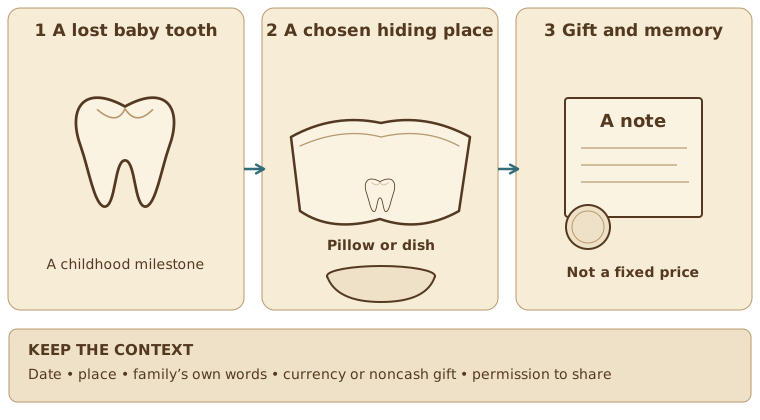
Original educational diagram, not a photograph. Original symbolic sequence for one familiar Tooth Fairy custom. It depicts a story and family practice, not evidence for a literal visitor or a universal rule.
Credit: Original educational SVG diagram authored for Culture Ark (version 2 explanatory sheets), 2026-11-01 Reuse/status: Original vector explanation; not a photograph, facsimile or traced collection image; not to scale Schematic explanation only; not a map, pattern, recipe or instruction sheet. Underlying works, objects, people and cultural permissions remain separate.
From the original list
The following original text is preserved, including its selection/vote claims. Preservation is not independent verification of every assertion.
Why: A fairy pays children for their teeth, at rates tracked like an economy.
What to preserve: tooth price index over years, pillow custom
Year and origin: 20th century · United States
Vote: 7/9 (historian 2 · future kid 3 · curator 2)
Learn more: Tooth fairy on Wikipedia
Explanatory sheets
1 original explanatory sheet prepared for this pick, each with its own diagram. Codes in square brackets such as [F1] point to the numbered sources at the end of the page.
A family story around a childhood milestone
Objects make the story tangible. In the pillow custom, a fallen baby tooth is placed for an imagined visitor and a small gift appears. The ADA also describes a dish, a receipt and a keepsake notebook. Families can adapt the story or not use it. [F1]
A poll is not a price list. The source entry’s “tooth price index” points toward survey evidence. A provider-sponsored poll measures reported practices in a particular sample. Preserve the sponsor, year, population, question wording and currency; do not turn an average into what a child should receive. [F2]
Preserve a family’s own version. Record whether the tooth went under a pillow, into a dish or somewhere else, and whether the gift was money, a note or another keepsake. Avoid publishing a child’s name or intimate household details without appropriate permission.
Keep the cultural scope clear. The record’s twentieth-century United States label remains archival wording. This sheet explains the named pillow practice; it does not claim that all tooth-loss traditions use a fairy, money or the same historical origin.
No payout amount is prescribed. The illustrated tooth is a cultural symbol, not a dental anatomy or extraction guide.
Where to learn more
- https://apiarybee.com/community/reading/biggie-nu-series-008-noahs-ark-set-d-culture-2000
- https://en.wikipedia.org/wiki/Tooth_fairy
Sources and rights
- F1 · American Dental Association Playing the Tooth Fairy — Pillow and dish variants, small gifts, notes and keepsakes. The sheet is cultural description, not dental treatment advice.
- F2 · Delta Dental 2025 Original Tooth Fairy Poll findings — An example of a provider-sponsored survey, not an authoritative price for every family. No payout value is presented as a current rate.
Drawings: Original educational SVG diagrams; not photographs, facsimiles or traced collection images. Sources consulted 2026-11-01. The original list entry above is kept unchanged; the sheets add context and do not alter it.
Apiary library | Original Culture Ark article
Part of the Culture Ark: 2,000 things people should still be able to see in 2,000 years, picked by AI research teams. This page keeps the original list entry for D-1632 word for word and adds context. Browse the gallery. The Culture Ark is an Artificial Mind Hive (AMH) project. AMH is owned by Austin Little.

Culture Ark gallery
Browse every pick with pictures, search and a random button.
Open the gallery →