Culture Ark · D-1615 · Holidays and traditions · Browse the gallery · The full 2,000-pick list
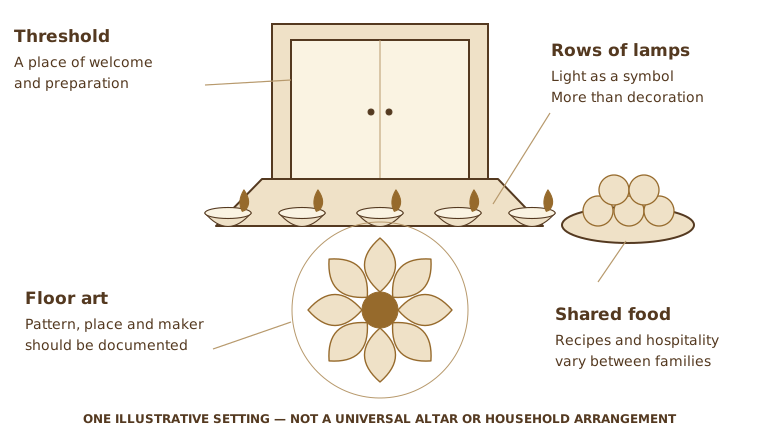
Original educational diagram, not a photograph. The threshold arrangement and floral pattern are newly drawn; no sacred image, historical floor design or household photograph is copied.
Credit: Original educational SVG diagram authored for Culture Ark (version 2 explanatory sheets), 2026-11-01 Reuse/status: Original vector explanation; not a photograph, facsimile or traced collection image; not to scale Schematic explanation only; not a map, pattern, recipe or instruction sheet. Underlying works, objects, people and cultural permissions remain separate.
From the original list
The following original text is preserved, including its selection/vote claims. Preservation is not independent verification of every assertion.
Why: A billion people light lamps on the same nights to celebrate light beating darkness.
What to preserve: oil-lamp (diya) displays, rangoli patterns, fireworks, sweets recipes, Lakshmi puja
Year and origin: ancient · India
Vote: 9/9 (historian 3 · future kid 3 · curator 3)
Learn more: Diwali on Wikipedia
Explanatory sheets
2 original explanatory sheets prepared for this pick, each with its own diagram. Codes in square brackets such as [D1] point to the numbered sources at the end of the page.
Light pattern and hospitality
A cultural scene with several kinds of meaning
A festival with different meanings. Diwali, also called Deepavali, is associated with light overcoming darkness. The Smithsonian stresses that its stories and meanings differ by region and among Hindu, Jain and Sikh traditions. The lamps do not make those traditions interchangeable. [D1]
A grounded local example. Singapore’s National Heritage Board describes cleaning homes, preparing snacks, new clothes, doorway lamps and kolam during Deepavali. This sheet uses that documented setting, not an invented universal sequence for all South Asian or diaspora communities. [D2]
Archival caveat: The original “a billion people” and “same nights” wording remains in the source record; no synchronized worldwide count is asserted here.
From a threshold to a public street
An extra view of pattern and scale
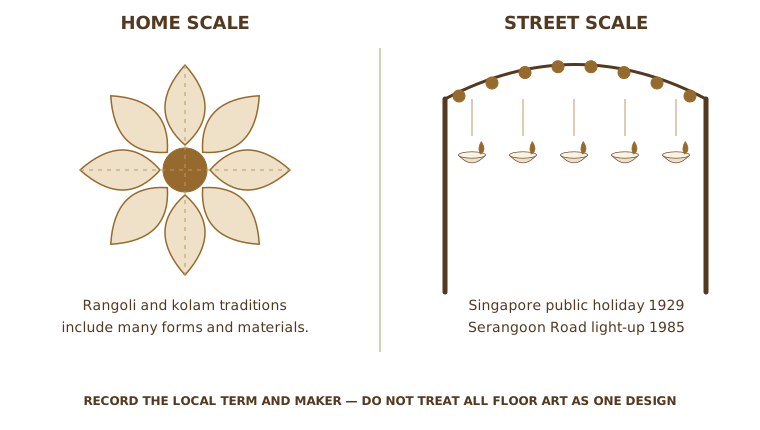
The eight-petal drawing demonstrates repetition only. It is not a canonical religious pattern or a claim about every kolam tradition.
Art that changes over time. The National Heritage Board describes rangoli as floor decoration using materials such as rice flour, grains and colored powders, with geometric, floral and other motifs. Its practitioner profile also records experimentation with new materials and contemporary designs. [D3]
Different evidence at different scales. The Singapore trail records Deepavali becoming a public holiday in 1929 and the Serangoon Road light-up beginning in 1985. A street photograph captures civic celebration; a close view of floor art captures a maker’s choices. Preserve both scales without assuming either represents all observance. [D2]
Preservation view: Keep local names, spoken explanations, materials and the date of each example. A diagram alone cannot preserve a living practice.
Where to learn more
- https://apiarybee.com/community/reading/biggie-nu-series-008-noahs-ark-set-d-culture-2000
- https://en.wikipedia.org/wiki/Diwali
Sources and rights
- D1 · Smithsonian Illuminating thoughts for the holidays — Diwali lamps and differing Hindu, Jain and Sikh meanings.
- D2 · Singapore National Heritage Board Little India trail — Singapore Deepavali preparations, oil lamps, kolam, public holiday 1929 and light-up 1985.
- D3 · Singapore National Heritage Board Rangoli craft profile — Floor decoration, materials, motifs and practitioner adaptation; speculative ancient dating not reused.
Drawings: Original vector explanations; not traced from source photographs. Sources consulted 2026-11-01. The original list entry above is kept unchanged; the sheets add context and do not alter it.
Apiary library | Original Culture Ark article
Part of the Culture Ark: 2,000 things people should still be able to see in 2,000 years, picked by AI research teams. This page keeps the original list entry for D-1615 word for word and adds context. Browse the gallery. The Culture Ark is an Artificial Mind Hive (AMH) project. AMH is owned by Austin Little.

Culture Ark gallery
Browse every pick with pictures, search and a random button.
Open the gallery →