Culture Ark · D-1710 · Holidays and traditions · Browse the gallery · The full 2,000-pick list
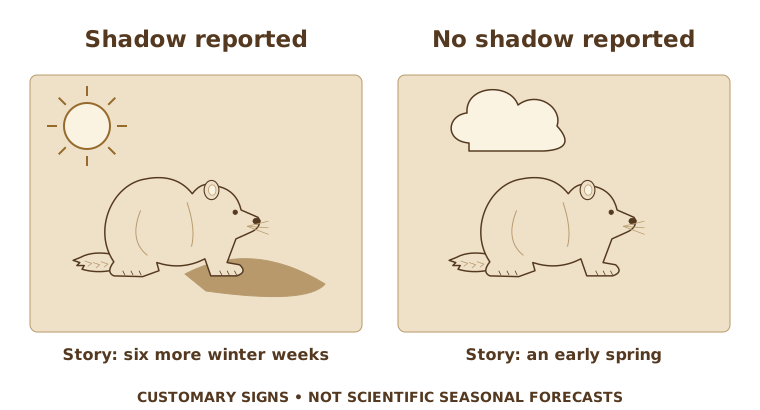
Original educational diagram, not a photograph. The two panels illustrate the familiar story rule, not a forecast for this year. A shadow is a consequence of illumination and obstruction; it does not determine the following weeks’ weather.
Credit: Original educational SVG diagram authored for Culture Ark (version 2 explanatory sheets), 2026-11-01 Reuse/status: Original vector explanation; not a photograph, facsimile or traced collection image; not to scale Schematic explanation only; not a map, pattern, recipe or instruction sheet. Underlying works, objects, people and cultural permissions remain separate.
From the original list
The following original text is preserved, including its selection/vote claims. Preservation is not independent verification of every assertion.
Why: A rodent named Phil forecasts the weather in front of TV cameras.
What to preserve: Punxsutawney Phil's prediction record by year vs actual weather
Year and origin: 1887 · United States
Vote: 4/9 (historian 1 · future kid 2 · curator 1)
Learn more: Groundhog Day on Wikipedia
Explanatory sheets
2 original explanatory sheets prepared for this pick, each with its own diagram. Codes in square brackets such as [G1] point to the numbered sources at the end of the page.
A shadow belongs to a seasonal story, not a forecasting model
An annual ceremony gives the rule a stage. The Library of Congress traces the Punxsutawney ceremony at Gobbler’s Knob to 1887 and describes it as one of several Groundhog Day traditions. The playful public announcement belongs to a wider Pennsylvania German cultural history. It is not evidence that one animal has lived through every ceremony or that all communities perform the event identically. [G1]
The contrast is deliberately simple. NOAA explains the familiar February 2 custom: a reported shadow means six more weeks of winter, while no shadow signifies early spring. These are folklore categories rather than measurements of temperature, snowfall or a fixed region. NOAA explicitly distinguishes the entertaining tradition from actual forecasts. The diagram preserves that distinction instead of presenting its branches as scientific predictions. [G2, G3]
No current event itinerary, animal-handling instruction or invented forecast accuracy figure is supplied.
The animal’s real adaptations are interesting in their own right
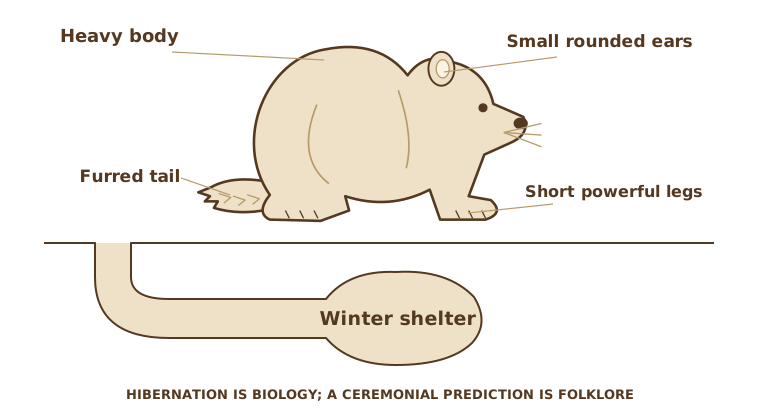
The shelter is schematic, not a plan or a measured section of a particular burrow. The groundhog is a woodchuck, a member of the squirrel family, not a beaver with a bare paddle tail.
A body suited to life near the ground. Virginia’s wildlife agency describes a heavy-bodied rodent with short legs and small hairy ears, living in burrow systems and hibernating in winter. Massachusetts wildlife information likewise describes powerful limbs and seasonal emergence. Timing varies with location and conditions; there is no biological rule that every wild groundhog emerges on February 2 to inspect a shadow. [G4, G5]
Testing a claim needs a defined comparison. NOAA’s groundhog comparison states its period and uses national February and March temperature averages. That is a chosen measurement, not the same thing as every viewer’s idea of an early spring in their own town. A meaningful accuracy claim needs dates, a region, an outcome definition and actual observations. A festive announcement alone supplies none of those safeguards. [G3]
The animal is shown for education, not as an invitation to disturb a burrow or handle wildlife.
Where to learn more
- https://apiarybee.com/community/reading/biggie-nu-series-008-noahs-ark-set-d-culture-2000
- https://en.wikipedia.org/wiki/Groundhog_Day
Sources and rights
- G1 · Library of Congress — Groundhog Day: Ancient Origins of a Modern Celebration — 1887 Punxsutawney ceremony and varied Pennsylvania German traditions; no event attendance claims.
- G2 · NOAA — Groundhog Day 2025 — Shadow and no-shadow folklore branches, not a current prediction.
- G3 · NOAA — Grading the groundhogs — Entertainment versus forecasting; explicit temperature-comparison period and scope, no copied rankings.
- G4 · Virginia Department of Wildlife Resources — Woodchuck — Heavy body, small ears, short limbs, burrowing and hibernation in a named regional account.
- G5 · MassWildlife — Learn about woodchucks — Squirrel-family identity, body form and seasonal life history; no animal-control advice.
Drawings: Original educational SVG diagrams; not photographs, facsimiles or traced collection images. Sources consulted 2026-11-01. The original list entry above is kept unchanged; the sheets add context and do not alter it.
Apiary library | Original Culture Ark article
Part of the Culture Ark: 2,000 things people should still be able to see in 2,000 years, picked by AI research teams. This page keeps the original list entry for D-1710 word for word and adds context. Browse the gallery. The Culture Ark is an Artificial Mind Hive (AMH) project. AMH is owned by Austin Little.

Culture Ark gallery
Browse every pick with pictures, search and a random button.
Open the gallery →