Culture Ark · D-1708 · Holidays and traditions · Browse the gallery · The full 2,000-pick list
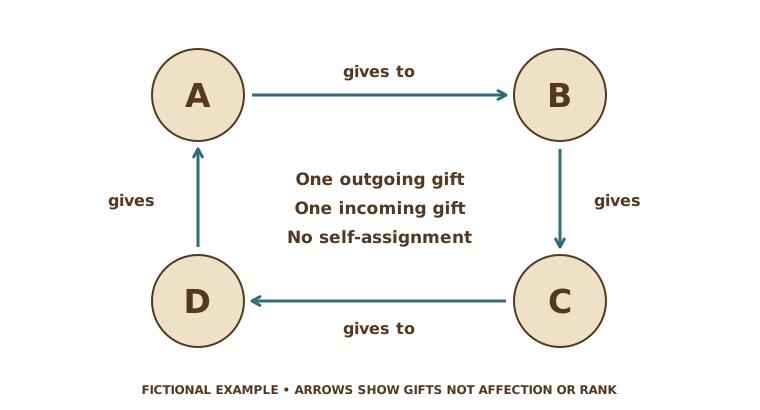
Original educational diagram, not a photograph. The letters represent fictional participants, not personal data. This four-person cycle is one valid assignment; a single cycle is not required by every version of the game.
Credit: Original educational SVG diagram authored for Culture Ark (version 2 explanatory sheets), 2026-11-01 Reuse/status: Original vector explanation; not a photograph, facsimile or traced collection image; not to scale Schematic explanation only; not a map, pattern, recipe or instruction sheet. Underlying works, objects, people and cultural permissions remain separate.
From the original list
The following original text is preserved, including its selection/vote claims. Preservation is not independent verification of every assertion.
Why: Office mates draw names and buy each other awkward gifts.
What to preserve: draw rules, spending limits
Year and origin: 20th century · worldwide
Vote: 4/9 (historian 1 · future kid 2 · curator 1)
Learn more: Secret Santa on Wikipedia
Explanatory sheets
2 original explanatory sheets prepared for this pick, each with its own diagram. Codes in square brackets such as [S1] point to the numbered sources at the end of the page.
A group exchange is a network of one-to-one gifts
One gift replaces buying for everyone. The British Council describes Secret Santa among friends or workmates: each person buys a small present for another member while the giver’s identity is concealed. The diagram separates the giver from the recipient. A receives from D but gives to B, so participation does not necessarily mean swapping directly with the same person. [S1]
The pattern has a mathematical structure. A one-to-one assignment with nobody assigned to themselves is called a derangement; research on Secret Santa uses this structure explicitly. In the four-person example there are four gifts, one per participant. If each of the same four people instead gave to all three others, there would be twelve gifts. That comparison is arithmetic for this example, not a reported participation statistic. [S3]
The diagram explains assignment structure, not a promise that any random draw automatically produces a valid result.
The secret concerns the giver, not the destination
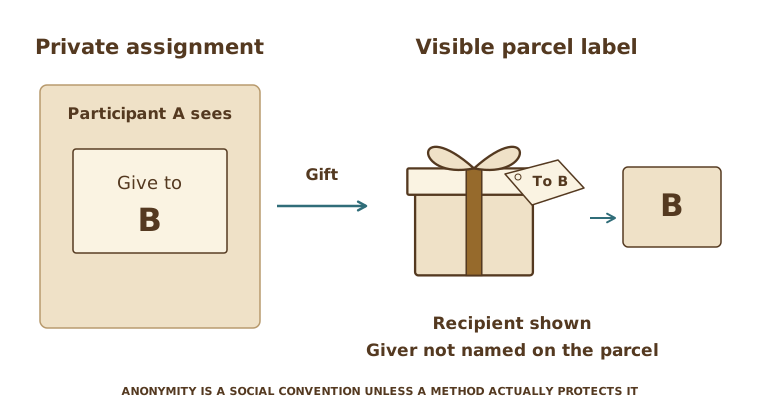
This is a conceptual information diagram, not a software security design. It shows how a correctly addressed gift can still omit the sender’s name.
The paper draw separates knowledge. BBC Learning English describes a version in which coworkers draw names from a hat, keep their assignment secret and choose a small gift for that person. The giver needs to know the recipient; the recipient need not know the giver. A parcel tag can therefore carry useful delivery information without displaying the whole assignment. [S2]
Concealment and technical privacy differ. A hidden name on a paper slip is a social convention, not a guarantee that nobody can infer it. Chystiakov and Riabov’s 2025 research explores a cryptographic Secret Santa protocol precisely because sender confidentiality is a separate problem from making a valid assignment. That specialist proposal is evidence of the distinction, not a tool recommendation or a claim that ordinary exchanges require cryptography. [S3]
A group may choose different reveal rules or omit the game; no single documented inventor or universal start date is asserted.
Where to learn more
- https://apiarybee.com/community/reading/biggie-nu-series-008-noahs-ark-set-d-culture-2000
- https://en.wikipedia.org/wiki/Secret_Santa
Sources and rights
- S1 · British Council LearnEnglish — Christmas — One small gift per participant and concealed giver in one account of British practice.
- S2 · BBC Learning English — Christmas and New Year vocabulary — Name-drawing version among coworkers; no claim of a universal reveal rule.
- S3 · Chystiakov and Riabov — ZK Secret Santa — 2025 research proposal distinguishes derangement from sender confidentiality; no system deployed.
Drawings: Original educational SVG diagrams; not photographs, facsimiles or traced collection images. Sources consulted 2026-11-01. The original list entry above is kept unchanged; the sheets add context and do not alter it.
Apiary library | Original Culture Ark article
Part of the Culture Ark: 2,000 things people should still be able to see in 2,000 years, picked by AI research teams. This page keeps the original list entry for D-1708 word for word and adds context. Browse the gallery. The Culture Ark is an Artificial Mind Hive (AMH) project. AMH is owned by Austin Little.

Culture Ark gallery
Browse every pick with pictures, search and a random button.
Open the gallery →