Culture Ark · D-1709 · Holidays and traditions · Browse the gallery · The full 2,000-pick list
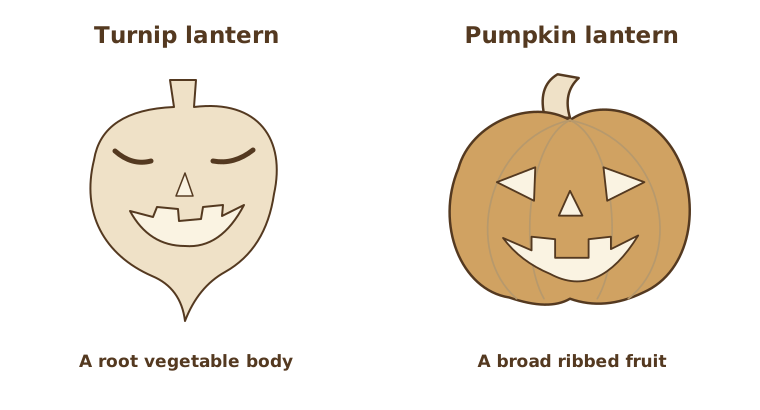
Original educational diagram, not a photograph. The drawings distinguish shapes rather than giving carving instructions. Neither face is copied from the National Museum of Ireland’s object or from a private household.
Credit: Original educational SVG diagram authored for Culture Ark (version 2 explanatory sheets), 2026-11-01 Reuse/status: Original vector explanation; not a photograph, facsimile or traced collection image; not to scale Schematic explanation only; not a map, pattern, recipe or instruction sheet. Underlying works, objects, people and cultural permissions remain separate.
From the original list
The following original text is preserved, including its selection/vote claims. Preservation is not independent verification of every assertion.
Why: A carved glowing pumpkin face guards doorsteps on Halloween.
What to preserve: carving styles, turnip origins
Year and origin: 19th century · Ireland
Vote: 4/9 (historian 1 · future kid 2 · curator 1)
Learn more: Jack-o'-lantern on Wikipedia
Explanatory sheets
2 original explanatory sheets prepared for this pick, each with its own diagram. Codes in square brackets such as [L1] point to the numbered sources at the end of the page.
The familiar face has more than one material history
A local turnip tradition is documented. The National Museum of Ireland received a turnip lantern in 1943 from teacher Rois Ní Braonáin near Fintown, County Donegal. Her account identified it as a type made locally around 1900. The museum’s surviving display model is a painted plaster cast by Eileen Barnes, an important distinction between the perishable original material and its museum representation. [L1]
Pumpkins became a different visible form. The museum describes the pumpkin lantern as an American development of the Irish tradition. Its lobed body differs from a tapered root. The illuminated face persists across these materials, without one compulsory vegetable or design. [L1]
No knife, cutting sequence, candle placement or flame instructions are shown.
Light makes the face readable and helps it travel
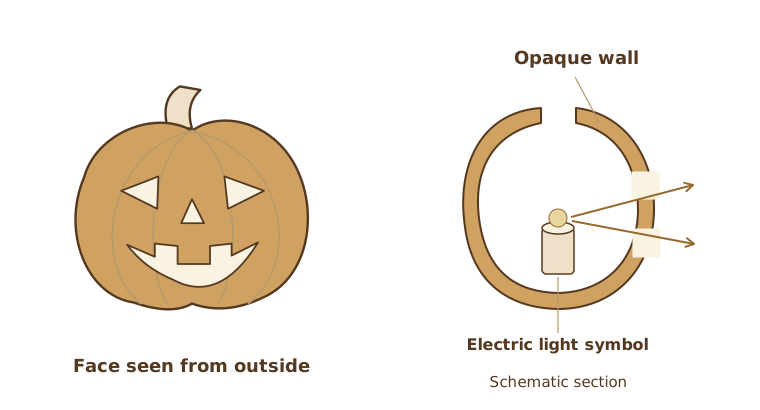
The section uses a generic electric-light symbol to explain contrast. It is not a product recommendation, electrical diagram or instruction for modifying a lantern.
A folktale gives the object a character. The National Museum of Ireland connects the name with a tale of Jack, excluded from both Heaven and Hell and wandering with a lantern. This is folklore, not a verified biography. Bright openings against a dark surface make the face readable at night. [L1]
A recognizable sign can enter new settings. The Royal Danish Library documents newspaper attention to pumpkin lanterns in Denmark in the early 1990s and connects later adoption of Halloween with American film, television and music. The lantern was one portable visual element in that exchange. A tradition can therefore spread through media and public display as well as through migration, acquiring local settings rather than remaining fixed. [L2]
The historical source describes candle use; the teaching diagram does not demonstrate flame use or claim that light proves a supernatural story.
Where to learn more
- https://apiarybee.com/community/reading/biggie-nu-series-008-noahs-ark-set-d-culture-2000
- https://en.wikipedia.org/wiki/Jack-o'-lantern
Sources and rights
- L1 · National Museum of Ireland — Ghost turnip — Donegal locality, 1943 acquisition, Eileen Barnes’s plaster cast and Jack folktale.
- L2 · Royal Danish Library — Halloween — Danish newspaper evidence from the early 1990s and media-led adaptation; broad ancient-origin claims not adopted.
Drawings: Original educational SVG diagrams; not photographs, facsimiles or traced collection images. Sources consulted 2026-11-01. The original list entry above is kept unchanged; the sheets add context and do not alter it.
Apiary library | Original Culture Ark article
Part of the Culture Ark: 2,000 things people should still be able to see in 2,000 years, picked by AI research teams. This page keeps the original list entry for D-1709 word for word and adds context. Browse the gallery. The Culture Ark is an Artificial Mind Hive (AMH) project. AMH is owned by Austin Little.

Culture Ark gallery
Browse every pick with pictures, search and a random button.
Open the gallery →