Culture Ark · D-1631 · Holidays and traditions · Browse the gallery · The full 2,000-pick list
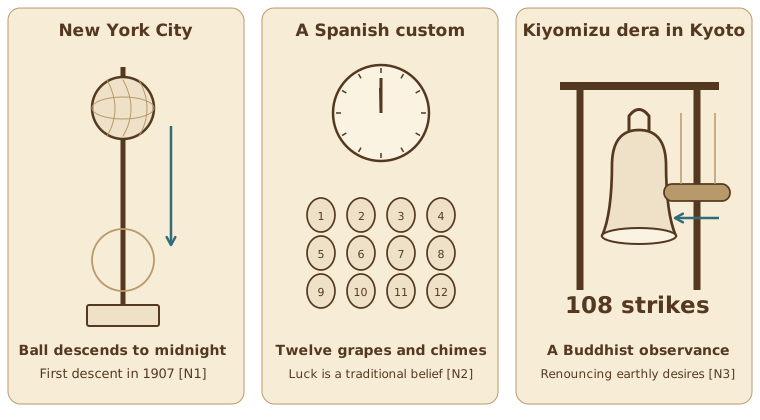
Original educational diagram, not a photograph. Original explanatory symbols. These three practices mark the December 31 to January 1 transition, but they are not one sequence and do not represent everyone in each place.
Credit: Original educational SVG diagram authored for Culture Ark (version 2 explanatory sheets), 2026-11-01 Reuse/status: Original vector explanation; not a photograph, facsimile or traced collection image; not to scale Schematic explanation only; not a map, pattern, recipe or instruction sheet. Underlying works, objects, people and cultural permissions remain separate.
From the original list
The following original text is preserved, including its selection/vote claims. Preservation is not independent verification of every assertion.
Why: The planet celebrates one time-zone at a time with countdowns and fireworks.
What to preserve: countdown footage, midnight customs per culture
Year and origin: ancient · worldwide
Vote: 7/9 (historian 2 · future kid 2 · curator 3)
Learn more: New Year's Eve on Wikipedia
Explanatory sheets
1 original explanatory sheet prepared for this pick, each with its own diagram. Codes in square brackets such as [N1] point to the numbered sources at the end of the page.
A shared date does not mean one shared ritual
Public countdown and local history. Times Square’s first ball descent marked the end of 1907. That documented New York tradition is not the origin of New Year celebrations. The drawing shows the idea of descent, not the mechanism or dimensions of a particular ball. [N1]
Food and religious meaning. Spain’s twelve grapes accompany twelve midnight chimes; good fortune is part of the tradition’s belief. At Kiyomizu dera in Kyoto, 108 bell strikes are associated with renouncing earthly desires. The numbers have different meanings, not interchangeable countdowns. [N2, N3]
Date and participation. This sheet covers the civil year boundary named in these sources. It does not replace other religious or cultural new years, or imply that all people celebrate at midnight. Record local date, time and time zone with any footage.
What to preserve. Keep a named place, year, organizer or participant, spoken words, sound, object details and reuse permission. A television montage may join events from different local times; retain the original timing rather than assuming simultaneity.
The archival phrase “the planet celebrates” is retained unchanged in the source record, not adopted here as a universal claim.
Where to learn more
- https://apiarybee.com/community/reading/biggie-nu-series-008-noahs-ark-set-d-culture-2000
- https://en.wikipedia.org/wiki/New_Year's_Eve
Sources and rights
- N1 · Times Square Alliance New Year’s Eve history — Organizer history of the 1907 first ball descent and the local countdown tradition; not a history of all New Year celebrations.
- N2 · Spain’s official tourism portal New Year’s Eve in Spain — Twelve grapes with the midnight chimes, including the belief about good luck.
- N3 · Kiyomizu dera Temple New Year’s Eve bells — The temple’s account of 108 bell strikes and their Buddhist meaning. Used for this named temple, not every Japanese household.
Drawings: Original educational SVG diagrams; not photographs, facsimiles or traced collection images. Sources consulted 2026-11-01. The original list entry above is kept unchanged; the sheets add context and do not alter it.
Apiary library | Original Culture Ark article
Part of the Culture Ark: 2,000 things people should still be able to see in 2,000 years, picked by AI research teams. This page keeps the original list entry for D-1631 word for word and adds context. Browse the gallery. The Culture Ark is an Artificial Mind Hive (AMH) project. AMH is owned by Austin Little.

Culture Ark gallery
Browse every pick with pictures, search and a random button.
Open the gallery →