Culture Ark · D-1704 · Holidays and traditions · Browse the gallery · The full 2,000-pick list
Original educational diagram, not a photograph. The three objects are invented teaching examples, not copies of museum pieces. Their shared silhouette does not make their materials, meanings or histories interchangeable.
Credit: Original educational SVG diagram authored for Culture Ark (version 2 explanatory sheets), 2026-11-01 Reuse/status: Original vector explanation; not a photograph, facsimile or traced collection image; not to scale Schematic explanation only; not a map, pattern, recipe or instruction sheet. Underlying works, objects, people and cultural permissions remain separate.
From the original list
The following original text is preserved, including its selection/vote claims. Preservation is not independent verification of every assertion.
Why: Decorated eggs symbolise new life and became hunts and chocolate.
What to preserve: dyeing styles, egg hunts, Fabergé eggs
Year and origin: medieval · Europe
Vote: 4/9 (historian 1 · future kid 2 · curator 1)
Learn more: Easter egg on Wikipedia
Explanatory sheets
2 original explanatory sheets prepared for this pick, each with its own diagram. Codes in square brackets such as [E1] point to the numbered sources at the end of the page.
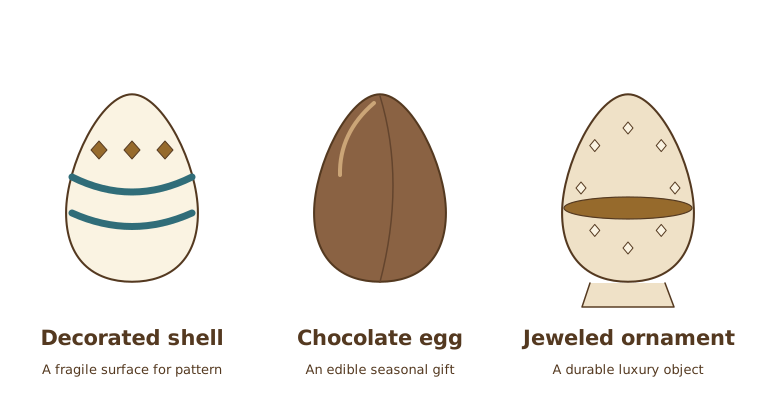
An egg shape can carry very different kinds of value
A shell can become an expressive surface. Egg decoration includes dyeing, wax-resist work and other methods across different communities. The Library of Congress describes traditions associated with Easter as well as other seasonal occasions. Patterns can connect a small, portable object with family knowledge and the skill of its maker. There is no single worldwide code in which every stripe or color always has the same meaning. [E1]
Confection and courtly gift are different uses. The Hershey Story records the growth of chocolate Easter shapes and metal molds in the late nineteenth and early twentieth centuries. A confection can be shared and eaten. By contrast, the V&A’s Fabergé exhibition documented precious imperial Easter gifts, including an egg presented in 1887. Such jeweled objects displayed exceptional workmanship and wealth; they were not ordinary household eggs. [E2, E3]
The egg designs here illustrate material differences; no traditional motif meanings or manufacture recipes are invented.
Wax-resist decoration preserves color by blocking dye
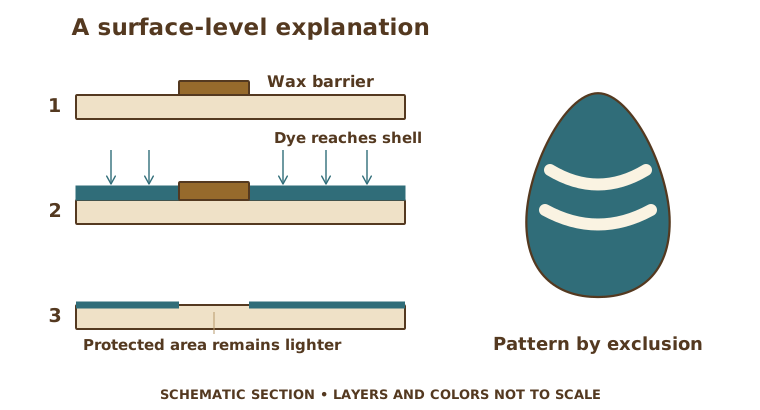
The diagram enlarges the shell surface rather than cutting through a whole egg. Blue is an explanatory contrast color. The simple bands are not presented as an authentic named pysanka design.
The protected area is the key. In wax-resist decoration, wax covers selected parts of the shell so that dye affects the uncovered areas. Repeated masking and coloring can preserve several lighter colors within a darker design. Florida’s folklife documentation of Ola Kryway identifies this approach in Ukrainian pysanky and records her transmission of skills through apprenticeship. The mechanism is protection of a surface, not painting every final line directly. [E4]
Knowledge travels through people. The Estonian National Commission for UNESCO describes pysanka as an important practice for Ukrainian communities in Estonia as well as Ukraine. Teaching, gifting and remembering cultural connections give the decorated object a life beyond its appearance. Its 2023 account also describes eggs kept as gifts rather than eaten. Practices and symbol interpretations belong to particular makers and communities, not to the generic bands in this drawing. [E5]
This is a material explanation, not a recipe or directions for handling heated wax or tools.
Where to learn more
- https://apiarybee.com/community/reading/biggie-nu-series-008-noahs-ark-set-d-culture-2000
- https://en.wikipedia.org/wiki/Easter_egg
Sources and rights
- E1 · Library of Congress — The Ancient Art of Decorating Eggs — Diverse egg-decorating methods and seasonal contexts; no exact prehistoric origin asserted.
- E2 · The Hershey Story — From Osterhase to Chocolate Eggs — Museum collection history of nests, gifts and chocolate molds. Its fifteenth-century hare claim is not adopted.
- E3 · Victoria and Albert Museum — Fabergé in London — Historical exhibition of imperial Easter eggs; an 1887 gift example. No object images copied.
- E4 · Florida Department of State — Ola Kryway — Wax-resist pysanky and apprenticeship transmission documented by the folklife program.
- E5 · Estonian National Commission for UNESCO — Pysanka nomination — 2023 account of Ukrainian and Estonian-Ukrainian community practice; not cited as a completed inscription.
Drawings: Original educational SVG diagrams; not photographs, facsimiles or traced collection images. Sources consulted 2026-11-01. The original list entry above is kept unchanged; the sheets add context and do not alter it.
Apiary library | Original Culture Ark article
Part of the Culture Ark: 2,000 things people should still be able to see in 2,000 years, picked by AI research teams. This page keeps the original list entry for D-1704 word for word and adds context. Browse the gallery. The Culture Ark is an Artificial Mind Hive (AMH) project. AMH is owned by Austin Little.

Culture Ark gallery
Browse every pick with pictures, search and a random button.
Open the gallery →