Culture Ark · D-1703 · Holidays and traditions · Browse the gallery · The full 2,000-pick list
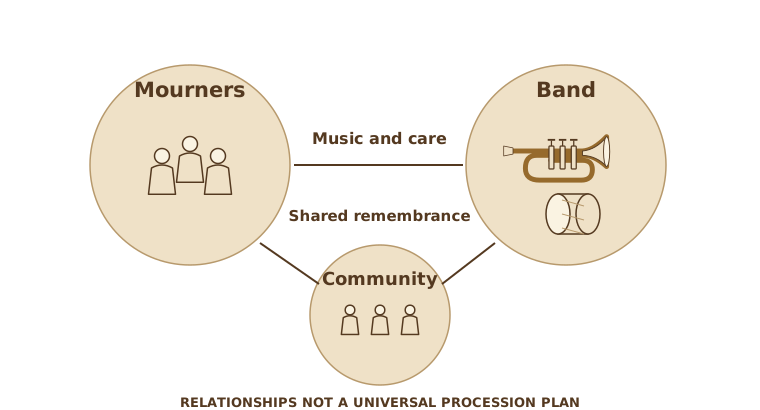
Original educational diagram, not a photograph. No deceased person, coffin, private ritual or route is shown. The connected circles represent roles that can overlap, not a required marching order.
Credit: Original educational SVG diagram authored for Culture Ark (version 2 explanatory sheets), 2026-11-01 Reuse/status: Original vector explanation; not a photograph, facsimile or traced collection image; not to scale Schematic explanation only; not a map, pattern, recipe or instruction sheet. Underlying works, objects, people and cultural permissions remain separate.
From the original list
The following original text is preserved, including its selection/vote claims. Preservation is not independent verification of every assertion.
Why: New Orleans buries its dead with brass bands turning grief into dance.
What to preserve: dirge-to-celebration music, second line
Year and origin: 19th century · United States
Vote: 4/9 (historian 1 · future kid 2 · curator 1)
Learn more: Jazz funeral on Wikipedia
Explanatory sheets
2 original explanatory sheets prepared for this pick, each with its own diagram. Codes in square brackets such as [J1] point to the numbered sources at the end of the page.
A funeral is held within a community of care
Mutual aid gave music a social foundation. The National Park Service connects New Orleans funeral processions with African-American mutual aid and benevolent societies. These organizations supported people facing exclusion from commercial insurance and other services. Hiring a band, accompanying mourners and publicly remembering a life belonged to a wider system of community care, not merely a musical spectacle. [J1]
Second line names participation not every funeral. The term second line refers to community participants accompanying an organized parade and its band; it can also refer more broadly to a whole event or musical tradition. Benjamin Doleac’s research explains its presence in several Black New Orleans expressive forms, including but not limited to funerals. Families, clubs and musicians shape each occasion, so the label is not a universal funeral script. [J2]
This is a non-graphic cultural explanation; participation in an actual funeral remains subject to the wishes of its community.
The band can hold sorrow and celebration together
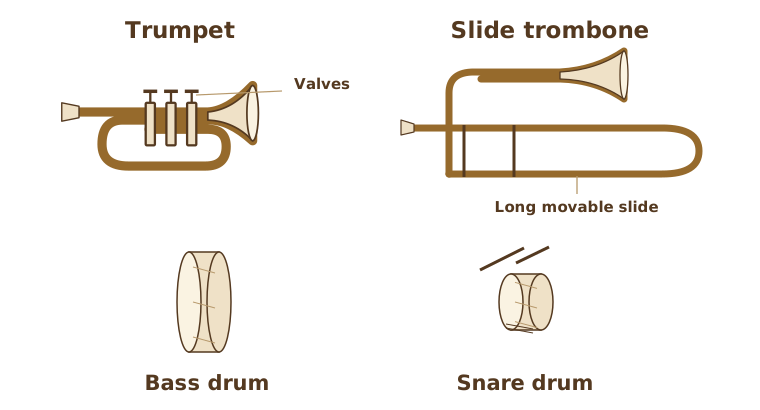
These are simplified original instrument drawings, not models, plans or a fixed personnel list. A trumpet’s compact valve tubing differs visibly from a trombone’s long slide.
Music can change without erasing grief. In the National Park Service’s historical account, Louis Armstrong recalls a change from solemn funeral music to lively tunes and community movement. That recollection helps explain the contrast often associated with jazz funerals, but it is one musician’s account rather than a command for every family. Doleac describes second-line rhythm as layered, syncopated and varied by performers. [J1, J2]
Form helps explain musical variety. A trumpet’s valves redirect air through extra tubing, while a slide trombone changes tube length with its long movable section. Drums contribute pulse and rhythmic detail. The ensemble can combine these different voices in hymns, marches and lively music; instrumentation and repertoire change by band and occasion. The drawings distinguish physical forms without pretending to reproduce a particular funeral performance. [J2, J3, J4]
No musical score, named dance choreography or universal transition point is invented here.
Where to learn more
- https://apiarybee.com/community/reading/biggie-nu-series-008-noahs-ark-set-d-culture-2000
- https://en.wikipedia.org/wiki/Jazz_funeral
Sources and rights
- J1 · National Park Service — Jazz Origins in New Orleans — Mutual aid societies and Armstrong’s historical account of funeral music.
- J2 · Benjamin Doleac — Strictly Second Line — 2013 research on social participation and layered, changing rhythmic practice.
- J3 · Yamaha — How does the trumpet generate sound — Valve tubing and pitch; no product recommendation or copied diagram.
- J4 · Yamaha — The trombone extends and retracts — Parallel slide tubes and changing pitch; no product recommendation or copied diagram.
Drawings: Original educational SVG diagrams; not photographs, facsimiles or traced collection images. Sources consulted 2026-11-01. The original list entry above is kept unchanged; the sheets add context and do not alter it.
Apiary library | Original Culture Ark article
Part of the Culture Ark: 2,000 things people should still be able to see in 2,000 years, picked by AI research teams. This page keeps the original list entry for D-1703 word for word and adds context. Browse the gallery. The Culture Ark is an Artificial Mind Hive (AMH) project. AMH is owned by Austin Little.

Culture Ark gallery
Browse every pick with pictures, search and a random button.
Open the gallery →