Culture Ark · D-1702 · Holidays and traditions · Browse the gallery · The full 2,000-pick list
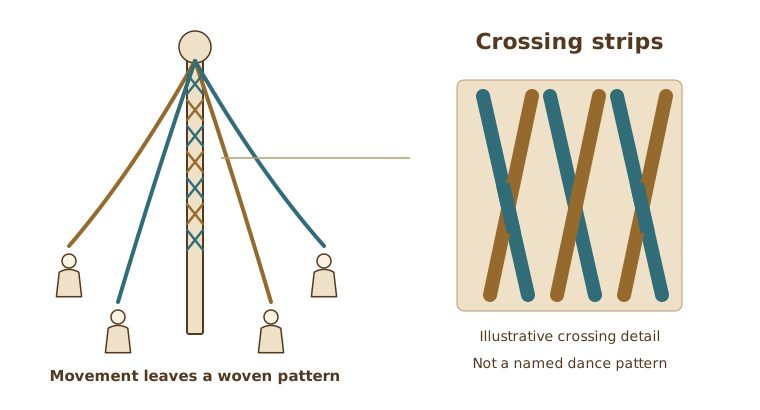
Original educational diagram, not a photograph. The enlargement is an invented strip-crossing example. It is not a notation of a named dance, a step order or a claim that all maypoles use ribbons.
Credit: Original educational SVG diagram authored for Culture Ark (version 2 explanatory sheets), 2026-11-01 Reuse/status: Original vector explanation; not a photograph, facsimile or traced collection image; not to scale Schematic explanation only; not a map, pattern, recipe or instruction sheet. Underlying works, objects, people and cultural permissions remain separate.
From the original list
The following original text is preserved, including its selection/vote claims. Preservation is not independent verification of every assertion.
Why: Dancers weave ribbons around a tall pole to welcome summer.
What to preserve: ribbon dance patterns
Year and origin: medieval · Europe
Vote: 4/9 (historian 1 · future kid 2 · curator 1)
Learn more: Maypole on Wikipedia
Explanatory sheets
2 original explanatory sheets prepared for this pick, each with its own diagram. Codes in square brackets such as [M1] point to the numbered sources at the end of the page.
A shared movement becomes a visible pattern
Ribbons give movement a material trace. In a familiar British May Day form, dancers hold ribbons attached near the top of a pole. Their movements create interlaced patterns around it. The National Trust describes this as a recognizable part of May Day celebration, alongside other spring customs. The pole provides a shared center while the ribbons make the group’s coordinated motion visible. [M1]
The performance changes with its setting. Maypole dancing has appeared in village festivities, school displays and heritage celebrations. The National Trust describes changing associations, from adult courtship to nostalgic children’s entertainment. A local dance can have its own tune, pattern and organization. The pictured material relationship is therefore more transferable than pretending there is one compulsory choreography for every community. [M1]
The drawing explains form and movement, not pole installation, load-bearing design or a universal dance lesson.
Related names do not mean identical customs
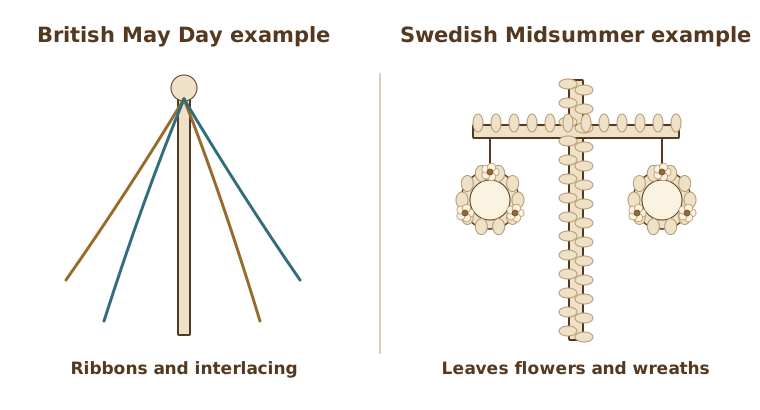
Both poles are original simplified examples. The Swedish form shown is recognizable but not the only local design, and it is not presented as a ribbon-braiding pole.
Why a Swedish pole is not simply a May calendar. Nordiska museet explains that the older Swedish term majstång relates to maja, decorating with leaves, rather than to the month of May. A leafy pole is central to many Swedish Midsummer celebrations. Greenery connects the custom with hopes for growth and successful harvests, while songs and group dances make it a social occasion. [M2]
A familiar form has its own history. The museum dates much of the familiar modern combination of a cross-shaped leafy pole and dancing to the nineteenth century. It treats older connections cautiously, rather than supplying an unbroken prehistoric origin. Comparing ribbon and leafy forms shows how communities can make a seasonal gathering recognizable through different materials, dates and performances. [M1, M2]
The comparison does not equate all European seasonal poles or assign one ancient meaning to every design.
Where to learn more
- https://apiarybee.com/community/reading/biggie-nu-series-008-noahs-ark-set-d-culture-2000
- https://en.wikipedia.org/wiki/Maypole
Sources and rights
- M1 · National Trust — The history of May Day — Ribbon patterns and changing social settings; no exact date for ribbon-dance origins asserted.
- M2 · Nordiska museet — Midsummer — Leafy pole, maja terminology, nineteenth-century forms and historical uncertainty.
Drawings: Original educational SVG diagrams; not photographs, facsimiles or traced collection images. Sources consulted 2026-11-01. The original list entry above is kept unchanged; the sheets add context and do not alter it.
Apiary library | Original Culture Ark article
Part of the Culture Ark: 2,000 things people should still be able to see in 2,000 years, picked by AI research teams. This page keeps the original list entry for D-1702 word for word and adds context. Browse the gallery. The Culture Ark is an Artificial Mind Hive (AMH) project. AMH is owned by Austin Little.

Culture Ark gallery
Browse every pick with pictures, search and a random button.
Open the gallery →