Culture Ark · D-1701 · Holidays and traditions · Browse the gallery · The full 2,000-pick list
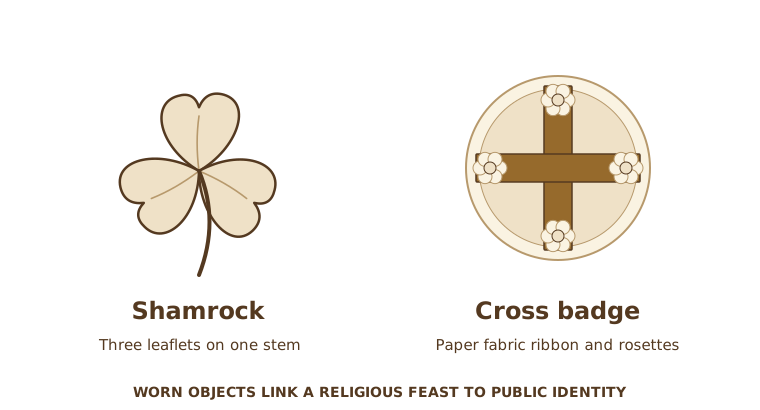
Original educational diagram, not a photograph. These are original teaching drawings, not copies of collection objects. The shamrock has three leaflets, not the four associated with a different luck motif.
Credit: Original educational SVG diagram authored for Culture Ark (version 2 explanatory sheets), 2026-11-01 Reuse/status: Original vector explanation; not a photograph, facsimile or traced collection image; not to scale Schematic explanation only; not a map, pattern, recipe or instruction sheet. Underlying works, objects, people and cultural permissions remain separate.
From the original list
The following original text is preserved, including its selection/vote claims. Preservation is not independent verification of every assertion.
Why: Rivers turn green and the whole world pretends to be Irish.
What to preserve: green dye in the Chicago River, parades, shamrocks
Year and origin: 1631 · Ireland
Vote: 4/9 (historian 1 · future kid 1 · curator 2)
Learn more: Saint Patrick's Day on Wikipedia
Explanatory sheets
2 original explanatory sheets prepared for this pick, each with its own diagram. Codes in square brackets such as [P1] point to the numbered sources at the end of the page.
A leaf and a badge tell different parts of the story
A feast day with visible signs. The National Museum of Ireland identifies 17 March as Patrick’s feast day and records a 1681 visitor’s account of people wearing crosses and shamrock. Later children’s cross badges used colored paper, fabric and ribbons, sometimes gathered into rosettes. Such small objects let a wearer display participation without requiring a large parade. [P1]
A religious story is not a botanical proof. The familiar account of Patrick using a shamrock to explain the Christian Trinity is a later tradition, not contemporary evidence from the saint’s lifetime. Its three-part form helps communicate a religious idea; it does not scientifically demonstrate that belief. The museum’s object histories also show that today’s rosettes developed through changing designs rather than remaining fixed. [P1]
This page explains documented symbols and later traditions; it does not establish 1631 as the beginning of every observance.
The same date can become different local traditions
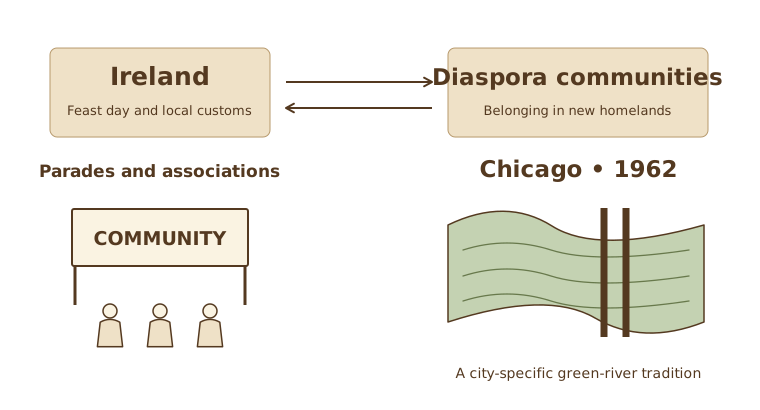
The arrows show cultural exchange rather than an itinerary. The Chicago river and bridge are schematic; no map, dye recipe or water-quality claim is supplied.
Parades make community visible. The National Folklore Collection’s Dúchas resource describes street parades as important expressions of Irish immigrant society, particularly in North America. An annual gathering can make shared origins visible in a new city while bringing associations and generations together. This helps explain why the day’s public forms differ from a purely church-centered feast. [P2]
One city adds its own landmark. Chicago’s official tourism account dates its river-dyeing tradition to 1962. A local waterway became a recognizable public emblem of the occasion, alongside parades and cultural events. That is a particular urban adaptation, not a practice followed by every Irish community. Religious observance, family identity, tourism and civic celebration can coexist without meaning the same thing to each participant. [P3]
Historical dates describe the traditions, not a current event schedule or an invitation to add substances to waterways.
Where to learn more
- https://apiarybee.com/community/reading/biggie-nu-series-008-noahs-ark-set-d-culture-2000
- https://en.wikipedia.org/wiki/Saint_Patrick's_Day
Sources and rights
- P1 · National Museum of Ireland — St Patrick and Folk Tradition · https://source.museum.ie/en-IE/Collections-Research/Folklife-Collections/Folklife-Collections-List-(1)/Religion-and-Calendar-Customs/St-Patrick — Cross badges, shamrock, 1681 account and later Trinity tradition.
- P2 · National Folklore Collection Dúchas — St Patrick’s Day — Diaspora and public parades. Its shorthand 1631 canonization statement is not adopted.
- P3 · Choose Chicago — St Patrick’s Day in Chicago — Official tourism history dates the river-dyeing addition to 1962; no process copied.
Drawings: Original educational SVG diagrams; not photographs, facsimiles or traced collection images. Sources consulted 2026-11-01. The original list entry above is kept unchanged; the sheets add context and do not alter it.
Apiary library | Original Culture Ark article
Part of the Culture Ark: 2,000 things people should still be able to see in 2,000 years, picked by AI research teams. This page keeps the original list entry for D-1701 word for word and adds context. Browse the gallery. The Culture Ark is an Artificial Mind Hive (AMH) project. AMH is owned by Austin Little.

Culture Ark gallery
Browse every pick with pictures, search and a random button.
Open the gallery →