Culture Ark · D-1670 · Holidays and traditions · Browse the gallery · The full 2,000-pick list
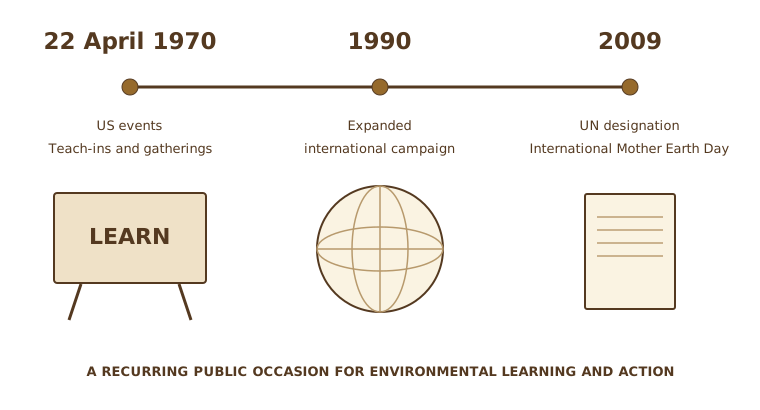
Original educational diagram, not a photograph. The globe is a network symbol, not a map of participation. No present-day crowd estimate is encoded in the diagram.
Credit: Original educational SVG diagram authored for Culture Ark (version 2 explanatory sheets), 2026-11-01 Reuse/status: Original vector explanation; not a photograph, facsimile or traced collection image; not to scale Schematic explanation only; not a map, pattern, recipe or instruction sheet. Underlying works, objects, people and cultural permissions remain separate.
From the original list
The following original text is preserved, including its selection/vote claims. Preservation is not independent verification of every assertion.
Why: 20 million Americans rallied in 1970; now a billion people take part.
What to preserve: 1970 rally, participation numbers by year
Year and origin: 1970 · United States
Vote: 5/9 (historian 2 · future kid 1 · curator 2)
Learn more: Earth Day on Wikipedia
Explanatory sheets
2 original explanatory sheets prepared for this pick, each with its own diagram. Codes in square brackets such as [E1] point to the numbered sources at the end of the page.
From a teach-in idea to a recurring global occasion
Public learning became public visibility. Senator Gaylord Nelson proposed an environmental teach-in, and Denis Hayes helped organize and broaden the effort. Events on 22 April 1970 connected campuses with communities around the United States. In his 1980 account, Nelson described the purpose as making the depth of public environmental concern visible to political leaders. [E1, E2]
The date spread through several channels. EARTHDAY.ORG identifies 1990 as a major expansion of its international campaign. In 2009 the UN General Assembly designated 22 April as International Mother Earth Day. These are related but distinct organizational histories, not one institution controlling every local event. Earth Day belongs within a much longer history of environmental knowledge, advocacy and public policy. [E2, E3]
No current participation totals are asserted, and the observance is not treated as the sole cause of environmental legislation.
One day of attention one connected planet
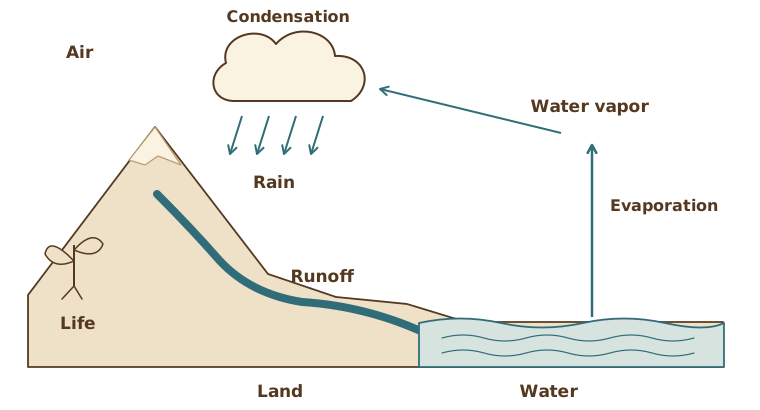
This simplified water-cycle cross section is original. Arrow widths are illustrative, not quantities; groundwater, ice, transpiration and many other exchanges are omitted.
What the science adds. NASA explains that water circulates between ocean, atmosphere and land through processes including evaporation, condensation and precipitation. The diagram follows one simplified pathway: water vapor enters the air, cloud droplets form, rain reaches land and runoff returns water toward the sea. Living things depend on water within this connected system. [E4]
An observance and evidence serve different roles. Earth Day creates a public occasion to learn, discuss and organize around environmental concerns. Earth science tests explanations and measures changes beyond a single anniversary. Connecting the two helps explain why a local river or patch of land can matter within wider systems, without treating a symbolic celebration as a scientific measurement of planetary health. [E1, E4]
The illustration explains a process, not a forecast, a local water assessment or a claim that one action solves every environmental problem.
Where to learn more
- https://apiarybee.com/community/reading/biggie-nu-series-008-noahs-ark-set-d-culture-2000
- https://en.wikipedia.org/wiki/Earth_Day
Sources and rights
- E1 · Gaylord Nelson — Earth Day ’70 What It Meant — Organizer’s 1980 retrospective in EPA Journal; purpose and public concern.
- E2 · EARTHDAY.ORG — The History of Earth Day — Organizer account of teach-ins, Hayes and the expanded 1990 campaign; no current totals used.
- E3 · United Nations — Mother Earth Day background — 2009 designation of 22 April as International Mother Earth Day.
- E4 · NASA — Earth Science Water Cycle — Water circulation links ocean, atmosphere, land and life; scientific process, not ritual belief.
Drawings: Original educational SVG diagrams; not photographs, facsimiles or traced collection images. Sources consulted 2026-11-01. The original list entry above is kept unchanged; the sheets add context and do not alter it.
Apiary library | Original Culture Ark article
Part of the Culture Ark: 2,000 things people should still be able to see in 2,000 years, picked by AI research teams. This page keeps the original list entry for D-1670 word for word and adds context. Browse the gallery. The Culture Ark is an Artificial Mind Hive (AMH) project. AMH is owned by Austin Little.

Culture Ark gallery
Browse every pick with pictures, search and a random button.
Open the gallery →