Culture Ark · D-1700 · Holidays and traditions · Browse the gallery · The full 2,000-pick list
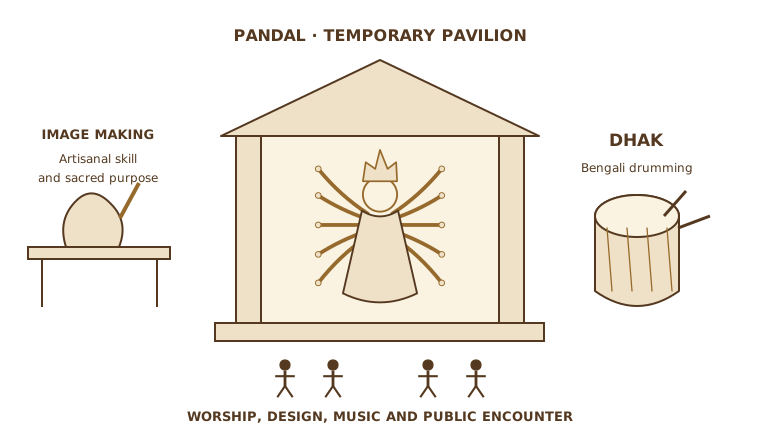
Original educational diagram, not a photograph. The pavilion and ten-armed figure are original schematic motifs. They omit the full deity ensemble and attributes rather than claim to reproduce a particular sacred image.
Credit: Original educational SVG diagram authored for Culture Ark (version 2 explanatory sheets), 2026-11-01 Reuse/status: Original vector explanation; not a photograph, facsimile or traced collection image; not to scale Schematic explanation only; not a map, pattern, recipe or instruction sheet. Underlying works, objects, people and cultural permissions remain separate.
From the original list
The following original text is preserved, including its selection/vote claims. Preservation is not independent verification of every assertion.
Why: Kolkata builds giant art installations for a goddess, then sinks the idols in the river.
What to preserve: pandal art, idol immersion, dhak drums, UNESCO listing 2021
Year and origin: medieval · India
Vote: 4/9 (historian 1 · future kid 1 · curator 2)
Learn more: Durga Puja on Wikipedia
Explanatory sheets
2 original explanatory sheets prepared for this pick, each with its own diagram. Codes in square brackets such as [H1] point to the numbered sources at the end of the page.
A temporary pavilion becomes a shared cultural space
Durga Puja joins worship with image making, design, music and gathering
The goddess gives the celebration its center. Durga is worshipped as a Hindu mother-goddess. The narrative of her overcoming the buffalo demon Mahisha is a major theme in her imagery; multiple arms express divine attributes and powers. Here the figure identifies the religious center without illustrating combat or treating the myth as a dated historical event. [H1, H3]
Many kinds of skill create the public occasion. UNESCO highlights Kolkata’s large installations, pavilions and collaborative artists. Clay image makers, designers, organizers and performers contribute different knowledge. The Ministry of Culture also identifies dhak drumming among the festival’s living arts. The pandal is therefore more than a decorative shell: it is a setting where worship and public encounter meet. [H1, H2]
Visual scope: This is a cultural relationship drawing, not an architectural plan, drum-making guide or complete iconographic specification.
The images are temporary; the knowledge continues
A seasonal return connects artistic labor, worship and farewell
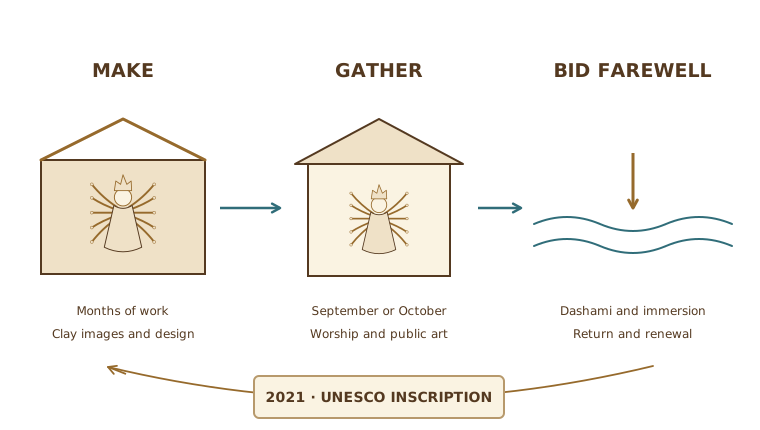
Water symbolizes the concluding immersion tradition without depicting handling or release instructions. The 2021 marker refers to heritage recognition, not the age of the festival.
The annual occasion has a life before and after its peak. Workshops prepare clay images well before the September–October festival season. Worship and public viewing culminate in farewell and immersion traditions, associated with return and homecoming. The images’ temporary life contrasts with the continuity of the skills and relationships that bring the next celebration into being. Bijaya Dashami is associated with the concluding immersion. [H1, H5]
Recognition concerns a living practice. Durga Puja in Kolkata was inscribed on UNESCO’s Representative List of the Intangible Cultural Heritage of Humanity in 2021. India’s Ministry of Culture emphasizes transmitted knowledge, skills, rituals, music and social participation, not simply the preservation of a permanent artwork. The listing names Kolkata; related celebrations also exist elsewhere and in the Bengali diaspora. [H1, H4]
Context note: Local ritual calendars and immersion arrangements vary. This sheet explains cultural meaning, not an event schedule or water-disposal procedure.
Where to learn more
- https://apiarybee.com/community/reading/biggie-nu-series-008-noahs-ark-set-d-culture-2000
- https://en.wikipedia.org/wiki/Durga_Puja
Sources and rights
- H1 · UNESCO: Durga Puja in Kolkata — September–October worship, clay image workshops, pavilions, communal art and immersion; 2021 inscription. Public search extract consulted after direct page presented a challenge; no challenge bypass attempted.
- H2 · India Ministry of Culture: living arts of Durga Puja — 2021 inscription commemorated in 2022; Dhak performance and craft, dance, ritual and community participation.
- H3 · University of Missouri museum: Durga iconography — Hindu narrative of Durga and Mahisha; multi-armed goddess and divine attributes. No source sculpture or photograph copied.
- H4 · India Ministry of Culture: 2021 inscription — Inscription on December 15, 2021; intangible heritage as transmitted knowledge, skills and practices rather than only objects.
- H5 · Kolkata Port / PIB: Dashami context — Bijaya Dashami and concluding immersion context. No operational handling or disposal details reused.
Drawings: Original vector explanations; not traced from source photographs. Sources consulted 2026-11-01. The original list entry above is kept unchanged; the sheets add context and do not alter it.
Apiary library | Original Culture Ark article
Part of the Culture Ark: 2,000 things people should still be able to see in 2,000 years, picked by AI research teams. This page keeps the original list entry for D-1700 word for word and adds context. Browse the gallery. The Culture Ark is an Artificial Mind Hive (AMH) project. AMH is owned by Austin Little.

Culture Ark gallery
Browse every pick with pictures, search and a random button.
Open the gallery →