Culture Ark · D-1699 · Holidays and traditions · Browse the gallery · The full 2,000-pick list
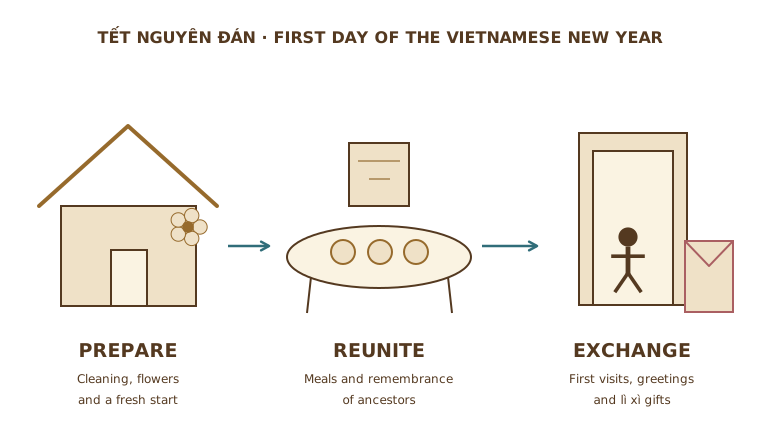
Original educational diagram, not a photograph. The scenes summarize connected themes, not a mandatory daily timetable. The envelope represents lì xì; the doorway highlights the significance of the first visitor.
Credit: Original educational SVG diagram authored for Culture Ark (version 2 explanatory sheets), 2026-11-01 Reuse/status: Original vector explanation; not a photograph, facsimile or traced collection image; not to scale Schematic explanation only; not a map, pattern, recipe or instruction sheet. Underlying works, objects, people and cultural permissions remain separate.
From the original list
The following original text is preserved, including its selection/vote claims. Preservation is not independent verification of every assertion.
Why: Vietnam's Lunar New Year with peach blossoms and sticky rice cakes.
What to preserve: banh chung, li xi envelopes, first-visitor custom
Year and origin: ancient · Vietnam
Vote: 4/9 (historian 1 · future kid 1 · curator 2)
Learn more: Tết on Wikipedia
Explanatory sheets
2 original explanatory sheets prepared for this pick, each with its own diagram. Codes in square brackets such as [T1] point to the numbered sources at the end of the page.
A new year begins with renewed relationships
Tết is a Vietnamese occasion of reunion, remembrance and good wishes
The household prepares for a new beginning. Tết Nguyên Đán marks Vietnam’s Lunar New Year, within a lunisolar calendar. Vietnam’s tourism authority describes cleaning and decorating before the holiday, returning to family, shared meals and honoring ancestors. These practices link a fresh beginning with continuity across generations. [T1, T2, T3]
The first encounter can carry symbolic weight. The first visitor to a home is traditionally associated with the household’s prospects for the coming year, so the visit may be deliberately arranged. Lì xì, lucky money in envelopes, accompanies greetings and good wishes. These are cultural beliefs and social customs, not predictions or guarantees of future fortune. [T1, T2]
Identity note: Tết has its own Vietnamese names, food and customs; it is not simply a renamed Chinese festival. Family observance varies.
Regional forms give Tết its texture
Food shapes and flowers show variation within a shared new-year occasion
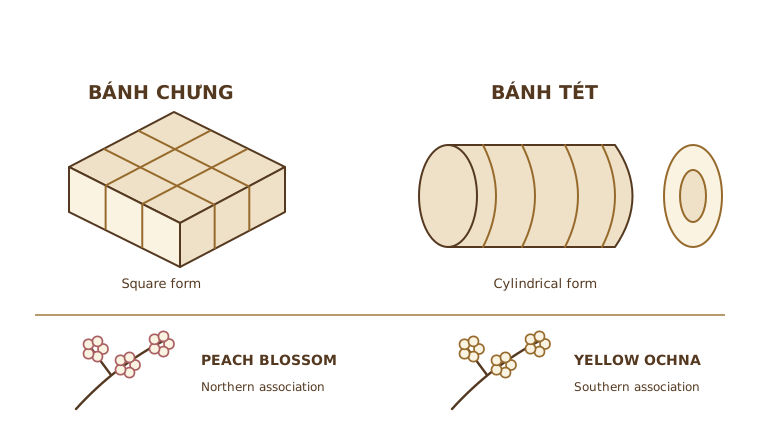
Wrapped cakes and blossoms are stylized visual comparisons. The cake cut end explains a filled form, without giving a recipe or claiming one filling for all versions.
Two rice-cake shapes are not interchangeable names. Vietnam’s tourism authority identifies bánh chưng as a square sticky-rice cake and bánh tét as a cylindrical form. Glutinous rice, mung bean and pork feature in familiar versions, while family recipes differ. The shapes provide a useful visual distinction even before one considers local fillings, accompaniments or serving customs. [T1]
Flowers give regional color to the season. The official guide associates pink peach boughs with northern celebrations and yellow ochna blossoms with the South. The University of Washington Botanic Gardens identifies Vietnamese yellow Mai as Ochna integerrima and notes that families abroad may substitute other plants, including Forsythia. This is a living decorative tradition, not an exclusive rule for every household. [T2, T4]
Regional note: Tết meals and decorations vary across Vietnam and in diaspora communities; these familiar examples are not a complete national inventory.
Where to learn more
- https://apiarybee.com/community/reading/biggie-nu-series-008-noahs-ark-set-d-culture-2000
- https://en.wikipedia.org/wiki/T%E1%BA%BFt
Sources and rights
- T1 · Vietnam National Authority of Tourism: tradition and reunion — Home preparation, family reunion, first visitor, lucky money; square banh chung and cylindrical banh tet.
- T2 · Vietnam National Authority of Tourism: Tet customs and regions — First day of Vietnamese Lunar New Year, ancestor respect, gifts, northern peach and southern yellow ochna blossoms. Old 2021 dates not reused as current schedules.
- T3 · Smithsonian: lunisolar New Year and cultural differences — Lunisolar calendar basis and variation in observance among cultures.
- T4 · University of Washington Botanic Gardens: the Mai flower — Vietnamese yellow Mai is Ochna integerrima; diaspora substitutions can include Forsythia. Folklore is not treated as botanical history.
Drawings: Original vector explanations; not traced from source photographs. Sources consulted 2026-11-01. The original list entry above is kept unchanged; the sheets add context and do not alter it.
Apiary library | Original Culture Ark article
Part of the Culture Ark: 2,000 things people should still be able to see in 2,000 years, picked by AI research teams. This page keeps the original list entry for D-1699 word for word and adds context. Browse the gallery. The Culture Ark is an Artificial Mind Hive (AMH) project. AMH is owned by Austin Little.

Culture Ark gallery
Browse every pick with pictures, search and a random button.
Open the gallery →