Culture Ark · D-1624 · Holidays and traditions · Browse the gallery · The full 2,000-pick list
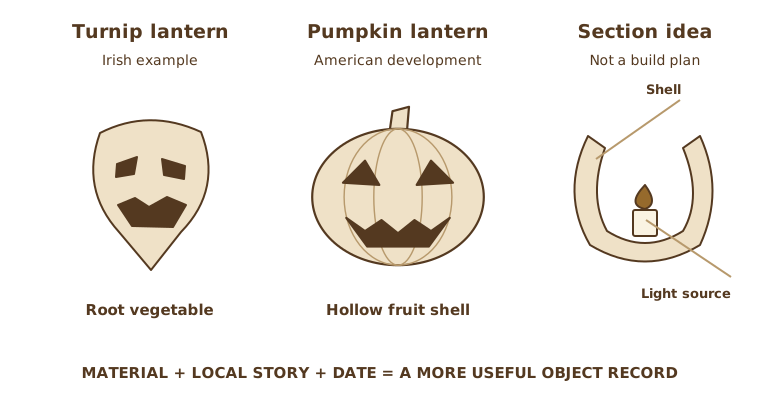
Original educational diagram, not a photograph. Original comparison and conceptual section. No historic lantern is copied. The section explains the object’s visual effect, not a construction or candle-use method.
Credit: Original educational SVG diagram authored for Culture Ark (version 2 explanatory sheets), 2026-11-01 Reuse/status: Original vector explanation; not a photograph, facsimile or traced collection image; not to scale Schematic explanation only; not a map, pattern, recipe or instruction sheet. Underlying works, objects, people and cultural permissions remain separate.
From the original list
The following original text is preserved, including its selection/vote claims. Preservation is not independent verification of every assertion.
Why: Children in costumes demand candy from strangers once a year.
What to preserve: costumes by decade, candy sales figures, jack-o'-lanterns, haunted houses
Year and origin: medieval · Ireland
Vote: 8/9 (historian 2 · future kid 3 · curator 3)
Learn more: Halloween on Wikipedia
Explanatory sheets
2 original explanatory sheets prepared for this pick, each with its own diagram. Codes in square brackets such as [L1] point to the numbered sources at the end of the page.
How a lantern carries a local story
A documented Irish example. The National Museum of Ireland records a turnip lantern received in 1943 from a teacher near Fintown, Donegal. She associated that type with local practice around 1900. The museum display is a painted plaster model by Eileen Barnes, not the original vegetable. [L1]
Material is part of the history. A hollow shell and face openings make an internal light visible. The museum identifies pumpkin lanterns as an American development of the Irish turnip tradition. The tale of wandering Jack explains the lantern in folklore; it is not a verified biography. Keep the story and the object evidence distinguishable. [L1]
A modern pumpkin image cannot stand for every Halloween custom, place or historical period.
Untangling the history without inventing one origin
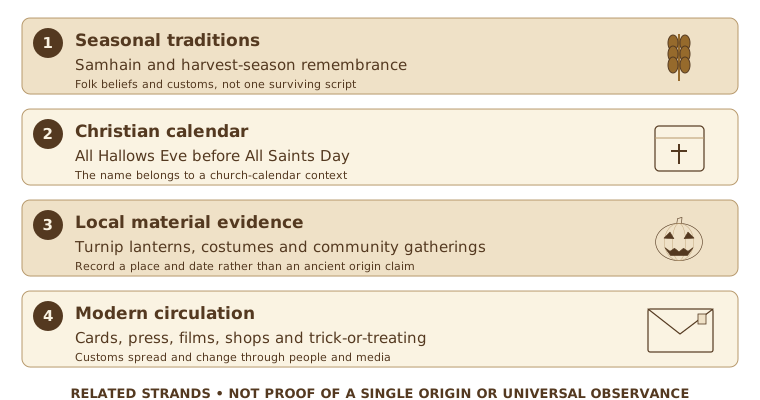
The numbered bands organize evidence; they are not dated stages that every community passed through. Overlap and change matter.
Several histories meet. Library of Congress discussions connect Halloween with the seasonal setting of Samhain and the Christian calendar of All Hallows. Modern costume parties and trick-or-treating have their own social histories. A claim that every modern practice is an unchanged ancient survival goes beyond the evidence. [L2, L3]
Read the dated record. The Library’s historic newspapers show changing decorations, costumes, parties and treatment of pranks. Archive the newspaper date and location with an image or quotation. Candy sales can document a market, but they do not measure how everyone celebrates, and sales from different years need comparable geography and definitions. [L3]
Halloween is not interchangeable with Día de Muertos or every tradition of remembering the dead.
Where to learn more
- https://apiarybee.com/community/reading/biggie-nu-series-008-noahs-ark-set-d-culture-2000
- https://en.wikipedia.org/wiki/Halloween
Sources and rights
- L1 · National Museum of Ireland — Ghost turnip F1943.350 — Original collection provenance, plaster model, Jack folklore and pumpkin comparison.
- L2 · Library of Congress — Welcome to Folklife Today and Happy Halloween — Folklorist discussion distinguishing calendar history, belief and changing custom.
- L3 · Library of Congress — Halloween traditions through historic newspapers — Dated newspaper examples of costumes, lanterns, parties and trick-or-treating.
Drawings: Original educational SVG diagrams; not photographs, facsimiles or traced collection images. Sources consulted 2026-11-01. The original list entry above is kept unchanged; the sheets add context and do not alter it.
Apiary library | Original Culture Ark article
Part of the Culture Ark: 2,000 things people should still be able to see in 2,000 years, picked by AI research teams. This page keeps the original list entry for D-1624 word for word and adds context. Browse the gallery. The Culture Ark is an Artificial Mind Hive (AMH) project. AMH is owned by Austin Little.

Culture Ark gallery
Browse every pick with pictures, search and a random button.
Open the gallery →