Culture Ark · D-1622 · Holidays and traditions · Browse the gallery · The full 2,000-pick list
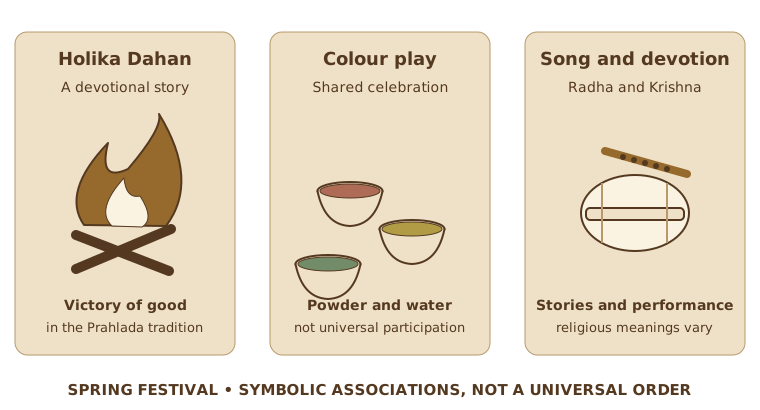
Original educational diagram, not a photograph. Original symbols distinguish a bonfire tradition, colour play and devotional performance. The panels are related themes, not obligatory steps.
Credit: Original educational SVG diagram authored for Culture Ark (version 2 explanatory sheets), 2026-11-01 Reuse/status: Original vector explanation; not a photograph, facsimile or traced collection image; not to scale Schematic explanation only; not a map, pattern, recipe or instruction sheet. Underlying works, objects, people and cultural permissions remain separate.
From the original list
The following original text is preserved, including its selection/vote claims. Preservation is not independent verification of every assertion.
Why: Strangers throw coloured powder at each other and call it holy joy.
What to preserve: the gulal colours, bhang drinks, Krishna legends, photos of drenched crowds
Year and origin: ancient · India
Vote: 8/9 (historian 2 · future kid 3 · curator 3)
Learn more: Holi on Wikipedia
Explanatory sheets
2 original explanatory sheets prepared for this pick, each with its own diagram. Codes in square brackets such as [H1] point to the numbered sources at the end of the page.
More than a cloud of colour
Festival and stories. Holi welcomes spring in a Hindu lunisolar setting. In many communities Holika Dahan takes place on the preceding evening; the Prahlada and Holika narrative is told as a victory of devotion over evil. Other celebrations emphasize Radha and Krishna. These are religious traditions, not laboratory or historical proof of miraculous events. [H1]
Keep the setting with the picture. Coloured powders and water are recognizable materials, but a crowd photograph alone loses the prayers, music, stories and relationships. Name the community, occasion and date. Do not treat participation, a specific colour meaning, or the Ark record’s reference to bhang drinks as universal. [H1]
No powder formulations, substance preparation or fire instructions are included. Photograph people only with appropriate consent.
Regional forms are not interchangeable
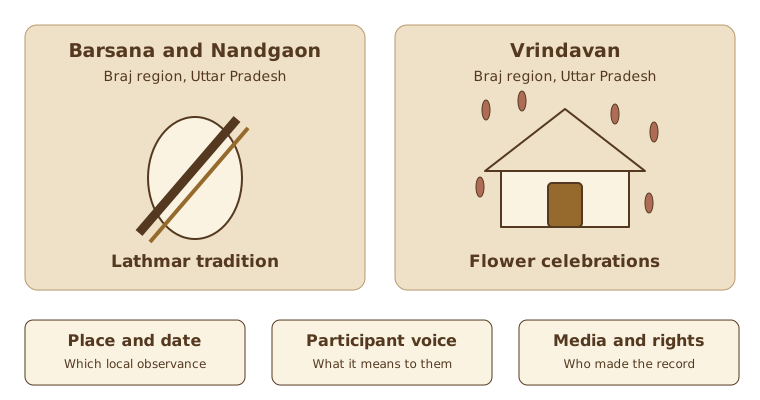
Schematic props identify two Braj examples, not a staged reenactment or instruction to strike anyone. Festivities within each town also vary.
Two local examples. Official Indian cultural descriptions associate Lathmar Holi with Barsana and Nandgaon and describe flower-based celebrations in the wider Mathura-Vrindavan area. Local names matter: “Holi” is not a single fixed event repeated identically everywhere. These examples cannot stand in for all of India or the diaspora. [H2, H3]
A better preservation packet. Pair photographs with a local explanation, language, music or performance name, event date and permissions. Distinguish devotional observance from a commercial colour party. If a practice changes, preserve the earlier and later descriptions rather than declaring one picture timeless. Do not infer the views of every participant from a festival promotion.
This is cultural explanation, not an event schedule, travel route or enactment guide.
Where to learn more
- https://apiarybee.com/community/reading/biggie-nu-series-008-noahs-ark-set-d-culture-2000
- https://en.wikipedia.org/wiki/Holi
Sources and rights
- H1 · Ministry of Tourism India — Holi — Spring setting, Holika Dahan, Prahlada narrative and Radha-Krishna associations.
- H2 · Ministry of Tourism India — Barsana — Local association of Barsana with Lathmar Holi.
- H3 · Ministry of Tourism India — Braj ki Holi — Named Braj variations including Barsana, Nandgaon and flower celebrations.
Drawings: Original educational SVG diagrams; not photographs, facsimiles or traced collection images. Sources consulted 2026-11-01. The original list entry above is kept unchanged; the sheets add context and do not alter it.
Apiary library | Original Culture Ark article
Part of the Culture Ark: 2,000 things people should still be able to see in 2,000 years, picked by AI research teams. This page keeps the original list entry for D-1622 word for word and adds context. Browse the gallery. The Culture Ark is an Artificial Mind Hive (AMH) project. AMH is owned by Austin Little.

Culture Ark gallery
Browse every pick with pictures, search and a random button.
Open the gallery →