Culture Ark · D-1623 · Holidays and traditions · Browse the gallery · The full 2,000-pick list
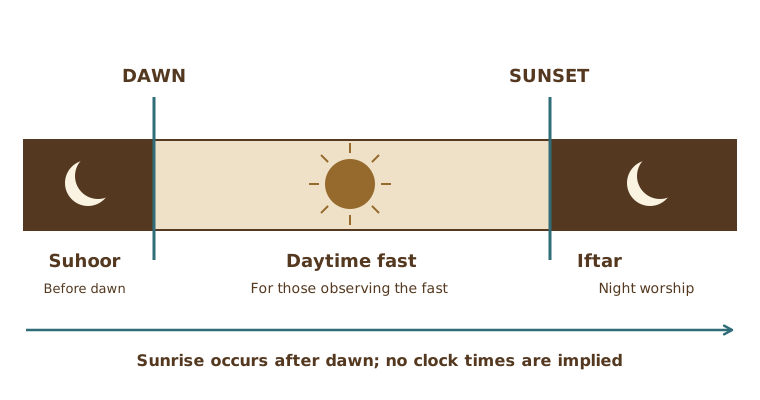
Original educational diagram, not a photograph. This schematic is deliberately not to time scale. It separates dawn from sunrise and labels meals without prescribing a diet or an individual religious ruling.
Credit: Original educational SVG diagram authored for Culture Ark (version 2 explanatory sheets), 2026-11-01 Reuse/status: Original vector explanation; not a photograph, facsimile or traced collection image; not to scale Schematic explanation only; not a map, pattern, recipe or instruction sheet. Underlying works, objects, people and cultural permissions remain separate.
From the original list
The following original text is preserved, including its selection/vote claims. Preservation is not independent verification of every assertion.
Why: Nearly two billion people fast from dawn to dusk for a month each year.
What to preserve: fasting rules, iftar meals, Tarawih prayers, lunar-calendar date shifts through the years
Year and origin: 624 · Arabia
Vote: 8/9 (historian 3 · future kid 2 · curator 3)
Learn more: Ramadan on Wikipedia
Explanatory sheets
2 original explanatory sheets prepared for this pick, each with its own diagram. Codes in square brackets such as [R1] point to the numbered sources at the end of the page.
The rhythm of a Ramadan day
Daily observance. For Muslims observing the fast, Ramadan fasting runs from dawn to sunset. Suhoor is the predawn meal and iftar breaks the fast at sunset. Worship, reflection and generosity belong to the month as well as abstaining from food and drink. Actual daily times vary with place and season. [R1, R2]
A community is not a single routine. Not every Muslim fasts, and religious exemptions and personal circumstances exist. Families and communities differ in meals and evening observances, including additional night prayers such as Tarawih. The source record’s population-wide claim is retained in the archive, but it should not be read as a count of people fasting. [R4]
Educational cultural description only. No medical fasting advice or personal religious guidance is offered.
A moving calendar and a shared table
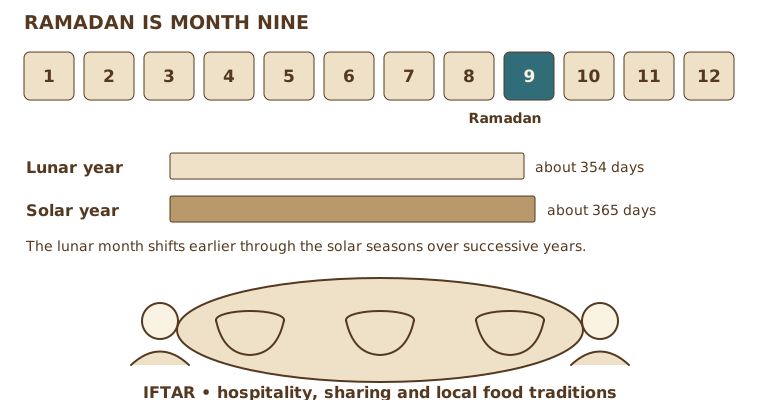
Approximate year lengths explain the seasonal shift; the bars are not a future-date calculator. The table is symbolic and does not represent a prescribed menu.
Why the season changes. Ramadan is the ninth Islamic lunar month. A lunar year is shorter than a solar year, so Ramadan generally arrives about ten or eleven days earlier in successive Gregorian years. Communities can use different methods to determine the month’s beginning; record the local dating source instead of silently merging dates. [R1, R3]
Iftar as living heritage. UNESCO’s 2023 inscription describes iftar traditions nominated by Azerbaijan, Iran, Türkiye and Uzbekistan. It foregrounds sharing, family and social connections. The inscription documents those communities; it neither defines all Muslim practice nor limits iftar to the nominating countries. Preserve recipes, voices and hospitality with their local context. [R2]
Keep a year, place, calendar and source with any Ramadan date or attendance figure.
Where to learn more
- https://apiarybee.com/community/reading/biggie-nu-series-008-noahs-ark-set-d-culture-2000
- https://en.wikipedia.org/wiki/Ramadan
Sources and rights
- R1 · Islamic Relief Worldwide — Iftar — Practitioner account of suhoor, iftar and the shifting lunar year; no dietary guidance reproduced.
- R2 · UNESCO — Iftar nomination decision 2023 — Official inscription decision and the scope of four nominating countries; indexed official text consulted.
- R3 · Department of Statistics Malaysia — Crescent Moon Sighting — Official educational presentation describing the 12-month lunar calendar and 354 or 355-day years.
- R4 · Brandeis University Center for Spiritual Life — Ramadan — University religious-observance guide; fasting exemptions and Tarawih night prayer.
Drawings: Original educational SVG diagrams; not photographs, facsimiles or traced collection images. Sources consulted 2026-11-01. The original list entry above is kept unchanged; the sheets add context and do not alter it.
Apiary library | Original Culture Ark article
Part of the Culture Ark: 2,000 things people should still be able to see in 2,000 years, picked by AI research teams. This page keeps the original list entry for D-1623 word for word and adds context. Browse the gallery. The Culture Ark is an Artificial Mind Hive (AMH) project. AMH is owned by Austin Little.

Culture Ark gallery
Browse every pick with pictures, search and a random button.
Open the gallery →