Culture Ark · D-1698 · Holidays and traditions · Browse the gallery · The full 2,000-pick list
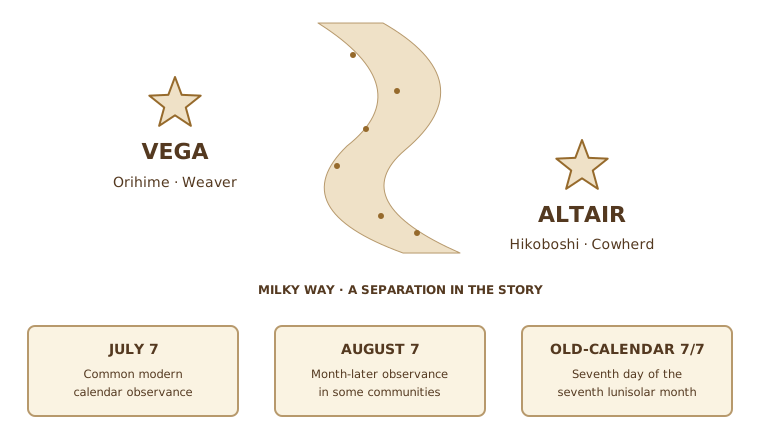
Original educational diagram, not a photograph. The stars and Milky Way are schematic story geography, not measured sky positions. No annual physical meeting of the stars is implied.
Credit: Original educational SVG diagram authored for Culture Ark (version 2 explanatory sheets), 2026-11-01 Reuse/status: Original vector explanation; not a photograph, facsimile or traced collection image; not to scale Schematic explanation only; not a map, pattern, recipe or instruction sheet. Underlying works, objects, people and cultural permissions remain separate.
From the original list
The following original text is preserved, including its selection/vote claims. Preservation is not independent verification of every assertion.
Why: People write wishes on paper strips for two star-crossed star lovers.
What to preserve: tanzaku wishes, bamboo decorations, Vega and Altair legend
Year and origin: 8th century · Japan
Vote: 4/9 (historian 1 · future kid 2 · curator 1)
Learn more: Tanabata on Wikipedia
Explanatory sheets
2 original explanatory sheets prepared for this pick, each with its own diagram. Codes in square brackets such as [J1] point to the numbered sources at the end of the page.
A star story is also a calendar story
Tanabata brings a Chinese-derived legend into distinctive Japanese traditions
The lovers belong to a legend. Tanabata links the Weaver Star, Vega, and the Cowherd Star, Altair, through a story of separation by the Milky Way and a permitted annual reunion. Web Japan describes Japanese versions as blends of a Chinese legend and local beliefs. Variants are part of that folklore, not competing scientific accounts. [J1, J2]
The same seventh-day idea has different civil dates. July 7 is a common modern observance, while some communities celebrate on August 7. The traditional date is day seven of the seventh lunisolar month, which is a different calendar convention. Sendai’s prominent regional festival runs August 6–8; that fixed local program should not be mistaken for a yearly conversion of old-calendar 7/7. [J1, J3, J5]
Calendar note: Always identify the community and calendar before giving a Tanabata date.
Paper makes wishes visible
Small personal messages and large public decorations share a visual language
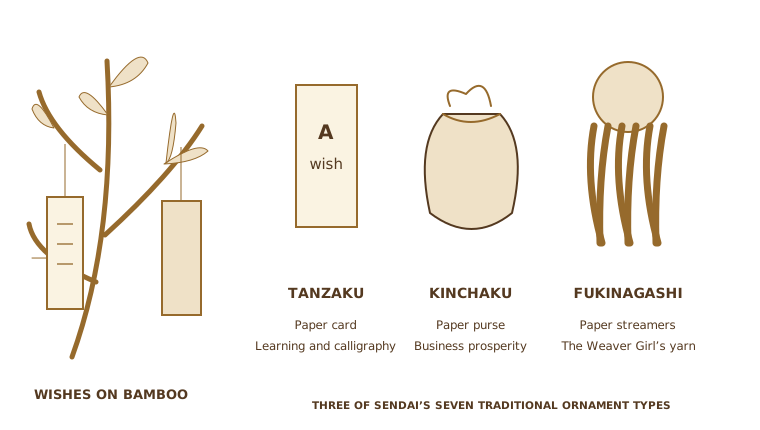
The card’s words are an invented example. The forms are interpretive motifs, not folding templates or copies of festival decorations.
A personal hope becomes part of a display. People write wishes on narrow paper strips and hang them with ornaments on bamboo. Web Japan describes both household and school settings, while city celebrations can fill shopping areas with elaborate decorations. A single handwritten message thus belongs to a wider culture of seasonal display. [J1]
Sendai gives individual ornaments distinct meanings. The Sendai organizer identifies seven traditional types. This close view selects three: tanzaku cards associated with learning and calligraphy, kinchaku purses with business prosperity, and fukinagashi streamers with the Weaver Girl’s yarn. These local meanings add detail beyond the broad idea that every decoration simply represents a wish. [J4]
Regional view: The selected ornament meanings belong to Sendai’s account; other communities may emphasize different forms.
Where to learn more
- https://apiarybee.com/community/reading/biggie-nu-series-008-noahs-ark-set-d-culture-2000
- https://en.wikipedia.org/wiki/Tanabata
Sources and rights
- J1 · Web Japan: Tanabata calendar and customs — July 7 and some August 7 observances; paper wishes, bamboo and local displays.
- J2 · Web Japan: Tanabata as a folk legend — Chinese legend blended with Japanese beliefs; Vega and Altair; regional story variants.
- J3 · Sendai Chamber of Commerce: festival dates — Sendai festival August 6–8; a regional month-later observance and public decorations.
- J4 · Sendai Chamber of Commerce: seven decorations — Tanzaku, kinchaku and fukinagashi meanings; decoration craft and community display. No fabrication instructions reused.
- J5 · National Astronomical Observatory of Japan: calendar terminology — Traditional Tanabata is the seventh day of the seventh lunisolar month; modern calendar distinction.
Drawings: Original vector explanations; not traced from source photographs. Sources consulted 2026-11-01. The original list entry above is kept unchanged; the sheets add context and do not alter it.
Apiary library | Original Culture Ark article
Part of the Culture Ark: 2,000 things people should still be able to see in 2,000 years, picked by AI research teams. This page keeps the original list entry for D-1698 word for word and adds context. Browse the gallery. The Culture Ark is an Artificial Mind Hive (AMH) project. AMH is owned by Austin Little.

Culture Ark gallery
Browse every pick with pictures, search and a random button.
Open the gallery →