Culture Ark · D-1625 · Holidays and traditions · Browse the gallery · The full 2,000-pick list
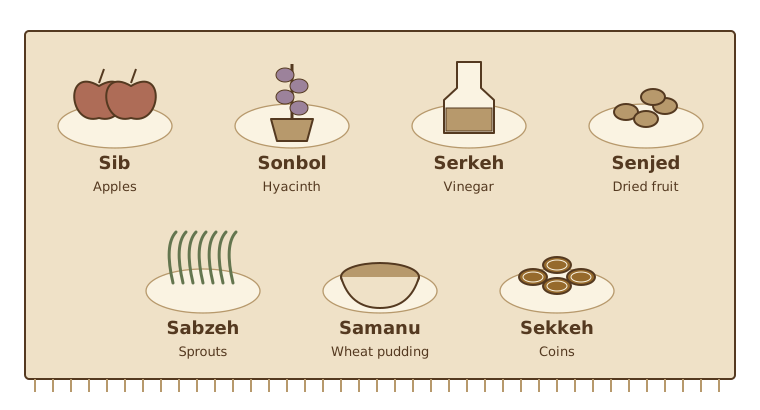
Original educational diagram, not a photograph. This is one Smithsonian-described selection, not a universal seven-item rule. Transliterations vary; the drawing is an original top-down schematic.
Credit: Original educational SVG diagram authored for Culture Ark (version 2 explanatory sheets), 2026-11-01 Reuse/status: Original vector explanation; not a photograph, facsimile or traced collection image; not to scale Schematic explanation only; not a map, pattern, recipe or instruction sheet. Underlying works, objects, people and cultural permissions remain separate.
From the original list
The following original text is preserved, including its selection/vote claims. Preservation is not independent verification of every assertion.
Why: A 3,000-year-old spring New Year shared by 300 million people across many countries.
What to preserve: haft-sin table, spring cleaning, fire jumping
Year and origin: ancient · Persia
Vote: 8/9 (historian 3 · future kid 2 · curator 3)
Learn more: Nowruz on Wikipedia
Explanatory sheets
2 original explanatory sheets prepared for this pick, each with its own diagram. Codes in square brackets such as [N1] point to the numbered sources at the end of the page.
Reading an Iranian Haftseen table
Seven names with an initial S. In the Iranian Haftseen tradition, a festive arrangement includes at least seven items whose Persian names begin with the sound seen. Here apples, hyacinth, vinegar, senjed fruit, sprouts, wheat sprout pudding and coins illustrate one documented selection. Other families and descriptions use different items. [N1]
Symbols are interpreted. Growth, renewal, sweetness and prosperity are among the meanings associated with the display. These are cultural associations, not physical effects of the objects. A mirror, book, decorated eggs or other additions may accompany the arrangement without being part of this particular seven-item set. Ask a household how it explains its own table. [N1]
This Iranian table should not be presented as the one way all Nowruz communities celebrate.
A shared new year with local forms
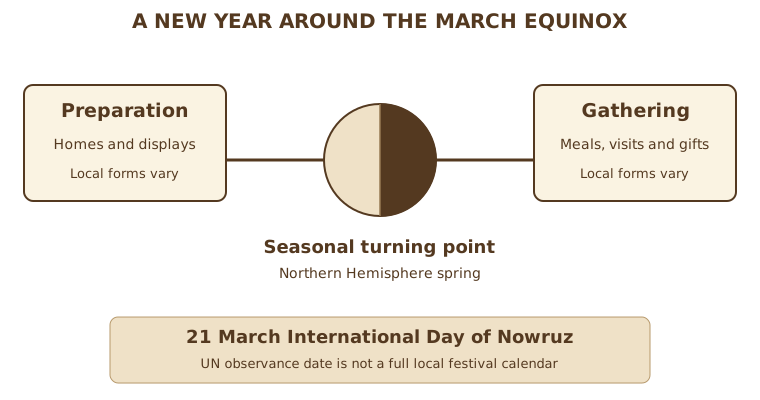
The half-light symbol represents a seasonal threshold, not an astronomical Earth model or a claim that day and night are exactly equal everywhere.
A seasonal connection. Nowruz means “new day” in Persian and is associated with the March equinox and the start of Northern Hemisphere spring. Celebrations extend across many regions, with distinct languages, foods and local histories. The United Nations recognizes 21 March as the International Day of Nowruz. [N1, N2, N3]
Record a celebration rather than a stereotype. Preparation, visits, shared meals and gift-giving appear in official descriptions, but dates and activities vary. Preserve the local name, community, year, calendar and participant interpretation. The source record mentions fire jumping; that does not make it a compulsory practice or a safe activity to recreate from a picture. [N2]
No fire activity instructions or event itinerary are supplied. Calendar and community are separate kinds of evidence.
Where to learn more
- https://apiarybee.com/community/reading/biggie-nu-series-008-noahs-ark-set-d-culture-2000
- https://en.wikipedia.org/wiki/Nowruz
Sources and rights
- N1 · Smithsonian National Museum of Asian Art — Nowruz Family Day — Iranian Haftseen example, object names and interpreted meanings; regional variation.
- N2 · United Nations — International Nowruz Day — Spring and equinox association, transregional celebration and preparations; indexed official text consulted.
- N3 · United Nations in Indonesia — International Nowruz Day 21 March — Official explanation of the General Assembly recognition of 21 March.
Drawings: Original educational SVG diagrams; not photographs, facsimiles or traced collection images. Sources consulted 2026-11-01. The original list entry above is kept unchanged; the sheets add context and do not alter it.
Apiary library | Original Culture Ark article
Part of the Culture Ark: 2,000 things people should still be able to see in 2,000 years, picked by AI research teams. This page keeps the original list entry for D-1625 word for word and adds context. Browse the gallery. The Culture Ark is an Artificial Mind Hive (AMH) project. AMH is owned by Austin Little.

Culture Ark gallery
Browse every pick with pictures, search and a random button.
Open the gallery →