Culture Ark · D-1621 · Holidays and traditions · Browse the gallery · The full 2,000-pick list
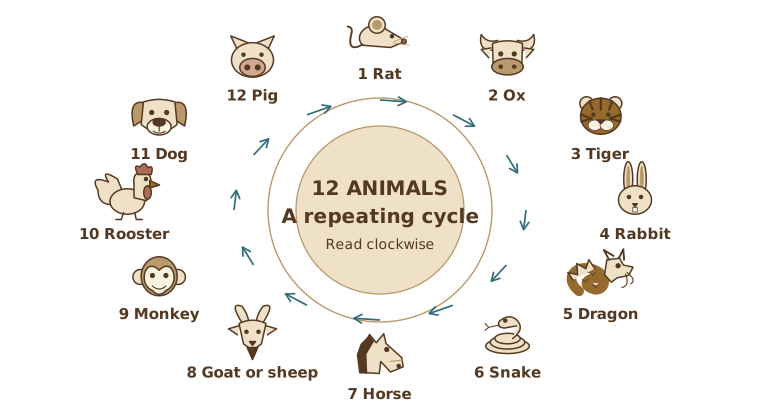
Original educational diagram, not a photograph. Original symbolic animal ring. Read clockwise from Rat. This is a calendar cycle, not a map of constellations or a personality test.
Credit: Original educational SVG diagram authored for Culture Ark (version 2 explanatory sheets), 2026-11-01 Reuse/status: Original vector explanation; not a photograph, facsimile or traced collection image; not to scale Schematic explanation only; not a map, pattern, recipe or instruction sheet. Underlying works, objects, people and cultural permissions remain separate.
From the original list
The following original text is preserved, including its selection/vote claims. Preservation is not independent verification of every assertion.
Why: Every year belongs to one of 12 animals.
What to preserve: animals, 60-year cycle
Year and origin: ancient · China
Vote: 9/9 (historian 3 · future kid 3 · curator 3)
Learn more: Chinese zodiac on Wikipedia
Explanatory sheets
2 original explanatory sheets prepared for this pick, each with its own diagram. Codes in square brackets such as [Z1] point to the numbered sources at the end of the page.
Reading the twelve animal cycle
A named sequence. The twelve animals label recurring positions in Chinese calendrical tradition. The Met dates its set of zodiac figures to the eighth century and notes that the conventional animal order was already established in the Eastern Han period. English labels for the eighth animal include ram, sheep and goat. [Z1]
Objects carry calendar ideas. The Met figures were tomb offerings in official robes. That use is one historical setting, not the purpose of every zodiac image. Preserve the object date, place, material and use alongside its animal name. Birth-year labels also require the calendar convention, not simply a January-to-December year. [Z1, Z2]
Traditional personality and fortune interpretations are beliefs, not scientifically established predictions.
Why twelve animals fit a sixty year cycle
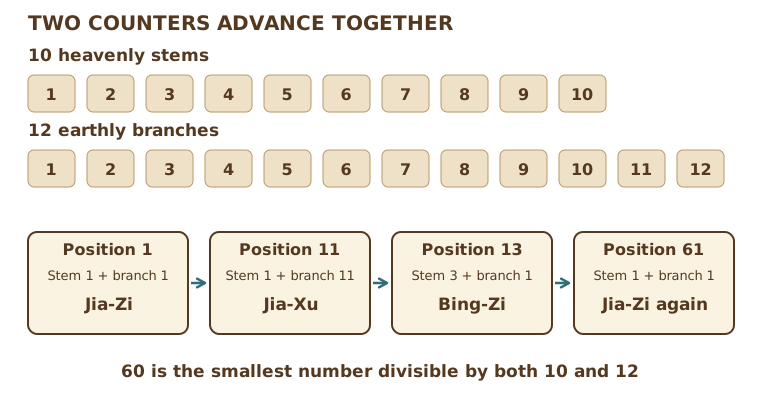
The counters are abstract teaching devices. Position numbers are not calendar dates; both sequences restart independently.
The pairing rule. Gan-Zhi joins ten heavenly stems with twelve earthly branches. Starting with Jia-Zi, both lists move one position at a time. After ten advances only the stem has returned; after twelve only the branch has. Both first return together after sixty. This follows the Hong Kong Observatory sequence. [Z2]
Do not multiply all possible pairs. The running cycle uses 60 pairs, not every one of the 120 mathematically possible combinations. The animal alone records less information than the full stem-branch name. Keep an original inscription, its transcription, and its dating interpretation separate in an archive. [Z2]
Preserve the calendar system and boundary convention whenever converting a historical year.
Where to learn more
- https://apiarybee.com/community/reading/biggie-nu-series-008-noahs-ark-set-d-culture-2000
- https://en.wikipedia.org/wiki/Chinese_zodiac
Sources and rights
- Z1 · The Metropolitan Museum of Art — Set of twelve zodiac animals — Collection record for the eighth-century figures, animal order and historical use.
- Z2 · Hong Kong Observatory — Heavenly Stems and Earthly Branches — The 10 stems, 12 branches and full 60-position Gan-Zhi table.
Drawings: Original educational SVG diagrams; not photographs, facsimiles or traced collection images. Sources consulted 2026-11-01. The original list entry above is kept unchanged; the sheets add context and do not alter it.
Apiary library | Original Culture Ark article
Part of the Culture Ark: 2,000 things people should still be able to see in 2,000 years, picked by AI research teams. This page keeps the original list entry for D-1621 word for word and adds context. Browse the gallery. The Culture Ark is an Artificial Mind Hive (AMH) project. AMH is owned by Austin Little.

Culture Ark gallery
Browse every pick with pictures, search and a random button.
Open the gallery →