Culture Ark · D-1697 · Holidays and traditions · Browse the gallery · The full 2,000-pick list
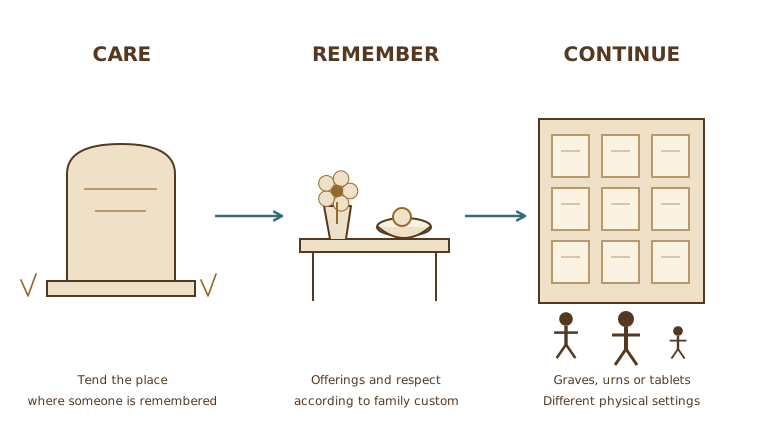
Original educational diagram, not a photograph. Anonymous grave and urn niches avoid inventing real names or epitaphs. Arrows connect themes; they do not prescribe a ritual order.
Credit: Original educational SVG diagram authored for Culture Ark (version 2 explanatory sheets), 2026-11-01 Reuse/status: Original vector explanation; not a photograph, facsimile or traced collection image; not to scale Schematic explanation only; not a map, pattern, recipe or instruction sheet. Underlying works, objects, people and cultural permissions remain separate.
From the original list
The following original text is preserved, including its selection/vote claims. Preservation is not independent verification of every assertion.
Why: Tomb-Sweeping Day: families clean ancestors' graves and burn paper offerings.
What to preserve: grave cleaning, joss paper, kite flying
Year and origin: ancient · China
Vote: 4/9 (historian 1 · future kid 1 · curator 2)
Learn more: Qingming Festival on Wikipedia
Explanatory sheets
2 original explanatory sheets prepared for this pick, each with its own diagram. Codes in square brackets such as [Q1] point to the numbered sources at the end of the page.
Remembrance begins with care
Qingming connects ancestors, living relatives and places of memory
A visit is also an act of upkeep. Singapore’s National Heritage Board describes cleaning and maintaining ancestors’ graves or urn places, paying respects and gathering as families. Food, tea and flowers may be brought according to local and dialect-group traditions. The work of tending a place makes remembrance tangible and can pass knowledge between generations. [Q1]
The setting changes without erasing the purpose. In Singapore, columbaria and temples holding ancestral tablets have become important alongside cemeteries. Caretakers and clan associations also preserve knowledge and help families maintain connections. This local account shows a living practice adapting to changing burial patterns, rather than one timeless ritual performed identically everywhere. [Q1]
Variation note: Paper offerings occur in some traditions; they are not universal. This sheet describes remembrance without burning instructions.
Why Qingming stays near early April
Its calendar anchor is the Sun’s seasonal position, not a fixed lunar day
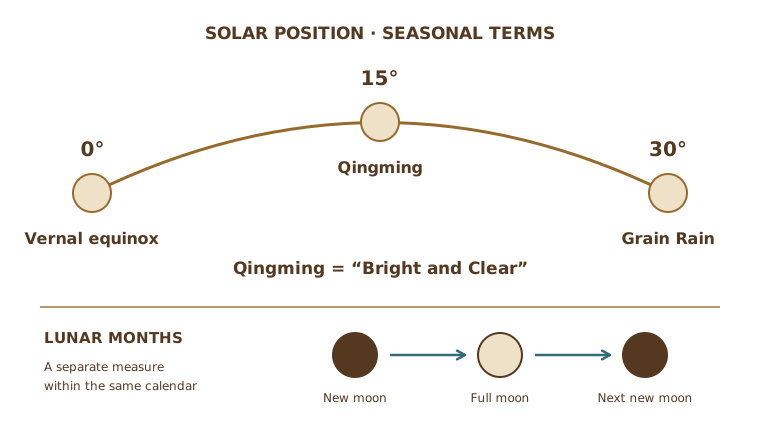
The short arc enlarges three successive solar terms. Lunar phases below are a separate calendar concept; the illustration does not align them to a particular year.
A named point on the seasonal cycle. The Hong Kong Observatory divides the ecliptic into twenty-four solar terms, spaced by fifteen degrees of the Sun’s apparent longitude. Qingming, translated as Bright and Clear, is at fifteen degrees: after the vernal equinox and before Grain Rain, also translated as Corn Rain. This solar basis explains its recurring spring position. [Q2]
Lunisolar does not mean every festival follows the Moon. The traditional Chinese calendar combines lunar months with solar seasonal markers. Qingming’s solar-term anchor is therefore different from the Lantern Festival’s first-month fifteenth day. Family visits may take place around Qingming rather than only on the exact day, and local remembrance practices need not follow a single timetable. [Q3, Q1]
Reading note: Solar longitude is an astronomical coordinate, not a local compass bearing or a claim about the weather on that day.
Where to learn more
- https://apiarybee.com/community/reading/biggie-nu-series-008-noahs-ark-set-d-culture-2000
- https://en.wikipedia.org/wiki/Qingming_Festival
Sources and rights
- Q1 · Singapore Heritage Board: Qing Ming Festival — Ancestor remembrance, grave and urn care, offerings, family visits and changing Singaporean settings. General lunar-month shorthand is not used as a calendar rule.
- Q2 · Hong Kong Observatory: the 24 solar terms — Solar longitude 0 degrees at vernal equinox, 15 at Qingming/Bright and Clear, 30 at Corn Rain; 24 equal ecliptic intervals.
- Q3 · Hong Kong Observatory: Chinese calendar systems — Lunisolar calendar combines seasonal solar terms with lunar months and phases.
Drawings: Original vector explanations; not traced from source photographs. Sources consulted 2026-11-01. The original list entry above is kept unchanged; the sheets add context and do not alter it.
Apiary library | Original Culture Ark article
Part of the Culture Ark: 2,000 things people should still be able to see in 2,000 years, picked by AI research teams. This page keeps the original list entry for D-1697 word for word and adds context. Browse the gallery. The Culture Ark is an Artificial Mind Hive (AMH) project. AMH is owned by Austin Little.

Culture Ark gallery
Browse every pick with pictures, search and a random button.
Open the gallery →