Culture Ark · D-1696 · Holidays and traditions · Browse the gallery · The full 2,000-pick list
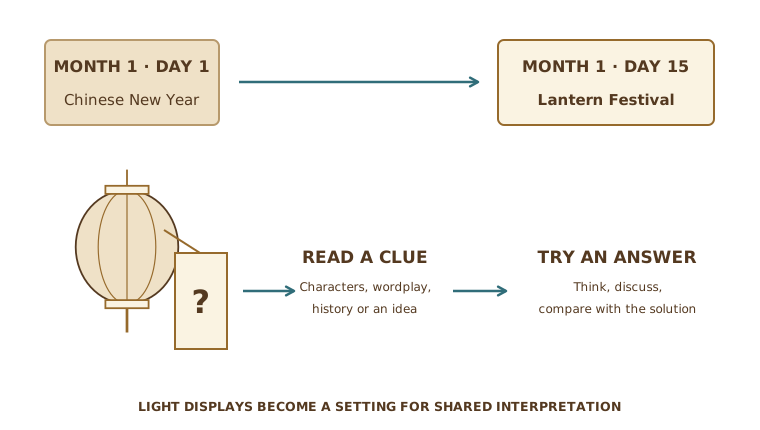
Original educational diagram, not a photograph. The calendar is a Chinese-festival context. The question-mark strip is an original explanatory symbol, not a reproduced riddle.
Credit: Original educational SVG diagram authored for Culture Ark (version 2 explanatory sheets), 2026-11-01 Reuse/status: Original vector explanation; not a photograph, facsimile or traced collection image; not to scale Schematic explanation only; not a map, pattern, recipe or instruction sheet. Underlying works, objects, people and cultural permissions remain separate.
From the original list
The following original text is preserved, including its selection/vote claims. Preservation is not independent verification of every assertion.
Why: The first full moon of the lunar year is lit up with lanterns and riddles.
What to preserve: lantern riddles, tangyuan, displays
Year and origin: ancient · China
Vote: 4/9 (historian 1 · future kid 2 · curator 1)
Learn more: Lantern Festival on Wikipedia
Explanatory sheets
2 original explanatory sheets prepared for this pick, each with its own diagram. Codes in square brackets such as [N1] point to the numbered sources at the end of the page.
Light, language and the first full-moon festival
Yuanxiao marks the fifteenth day of the Chinese New Year cycle
A particular place in the festive calendar. The Lantern Festival falls on the fifteenth day of the first month of the traditional Chinese calendar. It is associated with the first full moon of the new year and the close of the New Year celebration. This is not the autumn festival that also features lanterns in some communities. [N1, N3]
A lantern can invite people to think together. Riddle slips turn a display into a participatory activity. Shanghai’s municipal guide describes puzzles about characters, idioms and historical references. Looking, reading and discussing an answer add a social and literary dimension to the evening rather than making the lights merely a spectacle. [N2]
Calendar note: The Chinese calendar is lunisolar. The traditional fifteenth-day designation is not a guarantee that the astronomical full-moon instant falls on that civil date everywhere.
A shared bowl gives the celebration another scale
Festive food connects public lights with family togetherness
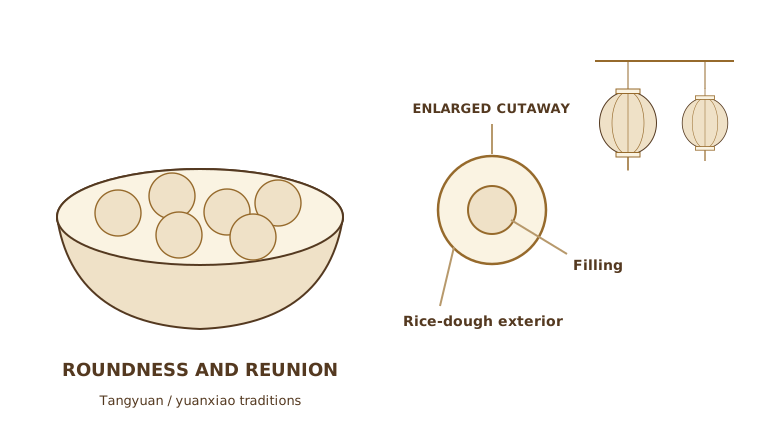
The cutaway explains form and filling only. It is not a recipe; the names and preparation traditions are not assumed to be identical in every region.
Shape carries an association. Glutinous-rice balls are associated with the festival under names including tangyuan and yuanxiao. Shanghai’s guide connects their round form with harmony and family reunion, and notes both sweet and savory fillings. The diagram separates the outer rice-based dough from a possible center without prescribing one local recipe. [N2]
Home and street are complementary settings. The Smithsonian’s Chinese New Year account places rice balls and lantern activity at the close of the celebration. A meal offers an intimate scale of participation while decorative displays make the occasion visible in shared space. The balance of food, riddles and public events varies among households and communities. [N3]
Display note: Lanterns are shown suspended and unlit. No fire, electrical construction or airborne release procedure is included.
Where to learn more
- https://apiarybee.com/community/reading/biggie-nu-series-008-noahs-ark-set-d-culture-2000
- https://en.wikipedia.org/wiki/Lantern_Festival
Sources and rights
- N1 · State Council / Xinhua: Lantern Festival customs — Chinese first-month day 15, hanging lanterns, riddles and wishes.
- N2 · Shanghai municipal guide: Lantern Festival — Round rice dumplings and reunion symbolism; fillings; written riddles; decorative displays. No instructions or photographs reused.
- N3 · Smithsonian National Museum of Asian Art: Lunar New Year — Lantern Festival as day 15 and conclusion of the Chinese New Year celebration; tangyuan and lanterns.
- Q3 · Hong Kong Observatory: Chinese calendar systems — Lunisolar calendar combines seasonal solar terms with lunar months and phases.
Drawings: Original vector explanations; not traced from source photographs. Sources consulted 2026-11-01. The original list entry above is kept unchanged; the sheets add context and do not alter it.
Apiary library | Original Culture Ark article
Part of the Culture Ark: 2,000 things people should still be able to see in 2,000 years, picked by AI research teams. This page keeps the original list entry for D-1696 word for word and adds context. Browse the gallery. The Culture Ark is an Artificial Mind Hive (AMH) project. AMH is owned by Austin Little.

Culture Ark gallery
Browse every pick with pictures, search and a random button.
Open the gallery →