Culture Ark · D-1695 · Holidays and traditions · Browse the gallery · The full 2,000-pick list
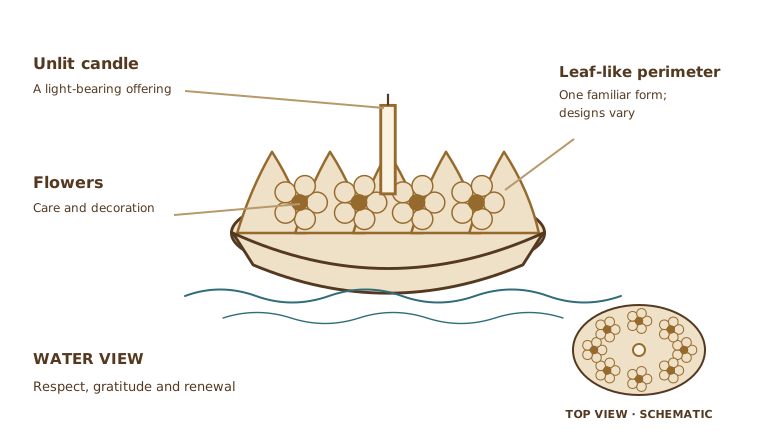
Original educational diagram, not a photograph. Side and top views explain a familiar decorated form. The candle is unlit; no materials list, dimensions or assembly sequence is supplied.
Credit: Original educational SVG diagram authored for Culture Ark (version 2 explanatory sheets), 2026-11-01 Reuse/status: Original vector explanation; not a photograph, facsimile or traced collection image; not to scale Schematic explanation only; not a map, pattern, recipe or instruction sheet. Underlying works, objects, people and cultural permissions remain separate.
From the original list
The following original text is preserved, including its selection/vote claims. Preservation is not independent verification of every assertion.
Why: People float candle-lit baskets on rivers to let go of bad luck.
What to preserve: krathong designs, lanterns at Yi Peng
Year and origin: ancient · Thailand
Vote: 4/9 (historian 1 · future kid 2 · curator 1)
Learn more: Loy Krathong on Wikipedia
Explanatory sheets
2 original explanatory sheets prepared for this pick, each with its own diagram. Codes in square brackets such as [L1] point to the numbered sources at the end of the page.
A small float carries several meanings
The krathong is a visual expression of respect for water
The object and the action are named together. In Thai, loi means to float, while krathong refers to a container or vessel. Decorated water floats often carry flowers and candles. TAT describes gratitude toward the water goddess and the symbolic letting go of bad luck or troubling feelings as meanings associated with the occasion. [L1]
One form can carry different interpretations. TAT also records Buddhist interpretations and the Noppamat story associated with Sukhothai. These are different cultural accounts, not a securely established single invention story. Reading the float as an offering and a symbol of renewal is more useful than assuming every participant explains it in exactly the same way. [L2]
Environment note: Cultural explanation is not a release recommendation. Follow local event and environmental guidance; display-only interpretations avoid adding objects to waterways.
Related celebrations are not interchangeable
Water floats and northern lantern traditions meet in the same festive season
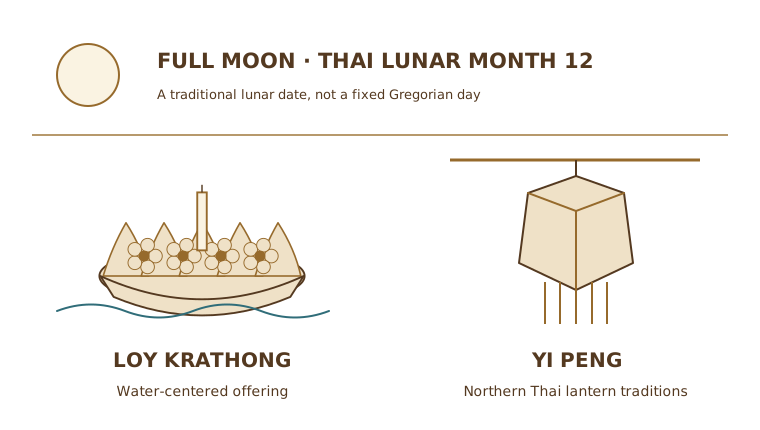
The hanging lantern stands for a lantern tradition without depicting an uncontrolled sky release. The two panels compare cultural forms, not directions for participating.
The moon locates the occasion. Loy Krathong takes place at the full moon of the twelfth month in the Thai lunar calendar. Its civil-calendar date changes from year to year. Northern Thailand also celebrates Yi Peng in conjunction with it; TAT distinguishes that lantern celebration from the water-float practice. [L1]
Origin stories are part of the culture. The Sukhothai court story, gratitude to Phra Mae Khongkha and Buddhist explanations offer different ways of interpreting the festival. TAT presents several such narratives. They should be labeled as traditions and stories rather than combined into a precise, unsupported ancient founding date. [L2]
Scope: This comparison explains related traditions, not a single nationwide event program or a lantern-release guide.
Where to learn more
- https://apiarybee.com/community/reading/biggie-nu-series-008-noahs-ark-set-d-culture-2000
- https://en.wikipedia.org/wiki/Loy_Krathong
Sources and rights
- L1 · Tourism Authority of Thailand: Loi Krathong — Full moon of Thai lunar month 12; water floats, meanings and distinct Yi Peng celebrations in northern Thailand. Historical 2022 event dates are not current schedules.
- L2 · Tourism Authority of Thailand: origin narratives — Water-goddess gratitude, Buddhist interpretations and the Noppamat narrative; origin stories are treated as traditions, not established founding facts.
Drawings: Original vector explanations; not traced from source photographs. Sources consulted 2026-11-01. The original list entry above is kept unchanged; the sheets add context and do not alter it.
Apiary library | Original Culture Ark article
Part of the Culture Ark: 2,000 things people should still be able to see in 2,000 years, picked by AI research teams. This page keeps the original list entry for D-1695 word for word and adds context. Browse the gallery. The Culture Ark is an Artificial Mind Hive (AMH) project. AMH is owned by Austin Little.

Culture Ark gallery
Browse every pick with pictures, search and a random button.
Open the gallery →