Culture Ark · D-1694 · Holidays and traditions · Browse the gallery · The full 2,000-pick list
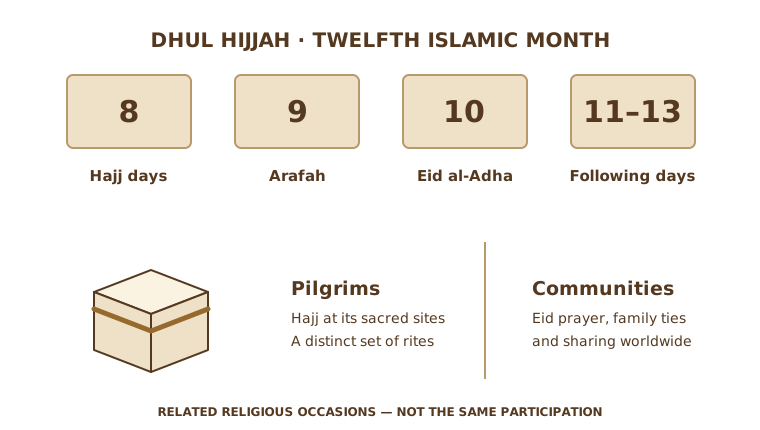
Original educational diagram, not a photograph. The date strip gives calendar context, not a pilgrimage itinerary. The geometric shrine icon is only a location symbol.
Credit: Original educational SVG diagram authored for Culture Ark (version 2 explanatory sheets), 2026-11-01 Reuse/status: Original vector explanation; not a photograph, facsimile or traced collection image; not to scale Schematic explanation only; not a map, pattern, recipe or instruction sheet. Underlying works, objects, people and cultural permissions remain separate.
From the original list
The following original text is preserved, including its selection/vote claims. Preservation is not independent verification of every assertion.
Why: Families worldwide share sacrificial meat with the poor to honour Abraham's story.
What to preserve: the Qurbani ritual, sharing rules, the link to Hajj
Year and origin: 624 · Arabia
Vote: 4/9 (historian 2 · future kid 1 · curator 1)
Learn more: Eid al-Adha on Wikipedia
Explanatory sheets
2 original explanatory sheets prepared for this pick, each with its own diagram. Codes in square brackets such as [D1] point to the numbered sources at the end of the page.
A feast within the pilgrimage season
Eid al-Adha and Hajj are linked without being identical
The tenth day has a particular meaning. Eid al-Adha begins on 10 Dhul Hijjah, within the period of Hajj. Arafah is associated with the preceding day in the pilgrimage calendar. Muslims across the world celebrate Eid even when they are not pilgrims, so the global feast and the rites at the sacred sites should be distinguished. [D1, D4]
Ibrahim’s devotion is remembered. The festival honors Ibrahim’s willingness to obey God in the sacrifice narrative. Qurbani, also called udhiyah, expresses devotion and is associated with sharing food. Prayer, family ties and care for others form part of the occasion’s wider meaning. [D1, D2]
Calendar variant: MUIS notes that local Eid dates can differ from Saudi dates because of lunar-calendar determination. [D3]
Sharing connects the rite to other households
A customary pattern illustrates generosity, not a universal formula
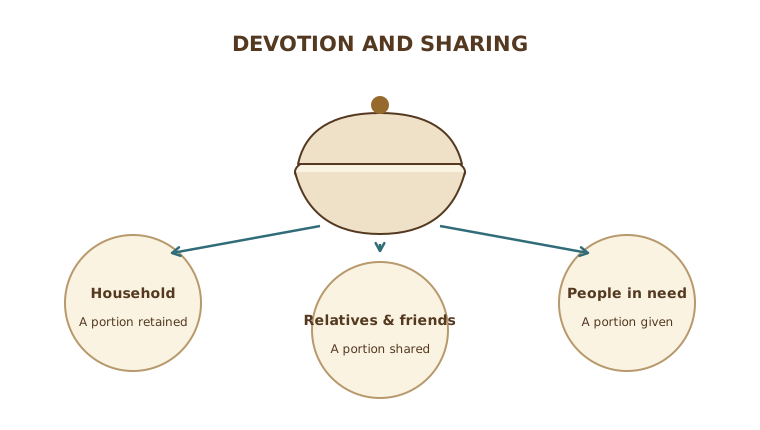
The covered vessel keeps the focus on social distribution. No animal, slaughter scene, equipment or procedure is shown.
How a common pattern is described. Islamic Relief explains a frequently recommended division among one’s household, relatives and friends, and people in need. It also describes charitable arrangements that give the entire distribution to people in need. The diagram therefore shows relationships, not a rule that every observance must use identical thirds. [D2]
Dignity belongs to the practice. The same source emphasizes recipients’ dignity and privacy. Sharing is part of a religious act of devotion rather than a spectacle of poverty. Local religious guidance, welfare arrangements and community circumstances shape how the observance is organized; a cultural explanation need not become a procedural manual. [D1, D2]
Safety scope: Religious meaning and food sharing only; no slaughter methods, graphic imagery or animal-handling instructions.
Where to learn more
- https://apiarybee.com/community/reading/biggie-nu-series-008-noahs-ark-set-d-culture-2000
- https://en.wikipedia.org/wiki/Eid_al-Adha
Sources and rights
- D1 · Islamic Relief: Eid al-Adha — Eid al-Adha, Ibrahim’s devotion, Dhul Hijjah and relation to Hajj; no slaughter procedure reused.
- D2 · Islamic Relief: sharing Qurbani — Common recommended sharing pattern and charitable distribution; dignity and privacy.
- D3 · MUIS: Eid al-Adha and Arafah — Local lunar-calendar dates may differ from those in Saudi Arabia.
- D4 · Islamic Relief: Hajj calendar context — Dhul Hijjah 9 Arafah and 10 Eid al-Adha during pilgrimage days; no procedural pilgrimage guide reused.
Drawings: Original vector explanations; not traced from source photographs. Sources consulted 2026-11-01. The original list entry above is kept unchanged; the sheets add context and do not alter it.
Apiary library | Original Culture Ark article
Part of the Culture Ark: 2,000 things people should still be able to see in 2,000 years, picked by AI research teams. This page keeps the original list entry for D-1694 word for word and adds context. Browse the gallery. The Culture Ark is an Artificial Mind Hive (AMH) project. AMH is owned by Austin Little.

Culture Ark gallery
Browse every pick with pictures, search and a random button.
Open the gallery →