Culture Ark · D-1693 · Holidays and traditions · Browse the gallery · The full 2,000-pick list
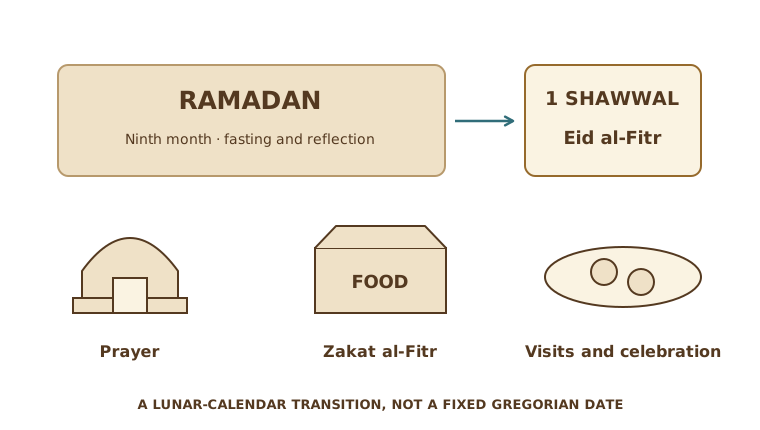
Original educational diagram, not a photograph. The sequence explains the relationship between two months. Icons identify social and religious themes rather than a full order of worship.
Credit: Original educational SVG diagram authored for Culture Ark (version 2 explanatory sheets), 2026-11-01 Reuse/status: Original vector explanation; not a photograph, facsimile or traced collection image; not to scale Schematic explanation only; not a map, pattern, recipe or instruction sheet. Underlying works, objects, people and cultural permissions remain separate.
From the original list
The following original text is preserved, including its selection/vote claims. Preservation is not independent verification of every assertion.
Why: The feast that breaks the Ramadan fast, with new clothes and charity.
What to preserve: Eid prayer, zakat al-fitr, festive foods and greetings
Year and origin: 624 · Arabia
Vote: 4/9 (historian 1 · future kid 1 · curator 2)
Learn more: Eid al-Fitr on Wikipedia
Explanatory sheets
2 original explanatory sheets prepared for this pick, each with its own diagram. Codes in square brackets such as [E1] point to the numbered sources at the end of the page.
From a month of fasting to a day of celebration
Eid al-Fitr begins with Shawwal, not with a new Islamic year
The calendar gives the feast its place. Eid al-Fitr falls on the first day of Shawwal, the month after Ramadan. It celebrates completion of the fasting month with prayer and rejoicing. Because this is a lunar calendar, the occasion moves through the seasons of the Gregorian year rather than returning on one fixed civil date. [E1, E3]
Celebration includes provision for others. Zakat al-Fitr is associated with Ramadan’s close and food provision before the Eid prayer. Islamic Relief explains its role in helping people in need participate in the occasion. It is distinct from simply buying gifts or hosting a festive meal; detailed obligations differ by scholarly tradition. [E2]
Calendar note: Local authorities use moon sighting, astronomical calculation or related criteria; community dates can differ. [E3]
One global occasion, many local expressions
Hari Raya Puasa offers a close view of regional culture
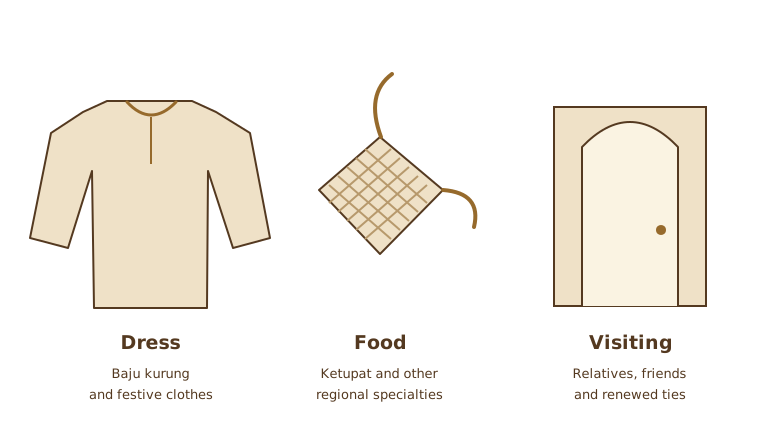
An illustrative tunic, ketupat parcel and doorway. They represent a Malay Singaporean strand, not a universal Eid costume or menu.
A regional name and visual language. Singapore’s National Heritage Board describes Hari Raya Puasa, also called Hari Raya Aidilfitri, as the local celebration of Eid al-Fitr. Visiting relatives, festive clothes and foods such as ketupat, kuih and rendang connect the religious occasion with Malay cultural life. [E1]
Shared faith does not require uniformity. The same calendar event can have different dress, dishes, greetings and visiting patterns across communities. MUIS also explains why valid calendar methods may produce different local dates. Understanding those variations preserves the common meaning of the feast without mistaking one region’s forms for requirements everywhere. [E3]
Identity note: Eid al-Fitr and Eid al-Adha are distinct occasions; the latter belongs to Dhul Hijjah and the Hajj season.
Where to learn more
- https://apiarybee.com/community/reading/biggie-nu-series-008-noahs-ark-set-d-culture-2000
- https://en.wikipedia.org/wiki/Eid_al-Fitr
Sources and rights
- E1 · Singapore Heritage Board: Hari Raya Puasa — Eid al-Fitr on 1 Shawwal after Ramadan; Malay Singaporean dress, visiting and food traditions.
- E2 · Islamic Relief: Zakat al-Fitr — Charitable food provision at Ramadan’s end before Eid prayer; variations in eligibility and practice. No payment instruction.
- E3 · MUIS: determining Shawwal — Moon sighting and astronomical calculation; valid local differences in calendar determination.
Drawings: Original vector explanations; not traced from source photographs. Sources consulted 2026-11-01. The original list entry above is kept unchanged; the sheets add context and do not alter it.
Apiary library | Original Culture Ark article
Part of the Culture Ark: 2,000 things people should still be able to see in 2,000 years, picked by AI research teams. This page keeps the original list entry for D-1693 word for word and adds context. Browse the gallery. The Culture Ark is an Artificial Mind Hive (AMH) project. AMH is owned by Austin Little.

Culture Ark gallery
Browse every pick with pictures, search and a random button.
Open the gallery →