Culture Ark · D-1692 · Holidays and traditions · Browse the gallery · The full 2,000-pick list
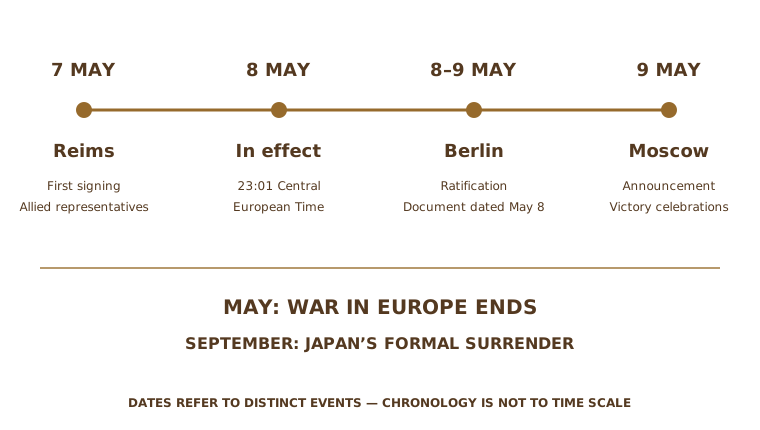
Original educational diagram, not a photograph. The timeline follows Museum Berlin-Karlshorst’s account. It distinguishes the time stated in the surrender terms from the later Berlin ceremony.
Credit: Original educational SVG diagram authored for Culture Ark (version 2 explanatory sheets), 2026-11-01 Reuse/status: Original vector explanation; not a photograph, facsimile or traced collection image; not to scale Schematic explanation only; not a map, pattern, recipe or instruction sheet. Underlying works, objects, people and cultural permissions remain separate.
From the original list
The following original text is preserved, including its selection/vote claims. Preservation is not independent verification of every assertion.
Why: Russia's biggest parade marking victory over Nazi Germany.
What to preserve: Red Square parade, Immortal Regiment
Year and origin: 1945 · Soviet Union
Vote: 4/9 (historian 2 · future kid 0 · curator 2)
Learn more: Victory Day (9 May) on Wikipedia
Explanatory sheets
2 original explanatory sheets prepared for this pick, each with its own diagram. Codes in square brackets such as [V1] point to the numbered sources at the end of the page.
Why 8 May and 9 May both matter
Signing, entry into force and announcement were different moments
A surrender to the Allied coalition. The German surrender was signed at Reims on 7 May 1945 and took effect on 8 May at 23:01 Central European Time. Higher-ranking commanders ratified it in Berlin on the night of 8–9 May; that document carried the date 8 May. Both ceremonies involved the Allied coalition, not separate surrenders to unrelated sides. [V1]
The announcement shaped remembrance. Moscow’s announcement and celebrations occurred on 9 May. This helps explain the Soviet Victory Day date alongside 8 May commemorations elsewhere. The surrender ended the war in Europe, not the entire Second World War, which continued in Asia until Japan’s surrender. [V1]
Historical scope: The sheet explains 1945 events and remembrance; it is not an endorsement of present-day military or political claims.
Victory and loss are remembered together
The public occasion and a family’s memory are related, but not identical
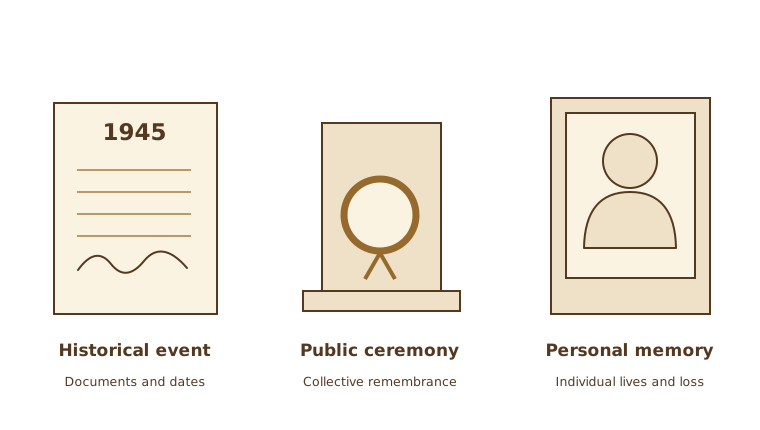
The document, memorial and portrait are fictional symbols. No insignia, parade footage or real person’s portrait is reproduced.
A multinational history. The wartime Soviet population included Russian, Ukrainian, Belarusian, Jewish and many other communities. Museum Karlshorst places their enormous sacrifice within the broader Allied victory over Nazi Germany. Reducing that coalition to a single present-day national identity obscures the historical people involved. [V3]
Commemoration can hold several meanings. The museum’s anniversary program joins liberation from National Socialism with individual remembrance of victims. Public ceremony can express collective history while a family image evokes one person’s experience. This distinction helps read the archive’s parade and portrait-march references without treating every participant’s memory as the same political statement. [V2]
Memory view: The original Red Square and Immortal Regiment preservation labels remain unchanged in the separate archival record.
Where to learn more
- https://apiarybee.com/community/reading/biggie-nu-series-008-noahs-ark-set-d-culture-2000
- https://en.wikipedia.org/wiki/Victory_Day_%289_May%29
Sources and rights
- V1 · Museum Karlshorst: German surrender in May 1945 — Reims May 7; effective ceasefire May 8; Berlin signing May 8–9; Moscow announcement May 9; Allied participation.
- V2 · Museum Karlshorst: 80 years after the European war — Commemoration of liberation from National Socialism and individual remembrance of victims.
- V3 · Museum Karlshorst: peoples of the wartime alliance — Historical recognition of Russian, Ukrainian, Belarusian, Jewish and other Soviet communities alongside British and U.S. allies; contemporary advocacy not reproduced.
Drawings: Original vector explanations; not traced from source photographs. Sources consulted 2026-11-01. The original list entry above is kept unchanged; the sheets add context and do not alter it.
Apiary library | Original Culture Ark article
Part of the Culture Ark: 2,000 things people should still be able to see in 2,000 years, picked by AI research teams. This page keeps the original list entry for D-1692 word for word and adds context. Browse the gallery. The Culture Ark is an Artificial Mind Hive (AMH) project. AMH is owned by Austin Little.

Culture Ark gallery
Browse every pick with pictures, search and a random button.
Open the gallery →