Culture Ark · D-1691 · Holidays and traditions · Browse the gallery · The full 2,000-pick list
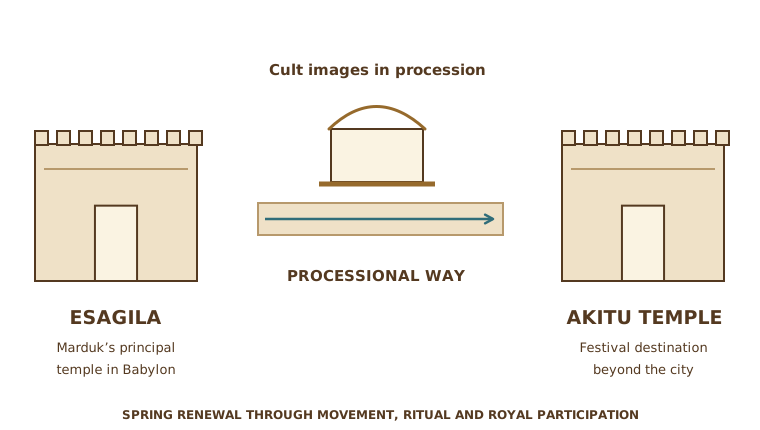
Original educational diagram, not a photograph. The route is schematic. The covered icon represents the presence of a cult image without inventing the appearance of Marduk’s lost statue.
Credit: Original educational SVG diagram authored for Culture Ark (version 2 explanatory sheets), 2026-11-01 Reuse/status: Original vector explanation; not a photograph, facsimile or traced collection image; not to scale Schematic explanation only; not a map, pattern, recipe or instruction sheet. Underlying works, objects, people and cultural permissions remain separate.
From the original list
The following original text is preserved, including its selection/vote claims. Preservation is not independent verification of every assertion.
Why: Babylon's New Year where the king was slapped by a priest.
What to preserve: rituals, Enuma Elish reading
Year and origin: ancient · Mesopotamia
Vote: 4/9 (historian 2 · future kid 0 · curator 2)
Learn more: Akitu on Wikipedia
Explanatory sheets
2 original explanatory sheets prepared for this pick, each with its own diagram. Codes in square brackets such as [A1] point to the numbered sources at the end of the page.
A city becomes a ritual route
The Babylonian New Year connected temple, procession and kingship
Movement made the festival public. The Met describes Marduk’s image and those of visiting gods being carried from Esagila along Babylon’s Processional Way to the Akitu temple. At the festival, the king’s relationship with the god was renewed through ritual. The city’s architecture helped give this sacred movement a visible setting. [A1]
Images were participants, not decoration. Cult statues represented divine presence in Mesopotamian worship. The Met emphasizes their importance while noting that the major images have not survived intact. A drawing can explain their role in the procession, but cannot securely reconstruct the objects themselves. [A3]
Scope: This is the Babylonian spring New Year strand, not a universal calendar or program for every Mesopotamian akitu festival.
Why the king’s humiliation mattered
Ritual submission belonged to a larger account of divine order
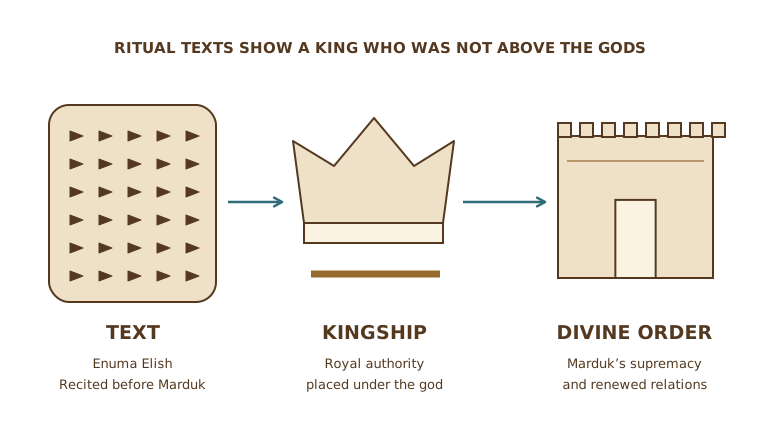
Tablet marks and regalia are invented explanatory motifs. The scene does not reenact physical punishment.
A striking act within a ritual text. ORACC’s scholarly account identifies a Parthian-period text describing Enuma Elish being recited before Marduk during the New Year festival, together with ritual slapping of the king. This specific textual evidence is more informative than treating the slap as an isolated curiosity. [A2]
The creation story had political meaning. Enuma Elish presents Marduk’s supremacy within a divine creation narrative. Read beside the king’s ritual submission, it shows how royal power was situated within a sacred order. The surviving text’s date and setting matter: it is evidence for a tradition, not proof that every earlier celebration followed an identical script. [A2, A4]
Evidence note: Mythic narrative, ritual prescription and archaeological remains are different kinds of evidence. No ancient wording is copied here.
Where to learn more
- https://apiarybee.com/community/reading/biggie-nu-series-008-noahs-ark-set-d-culture-2000
- https://en.wikipedia.org/wiki/Akitu
Sources and rights
- A1 · The Met: Babylon and the New Year procession — Marduk, Esagila, Processional Way and Akitu temple; royal and divine relationship.
- A2 · ORACC: Marduk and ritual texts — Parthian-period ritual text, Enuma Elish recitation and ritual slapping of the king.
- A3 · The Met: vanished cult images — Visiting deities represented by cult images; none of the major images survives intact.
- A4 · The Met: Mesopotamian creation myths — Enuma Elish and the theological elevation of Marduk; myth, not modern historical reportage.
Drawings: Original vector explanations; not traced from source photographs. Sources consulted 2026-11-01. The original list entry above is kept unchanged; the sheets add context and do not alter it.
Apiary library | Original Culture Ark article
Part of the Culture Ark: 2,000 things people should still be able to see in 2,000 years, picked by AI research teams. This page keeps the original list entry for D-1691 word for word and adds context. Browse the gallery. The Culture Ark is an Artificial Mind Hive (AMH) project. AMH is owned by Austin Little.

Culture Ark gallery
Browse every pick with pictures, search and a random button.
Open the gallery →