Culture Ark · D-1660 · Holidays and traditions · Browse the gallery · The full 2,000-pick list
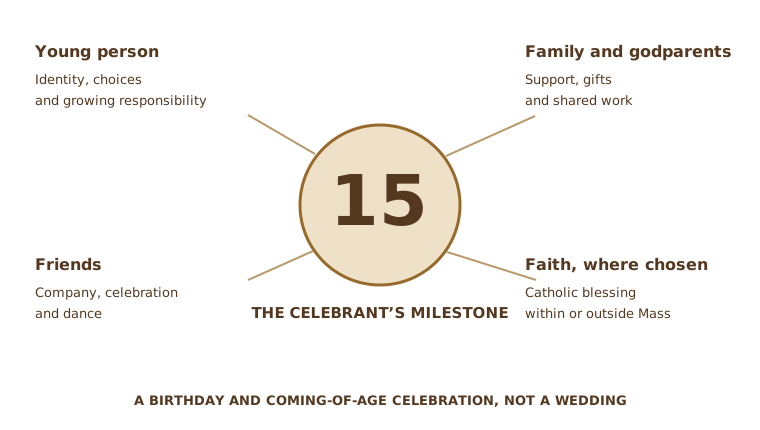
Original educational diagram, not a photograph. A relationship map rather than a mandatory guest list or order of ceremony. Religious and social forms vary.
Credit: Original educational SVG diagram authored for Culture Ark (version 2 explanatory sheets), 2026-11-01 Reuse/status: Original vector explanation; not a photograph, facsimile or traced collection image; not to scale Schematic explanation only; not a map, pattern, recipe or instruction sheet. Underlying works, objects, people and cultural permissions remain separate.
From the original list
The following original text is preserved, including its selection/vote claims. Preservation is not independent verification of every assertion.
Why: A girl's 15th birthday celebrated like a wedding.
What to preserve: dresses, the father-daughter waltz, last doll
Year and origin: colonial era · Latin America
Vote: 5/9 (historian 2 · future kid 1 · curator 2)
Learn more: Quinceañera on Wikipedia
Explanatory sheets
2 original explanatory sheets prepared for this pick, each with its own diagram. Codes in square brackets such as [Q1] point to the numbered sources at the end of the page.
The person at the center of the celebration
A fifteenth birthday joins family support, identity and gratitude
More than a formal party. A quinceañera traditionally marks a young woman’s fifteenth birthday in many Latin American and Latino communities. In the Catholic form described by the USCCB, a blessing expresses gratitude for life and asks for guidance in the years ahead. It may take place within Mass or separately. [Q1]
Family meaning travels. The Smithsonian’s account of Natalia Flores’s Chicago celebration emphasizes spiritual preparation, responsibility and family identity. Her mother wanted her to experience a tradition she herself had not celebrated in Mexico. This example shows cultural continuity being chosen and reshaped through family life and migration. [Q2, Q3]
Context: Formal dress and dancing do not make the occasion a marriage. Participation, expense, religious observance and family roles vary.
A second view reveals different information
Garment form and social movement belong to the same occasion
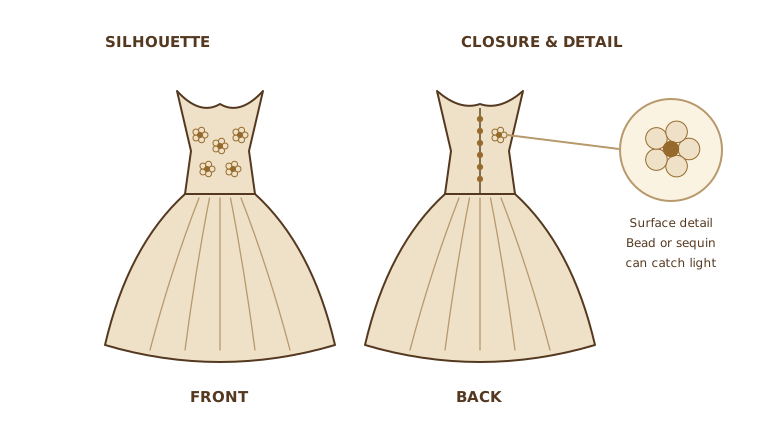
An invented, garment-only study: front embellishment, a back closure and skirt volume. It does not reproduce Natalia Flores’s gown or a sewing pattern.
Clothing carries a personal history. The Smithsonian preserves Flores’s formal gown from her 2006 Chicago quinceañera, alongside accessories and her account of the day. A dress can hold several histories at once: its making, its wearer’s choices, family expectations and a particular celebration. The drawing shows how front and back views reveal different features. [Q2, Q3]
The dance is a social relationship. A 1994 Mexican cultural field record documents a quince años waltz with relatives, friends and godparents in a family home. That example widens the story beyond one father-daughter photograph. Music and partners link the celebrant to a community; their particular roles should be understood locally. [Q4]
Variant note: The archival “last doll” and father-daughter waltz remain in the exact record; neither is treated here as a compulsory custom.
Where to learn more
- https://apiarybee.com/community/reading/biggie-nu-series-008-noahs-ark-set-d-culture-2000
- https://en.wikipedia.org/wiki/Quincea%C3%B1era
Sources and rights
- Q1 · USCCB: fifteenth-birthday blessing — Catholic blessing within or outside Mass, family/godparents, gratitude, 2007 U.S. approval; possible origins explicitly uncertain.
- Q2 · Smithsonian: collecting a quince años — Natalia Flores’s experience and clothing/accessories as family and cultural evidence.
- Q3 · Smithsonian: quinceañera dress record — 2006 Chicago celebration; formal gown, migration and family meaning; no object image copied.
- Q4 · Mexico Culture: a documented quince años waltz — 1994 field record of a waltz with relatives, friends and godparents; no photograph reproduced.
Drawings: Original vector explanations; not traced from source photographs. Sources consulted 2026-11-01. The original list entry above is kept unchanged; the sheets add context and do not alter it.
Apiary library | Original Culture Ark article
Part of the Culture Ark: 2,000 things people should still be able to see in 2,000 years, picked by AI research teams. This page keeps the original list entry for D-1660 word for word and adds context. Browse the gallery. The Culture Ark is an Artificial Mind Hive (AMH) project. AMH is owned by Austin Little.

Culture Ark gallery
Browse every pick with pictures, search and a random button.
Open the gallery →