Culture Ark · D-1690 · Holidays and traditions · Browse the gallery · The full 2,000-pick list
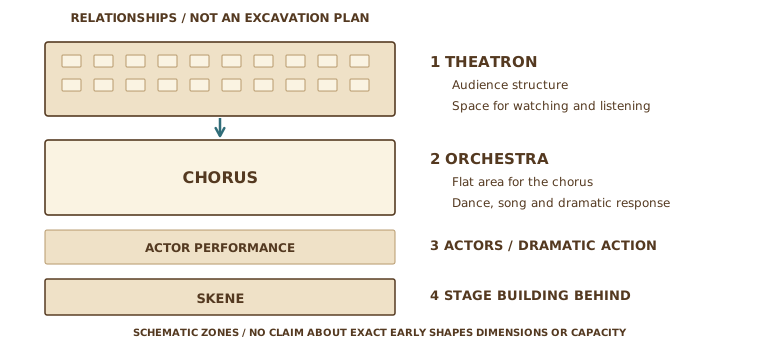
Original educational diagram, not a photograph. A functional relationship diagram, not an archaeological plan of fifth-century Athens. Zones explain audience, chorus, actors and stage building without inventing their exact shapes or dimensions.
Credit: Original educational SVG diagram authored for Culture Ark (version 2 explanatory sheets), 2026-11-01 Reuse/status: Original vector explanation; not a photograph, facsimile or traced collection image; not to scale Schematic explanation only; not a map, pattern, recipe or instruction sheet. Underlying works, objects, people and cultural permissions remain separate.
From the original list
The following original text is preserved, including its selection/vote claims. Preservation is not independent verification of every assertion.
Why: The festival where Greek theatre was born.
What to preserve: tragedy competitions
Year and origin: ancient · Greece
Vote: 4/9 (historian 2 · future kid 0 · curator 2)
Learn more: Dionysia on Wikipedia
Explanatory sheets
2 original explanatory sheets prepared for this pick, each with its own diagram. Codes in square brackets such as [A] point to the numbered sources at the end of the page.
The City Dionysia joined worship public performance and competition
One Athenian festival in a wider religious setting. The Acropolis Museum locates the Sanctuary of Dionysos on the Acropolis’s South Slope, founded after the middle of the sixth century BCE. It identifies the Greater or City Dionysia as the major celebration held there in the god’s honour. The name Dionysia also belongs to a broader set of festivals; this sheet concentrates on the Athenian City Dionysia rather than treating every local celebration as identical. [R1, R3]
Read functions before reconstructing a building. The orchestra was the chorus’s flat dancing area; the theatron was the audience structure. Actors performed in relation to these spaces, while a skene provided a stage building behind them. The Met stresses that repeated rebuilding limits what surviving theatres reveal about early performances. A familiar later semicircular theatre should not be passed off as an exact plan of fifth-century Athens. [R2]
Drama was both performance and civic encounter. The RD Milns Antiquities Museum describes competitive tragedy, comedy and satyr plays within festivals honouring Dionysos. Performances gathered people to experience drama and examine social questions as well as worship. These are distinct forms: a satyr play uses a chorus of satyrs in mythological situations, while comedy can parody public life. “Satyr” is not simply a spelling of modern “satire.” [R3]
Different dramatic genres occupied distinct competition forms
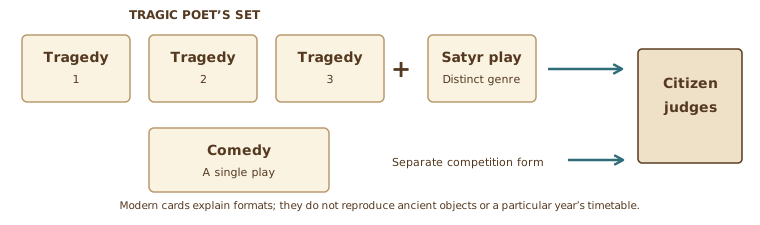
Simple programme cards explain the competition forms described by the RD Milns Antiquities Museum. They are not ancient scrolls, a reconstructed festival day or a fixed schedule for every period.
A contest structure is not a single origin story. The museum describes poets presenting one comedy or a set of three tragedies and a satyr play at the City Dionysia, judged by citizens. That comparison explains formats, not an unchanging running order. The Met notes how little is known about tragedy before Aeschylus; his earliest surviving play, Persians, was produced in 472 BCE. The archive’s broad “ancient” label does not prove that theatre was invented at one precisely recoverable moment. [R2, R3]
Where to learn more
- https://apiarybee.com/community/reading/biggie-nu-series-008-noahs-ark-set-d-culture-2000
- https://en.wikipedia.org/wiki/Dionysia
Sources and rights
- A · Existing Culture Ark record — Exact approved current-live refresh; original body retained.
- R1 · Acropolis Museum — Sanctuary and Theatre of Dionysos — South Slope sanctuary and the Greater/City Dionysia.
- R2 · Colette Hemingway, Metropolitan Museum — Theater in Ancient Greece — Space functions, rebuilding uncertainty and early surviving tragedy.
- R3 · RD Milns Antiquities Museum, University of Queensland — Theatre — Dionysiac context; genres, citizen judging and contest forms.
Drawings: Original educational SVG schematics; no copied historical/product artwork. Not to scale. Archive note: The original “ancient · Greece” wording is preserved. No disputed first-theatre date, exact early theatre plan, sacred object or ancient mask is fabricated; schematic cards are modern explanatory devices. Sources consulted 2026-11-01. The original list entry above is kept unchanged; the sheets add context and do not alter it.
Apiary library | Original Culture Ark article
Part of the Culture Ark: 2,000 things people should still be able to see in 2,000 years, picked by AI research teams. This page keeps the original list entry for D-1690 word for word and adds context. Browse the gallery. The Culture Ark is an Artificial Mind Hive (AMH) project. AMH is owned by Austin Little.

Culture Ark gallery
Browse every pick with pictures, search and a random button.
Open the gallery →