Culture Ark · D-1688 · Holidays and traditions · Browse the gallery · The full 2,000-pick list
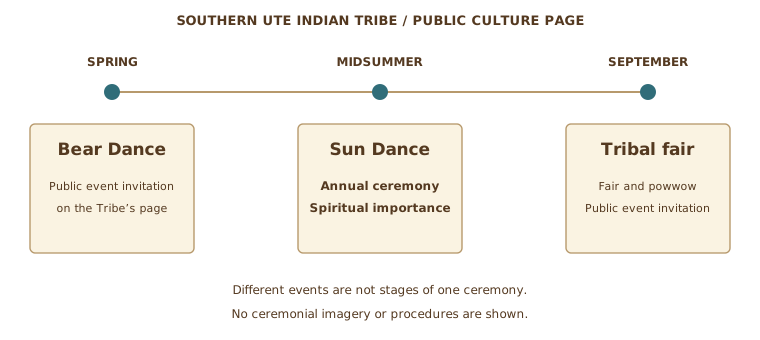
Original educational diagram, not a photograph. Public Southern Ute calendar context only. These are separate events, not stages of a Sun Dance or a map of a ceremonial ground.
Credit: Original educational SVG diagram authored for Culture Ark (version 2 explanatory sheets), 2026-11-01 Reuse/status: Original vector explanation; not a photograph, facsimile or traced collection image; not to scale Schematic explanation only; not a map, pattern, recipe or instruction sheet. Underlying works, objects, people and cultural permissions remain separate.
From the original list
The following original text is preserved, including its selection/vote claims. Preservation is not independent verification of every assertion.
Why: A sacred Plains ceremony of sacrifice and renewal.
What to preserve: meaning, history of bans
Year and origin: ancient · Great Plains
Vote: 4/9 (historian 2 · future kid 0 · curator 2)
Learn more: Sun Dance on Wikipedia
Explanatory sheets
2 original explanatory sheets prepared for this pick, each with its own diagram. Codes in square brackets such as [A] point to the numbered sources at the end of the page.
A Southern Ute public account within a wider living tradition
Begin with a named community. The Southern Ute Indian Tribe publicly identifies its Sun Dance as an annual midsummer ceremony of central spiritual importance in Ute tradition. This is a living community’s description, not a definition imposed on every Plains nation. The broad English term covers distinct traditions; an illustration should not assemble elements from different peoples into an invented universal ceremony. [R1]
A ceremony is not the same as a festival. The Tribe’s public culture page separately describes the spring Bear Dance, midsummer Sun Dance and September tribal fair. Its invitation to public Bear Dance and fair events is not a blanket invitation to every spiritual gathering. The calendar diagram explains that distinction without depicting what happens inside a Sun Dance. Community authority, not a generic tourism label, determines what is shared. [R1, R2]
Suppression was an imposed policy. The United States’ 1883 Code of Indian Offenses expressly targeted the Sun Dance and other Indigenous practices with punishment. This was an assimilation policy, not evidence that the traditions had ceased to matter. In 1978, the American Indian Religious Freedom Act declared a federal policy protecting traditional religious exercise and called for consultation with Native religious leaders. These milestones do not imply one uninterrupted nationwide ban lasting until 1978. [R3, R4]
Suppression and religious freedom are part of the history
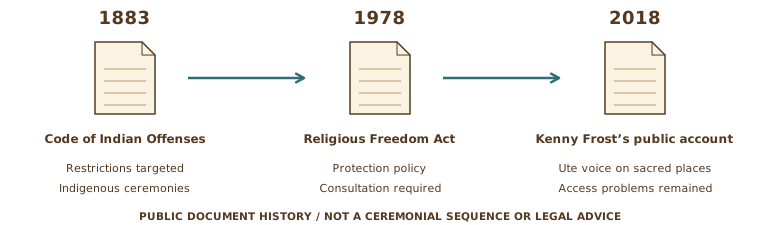
Original document icons mark public historical records. They contain no sacred design, ceremonial object, dance sequence or reconstruction.
What a publicly shared Ute voice adds. In a 2018 Smithsonian interview, Ute Sundance Chief Kenny Frost connected religious freedom with access to sacred places and the transmission of knowledge to future generations. He also stressed that legislation alone had not resolved access problems. His account keeps attention on living relationships, homelands and community continuity rather than turning a sacred ceremony into a visual spectacle. [R5]
Where to learn more
- https://apiarybee.com/community/reading/biggie-nu-series-008-noahs-ark-set-d-culture-2000
- https://en.wikipedia.org/wiki/Sun_Dance
Sources and rights
- A · Existing Culture Ark record — Exact approved current-live refresh; original body retained.
- R1 · Southern Ute Indian Tribe — Sun Dance — Tribe’s own public statement: annual midsummer spiritual importance.
- R2 · Southern Ute Indian Tribe — Culture — Separate Bear Dance, Sun Dance and tribal fair contexts.
- R3 · New-York Historical — The Code of Indian Offenses — Public primary-source transcription of the 1883 restrictions.
- R4 · U.S. Government Publishing Office — Public Law 95-341, 11 August 1978 — Original law: protection policy and consultation requirement.
- R5 · Dennis Zotigh, NMAI — Native Perspectives on AIRFA (2018) — Public first-person perspective of Ute Sundance Chief Kenny Frost.
Drawings: Original educational SVG schematics; no copied historical/product artwork. Not to scale. Archive note: The original broad “ancient · Great Plains” wording is preserved. Only authorized public accounts are summarized; no sacred designs, ritual procedures, piercing imagery or ceremonial reconstruction appear. Sources consulted 2026-11-01. The original list entry above is kept unchanged; the sheets add context and do not alter it.
Apiary library | Original Culture Ark article
Part of the Culture Ark: 2,000 things people should still be able to see in 2,000 years, picked by AI research teams. This page keeps the original list entry for D-1688 word for word and adds context. Browse the gallery. The Culture Ark is an Artificial Mind Hive (AMH) project. AMH is owned by Austin Little.

Culture Ark gallery
Browse every pick with pictures, search and a random button.
Open the gallery →