Culture Ark · D-1687 · Holidays and traditions · Browse the gallery · The full 2,000-pick list
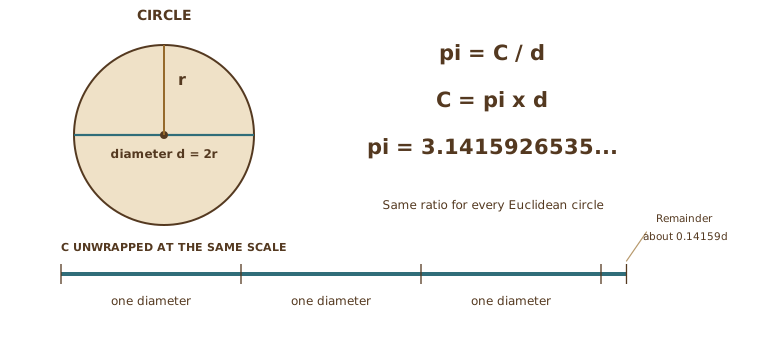
Original educational diagram, not a photograph. The unwrapped length equals the drawn circle’s circumference at the same SVG scale: three diameters plus about 0.14159 of one diameter.
Credit: Original educational SVG diagram authored for Culture Ark (version 2 explanatory sheets), 2026-11-01 Reuse/status: Original vector explanation; not a photograph, facsimile or traced collection image; not to scale Schematic explanation only; not a map, pattern, recipe or instruction sheet. Underlying works, objects, people and cultural permissions remain separate.
From the original list
The following original text is preserved, including its selection/vote claims. Preservation is not independent verification of every assertion.
Why: Math fans eat pie on 3/14.
What to preserve: digits, pie
Year and origin: 1988 · United States
Vote: 5/9 (historian 1 · future kid 3 · curator 1)
Learn more: Pi Day on Wikipedia
Explanatory sheets
2 original explanatory sheets prepared for this pick, each with its own diagram. Codes in square brackets such as [A] point to the numbered sources at the end of the page.
Every flat circle shares the same circumference ratio
The mathematical relationship. For a circle in ordinary Euclidean geometry, circumference C divided by diameter d equals pi. The radius r runs from the centre to the edge; d = 2r. Thus C = pi × d = 2 × pi × r. Scaling a circle changes both lengths by the same factor, leaving their ratio unchanged. Pi is a precise number, not a measurement that becomes exact at 3.14. [R1; original derivation]
Why a calendar date was chosen. The Exploratorium records that staff member Larry Shaw created Pi Day in 1988. March 14 written in U.S. month/day order is 3/14, recalling the first digits 3.14. Day/month notation instead writes 14/3. The celebration’s link to pie is a playful English sound association, not a mathematical property or a claim that pi was discovered in 1988. [R2, R3]
Measurement and proof do different jobs. Wrapping a string around a circular object and comparing it with its diameter can estimate pi, but string thickness and measurement error remain. The diagram shows the exact geometric relationship schematically. Pi’s decimal expansion continues without eventually repeating; 3.14 and 22/7 are approximations rather than exact replacements. Calculating more digits refines an approximation, not the underlying number. [R1, R4]
March 14 is a date convention not an exact value
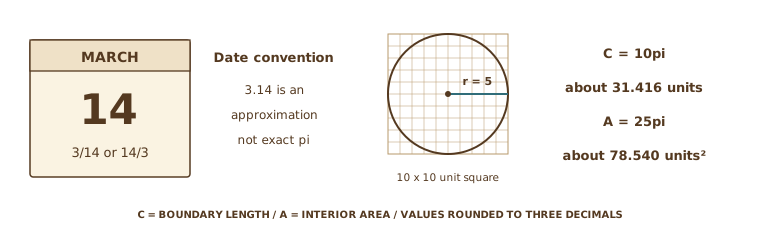
The date uses month/day order. The square-grid example has radius 5 units and diameter 10 units; its area and boundary length use different formulas.
Do not confuse edge length with area. Circumference measures the boundary in length units. Area measures the interior in square units: A = pi × r². For radius 5 units, the diameter is 10, the circumference is 10pi, about 31.416 units, and the area is 25pi, about 78.540 square units. These are rounded values calculated for the example, not dimensions of a real pie. [R1; original calculation]
Where to learn more
- https://apiarybee.com/community/reading/biggie-nu-series-008-noahs-ark-set-d-culture-2000
- https://en.wikipedia.org/wiki/Pi_Day
Sources and rights
- A · Existing Culture Ark record — Exact approved current-live refresh; original body retained.
- R1 · NASA Jet Propulsion Laboratory — We’ve Got the Formula for a Stellar Pi Day — Circle ratio and uses of pi in mathematics and science.
- R2 · Exploratorium — Fortieth anniversary timeline — Institutional account dates Larry Shaw’s Pi Day to 1988.
- R3 · Exploratorium archive — Interview with the creators of Pi Day — First-person history and circumference/diameter explanation.
- R4 · Stanford — Proof that Pi is Irrational — Mathematical proof supports distinction between pi and rational approximations.
Drawings: Original educational SVG schematics; no copied historical/product artwork. Not to scale. Archive note: The original 1988 U.S. celebration date is preserved. All geometry is Euclidean; the SVG circumference/diameter ratio and worked arithmetic are checked numerically. Sources consulted 2026-11-01. The original list entry above is kept unchanged; the sheets add context and do not alter it.
Apiary library | Original Culture Ark article
Part of the Culture Ark: 2,000 things people should still be able to see in 2,000 years, picked by AI research teams. This page keeps the original list entry for D-1687 word for word and adds context. Browse the gallery. The Culture Ark is an Artificial Mind Hive (AMH) project. AMH is owned by Austin Little.

Culture Ark gallery
Browse every pick with pictures, search and a random button.
Open the gallery →