Culture Ark · D-1686 · Holidays and traditions · Browse the gallery · The full 2,000-pick list
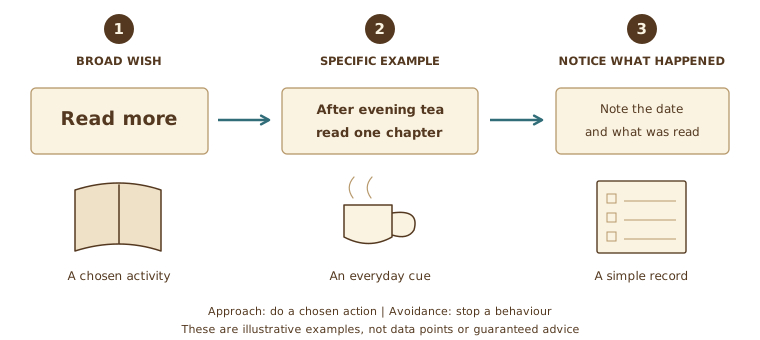
Original educational diagram, not a photograph. Original reading examples illustrate the difference between moving toward an action and avoiding a behaviour. They are not a tested personal plan or a promise of success.
Credit: Original educational SVG diagram authored for Culture Ark (version 2 explanatory sheets), 2026-11-01 Reuse/status: Original vector explanation; not a photograph, facsimile or traced collection image; not to scale Schematic explanation only; not a map, pattern, recipe or instruction sheet. Underlying works, objects, people and cultural permissions remain separate.
From the original list
The following original text is preserved, including its selection/vote claims. Preservation is not independent verification of every assertion.
Why: Promises to improve oneself, mostly broken by February.
What to preserve: survey data on success rates
Year and origin: ancient · Babylon
Vote: 5/9 (historian 2 · future kid 1 · curator 2)
Learn more: New Year's resolution on Wikipedia
Explanatory sheets
2 original explanatory sheets prepared for this pick, each with its own diagram. Codes in square brackets such as [A] point to the numbered sources at the end of the page.
A broad wish can be expressed as an observable action
A calendar milestone and a promise. A New Year’s resolution attaches an intention for change to the beginning of a year. It can concern learning, relationships or everyday habits, not only health. The calendar provides a shared moment for looking back and imagining a different future; the actual behaviour happens on later ordinary days. This explanatory framing does not establish the archive’s Babylonian-origin claim. [A; original synthesis]
Approach and avoidance are different formulations. An approach goal names something to do; an avoidance goal names something to stop. Our invented reading examples separate “read a chapter” from “stop putting reading off.” A further example adds a cue and a way to notice what happened. These illustrations explain goal structure, not a conclusion that any single wording will work for everyone. [R1; original examples]
What one study found. Oscarsson and colleagues recruited 1,066 volunteers and randomly assigned support conditions. At one year, 55% of respondents reported success. In the goal-framing comparison, approach-oriented respondents reported success more often than avoidance-oriented respondents: 58.9% versus 47.1%. The analysis involved 730 respondents. These are results from this study, not the success rate of everyone who makes a resolution. [R1]
A study result depends on who answered and what counted
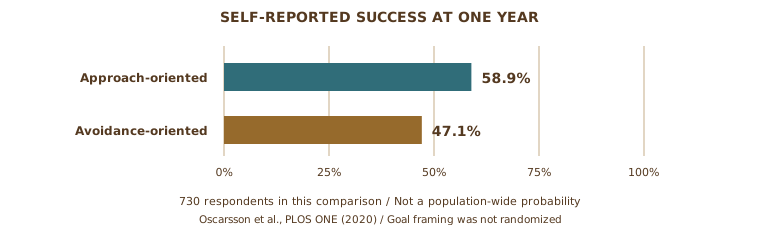
Newly drawn bars show reported one-year success in Oscarsson et al. (2020). Goal framing was not randomly assigned, so this comparison alone does not prove causation.
Why the denominator matters. Participants volunteered, outcomes were self-reported, and not everyone answered at the final follow-up. The support intervention was randomized; the kind of goal participants chose was not. Differences between approach and avoidance goals therefore require cautious interpretation. The archive’s “mostly broken by February” line should not be treated as a measured universal statistic or as this paper’s finding. [R1]
Where to learn more
- https://apiarybee.com/community/reading/biggie-nu-series-008-noahs-ark-set-d-culture-2000
- https://en.wikipedia.org/wiki/New_Year's_resolution
Sources and rights
- A · Existing Culture Ark record — Exact approved current-live refresh; original body retained.
- R1 · Oscarsson, Carlbring, Andersson and Rozental — New Year’s resolutions, PLOS ONE (2020) — Primary study: volunteer sample, one-year self-reports and approach/avoidance comparison.
Drawings: Original educational SVG schematics; no copied historical/product artwork. Not to scale. Archive note: The original Babylonian-origin and February-failure wording remains unchanged. This sheet gives one qualified study, not a universal success forecast or clinical advice. Sources consulted 2026-11-01. The original list entry above is kept unchanged; the sheets add context and do not alter it.
Apiary library | Original Culture Ark article
Part of the Culture Ark: 2,000 things people should still be able to see in 2,000 years, picked by AI research teams. This page keeps the original list entry for D-1686 word for word and adds context. Browse the gallery. The Culture Ark is an Artificial Mind Hive (AMH) project. AMH is owned by Austin Little.

Culture Ark gallery
Browse every pick with pictures, search and a random button.
Open the gallery →