Culture Ark · D-1685 · Holidays and traditions · Browse the gallery · The full 2,000-pick list
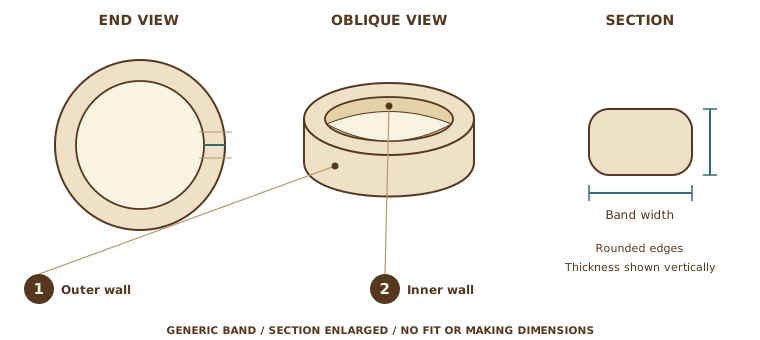
Original educational diagram, not a photograph. Three views of one generic rounded band. Section thickness is exaggerated for explanation; no ring size, authentic inscription or manufacturing process is supplied.
Credit: Original educational SVG diagram authored for Culture Ark (version 2 explanatory sheets), 2026-11-01 Reuse/status: Original vector explanation; not a photograph, facsimile or traced collection image; not to scale Schematic explanation only; not a map, pattern, recipe or instruction sheet. Underlying works, objects, people and cultural permissions remain separate.
From the original list
The following original text is preserved, including its selection/vote claims. Preservation is not independent verification of every assertion.
Why: A ring on the fourth finger symbolises lasting love.
What to preserve: finger custom, metals
Year and origin: ancient · Egypt
Vote: 5/9 (historian 2 · future kid 1 · curator 2)
Learn more: Wedding ring on Wikipedia
Explanatory sheets
2 original explanatory sheets prepared for this pick, each with its own diagram. Codes in square brackets such as [A] point to the numbered sources at the end of the page.
The band is simple but its meanings vary
An object made meaningful by use. A wedding ring can mark a marriage through exchange, wearing and remembrance. The circle may express continuing commitment, but the meaning comes from a particular community or couple rather than from metal alone. The Church of England’s marriage service explicitly connects the ring with marriage and faithfulness; that is a named Christian example, not a universal interpretation. [R1]
Reading a plain band. The outer surface is visible, the inner surface rests against the finger, and the band’s width is different from its radial thickness. A rounded cross-section explains how these surfaces join. An inner inscription can make a plain-looking object personal. Historic New England’s eighteenth-century gold ring retains traces of an inscription that is no longer legible; no text has been invented to fill that gap. [R2; original structural explanation]
A documented custom rather than a legend. The Church of England specifies the fourth finger of the left hand in its marriage service. Other practices need not follow that rule. Historic New England notes that wedding bands were not common throughout eighteenth-century America, showing that today’s familiar object was not always universal even within one country. The archive’s Egyptian-origin shorthand does not establish an unbroken worldwide custom. [R1, R2]
Material composition is not the same as symbolism
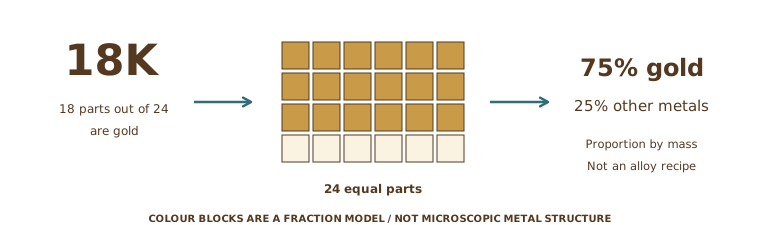
The 24-part diagram explains 18K gold as a proportion, not an alloy recipe or a claim about every wedding ring.
What the metal contributes. GIA explains that pure gold is soft and is commonly mixed with other metals for jewellery. Karat expresses gold content out of 24: 18K means 18 parts gold and six parts other metals, or 75% gold. Different alloys alter appearance and working properties. Gold, white gold and platinum are not interchangeable labels, and neither a metal’s price nor a stone’s presence determines a marriage’s meaning. [R3]
Where to learn more
- https://apiarybee.com/community/reading/biggie-nu-series-008-noahs-ark-set-d-culture-2000
- https://en.wikipedia.org/wiki/Wedding_ring
Sources and rights
- A · Existing Culture Ark record — Exact approved current-live refresh; original body retained.
- R1 · Church of England — Common Worship Marriage — Named ring symbolism and fourth-finger left-hand convention.
- R2 · Historic New England — Wedding Ring, accession 1953.9 — Plain gold band; illegible inscription; not universal in eighteenth-century America.
- R3 · Gemological Institute of America — 10 Tips for Buying an Engagement Ring, metal section — Gold alloying and 18K = 75% gold; jewellery metal distinctions.
Drawings: Original educational SVG schematics; no copied historical/product artwork. Not to scale. Archive note: The original “ancient · Egypt” and fourth-finger wording is preserved. No single earliest wedding-ring date or special finger-to-heart vein is asserted. Sources consulted 2026-11-01. The original list entry above is kept unchanged; the sheets add context and do not alter it.
Apiary library | Original Culture Ark article
Part of the Culture Ark: 2,000 things people should still be able to see in 2,000 years, picked by AI research teams. This page keeps the original list entry for D-1685 word for word and adds context. Browse the gallery. The Culture Ark is an Artificial Mind Hive (AMH) project. AMH is owned by Austin Little.

Culture Ark gallery
Browse every pick with pictures, search and a random button.
Open the gallery →