Culture Ark · D-1682 · Holidays and traditions · Browse the gallery · The full 2,000-pick list
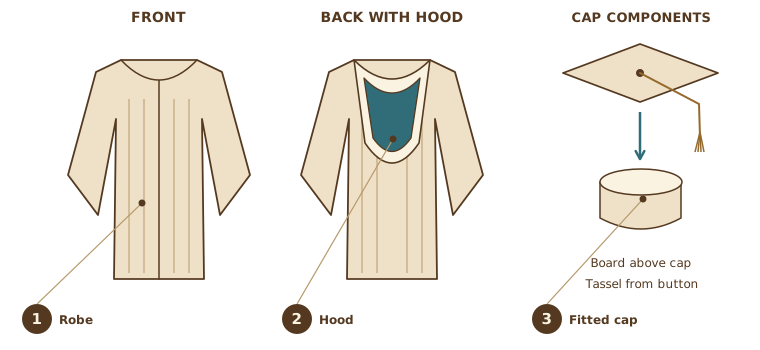
Original educational diagram, not a photograph. Representative American academic regalia with an optional hood shown at the back. Colours are diagrammatic, not an institution or degree code.
Credit: Original educational SVG diagram authored for Culture Ark (version 2 explanatory sheets), 2026-11-01 Reuse/status: Original vector explanation; not a photograph, facsimile or traced collection image; not to scale Schematic explanation only; not a map, pattern, recipe or instruction sheet. Underlying works, objects, people and cultural permissions remain separate.
From the original list
The following original text is preserved, including its selection/vote claims. Preservation is not independent verification of every assertion.
Why: Caps tossed in the air mark finishing school.
What to preserve: gown and cap, the speech
Year and origin: medieval · Europe
Vote: 5/9 (historian 2 · future kid 1 · curator 2)
Learn more: Graduation on Wikipedia
Explanatory sheets
2 original explanatory sheets prepared for this pick, each with its own diagram. Codes in square brackets such as [A] point to the numbered sources at the end of the page.
A gown is part of a larger visual language
From academic clothing to ceremony. Academic regalia connects modern graduation ceremonies to clothing worn at medieval European universities. The University of South Carolina Aiken describes the American intercollegiate standard adopted in 1895. This history concerns regalia, not a claim that every kind of school completion or cap-tossing ritual began in medieval Europe. [R1]
Three elements and several signals. A robe supplies the main silhouette, a cap marks academic dress, and a hood may display the degree and awarding institution. The hood hangs down the back; it is not a sash worn only across the front. A square mortarboard has a flat board above a fitted cap and a hanging tassel. Hood use and tassel customs depend on the institution. [R1; schematic cap structure]
The sleeve comparison. In the American forms described by USCA, a bachelor’s gown has open, pointed sleeves. A master’s sleeve extends below the arm opening, while doctoral sleeves are fuller and bell-shaped, with velvet trim. These differences make rank legible at a distance. They should not be converted into universal measurements or an assumption that colour alone identifies every degree. [R1]
Sleeves distinguish three common American forms
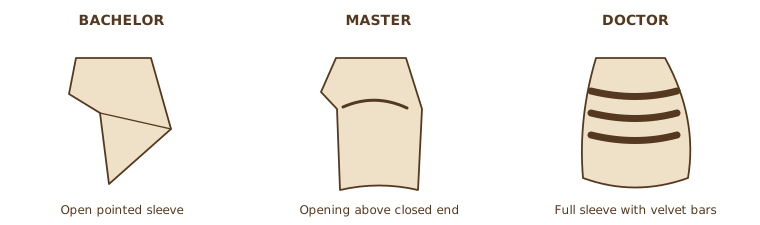
Simplified sleeve comparisons follow a named university account. They are not sewing patterns, and universities use exceptions and variants.
A ceremony changes status. Oxford provides a contrasting institutional example: candidates may change gowns or hoods during the ceremony to mark the status being conferred. Its rules distinguish mortarboards from soft caps and bonnets. A graduation therefore combines an academic decision with public recognition; speeches, names, processions and clothing make that change visible, while the exact sequence and awards remain institution-specific. [R2]
Where to learn more
- https://apiarybee.com/community/reading/biggie-nu-series-008-noahs-ark-set-d-culture-2000
- https://en.wikipedia.org/wiki/Graduation
Sources and rights
- A · Existing Culture Ark record — Exact approved current-live refresh; original body retained.
- R1 · University of South Carolina Aiken — History of Regalia — Medieval antecedents, 1895 code, gown/hood/cap and sleeve forms.
- R2 · University of Oxford — Academic dress — Named institutional variant; degree-ceremony changes and headwear.
Drawings: Original educational SVG schematics; no copied historical/product artwork. Not to scale. Archive note: The original medieval-Europe and cap-toss wording is preserved. The drawings show representative academic forms, not all graduations; no wearing or cutting dimensions are supplied. Sources consulted 2026-11-01. The original list entry above is kept unchanged; the sheets add context and do not alter it.
Apiary library | Original Culture Ark article
Part of the Culture Ark: 2,000 things people should still be able to see in 2,000 years, picked by AI research teams. This page keeps the original list entry for D-1682 word for word and adds context. Browse the gallery. The Culture Ark is an Artificial Mind Hive (AMH) project. AMH is owned by Austin Little.

Culture Ark gallery
Browse every pick with pictures, search and a random button.
Open the gallery →