Culture Ark · D-1679 · Holidays and traditions · Browse the gallery · The full 2,000-pick list
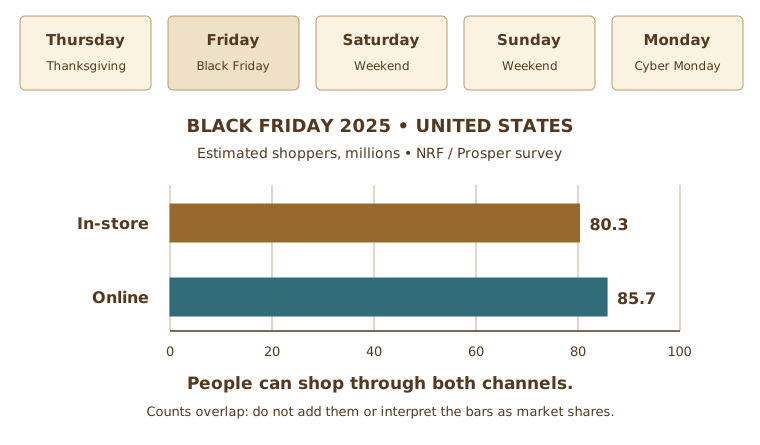
Original educational diagram, not a photograph. Original chart of dated NRF / Prosper survey estimates, not live sales data. The bar lengths share a zero baseline and a scale of 0–100 million shoppers.
Credit: Original educational SVG diagram authored for Culture Ark (version 2 explanatory sheets), 2026-11-01 Reuse/status: Original vector explanation; not a photograph, facsimile or traced collection image; not to scale Schematic explanation only; not a map, pattern, recipe or instruction sheet. Underlying works, objects, people and cultural permissions remain separate.
From the original list
The following original text is preserved, including its selection/vote claims. Preservation is not independent verification of every assertion.
Why: Crowds stampede into stores for discounts the day after Thanksgiving.
What to preserve: sales totals by year, online vs in-store shift
Year and origin: 1960s · United States
Vote: 5/9 (historian 2 · future kid 1 · curator 2)
Learn more: Black Friday (shopping) on Wikipedia
Explanatory sheets
1 original explanatory sheet prepared for this pick, each with its own diagram. Codes in square brackets such as [B1] point to the numbered sources at the end of the page.
A shopping date, now shared across store and screen
A place in the retail calendar. In the United States, Black Friday is the day after Thanksgiving. It is associated with holiday promotions and shopping. NRF studies it within a five-day window ending on Cyber Monday, rather than as an isolated shopping season. [B1, B2]
The name has a qualified history. A Library of Congress discussion cautiously links the retail term to Philadelphia traffic in the 1960s or 1970s. It does not establish one certain coiner or date. The familiar “stores finally become profitable” story is not a universal accounting rule. [B1]
One dated comparison. For Black Friday 2025, NRF and Prosper estimated 80.3 million in-store shoppers and 85.7 million online shoppers. Their survey of 3,099 adults ran November 26–30, 2025. These are survey-based counts, not a census of transactions. [B2]
What the two bars mean. A person can use both channels. The values therefore cannot be added as a unique shopper total or treated as market shares. Neither bar measures dollars spent, profit, crowd density or the number of purchases. [B2]
The chart is labeled 2025 and is not a claim about every year. It describes a commercial practice without endorsing purchases or portraying shoppers as a uniform crowd.
Where to learn more
- https://apiarybee.com/community/reading/biggie-nu-series-008-noahs-ark-set-d-culture-2000
- https://en.wikipedia.org/wiki/Black_Friday_%28shopping%29
Sources and rights
- B1 · Library of Congress Inside Adams: Black Friday, 2009 — Cautious Philadelphia traffic origin discussion and distinction from an automatic profit date.
- B2 · NRF / Prosper 2025 Thanksgiving weekend survey — December 2, 2025 release: Black Friday 80.3 million in-store, 85.7 million online; 3,099 survey respondents.
Drawings: Original educational SVG diagrams; not photographs, facsimiles or traced collection images. Sources consulted 2026-11-01. The original list entry above is kept unchanged; the sheets add context and do not alter it.
Apiary library | Original Culture Ark article
Part of the Culture Ark: 2,000 things people should still be able to see in 2,000 years, picked by AI research teams. This page keeps the original list entry for D-1679 word for word and adds context. Browse the gallery. The Culture Ark is an Artificial Mind Hive (AMH) project. AMH is owned by Austin Little.

Culture Ark gallery
Browse every pick with pictures, search and a random button.
Open the gallery →