Culture Ark · D-1678 · Holidays and traditions · Browse the gallery · The full 2,000-pick list
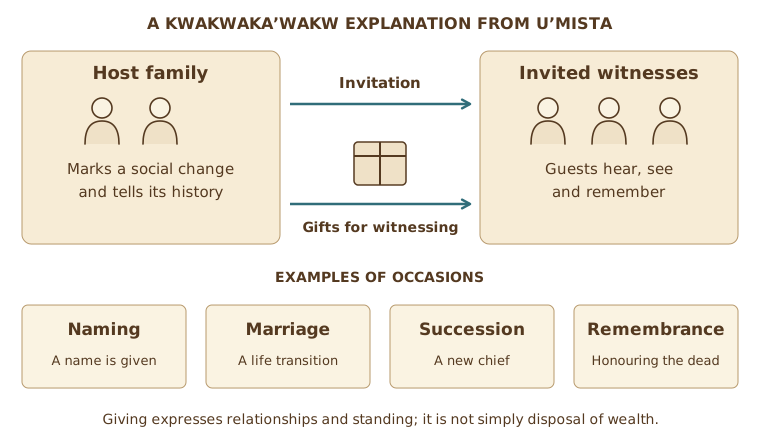
Original educational diagram, not a photograph. A relationship diagram based on U’mista’s public teaching. Plain figures and parcels are explanatory symbols, not authentic regalia, gifts or a prescribed ceremonial order.
Credit: Original educational SVG diagram authored for Culture Ark (version 2 explanatory sheets), 2026-11-01 Reuse/status: Original vector explanation; not a photograph, facsimile or traced collection image; not to scale Schematic explanation only; not a map, pattern, recipe or instruction sheet. Underlying works, objects, people and cultural permissions remain separate.
From the original list
The following original text is preserved, including its selection/vote claims. Preservation is not independent verification of every assertion.
Why: Chiefs gain status by giving away wealth; it was once banned.
What to preserve: gift-giving, the 1885 ban
Year and origin: ancient · Pacific Northwest
Vote: 5/9 (historian 2 · future kid 1 · curator 2)
Learn more: Potlatch on Wikipedia
Explanatory sheets
2 original explanatory sheets prepared for this pick, each with its own diagram. Codes in square brackets such as [P1] point to the numbered sources at the end of the page.
Giving matters because people witness and remember
A Kwakwaka’wakw account. U’mista Cultural Centre describes the potlatch from a Kwakwaka’wakw perspective. Its account connects stories and songs with social changes. Naming, marriage, chiefly succession and death are among the occasions it identifies. [P1]
Guests are also witnesses. An invitation is more than attendance at a feast. People witness what is announced and shown; gifts acknowledge this role. The diagram therefore places witnessing beside giving, rather than treating the event as a one-way transfer of possessions. [P1]
Generosity expresses standing. In Chief Bill Cranmer’s public teaching, wealth and standing are expressed through giving. This is part of a relationship among hosts, guests and community—not simply a competition to discard the largest pile of goods. [P2]
A living institution. Cranmer describes potlatching as continuing to unify community life. Songs, dances, names and privileges have particular owners and histories. A broad regional label does not erase the distinct practices of different Northwest Coast peoples. [P2, P3]
The drawings contain no masks, crests, sacred designs or ceremony instructions. The explanation stays within public community teaching.
Prohibition, persistence and the return of treasures
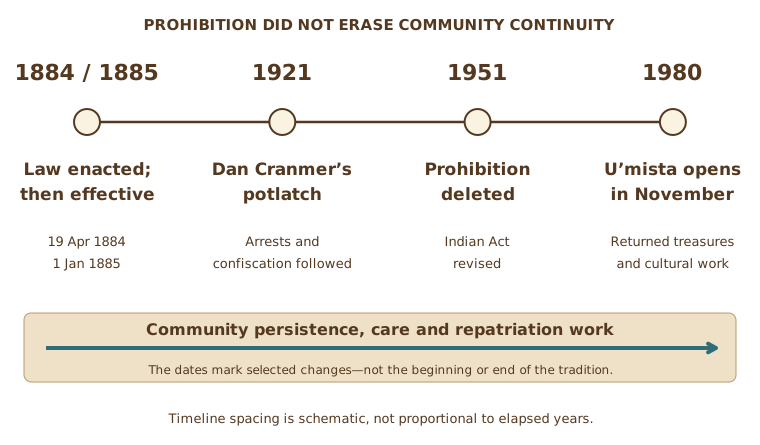
Dates distinguish legislation from its coming into effect. The uninterrupted lower band signifies community persistence, not uninterrupted freedom from colonial repression.
Two different legal dates. Canada amended the Indian Act on April 19, 1884; the prohibition became effective January 1, 1885. These are different stages of the same measure, not competing dates for a single moment. [P3]
The 1921 repression. Dan Cranmer hosted a potlatch at Village Island in 1921. Arrests, imprisonment and confiscation followed. U’mista’s account makes clear that community practice persisted under persecution. [P1]
Ending the prohibition. The prohibition was deleted in the 1951 revision. Removing it did not automatically return the confiscated treasures. Chief Bill Cranmer describes their return from distant collections as a form of U’mista—coming home from captivity. [P1, P2]
Continuing cultural life. U’mista opened in November 1980. Its work concerns the survival of Kwakwaka’wakw cultural heritage, not only the display of historical objects. The Potlatch Collection sits within that broader community-led purpose. [P4]
This historical overview does not reproduce confiscated treasures. No single present-day protocol is inferred from the timeline.
Where to learn more
- https://apiarybee.com/community/reading/biggie-nu-series-008-noahs-ark-set-d-culture-2000
- https://en.wikipedia.org/wiki/Potlatch
Sources and rights
- P1 · U’mista History of the Potlatch Collection — Community explanation of witnesses and social changes; prohibition, 1921 repression and persistence.
- P2 · U’mista Chief Bill Cranmer teaching transcripts — Giving, standing, community continuity and meaning of return. Text consulted; no recordings reused.
- P3 · Noel Knockwood Potlatch mini-research paper, 1992 — PDF page 7 distinguishes April 19, 1884 enactment from January 1, 1885 effect. Used for dates only.
- P4 · U’mista About Us — November 1980 opening and community-led cultural heritage mandate.
Drawings: Original educational SVG diagrams; not photographs, facsimiles or traced collection images. Sources consulted 2026-11-01. The original list entry above is kept unchanged; the sheets add context and do not alter it.
Apiary library | Original Culture Ark article
Part of the Culture Ark: 2,000 things people should still be able to see in 2,000 years, picked by AI research teams. This page keeps the original list entry for D-1678 word for word and adds context. Browse the gallery. The Culture Ark is an Artificial Mind Hive (AMH) project. AMH is owned by Austin Little.

Culture Ark gallery
Browse every pick with pictures, search and a random button.
Open the gallery →