Culture Ark · D-1675 · Holidays and traditions · Browse the gallery · The full 2,000-pick list
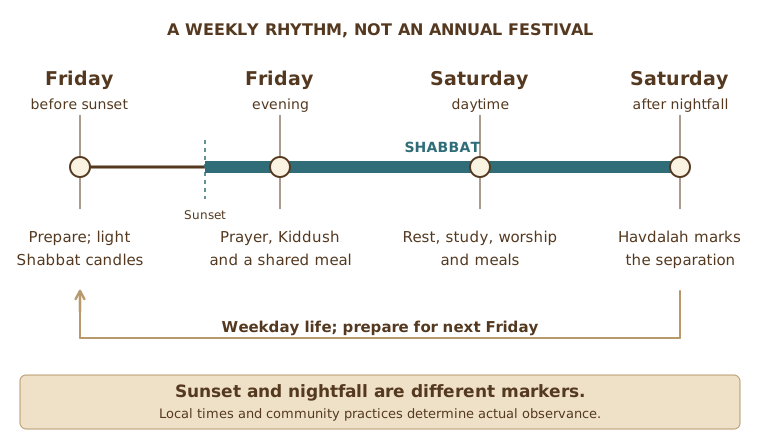
Original educational diagram, not a photograph. A timing framework, not a minute-by-minute observance guide. The central span is schematic; local sunset, nightfall and community customs matter.
Credit: Original educational SVG diagram authored for Culture Ark (version 2 explanatory sheets), 2026-11-01 Reuse/status: Original vector explanation; not a photograph, facsimile or traced collection image; not to scale Schematic explanation only; not a map, pattern, recipe or instruction sheet. Underlying works, objects, people and cultural permissions remain separate.
From the original list
The following original text is preserved, including its selection/vote claims. Preservation is not independent verification of every assertion.
Why: A weekly day of complete rest, kept for millennia.
What to preserve: candle lighting, challah, rules
Year and origin: ancient · Ancient Israel
Vote: 5/9 (historian 2 · future kid 1 · curator 2)
Learn more: Shabbat on Wikipedia
Explanatory sheets
2 original explanatory sheets prepared for this pick, each with its own diagram. Codes in square brackets such as [S1] point to the numbered sources at the end of the page.
A weekly boundary around rest and shared time
A recurring weekly observance. Shabbat is the Jewish weekly day of rest and celebration, welcomed before Friday sunset and concluded after Saturday nightfall. It is not limited to Friday dinner, nor is its ending simply Saturday sunset. [S1]
Rest includes positive activities. Meals, prayer, study, song and time with others give the day a distinctive character. Preparation helps separate it from weekday activity. Rest here need not mean inactivity or the absence of conversation and enjoyment. [S1]
Work has a particular religious meaning. In the Orthodox framework described by Chabad, melachah is organized into 39 traditional categories. This is not merely a measure of physical effort. Different Jewish communities and individuals understand and observe these boundaries differently. [S3, S4]
Household practices have variety. Reform resources present familiar blessings while inviting choices suited to a household’s practice. The shared weekly rhythm can coexist with differences in services, food, technology use and the extent of observance. [S4]
This is cultural explanation, not a religious ruling. Use a relevant local community’s calendar and guidance for actual observance.
A close view of welcoming and concluding objects
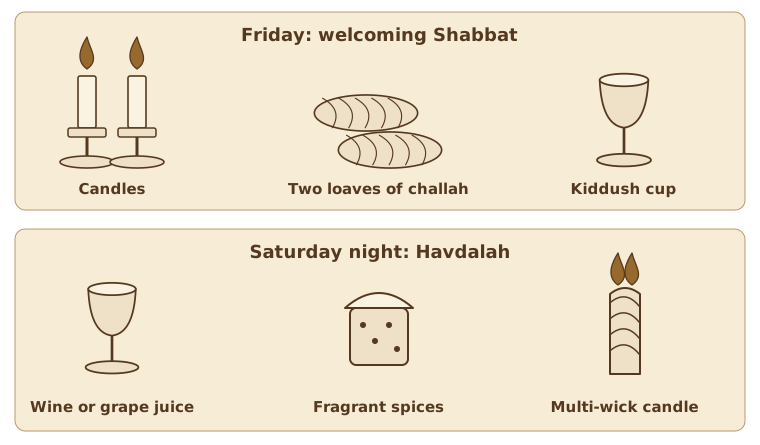
Original object studies, separated by time rather than shown as a single table setting. The two-candle and braided-bread forms are familiar examples, not the only household arrangements.
Light marks the welcome. Two candles are a widespread custom. The Reform source connects the pair with remembering and observing Shabbat. Candle lighting belongs to the welcome before sunset; the concluding flame has a different role. [S2]
Cup and bread accompany a meal. Kiddush sanctifies the day over wine; grape juice is also used. Two loaves recall the biblical account of a double portion of manna. Bread may be covered during Kiddush, then blessed and shared. [S2, S5]
Havdalah engages the senses. At the conclusion, blessings accompany a cup, fragrant spices and a flame, commonly from a braided multi-wick candle. Havdalah marks separation between Shabbat and weekday time. The same category of object—light—serves a different moment. [S3]
Objects carry meaning through use. A cup is not Kiddush by itself, and a spice box is not the whole Havdalah ceremony. Words, timing and participation give the objects their ritual roles. Decoration, bread shape and household practice can vary. [S2, S3, S4]
These are invented object shapes without sacred inscriptions or copied collection designs. No candle-making or flame-handling instructions are included.
Where to learn more
- https://apiarybee.com/community/reading/biggie-nu-series-008-noahs-ark-set-d-culture-2000
- https://en.wikipedia.org/wiki/Shabbat
Sources and rights
- S1 · Chabad What Is Shabbat? — Weekly rest, Friday-before-sunset to Saturday-after-nightfall framework and positive observances.
- S2 · Union for Reform Judaism Shabbat Home Ritual — Candles, Kiddush, two loaves, shared food and diverse family practices.
- S3 · Chabad Shabbat: purpose, meals and Havdallah — The traditional 39 melachot framework; Havdalah wine, spices and flame; named Orthodox presentation.
- S4 · Union for Reform Judaism Shabbat Blessings — Weekly blessing sequence and a Reform invitation to adapt household ritual practice.
- S5 · Reform Judaism UK Shabbat at Home — Wine or grape juice, two loaves, cloth cover and Havdalah items; official indexed teaching resource.
Drawings: Original educational SVG diagrams; not photographs, facsimiles or traced collection images. Sources consulted 2026-11-01. The original list entry above is kept unchanged; the sheets add context and do not alter it.
Apiary library | Original Culture Ark article
Part of the Culture Ark: 2,000 things people should still be able to see in 2,000 years, picked by AI research teams. This page keeps the original list entry for D-1675 word for word and adds context. Browse the gallery. The Culture Ark is an Artificial Mind Hive (AMH) project. AMH is owned by Austin Little.

Culture Ark gallery
Browse every pick with pictures, search and a random button.
Open the gallery →