Culture Ark · D-1674 · Holidays and traditions · Browse the gallery · The full 2,000-pick list
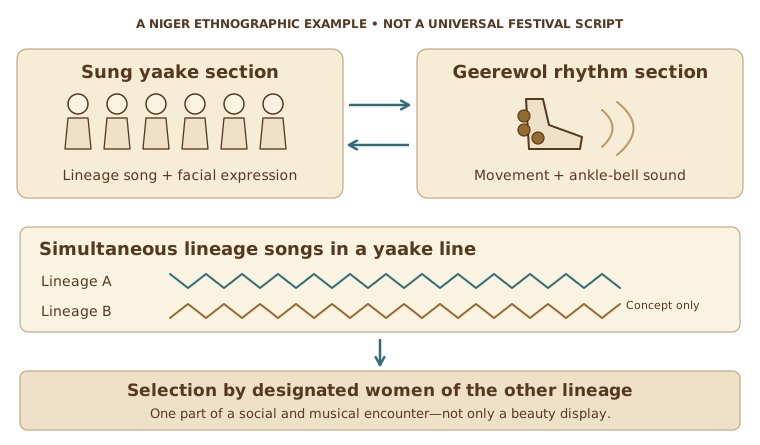
Original educational diagram, not a photograph. Original abstract explanation of public research descriptions. The sound lines are not actual melodies; figures carry no copied dress, face paint or restricted design.
Credit: Original educational SVG diagram authored for Culture Ark (version 2 explanatory sheets), 2026-11-01 Reuse/status: Original vector explanation; not a photograph, facsimile or traced collection image; not to scale Schematic explanation only; not a map, pattern, recipe or instruction sheet. Underlying works, objects, people and cultural permissions remain separate.
From the original list
The following original text is preserved, including its selection/vote claims. Preservation is not independent verification of every assertion.
Why: Wodaabe men paint faces and dance in a beauty contest judged by women.
What to preserve: makeup, yaake dance
Year and origin: ancient · Niger
Vote: 5/9 (historian 2 · future kid 1 · curator 2)
Learn more: Guérewol on Wikipedia
Explanatory sheets
1 original explanatory sheet prepared for this pick, each with its own diagram. Codes in square brackets such as [G1] point to the numbered sources at the end of the page.
Voice, rhythm and social relations—not only appearance
A specific documented context. Ethnomusicologist Sandrine Loncke’s research in Niger between 1997 and 2008 examines Wodaabe music, dance and social relations. This sheet follows that named body of research rather than treating every event marketed as Gerewol as identical. [G2]
Yaake combines several voices. In a yaake line, different lineages may sing their own songs simultaneously. The performers also use controlled facial expression. The collective sound and group identification matter alongside the visual presentation. [G1]
Alternating kinds of performance. Loncke distinguishes sung yaake sections from geerewol sections organized around ankle-bell rhythm. Yaake can also occur in other festive circumstances; the words are not interchangeable names for one generic dance. [G1]
Selection sits within a relationship. In the described inter-lineage ceremony, designated women of the other lineage select a dancer. The gathering also involves elders, youth leaders, allies and audiences. Reducing it to face paint alone misses the organized social encounter. [G1, G2]
Only publicly described relationships are diagrammed. No audio, video frame, melody, authentic facial design or ceremonial choreography is reproduced.
Where to learn more
- https://apiarybee.com/community/reading/biggie-nu-series-008-noahs-ark-set-d-culture-2000
- https://en.wikipedia.org/wiki/Gu%C3%A9rewol
Sources and rights
- G1 · Sandrine Loncke Geerewol annotated musical research — Sections 4–5: yaake, lineage songs, alternating geerewol sequences and selection. Text only; no recordings, frames or costume designs reused.
- G2 · Sandrine Loncke About the Geerewol research — Research in Niger, 1997–2008, under CNRS; social and musical scope and rights context.
Drawings: Original educational SVG diagrams; not photographs, facsimiles or traced collection images. Sources consulted 2026-11-01. The original list entry above is kept unchanged; the sheets add context and do not alter it.
Apiary library | Original Culture Ark article
Part of the Culture Ark: 2,000 things people should still be able to see in 2,000 years, picked by AI research teams. This page keeps the original list entry for D-1674 word for word and adds context. Browse the gallery. The Culture Ark is an Artificial Mind Hive (AMH) project. AMH is owned by Austin Little.

Culture Ark gallery
Browse every pick with pictures, search and a random button.
Open the gallery →