Culture Ark · D-1673 · Holidays and traditions · Browse the gallery · The full 2,000-pick list
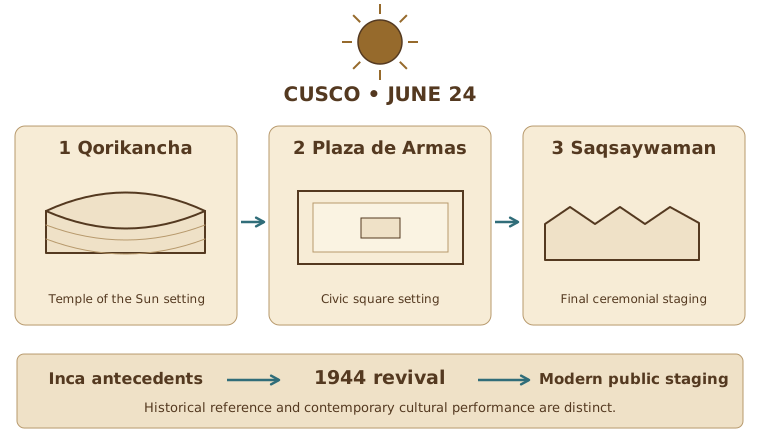
Original educational diagram, not a photograph. Original route-and-history diagram. The buildings are schematic location cues, not measured plans, sacred designs or a reconstruction of an Inca ceremony.
Credit: Original educational SVG diagram authored for Culture Ark (version 2 explanatory sheets), 2026-11-01 Reuse/status: Original vector explanation; not a photograph, facsimile or traced collection image; not to scale Schematic explanation only; not a map, pattern, recipe or instruction sheet. Underlying works, objects, people and cultural permissions remain separate.
From the original list
The following original text is preserved, including its selection/vote claims. Preservation is not independent verification of every assertion.
Why: The Inca Festival of the Sun, revived in Cusco.
What to preserve: Sacsayhuamán ceremony, Quechua rituals
Year and origin: 1412 · Peru
Vote: 5/9 (historian 2 · future kid 1 · curator 2)
Learn more: Inti Raymi on Wikipedia
Explanatory sheets
1 original explanatory sheet prepared for this pick, each with its own diagram. Codes in square brackets such as [I1] point to the numbered sources at the end of the page.
Three places in the modern Cusco Festival of the Sun
Qorikancha: a solar setting. The organizer identifies Qorikancha as the Inca temple dedicated to the Sun. Beginning here gives the modern performance a place directly associated with the festival’s solar reference. [I1]
Square and archaeological landscape. The public sequence continues through Cusco’s Plaza de Armas and ends at Saqsaywaman. Changing settings expands the event from a temple association to the civic center and a large archaeological setting. [I1]
1944 is a documented modern milestone. Peru’s Ministry of Culture dates the first modern staged evocation to June 24, 1944 at Saqsaywaman. Revival describes a new public presentation drawing on Inca history; it does not establish an unbroken identical performance since antiquity. [I2]
An annual cultural performance. EMUFEC names June 24 as the date. A 2026 Ministry resolution classifies that year’s staging as a public cultural theatrical event at the three sites. The present-day performance is a contemporary cultural expression with historical references. [I1, I3]
The source record’s exact founding year, 1412, is retained archivally but is not established by the official sources used for this sheet.
Where to learn more
- https://apiarybee.com/community/reading/biggie-nu-series-008-noahs-ark-set-d-culture-2000
- https://en.wikipedia.org/wiki/Inti_Raymi
Sources and rights
- I1 · EMUFEC Inti Raymi — Organizer description of June 24 and the three settings: Qorikancha, Plaza de Armas and Saqsaywaman.
- I2 · Peru Ministry of Culture 2021 Inti Raymi history — June 24, 1944 revival of the staged evocation. Official search-index text; direct fetch unavailable.
- I3 · Peru Ministry of Culture 2026 staging resolution — Official classification of the June 24, 2026 staging as a public cultural theatrical event at the three sites.
Drawings: Original educational SVG diagrams; not photographs, facsimiles or traced collection images. Sources consulted 2026-11-01. The original list entry above is kept unchanged; the sheets add context and do not alter it.
Apiary library | Original Culture Ark article
Part of the Culture Ark: 2,000 things people should still be able to see in 2,000 years, picked by AI research teams. This page keeps the original list entry for D-1673 word for word and adds context. Browse the gallery. The Culture Ark is an Artificial Mind Hive (AMH) project. AMH is owned by Austin Little.

Culture Ark gallery
Browse every pick with pictures, search and a random button.
Open the gallery →