Culture Ark · D-1672 · Holidays and traditions · Browse the gallery · The full 2,000-pick list
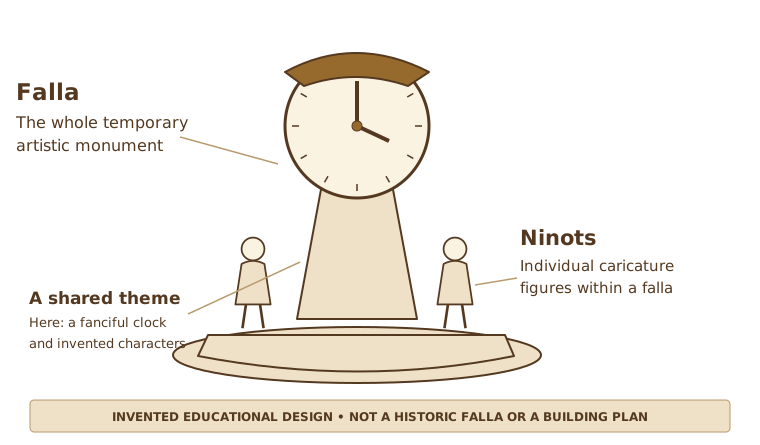
Original educational diagram, not a photograph. A made-up clock-and-figures design illustrates vocabulary. It is not a copy of a Valencia monument, an authentic artist’s sketch or a construction plan.
Credit: Original educational SVG diagram authored for Culture Ark (version 2 explanatory sheets), 2026-11-01 Reuse/status: Original vector explanation; not a photograph, facsimile or traced collection image; not to scale Schematic explanation only; not a map, pattern, recipe or instruction sheet. Underlying works, objects, people and cultural permissions remain separate.
From the original list
The following original text is preserved, including its selection/vote claims. Preservation is not independent verification of every assertion.
Why: Valencia builds giant satirical sculptures and burns them all.
What to preserve: ninots, cremà night, mascletà
Year and origin: 18th century · Spain
Vote: 5/9 (historian 1 · future kid 2 · curator 2)
Learn more: Fallas on Wikipedia
Explanatory sheets
2 original explanatory sheets prepared for this pick, each with its own diagram. Codes in square brackets such as [F1] point to the numbered sources at the end of the page.
From a small ninot to a whole satirical monument
Whole and part. A falla is the temporary artistic monument; ninots are the caricature pieces within it. Their grouping can turn recognizable human behavior or current affairs into a humorous or critical scene. [F1]
A public art of commentary. Satire gives the sculpture a purpose beyond size. Exaggeration, visual contrast and the relation between characters can make social commentary readable to people walking through the neighborhood. The invented clock is only a teaching example. [F1]
Artists and neighborhood commissions. Valencia’s local commissions organize the celebration, while artists bring a range of craft skills to the monuments. The city describes a professional fallero art industry developing from the 1930s alongside earlier neighborhood making. [F2]
More than a sculpture display. Music, meals and street gatherings surround the monuments. Skills pass through families and craft communities, so Fallas involves both temporary artworks and continuing social participation. [F1]
No frame, load, combustible-material recipe or pyrotechnic construction is provided. The next view follows the festival’s public cycle.
The festival cycle—and the figure that is saved
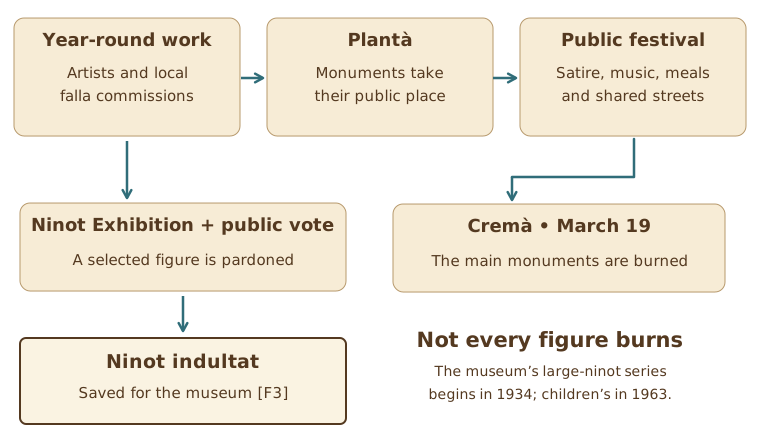
Conceptual sequence, not a timetable for technicians. The saved-ninot branch corrects the shorthand that every figure is burned.
Plantà opens the exhibition. The monuments take their public places for the March festival. The city distinguishes the children’s plantà on March 15 from the larger monuments that night. Individual schedules and installations can extend beyond this simple overview. [F2]
Cremà closes the cycle. The March 19 culmination includes the burning of the monuments, with children’s fallas before the larger ones. It is a planned public event within the local festival, not an invitation to reproduce a burn independently. [F2]
A vote creates a lasting collection. Visitors select a ninot to be pardoned from the fire. The museum’s large-ninot collection begins in 1934 and its children’s collection in 1963. The retained figures let successive artistic styles and public choices be compared. [F3]
The festival also has a soundscape. The mascletà emphasizes sound, while marching bands and other events animate the streets. It is distinct from the sculptural monument and the cremà. Food and social gatherings are another part of the shared experience. [F4]
This sheet explains cultural roles and sequence only; it contains no fireworks, burning or crowd-management instructions.
Where to learn more
- https://apiarybee.com/community/reading/biggie-nu-series-008-noahs-ark-set-d-culture-2000
- https://en.wikipedia.org/wiki/Fallas
Sources and rights
- F1 · UNESCO Valencia Fallas festivity — Ninots, social commentary, craft transmission and community celebration. Search-index text consulted; live page required JavaScript.
- F2 · City of Valencia Fallas cultural heritage — Commissions, historical development, plantà and March 19 cremà.
- F3 · City of Valencia Fallas Museum leaflet — Public-vote pardon, large ninots from 1934 and children’s ninots from 1963. Official indexed PDF text.
- F4 · Comunitat Valenciana The Fallas today — Public street viewing, music, foods and the sound-centered mascletà.
Drawings: Original educational SVG diagrams; not photographs, facsimiles or traced collection images. Sources consulted 2026-11-01. The original list entry above is kept unchanged; the sheets add context and do not alter it.
Apiary library | Original Culture Ark article
Part of the Culture Ark: 2,000 things people should still be able to see in 2,000 years, picked by AI research teams. This page keeps the original list entry for D-1672 word for word and adds context. Browse the gallery. The Culture Ark is an Artificial Mind Hive (AMH) project. AMH is owned by Austin Little.

Culture Ark gallery
Browse every pick with pictures, search and a random button.
Open the gallery →