Culture Ark · D-1671 · Holidays and traditions · Browse the gallery · The full 2,000-pick list
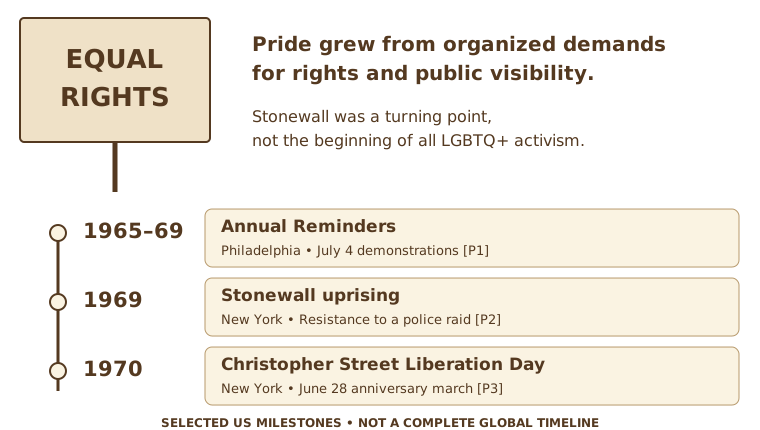
Original educational diagram, not a photograph. Original timeline, not a reconstructed crowd scene. The selected US events help explain the record’s 1970 date without treating that year as the start of all LGBTQ+ activism.
Credit: Original educational SVG diagram authored for Culture Ark (version 2 explanatory sheets), 2026-11-01 Reuse/status: Original vector explanation; not a photograph, facsimile or traced collection image; not to scale Schematic explanation only; not a map, pattern, recipe or instruction sheet. Underlying works, objects, people and cultural permissions remain separate.
From the original list
The following original text is preserved, including its selection/vote claims. Preservation is not independent verification of every assertion.
Why: LGBTQ+ people march in celebration and protest, starting after Stonewall.
What to preserve: rainbow flag, march footage, number of cities by year
Year and origin: 1970 · United States
Vote: 5/9 (historian 2 · future kid 1 · curator 2)
Learn more: Pride parade on Wikipedia
Explanatory sheets
2 original explanatory sheets prepared for this pick, each with its own diagram. Codes in square brackets such as [P1] point to the numbered sources at the end of the page.
A march with a history of visibility and protest
Before Stonewall. Philadelphia’s Annual Reminder demonstrations took place outside Independence Hall each July 4 from 1965 to 1969. Their demand for equal rights shows that organized public activism preceded the uprising. [P1]
A turning point in 1969. Resistance to a police raid at New York’s Stonewall Inn began on June 28, 1969. Demonstrations continued over subsequent nights. Stonewall gave momentum to an existing movement rather than creating its people or concerns. [P2]
An anniversary becomes a march. The New York march on June 28, 1970 commemorated the uprising’s first anniversary. Marching made a claim to public space and visibility; the event was not merely a costume procession. [P3]
Protest and celebration can coexist. The history links public visibility with demands for equality. Pride events may combine commemoration, political speech and celebration, with forms shaped by their communities. The timeline does not stand for every city’s history. [P1, P2, P3]
No real individuals are depicted or assigned identities. The next view explains one widely used symbol: the rainbow flag.
The rainbow flag: two views of a changing symbol
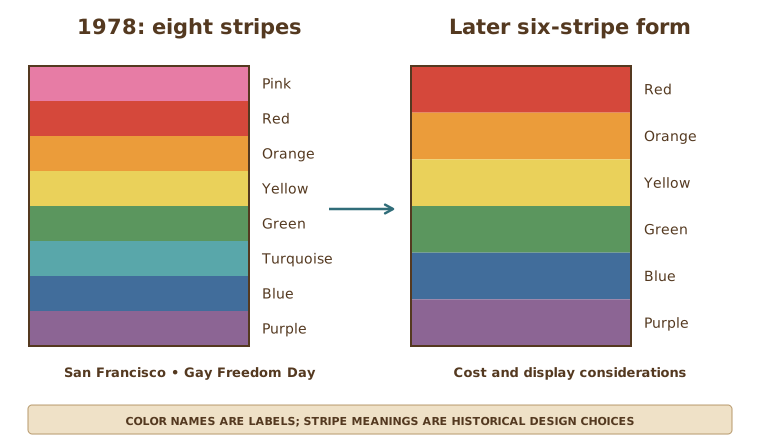
Original flat color diagrams, not facsimiles of museum flags. Color is retained here because it carries the information; the surrounding sheet keeps the cream-and-sepia design.
A collaborative 1978 creation. The first flags were raised at San Francisco’s Gay Freedom Day on June 25, 1978. The museum credits Gilbert Baker, Lynn Segerblom, James McNamara, Glenne McElhinney, Joe Duran, Paul Langlotz and other volunteers. [P5]
Eight assigned meanings. Baker associated pink with sex, red with life, orange with healing, yellow with the sun, green with nature, turquoise with art and magic, blue with serenity and purple with spirit. These are this design’s historical meanings. [P4]
Why the familiar version has six. Pink and turquoise were removed in the following year amid cost and display considerations. The six-stripe flag is therefore a later form, not the exact eight-stripe arrangement first displayed in 1978. [P4]
One symbol, many uses. The flag joined visual art to activism. Large flags can also become collective objects carried by many participants. The museum’s exhibition places the design within Baker’s wider practice of banners, performance and protest. [P4]
A flag in a picture is not evidence of any individual’s sexual orientation or gender identity.
Where to learn more
- https://apiarybee.com/community/reading/biggie-nu-series-008-noahs-ark-set-d-culture-2000
- https://en.wikipedia.org/wiki/Pride_parade
Sources and rights
- P1 · City of Philadelphia 2023 Pride resolution — Annual Reminder demonstrations outside Independence Hall, July 4 in 1965–1969.
- P2 · National Park Service Stonewall history — June 28, 1969 raid, resistance and subsequent demonstrations; a turning point within a longer movement.
- P3 · Library of Congress Today in History June 28 — June 28, 1970 anniversary march. Search-index text consulted; direct fetch returned 403.
- P4 · GLBT Historical Society Gilbert Baker exhibition — Eight original flag colors, assigned meanings and later six-stripe form.
- P5 · GLBT Historical Society 2021 annual report — Bringing the Rainbow Home, page 4: the first flags and the collaborative makers.
Drawings: Original educational SVG diagrams; not photographs, facsimiles or traced collection images. Sources consulted 2026-11-01. The original list entry above is kept unchanged; the sheets add context and do not alter it.
Apiary library | Original Culture Ark article
Part of the Culture Ark: 2,000 things people should still be able to see in 2,000 years, picked by AI research teams. This page keeps the original list entry for D-1671 word for word and adds context. Browse the gallery. The Culture Ark is an Artificial Mind Hive (AMH) project. AMH is owned by Austin Little.

Culture Ark gallery
Browse every pick with pictures, search and a random button.
Open the gallery →