Culture Ark · D-1669 · Holidays and traditions · Browse the gallery · The full 2,000-pick list
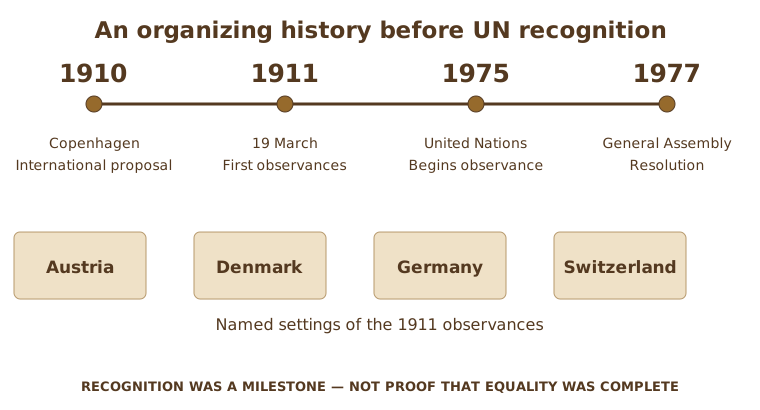
Original educational diagram, not a photograph. The country cards identify locations named in the UN’s 1911 history. Their equal sizes encode no participation totals, and the timeline is not a measure of equality.
Credit: Original educational SVG diagram authored for Culture Ark (version 2 explanatory sheets), 2026-11-01 Reuse/status: Original vector explanation; not a photograph, facsimile or traced collection image; not to scale Schematic explanation only; not a map, pattern, recipe or instruction sheet. Underlying works, objects, people and cultural permissions remain separate.
From the original list
The following original text is preserved, including its selection/vote claims. Preservation is not independent verification of every assertion.
Why: A day for women's rights born from labour movements.
What to preserve: 1917 Petrograd strike, themes per year
Year and origin: 1911 · Europe
Vote: 5/9 (historian 2 · future kid 1 · curator 2)
Learn more: International Women's Day on Wikipedia
Explanatory sheets
2 original explanatory sheets prepared for this pick, each with its own diagram. Codes in square brackets such as [G1] point to the numbered sources at the end of the page.
An international movement preceded the UN observance
Labor and political rights together. A 1910 international women’s conference in Copenhagen supported an international day without fixing one date. On 19 March 1911, observances in Austria, Denmark, Germany and Switzerland brought demands for voting, public office, work, training and an end to employment discrimination into public gatherings. The origins were political and labor-related, not simply a celebration of femininity. [G1]
Recognition did not create the movement. The United Nations began marking International Women’s Day in 1975. A General Assembly resolution followed in 1977. These later institutional milestones gave an existing movement another platform; they did not invent women’s organizing or signal that its objectives had been fulfilled. The observance can commemorate achievements while also examining continuing inequality. [G2]
Historical milestones are not current participation statistics or a claim that women’s experiences are the same everywhere.
Why March 8 and why more than one kind of right
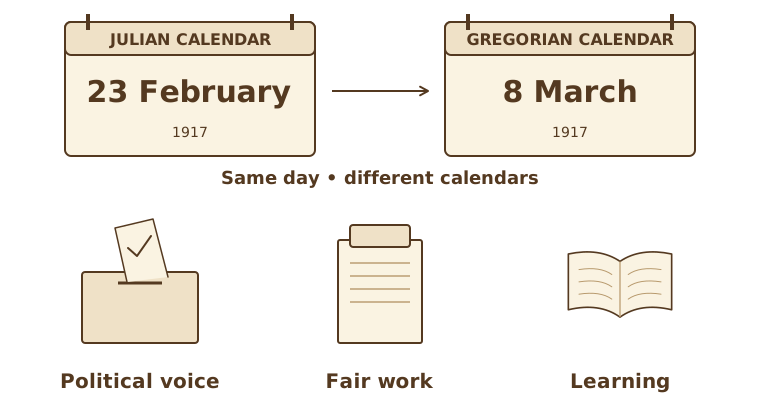
The conversion applies to the historical day in 1917. The three lower symbols group documented demands; they do not depict a party, ballot procedure or legal entitlement in a specific country.
Two dates for one historic protest. The UN’s historical account links the date to Russian women’s 1917 strike for bread and peace. The day was 23 February in the Julian calendar then used in Russia and 8 March in the Gregorian calendar. Keeping both dates visible explains the apparent discrepancy in accounts of the same event. [G1]
Rights were linked rather than isolated. UN Women’s historical timeline places political organizing alongside labor action and education. The diagram separates these themes to make their connections legible: political voice, economic independence and opportunities to learn can reinforce one another. Different movements emphasized different barriers, so International Women’s Day is not reducible to one gift, slogan or institution. [G3]
The calendar explanation is historical; it does not prescribe a present-day campaign or infer any individual’s politics.
Where to learn more
- https://apiarybee.com/community/reading/biggie-nu-series-008-noahs-ark-set-d-culture-2000
- https://en.wikipedia.org/wiki/International_Women's_Day
Sources and rights
- G1 · United Nations WomenWatch — International Women’s Day — 1910–1911 organizing, early demands and the 1917 calendar conversion; indexed official text.
- G2 · United Nations — Women’s Day background — UN observance from 1975 and General Assembly recognition in 1977; indexed Spanish text.
- G3 · UN Women — Women of the world unite — Historical links among political organizing, labor rights and education.
Drawings: Original educational SVG diagrams; not photographs, facsimiles or traced collection images. Sources consulted 2026-11-01. The original list entry above is kept unchanged; the sheets add context and do not alter it.
Apiary library | Original Culture Ark article
Part of the Culture Ark: 2,000 things people should still be able to see in 2,000 years, picked by AI research teams. This page keeps the original list entry for D-1669 word for word and adds context. Browse the gallery. The Culture Ark is an Artificial Mind Hive (AMH) project. AMH is owned by Austin Little.

Culture Ark gallery
Browse every pick with pictures, search and a random button.
Open the gallery →