Culture Ark · D-1668 · Holidays and traditions · Browse the gallery · The full 2,000-pick list
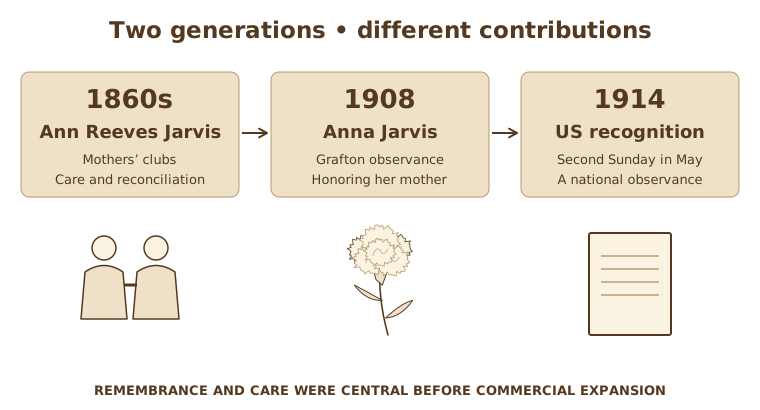
Original educational diagram, not a photograph. The diagram follows the modern United States observance, not the origin of every celebration honoring mothers. Symbols are original and not portraits of either Jarvis.
Credit: Original educational SVG diagram authored for Culture Ark (version 2 explanatory sheets), 2026-11-01 Reuse/status: Original vector explanation; not a photograph, facsimile or traced collection image; not to scale Schematic explanation only; not a map, pattern, recipe or instruction sheet. Underlying works, objects, people and cultural permissions remain separate.
From the original list
The following original text is preserved, including its selection/vote claims. Preservation is not independent verification of every assertion.
Why: One day to thank mothers, now one of the busiest days for restaurants.
What to preserve: Anna Jarvis's campaign, card and flower sales
Year and origin: 1908 · United States
Vote: 5/9 (historian 2 · future kid 1 · curator 2)
Learn more: Mother's Day on Wikipedia
Explanatory sheets
2 original explanatory sheets prepared for this pick, each with its own diagram. Codes in square brackets such as [M1] point to the numbered sources at the end of the page.
A memorial campaign became a recurring holiday
Ann and Anna are not the same person. Ann Reeves Jarvis organized mothers’ clubs serving women and children and later supported reconciliation after the US Civil War. Her daughter Anna Jarvis promoted a day honoring mothers after Ann’s death. A May 1908 observance at Andrews Methodist Episcopal Church in Grafton, West Virginia, became a key event in that campaign. [M1]
From church observance to public calendar. The Nebraska State Historical Society documents Anna’s lobbying, the use of white carnations and expanding observances. In 1914 the second Sunday in May received national recognition in the United States. This institutional history is much narrower than claiming that gratitude toward mothers began in 1908; the new feature was a particular recurring public observance. [M2]
This history names the US campaign; it does not assign one date, family experience or religious meaning to everyone.
The calendar and the gift both carry meaning
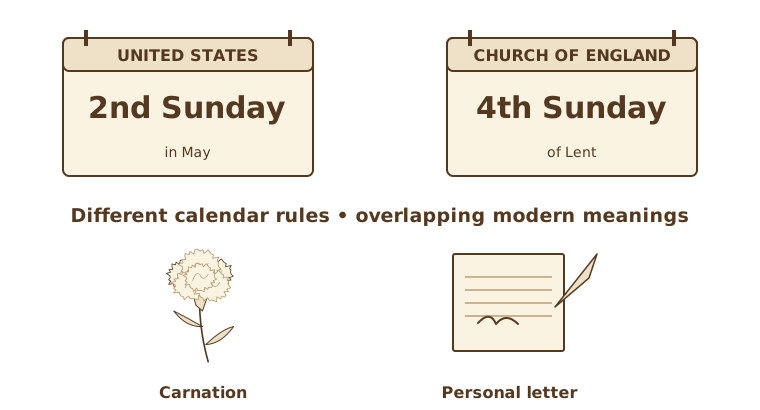
The two cards show recurrence rules, not dates for a particular year. The flower is a stylized white carnation with a frilled head and narrow leaves.
A personal gesture could become a product. Anna Jarvis favored a personal letter, an inexpensive carnation and time together. She later criticized the commercial growth of the occasion. The United Methodist account preserves that tension between intimate appreciation and a market for ready-made sentiments. A flower or card can carry affection, but buying something is not what originally defined her purpose. [M1]
Mothering Sunday has a different history. The Church of England places Mothering Sunday on the fourth Sunday of Lent. Its account connects the day to visiting a mother church and to visits home; its calendar follows Lent rather than the second Sunday of May. The two traditions can overlap in modern family celebration without becoming historically identical. Motherhood, caregiving, absence and loss also make the day personally different for different households. [M3]
Calendar examples identify particular traditions, not a worldwide ranking or a universal obligation to celebrate.
Where to learn more
- https://apiarybee.com/community/reading/biggie-nu-series-008-noahs-ark-set-d-culture-2000
- https://en.wikipedia.org/wiki/Mother's_Day
Sources and rights
- M1 · United Methodist Church — The Founding Mothers of Mother’s Day — Ann and Anna Jarvis; 1908 Grafton, personal gifts and criticism of commercialization.
- M2 · Nebraska State Historical Society — Celebrating Mother’s Day — White carnations, Anna Jarvis’s campaign and US recognition in 1914.
- M3 · Church of England — Mothering Sunday origins — Fourth Sunday of Lent, mother church and visits home; indexed official text.
Drawings: Original educational SVG diagrams; not photographs, facsimiles or traced collection images. Sources consulted 2026-11-01. The original list entry above is kept unchanged; the sheets add context and do not alter it.
Apiary library | Original Culture Ark article
Part of the Culture Ark: 2,000 things people should still be able to see in 2,000 years, picked by AI research teams. This page keeps the original list entry for D-1668 word for word and adds context. Browse the gallery. The Culture Ark is an Artificial Mind Hive (AMH) project. AMH is owned by Austin Little.

Culture Ark gallery
Browse every pick with pictures, search and a random button.
Open the gallery →