Culture Ark · D-1667 · Holidays and traditions · Browse the gallery · The full 2,000-pick list
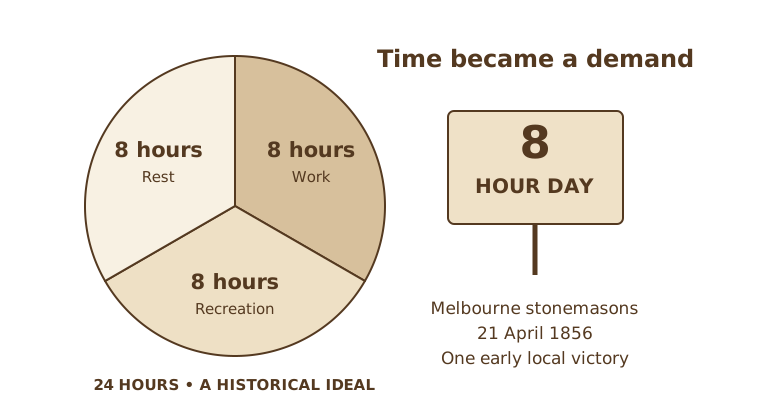
Original educational diagram, not a photograph. Equal sectors visualize a historical aspiration: work, recreation and rest. They do not claim that workers actually received equal thirds of their day.
Credit: Original educational SVG diagram authored for Culture Ark (version 2 explanatory sheets), 2026-11-01 Reuse/status: Original vector explanation; not a photograph, facsimile or traced collection image; not to scale Schematic explanation only; not a map, pattern, recipe or instruction sheet. Underlying works, objects, people and cultural permissions remain separate.
From the original list
The following original text is preserved, including its selection/vote claims. Preservation is not independent verification of every assertion.
Why: Workers march for their rights every first of May.
What to preserve: Haymarket affair link, marches
Year and origin: 1889 · worldwide
Vote: 5/9 (historian 2 · future kid 1 · curator 2)
Learn more: Labour Day on Wikipedia
Explanatory sheets
2 original explanatory sheets prepared for this pick, each with its own diagram. Codes in square brackets such as [W1] point to the numbered sources at the end of the page.
The struggle over who controls the working day
Why eight hours mattered. The eight-hour movement challenged extremely long working days by arguing for time outside paid labor. The National Museum of Australia records Melbourne stonemasons walking off construction jobs on 21 April 1856. Negotiations won an eight-hour day without reducing the wage previously paid for ten hours. This local history predates the international May Day observance. [W1]
A gain was not universal. The museum emphasizes that early gains reached only a minority, especially in building trades. Many other workers, including women and children, continued to work longer for lower pay. The familiar three-part ideal therefore expresses a demand about dignity and time, not a claim that every occupation or country achieved the same conditions at once. [W1]
The diagram describes a historical labor ideal; it is not a modern employment-law summary or health prescription.
How a local struggle gained an international date
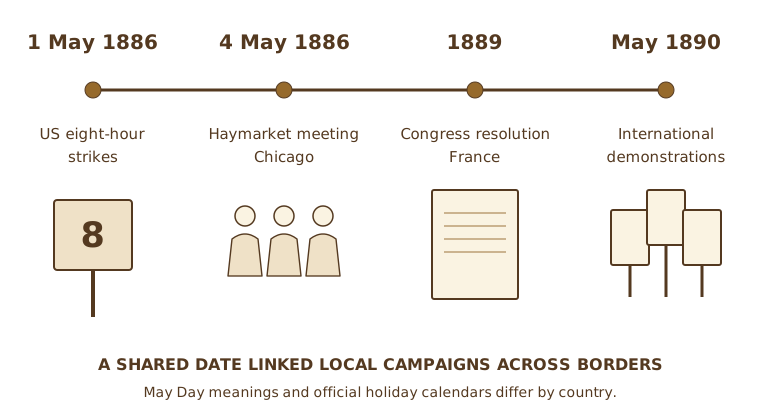
The symbols represent demands, a meeting, a resolution and demonstrations. They are not reproductions of historical posters or a depiction of the violence at Haymarket.
Chicago and its aftermath. US workers struck for an eight-hour day on 1 May 1886. At a labor meeting near Chicago’s Haymarket on 4 May, a bomb and subsequent gunfire caused deaths and injuries. The Chicago History Museum notes that the bomber’s identity remains uncertain. The affair, prosecutions and international reaction became part of labor movement memory. [W2]
A recurring international occasion. In 1889 an International Socialist Congress in France called for demonstrations on 1 May 1890, aligning with a date already selected by the American Federation of Labor. Actions across Europe helped establish an international labor observance. The Smithsonian also explains why many US unions instead favored a September Labor Day. Similar names therefore need not indicate the same date or political history. [W3]
This is historical explanation, not an endorsement of a party or a claim that all countries observe May Day alike.
Where to learn more
- https://apiarybee.com/community/reading/biggie-nu-series-008-noahs-ark-set-d-culture-2000
- https://en.wikipedia.org/wiki/Labour_Day
Sources and rights
- W1 · National Museum of Australia — Eight-hour day — 1856 Melbourne victory; the three-part time ideal and uneven access to shorter hours.
- W2 · Chicago History Museum — Haymarket chronology — May 1886 events and uncertainty about the bomber’s identity.
- W3 · Smithsonian — May Day Part 2 — 1889 resolution, 1890 demonstrations and US September alternative; indexed official text.
Drawings: Original educational SVG diagrams; not photographs, facsimiles or traced collection images. Sources consulted 2026-11-01. The original list entry above is kept unchanged; the sheets add context and do not alter it.
Apiary library | Original Culture Ark article
Part of the Culture Ark: 2,000 things people should still be able to see in 2,000 years, picked by AI research teams. This page keeps the original list entry for D-1667 word for word and adds context. Browse the gallery. The Culture Ark is an Artificial Mind Hive (AMH) project. AMH is owned by Austin Little.

Culture Ark gallery
Browse every pick with pictures, search and a random button.
Open the gallery →