Culture Ark · D-1666 · Holidays and traditions · Browse the gallery · The full 2,000-pick list
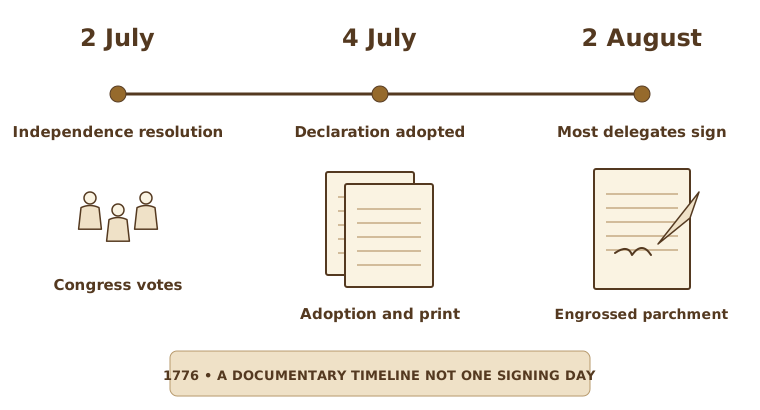
Original educational diagram, not a photograph. This existing selection concerns the United States. The paper and assembly drawings are original teaching symbols, not copies of founding documents.
Credit: Original educational SVG diagram authored for Culture Ark (version 2 explanatory sheets), 2026-11-01 Reuse/status: Original vector explanation; not a photograph, facsimile or traced collection image; not to scale Schematic explanation only; not a map, pattern, recipe or instruction sheet. Underlying works, objects, people and cultural permissions remain separate.
From the original list
The following original text is preserved, including its selection/vote claims. Preservation is not independent verification of every assertion.
Why: America's birthday with fireworks, hot dogs and flags.
What to preserve: fireworks displays, hot-dog eating contest records
Year and origin: 1776 · United States
Vote: 5/9 (historian 2 · future kid 1 · curator 2)
Learn more: Independence Day (United States) on Wikipedia
Explanatory sheets
2 original explanatory sheets prepared for this pick, each with its own diagram. Codes in square brackets such as [I1] point to the numbered sources at the end of the page.
Why the holiday is the Fourth of July
Decision declaration and signature. Congress adopted the independence resolution on 2 July 1776. It adopted the Declaration on 4 July, and copies went to printer John Dunlap. Most delegates signed the engrossed parchment on 2 August. These were connected but distinct actions; the familiar holiday date is not proof that all signatures were written on 4 July. [I1]
A statement had to circulate. Printed copies carried the declaration beyond the meeting room. The National Archives timeline records copies dispatched on 5 July to committees, assemblies and military commanders. Reading the holiday through documents therefore reveals drafting, political decision, printing and communication, rather than just one ceremonial image of the founders. [I1]
This date sequence concerns the Declaration, not the end of the Revolutionary War.
Celebration also became a platform for criticism
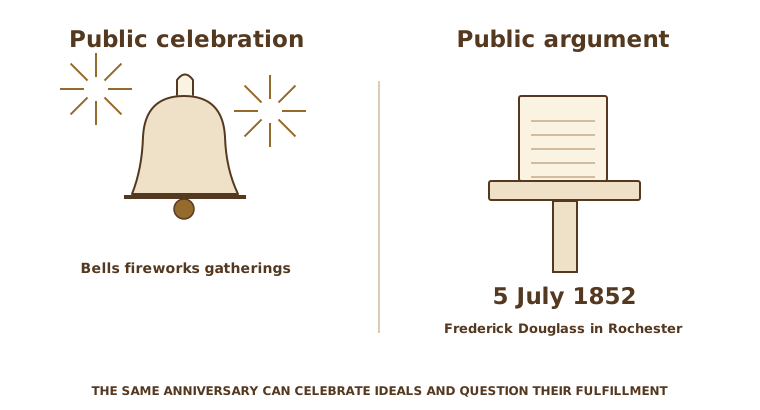
The bell is not a replica of the Liberty Bell. Fireworks are shown only as distant light patterns, without devices or instructions.
A public anniversary takes shape. The Library of Congress traces Independence Day’s public celebrations, including an early Philadelphia anniversary in 1777. Bells, music, speeches and fireworks helped turn a political document into a recurring civic occasion. Local celebrations could combine public ceremony with family and neighborhood gatherings; no one activity defines everyone’s observance. [I2]
Whose freedom was being celebrated. On 5 July 1852, Frederick Douglass addressed an antislavery audience in Rochester, challenging a nation that praised liberty while maintaining slavery. His speech used the anniversary to expose the gap between founding ideals and unequal realities. That history shows why celebration and critical reflection are both part of the holiday’s cultural record. [I3]
These are historical examples, not claims about current participation totals or every American’s political views.
Where to learn more
- https://apiarybee.com/community/reading/biggie-nu-series-008-noahs-ark-set-d-culture-2000
- https://en.wikipedia.org/wiki/Independence_Day_%28United_States%29
Sources and rights
- I1 · US National Archives — Creating the Declaration A Timeline — July 2 resolution, July 4 adoption and printing, July 5 dispatch and August 2 signing.
- I2 · Library of Congress — Today in History July 4 — Historical public celebration and civic customs; official indexed text consulted.
- I3 · Library of Congress — Declaration Legacy — Primary-document exhibition including Douglass’s 5 July 1852 address and the Declaration’s contested legacy.
Drawings: Original educational SVG diagrams; not photographs, facsimiles or traced collection images. Sources consulted 2026-11-01. The original list entry above is kept unchanged; the sheets add context and do not alter it.
Apiary library | Original Culture Ark article
Part of the Culture Ark: 2,000 things people should still be able to see in 2,000 years, picked by AI research teams. This page keeps the original list entry for D-1666 word for word and adds context. Browse the gallery. The Culture Ark is an Artificial Mind Hive (AMH) project. AMH is owned by Austin Little.

Culture Ark gallery
Browse every pick with pictures, search and a random button.
Open the gallery →