Culture Ark · D-1665 · Holidays and traditions · Browse the gallery · The full 2,000-pick list
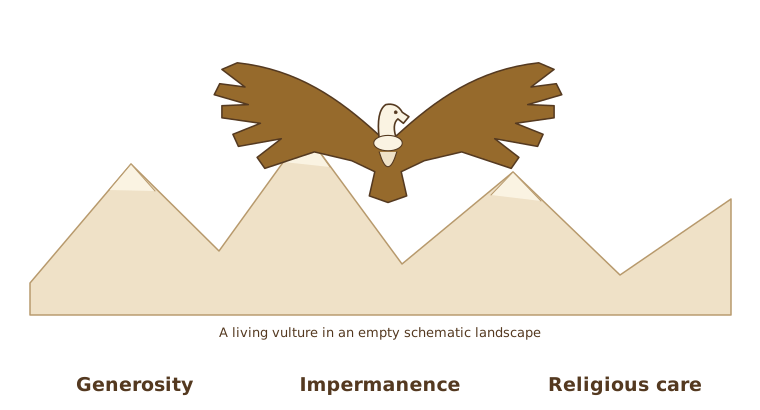
Original educational diagram, not a photograph. The bird and mountains supply context, not access information or a reconstruction of a sacred site. The illustration contains no human remains.
Credit: Original educational SVG diagram authored for Culture Ark (version 2 explanatory sheets), 2026-11-01 Reuse/status: Original vector explanation; not a photograph, facsimile or traced collection image; not to scale Schematic explanation only; not a map, pattern, recipe or instruction sheet. Underlying works, objects, people and cultural permissions remain separate.
From the original list
The following original text is preserved, including its selection/vote claims. Preservation is not independent verification of every assertion.
Why: Tibetans offer their dead to vultures as a final act of generosity.
What to preserve: ritual meaning, sites
Year and origin: ancient · Tibet
Vote: 5/9 (historian 2 · future kid 1 · curator 2)
Learn more: Sky burial on Wikipedia
Explanatory sheets
2 original explanatory sheets prepared for this pick, each with its own diagram. Codes in square brackets such as [S1] point to the numbered sources at the end of the page.
A funerary tradition understood through giving
Generosity rather than spectacle. The Tibetan practice often called sky burial involves offering the deceased’s body to scavenging birds. In Buddhist explanations, benefiting other beings can be understood as a final gift. The Asian Art Museum’s educational account places this within compassion and beliefs about the distinction between a person’s consciousness and the body after death. [S1]
A wider religious understanding of death. Kagyu Samye Ling describes Tibetan Buddhist beliefs in an intermediate state, or bardo, and rebirth. These ideas explain why prayer and religious care matter beyond physical arrangements. They are teachings within a tradition, not scientific findings about consciousness after death. Not every Tibetan community or family uses the same funerary form. [S2, S3]
Respect for bereaved communities matters more than outsider spectacle; no viewing itinerary or handling instructions are provided.
One practice within a varied funerary history
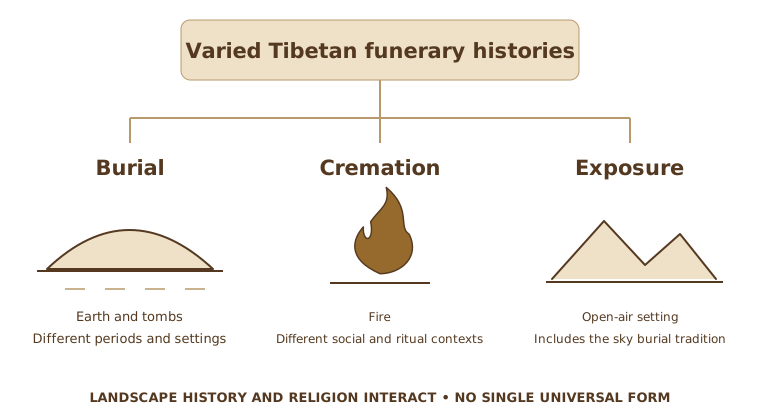
The branches are alternatives in a historical overview, not stages of one funeral. The generic earth, fire and landscape symbols are not replicas of sacred structures.
History resists a single origin story. Dan Martin’s historical research treats sky burial as one of several Tibetan funerary practices. Royal burial mounds and accounts of cremation complicate any claim that every Tibetan, in every period, followed one custom. Evidence for early ordinary funerals is limited, so an exact single origin should not be supplied as if settled. [S3]
Environment is context not a complete cause. Rocky ground, fuel availability and scavenging birds help explain why researchers discuss the plateau’s ecology. But Martin explicitly treats culture and environment as interacting, not as one mechanically determining the other. Religious generosity, local relationships and historical change remain part of the explanation; geography alone cannot tell us what a family believes or does. [S1, S3]
This broad comparison does not imply that the listed forms have equal prevalence or the same meaning.
Where to learn more
- https://apiarybee.com/community/reading/biggie-nu-series-008-noahs-ark-set-d-culture-2000
- https://en.wikipedia.org/wiki/Sky_burial
Sources and rights
- S1 · Asian Art Museum — Sacred Arts of Tibet — Page 62: generosity and religious meaning; no restricted ritual objects or images reproduced.
- S2 · Kagyu Samye Ling — Funeral and Bardo Advice — Named Tibetan Buddhist account of bardo and rebirth; beliefs only, not practical funeral advice.
- S3 · Dan Martin — On the Cultural Ecology of Sky Burial on the Himalayan Plateau — Author’s text of 1996 research on historical plurality and interacting cultural and ecological factors.
Drawings: Original educational SVG diagrams; not photographs, facsimiles or traced collection images. Sources consulted 2026-11-01. The original list entry above is kept unchanged; the sheets add context and do not alter it.
Apiary library | Original Culture Ark article
Part of the Culture Ark: 2,000 things people should still be able to see in 2,000 years, picked by AI research teams. This page keeps the original list entry for D-1665 word for word and adds context. Browse the gallery. The Culture Ark is an Artificial Mind Hive (AMH) project. AMH is owned by Austin Little.

Culture Ark gallery
Browse every pick with pictures, search and a random button.
Open the gallery →