Culture Ark · D-1664 · Holidays and traditions · Browse the gallery · The full 2,000-pick list
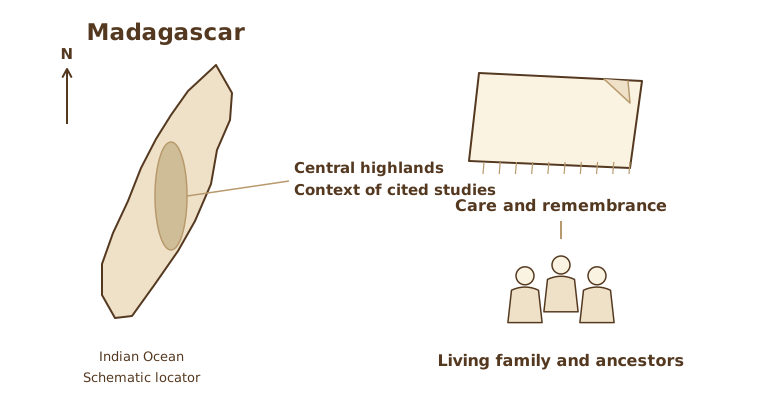
Original educational diagram, not a photograph. The locator is approximate and does not map ethnicity or ritual prevalence. The cloth and family symbols are not a reconstruction of a private ceremony.
Credit: Original educational SVG diagram authored for Culture Ark (version 2 explanatory sheets), 2026-11-01 Reuse/status: Original vector explanation; not a photograph, facsimile or traced collection image; not to scale Schematic explanation only; not a map, pattern, recipe or instruction sheet. Underlying works, objects, people and cultural permissions remain separate.
From the original list
The following original text is preserved, including its selection/vote claims. Preservation is not independent verification of every assertion.
Why: Families dig up ancestors, rewrap them and dance with the bodies.
What to preserve: turning-of-the-bones ritual, shrouds, music
Year and origin: 17th century · Madagascar
Vote: 5/9 (historian 2 · future kid 1 · curator 2)
Learn more: Famadihana on Wikipedia
Explanatory sheets
2 original explanatory sheets prepared for this pick, each with its own diagram. Codes in square brackets such as [F1] point to the numbered sources at the end of the page.
Ancestral relationships in the central highlands
More than a sensational description. Famadihana is a recurring ancestral reburial observance associated especially with highland Malagasy communities, including Merina and Betsileo. Rebecca Green’s field research explains it through relationships between descendants, ancestors and cloth. Families honor predecessors and seek continuing connection; the practice is not shared uniformly by everyone in Madagascar. [F1]
A family occasion with local histories. The Smithsonian’s catalog of a 1963 film describes an extended-family feast accompanying an ancestral observance. That is evidence for a particular recorded event, not a universal schedule. David Graeber’s research in Imerina also examines authority, gender and ambivalent feelings toward ancestors, showing that meanings within a community can be complex. [F2, F3]
This account is non-graphic. It gives no instructions for handling remains and does not establish a single seventeenth-century origin.
Cloth carries care identity and connection
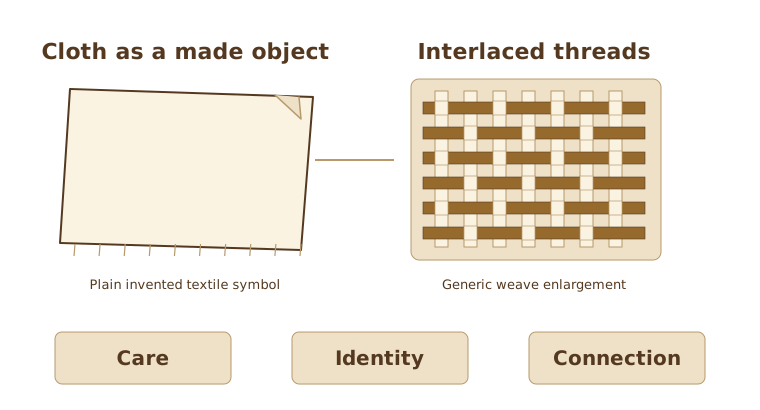
The enlargement explains ordinary interlacing only. It does not identify the weave, pattern or ritual use of any particular family’s cloth.
A material form of care. In Green’s highland study, silk shrouds are offerings that allow descendants to honor ancestors and request blessings. Cloth does not merely cover an object: it contributes to a relationship and to the deceased person’s place within a family’s ancestral world. These are locally described social and religious meanings. [F1]
A cloth name is not a whole tradition. The National Museum of African Art catalogs one burial cloth as lambamena landikely, identifying mulberry silk in its terminology. A museum example records one material and object history; it cannot stand for every region or family. The plain diagram separates textile structure from the additional meanings people give the cloth. [F4]
No remains, wrapped body, private family design or ritual procedure is pictured.
Where to learn more
- https://apiarybee.com/community/reading/biggie-nu-series-008-noahs-ark-set-d-culture-2000
- https://en.wikipedia.org/wiki/Famadihana
Sources and rights
- F1 · Rebecca L Green — Divine Worth Weaving and the Ancestors in Highland Madagascar — Field research among Merina and Betsileo; cloth, ancestry, care and local variation.
- F2 · Smithsonian Human Studies Film Archives — Film of a famadihana 1963 — Collection description of one filmed observance and family feast; no footage reproduced.
- F3 · David Graeber — An interpretation of famadihana in Arivonimamo — 1995 research abstract on kinship, authority and gender; not a uniform belief survey.
- F4 · Smithsonian National Museum of African Art — Burial cloth — Object 2000-13-10 and lambamena landikely terminology; official indexed text consulted.
Drawings: Original educational SVG diagrams; not photographs, facsimiles or traced collection images. Sources consulted 2026-11-01. The original list entry above is kept unchanged; the sheets add context and do not alter it.
Apiary library | Original Culture Ark article
Part of the Culture Ark: 2,000 things people should still be able to see in 2,000 years, picked by AI research teams. This page keeps the original list entry for D-1664 word for word and adds context. Browse the gallery. The Culture Ark is an Artificial Mind Hive (AMH) project. AMH is owned by Austin Little.

Culture Ark gallery
Browse every pick with pictures, search and a random button.
Open the gallery →